Tuesday, 16 December 2014

Ukok Princess to find final resting place in Altai

Mausoleum plans unveiled for homecoming of Siberian ice maiden

Tattooed 2,500-year-old princess found mummified and preserved in permafrost could finally be reburied in special monument.
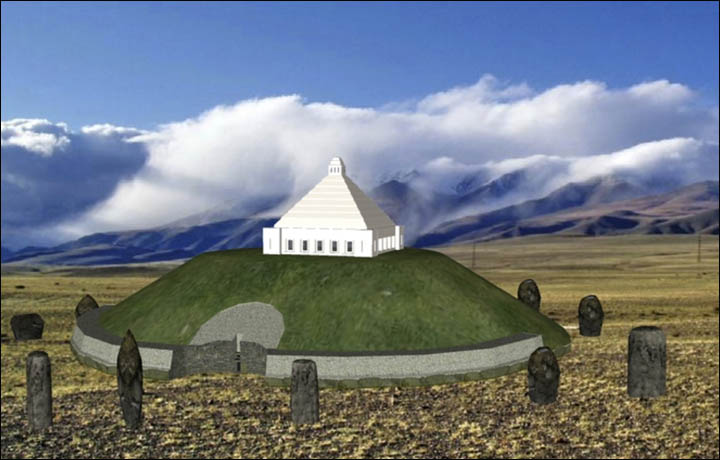
Plans have been put forward to build a permanent monument and final resting place for the ice maiden, who was uncovered by archaeologists in 1993. Picture: Spiritual Centre of the Turks Kin Altai
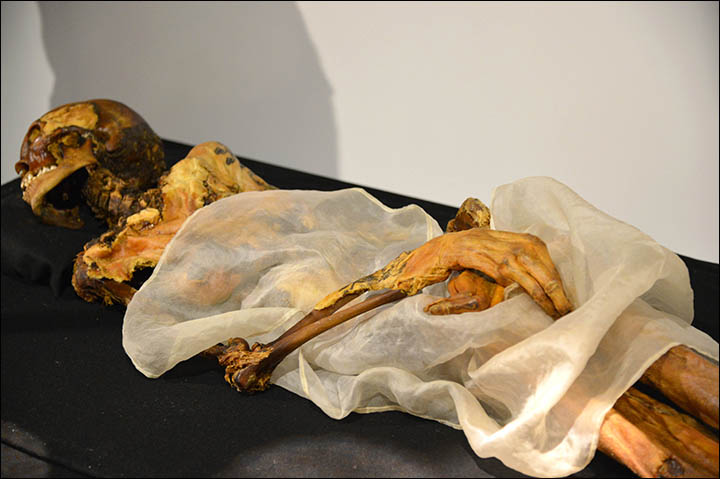
A tattooed Siberian princess found mummified and preserved after almost 2,500 years in permafrost is set to be buried in her own special mausoleum. Plans have been put forward to build a permanent monument and final resting place for the ice maiden, who was uncovered by archaeologists in 1993.
Known as Princess Ukok, after the high altitude plateau on which she was discovered, her body was decorated in the best-preserved, and most elaborate, ancient art ever found.
She spent most of the past two decades at a scientific institute in Novosibirsk, and is now at the Republican National Museum in Gorno-Altaisk, sparking anger among the local people in the Altai Mountain region who want her re-buried.
Ancient beliefs dictate that her presence in the burial chamber had been to 'bar the entrance to the kingdom of the dead'. Elders insisted that removing the mummified remains meant this doorway to the other world is now open and that her anger has already caused a series of floods and earthquakes. But now the revered princess could finally be repatriated to her original resting place in the Ukok plateau, with a beautiful mausoleum built on top.
The first sketches of the plans were presented by Akai Kine, the zaisan (leader) of the Teles ethnic group, and president of the Spiritual Centre of the Turks Kin Altai.
Mausoleum for Ukok princess

Tattoed 2,500 year old Siberian princess 'to be reburied to stop her posthumous anger which causes floods and earthquakes'
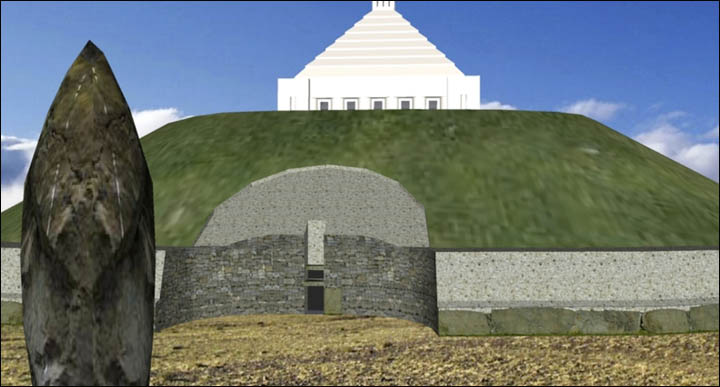
The mummy will be put in her original resting place, and on the top will be build funerary monument, which will be located on the Ukok plateau. Pictures: Spiritual Centre of the Turks Kin Altai, The Siberian Times
He said: 'According to the drafts, the mummy will be put in her original resting place, and on the top will be build funerary monument. The mausoleum will be located on the Ukok plateau in the place where the mummy was found by archaeologists in 1993.
'These are the first options for the future mausoleum. Publishing them, we want to start a public discussion in the media. There is no State decision on reburial of the Princess. But we have the main thing - we believe that this revered woman will be reburied.
'At one point, few people believed the princess to come back into the Altai Republic. Nevertheless, it that happened.'
The mummy was excavated by Novosibirsk scientist Natalia Polosmak and was heralded as 'one of the most significant archaeological discoveries of the 20th century'.
Thought to be about 27 years old when she died, she was found preserved in permafrost at an altitude of about 2,500 metres, with two men also discovered nearby. Buried around her were six horses, saddled and bridled and said to have been her spiritual escorts to the next world, along with a meal of sheep and horse meat.
Archaeologists also found ornaments made from felt, wood, bronze and gold as well as a small container of cannabis and a stone plate on which coriander seeds were burned. From her clothes and possessions including a 'cosmetics bag', scientists were able to recreate her fashion and beauty secrets.
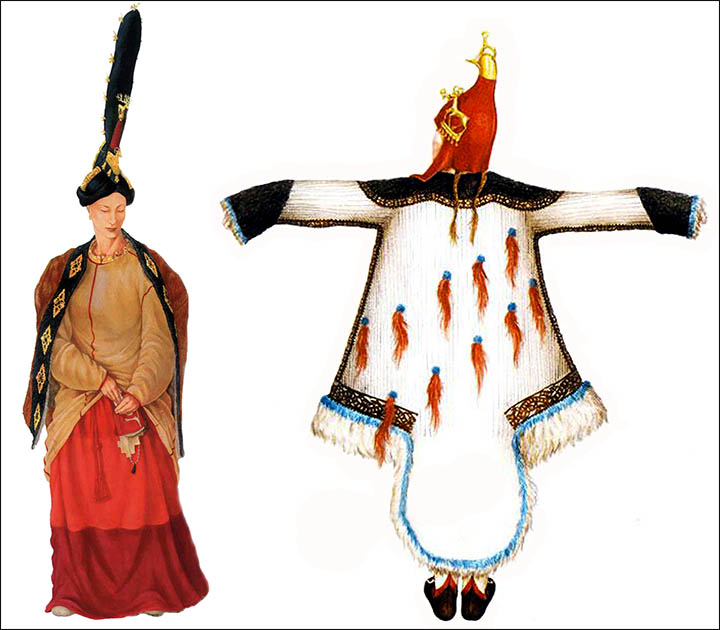
She was dressed in a long shirt made from Chinese silk, and had long felt sleeve boots with a beautiful decoration on them. At this time Chinese silk was only ever found in royal burials of the Pazyrk people, and since it was more expensive than gold it gave an indication of her wealth and status.
Tattoed 2,500 year old Siberian princess 'to be reburied to stop her posthumous anger which causes floods and earthquakes'

Tattoed 2,500 year old Siberian princess 'to be reburied to stop her posthumous anger which causes floods and earthquakes'

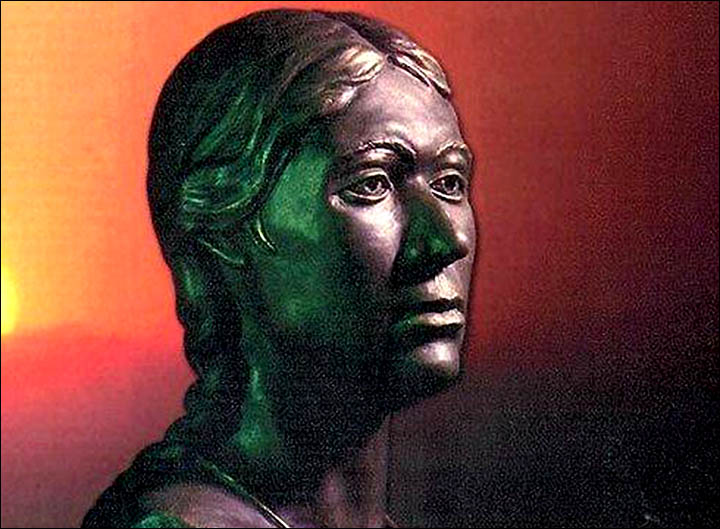
Sculpture of Ukok mummy as artists imagined her
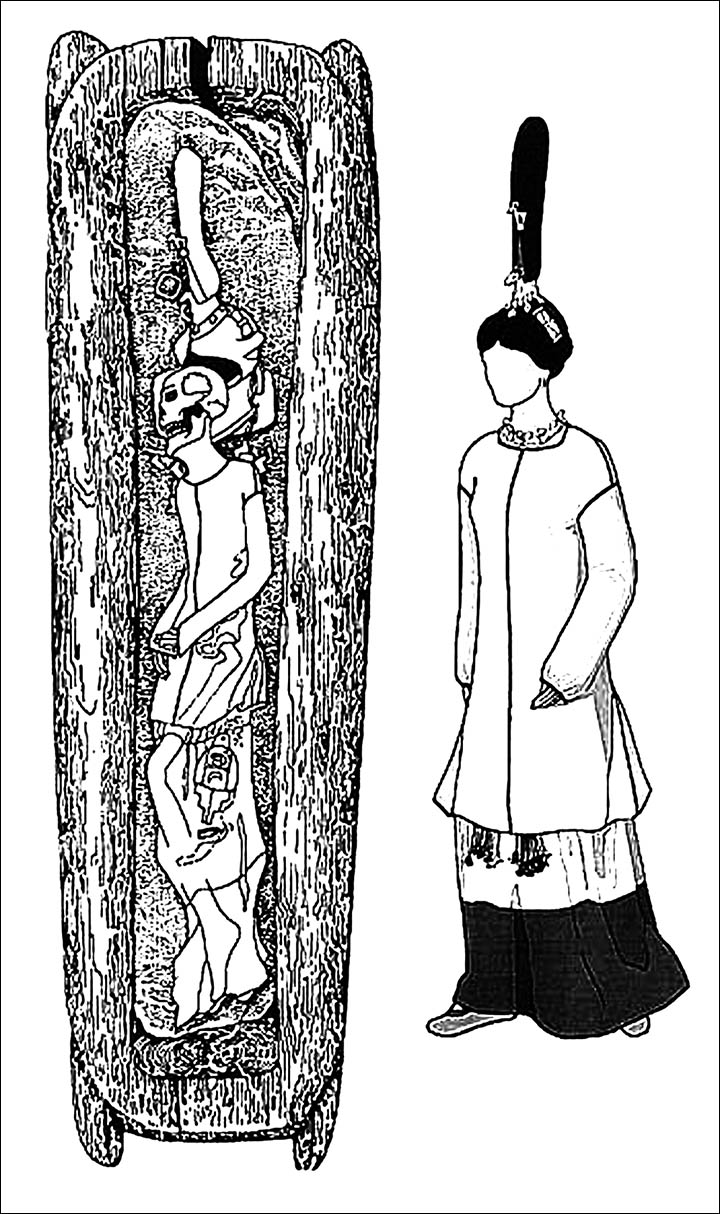
Scheme of the burial and reconstructions of Pazyryk woman's and man's costumes, reconstruction by D. Pozdnyakov, Institute of Archeology and Ethnography, Siberian Branch of Russian Academy of Science; sculptor's impression of how Princess Ukok looked 2,500 years ago
Her head was completely shaved, and she wore a horse hair wig on top of which was a carving of a wooden deer.
The princess's face and neck skin was not preserved, but the skin of her left arm survived. But the most exciting discovery was her elaborate body art, which many observers said bore striking similarities to modern-day tattoos.
On her left shoulder was a fantastical mythological animal made up of a deer with a griffon’s beak and a Capricorn’s antlers. The antlers themselves were decorated with the heads of griffons. The mouth of a spotted panther with a long tail could also be seen, and she had a deer’s head on her wrist.
Elders in the Altai Mountains have long called for the mummified remains to be reinterred to 'stop her anger which causes floods and earthquakes'. They insisted that the worst flooding in 50 years in Altai and a series of earthquakes were caused by the dead princess.
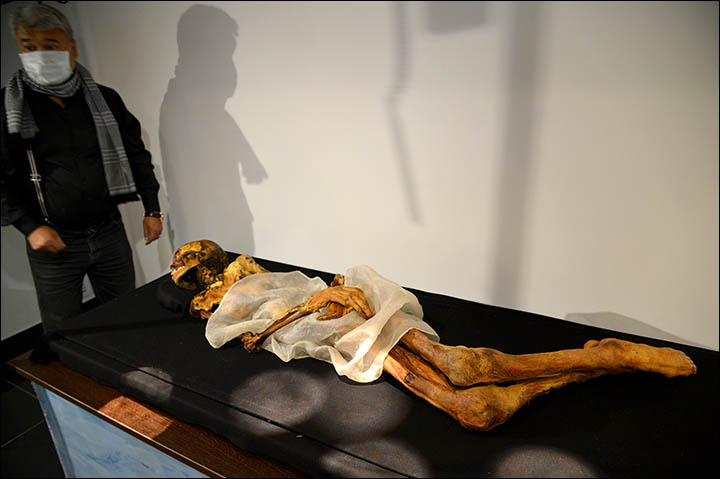
She is believed to have been between 25 and 28 years old and about 1.62 metres tall. Her remains have been treated by the same scientists in Moscow who preserved the body of former Soviet leader Vladimir Lenin.
Tattoed 2,500 year old Siberian princess 'to be reburied to stop her posthumous anger which causes floods and earthquakes'

Tattoed 2,500 year old Siberian princess 'to be reburied to stop her posthumous anger which causes floods and earthquakes'

Tattoed 2,500 year old Siberian princess 'to be reburied to stop her posthumous anger which causes floods and earthquakes'

Tattoed 2,500 year old Siberian princess 'to be reburied to stop her posthumous anger which causes floods and earthquakes'
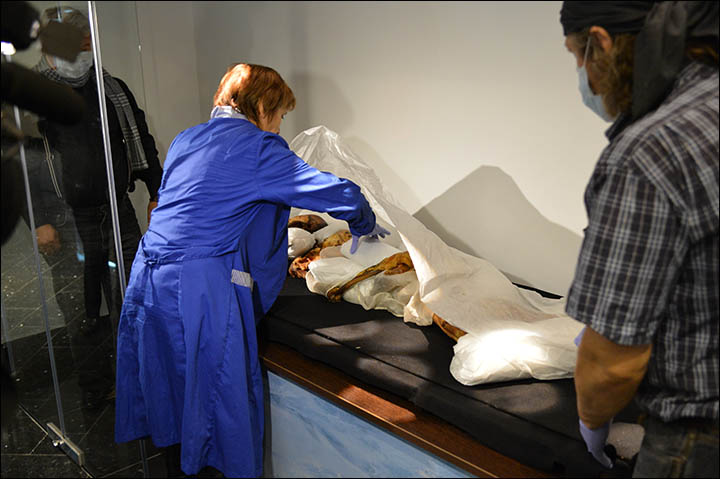
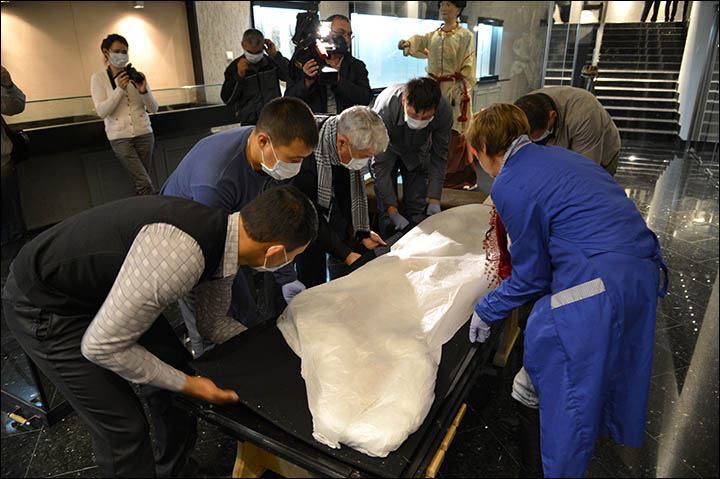
The mummy is getting inside a sarcophagus of Anokhin museum, Gorno-Altaisk, under a watchful eye of Irina Salnikova, head of the Siberian Branch of Russian Academy of Sciences Museum of Archeology and Ethnography. Pictures: Alexander Tyryshkin
Under the proposals put forward for the mausoleum the elders say any project should meet three basic requirements.
Akai Kine said: 'Firstly, the body should be reposed in the site of the original burial. Second, the mausoleum mound must be made according to the traditions that were followed when the Princess was buried. And third, scientists shall be granted access to the body.'

Wednesday, 10 December 2014

Hoaxes, Satire, Legends

Hoaxes, satire, legends

Chinggis - Chinese caricatureIn November a satirical news site announced the discovery of Genghis Khan’s tomb: archaeologists-unearth-tomb-of-genghis-khan
Hoax exposed on this satire watch site: badsatiretoday.com/tomb-genghis-khan
What’s the purpose of satire? To imitate the real news so closely as to point out its idiocies. The Lost Tomb is among the most popular of Genghis topics, and I get asked about it. Here’s my answer: I hope and trust he was laid simply in the open, on a spiritual mountain, or under a tree – one legend has him choose his tree. In life he was anti-ostentation, and a strong traditionalist in ways — in these ways, I think. The Mongols’ neighbour people transitioned from a shamanist disposal in trees to lavish tombs, quickly with their Imperial Period, as I wrote about here: tomb-masks-from-the-kingdom-of-qatay  Whereas the Jurchen Jin, after a century in China, kept such simple burials, even for royalty, that there is speculation they did not believe in an afterlife. Interestingly, they painted tomb inhabitants as spectators at a theatre: theatre-life-and-afterlife-tomb-decor-jin-dynasty [1] Traditional or pre-imperial disposal among the Jurchen, too, seems to have been so simple as to leave no record.
Sensationalism is of course an ancient art. The most bloodthirsty legend attached to dead Genghis dates to Rashid al-Din’s Jami al-Tawarikh, where you can read (in my Wheeler Thackston translation): “Picking up his coffin, they set out upon the return, slaying every creature they encountered along the way until they reached the ordus.”
I’m not the only one who thinks this as legendary as Genghis’ most-quoted quote, also the responsibility of Rashid:
“Genghis answered: ‘You are mistaken. Man’s greatest good fortune is to chase and defeat his enemy, seize his total possessions, leave his married women weeping and wailing, ride his gelding, use the bodies of his women as a nightshirt and support, gazing upon and kissing their rosy breasts, sucking their lips which are as sweet as the berries of their breasts.” — the translation found in Paul Ratchnevsky’s biography
Alternate translation, courtesy of Yu, Dajun & Zhou:
“The real greatest pleasure of men is to repress rebels and defeat enemies, to exterminate them and grab everything they have; to see their married women crying, to ride on their steeds with smooth backs, to treat their beautiful queens and concubines as pajamas and pillows, to stare and kiss their rose-colored faces and to suck their sweet lips of nipple-colored.” [sic… or did I mean, sick?]
I found that translation in WikiQuotes, where at least the attribution is ‘disputed’.
I’ll illustrate this post, fittingly, with Chinese caricatures of Chinggis (above) and Subutai (I call him Zab for short – beneath).
#
[1]  More on Jin tombs in Linda Cooke Johnson, Women of the Conquest Dynasties. She says, ‘The meagre Jurchen interments have typically attracted little archaeological attention’ [60] – which is a pity, because we can only guess what they meant by their tomb murals of the husband and wife seated in a private box above a stage; and I’m intrigued by their afterlife beliefs or lack of.
Subedei-Chinese ink

Critical Silk Road Studies


About Critical Silk Road Studies

Critical Silk Road Studies is a year-long series of workshops funded by the John 
E. Sawyer Seminarsprogram of the Andrew W. Mellon Foundation.  These 
workshops are focused upon a critical examination of the Silk Road. Our goal is 
to investigate the invention and development of the concept of the Silk Road as 
well as its on-going impact—its potential as well as its limitations for framing 
fields of academic inquiry and even policy-making.  Today, the term "Silk Road" 
serves as a rubric in contexts ranging from the undergraduate curriculum to 
institutional funding and international symposia, and has become a household 
word through educational television and other popular media.   Yet seldom has 
its definition been examined, and it remains a challenge to overcome the 
chronological, regional, linguistic, and disciplinary compartmentalization of 
specialists to consider the workings and effects of the trans-Eurasian Silk Road 
as a broader phenomenon.

Critical Silk Road Studies will expose our seminar members to a range of 
empirical expertise while considering collectively the macro-level issues from 
a perspective that is interdisciplinary, interregional and longue durée.  We will 
bring together scholars of ancient and modern history, art history, religious 
studies, literature, musicology, anthropology, archaeology, as well as foreign 
policy academics and practitioners in an interrogation and exploration of the 
notion of the Silk Road and its usefulness towards understanding both past 
and present. 

General Information

Participation in the seminars of Critical Silk Road Studies is free and restricted to 
current faculty, academic staff, and graduate and undergraduate students.  The 
seminars are scheduled for 5:00-7:30pm in Intercultural Center (ICC) 662, which 
is located on Georgetown’s main campus.  Further information is available 
regarding transportation and visitor parking. 

The format of each seminar consists of moderated discussion of the presenters’ 
pre-circulated papers. For this reason, pre-registration for individual seminars is 
required, as papers will be circulated only to registered participants of the seminar.


Please visit the main Schedule of Events page for information regarding the time 
and location of each seminar.

A Demise Greatly Exaggerated: the Silk Road in the Early Modern Era
January 8, 2015 

Presenters:
Associate Professor, Department of History, University of Hawai'i at Manoa
“The Eurasian Drug Trade: Commodities and Medical Knowledge between East 
and West”

Associate Professor, Department of History, Ohio State University
“Networks of Trade in Early Modern Central Asia”

Discussant:
Professor, Department of History, Georgetown University

Science on the Silk Road
January 29, 2015 

Presenters:
Canada Research Chair of Early Modern Studies and Associate Professor, 
Department of History, University of British Columbia
“Paper Dolls: An Architectonics of Translation in Early Modern Eurasia”

Assistant Professor, Department of History, Pennsylvania State University-Abington
"Are Buddhist Scriptures the 'Missing Link' in the Global History of Medicine?"

Discussant:
Associate Professor, Department of History, Georgetown University

Islamic Encounters with Sinic and Buddhistic Realms
February 19, 2015 

Presenters:
Professor, Department of Religious Studies, Southern Methodist University
“‘Ala’ ad-dawla as-Simnani and the Buddhists of Iran, 1258-1328”

Prince Alwaleed Bin Talal Professor of Islamic Art History, Department of History 
of Art and Architecture, Harvard University
“Ghiyath al-Din Naqqash and His Visit to Beijing, 1419-22”

Discussant:
Assistant Professor, Department of Art History, George Washington University

Performance and Performativity
March 19, 2015 

Presenters:
Arthur R. Virgin Professor of Music, Department of Music, Dartmouth College
“The Silk Road as Jam Session, Then and Now”

Assistant Professor, Department of Art, Lafayette College
“Strumming Strings along the Ancient Silk Road: Archaeological Evidence for 
Lutes and their Performance in the First Centuries CE”

Discussant:
Professor, Department of Ethnomusicology, University of Maryland School of Music

Institutional Settings
April 9, 2015 

Presenters:
Programme Specialist, Asia and Pacific Unit, UNESCO
“Heritage Conservation, International Cooperation, and Capacity Development: 
UNESCO’s Recent Projects for the Silk Roads Serial and Transnational World 
Heritage Nomination in Central Asia”

Director, International Dunhuang Project, British Library
“Defining a Cultural Silk Road for Today: IDP and Negotiating the Landscape of 
International Collaboration”

Discussant:
Curator of Ancient Chinese Art, Freer and Sackler Galleries, Smithsonian Institution

On-Site Session at the Freer Gallery of Art
April 24, 2015 (2:30-4:30pm)

Presenter:
Associate Curator for Chinese Painting and Calligraphy, Freer and Sackler 
Galleries, Smithsonian Institution
"Two Dunhuang Paintings in the Freer Gallery of Art: History, Content, and 
Materials"

Discussant:
Sawyer Seminar Postdoctoral Fellow, Department of Art and Art History, 
Georgetown University

Silk Road Politics and Policies: Security, Energy and Eurasian Land 
Bridges
April 30, 2015 

Presenters:
Research Professor, Elliott School of International Affairs, George Washington 
University
“Envisioning a Region: China's Silk Road and Russia's Eurasia”

Associate Professor and Assistant Director of the Institute of International 
Relations, Shanghai Academy of Social Sciences
“Building an Interest Community: New Development of the Energy Club in the Silk 
Road Economic Belt”

Discussant:
Professor of Practice of International Affairs, Elliott School, George Washington 
University

Celadon Daoist Longquan shrine 陶瓷道教神龕


From The British Museum October 10, 2014

The celadon shrine is one of the star objects in the current BP exhibition Ming: 50 years that changed China at the British Museum 18 September 2014 – 5 January 2015

Tuesday, 9 December 2014

Ornate Clothing from the Ming Dynasty Unearthed in China 2 (Photos)


On the coast of the East China Sea, near the modern Taizhou City, archaeologists have unearthed an unusual find: A husband-and-wife tomb dating to the Ming Dynasty that contains extraordinarily well-preserved clothing, decorated with elaborate designs.
Gowns belonging to both the husband and wife covered in highly intricate patterns — including lotus flowers, banana leaves, coins and chime stones — were unearthed when the 500-year-old tomb was excavated, the researchers reported.
The findings demonstrate that China was a prosperous place during the Ming Dynasty, which lasted from 1368 to 1644, experts said. [Full story: Opulent Clothing Unearthed in Ming Dynasty Tomb]

Here is a look at the clothing within the tomb. (Images courtesy Chinese Cultural Relics.)
Intricate patterns
ming clothing, china, archaeology, designs


The patches seen here are from an undershirt found in the wife’s coffin. The design depicts a Kylin, a mythical creature with a dragon’s head, scaly body and bushy tale. The Kylin is shown amidst clouds, sea water and rocks. A banner found with the wife's coffin revealed that the woman buried here is "Lady Xu, Deceased Mother of the Wang family of the Ming Dynasty." The husband's banner was in poorer condition, although fine clothes were also found in his coffin.

A mythical creature
ming clothing, china, archaeology, designs, kylin


A close up of the Kylin with the image sharpened and enhanced. (Image enhancement by Owen Jarus.)

Elaborate shoes
ming clothing, china, archaeology, designs, shoes


These shoes were also found in the wife's coffin. The "toes are embroidered with patterns of flowers, ancient coins, square knots and chime stones," researchers noted in their report, while the heels "are woven with floral and miscellaneous treasure patterns."

Clothing for the afterlife
ming clothing, china, archaeology, designs, skirts


The wife's coffin contained several skirts including this one, which is 35 inches (89 centimeters) long and decorated with gold thread.

Delicate details
ming clothing, china, archaeology, designs, skirt details


A close-up view of some of the patterns on the skirt with gold thread.


For the hair
ming clothing, china, archaeology, designs, hairpin


This silver hairpin, with gold cladding, was found in the wife's coffin.


A place to keep things
ming clothing, china, archaeology, designs


This porcelain jar was found in the wife's coffin


For him
ming clothing, china, archaeology, designs


The husband’s coffin also contained fine clothing. This gown, which was found in his coffin, was elaborately decorated.


Masculine details
ming clothing, china, archaeology, designs


A close-up view revealing some of the gown's decoration. Researchers wrote that the "fabric is woven with a lotus, peony, plum and chrysanthemum flowery pattern, interspersed with miscellaneous treasure patterns, such as coin, fire beads, horns, squares, banana leaves, ruyi-scepter, silver bullion and chime stones."

Moving on
ming clothing, china, archaeology, designs


This pillow sheet, in two pieces, was also found in the husband's coffin. It says "early fly to Heaven" and "to be born in the next life in the Western World."
The researchers didn't speculate on what religious beliefs the husband and wife may have held. However, the phrase "western world" could be a reference to Buddhist beliefs. There is a paradise, also called Sukhavati, that exists in the far west, according to the Pure Land school of Mahayana Buddhism. The paradise can be entered by invoking the name of the Amitābha Buddha.

Monday, 8 December 2014

Opulent Clothing Unearthed in Ming Dynasty Tomb


Both of the coffins within a husband-and-wife's tomb found in China contained fine clothing. This gown, which was found in the husband’s coffin, is elaborately decorated.
Credit: Photo courtesy Chinese Cultural Relics


Archaeologists in China have unearthed a husband-and-wife tomb dating to the Ming Dynasty that contains extraordinarily well-preserved clothing decorated with elaborate designs.
The 500-year-old tomb contained a wooden coffin for the husband and another for his wife. The two coffins lay side by side within an outer coffin, which in turn was covered by a layer of slurry (a mix of lime and sticky rice soup). Although archaeologists found only a few bones in the coffins, the clothing was finely preserved.
The woman's coffin had a banner saying that she was "Lady Xu, deceased mother of the Wang family of the Ming Dynasty." Her coffin contains an undershirt with patches that show a detailed image of a Kylin, a mythical creature with the head of a dragon, a scaly body and bushy tale. The Kylin is shown amidst clouds, rocks and sea water. [In Photos: Amazing Ruins of the Ancient World]
Several skirts were found in the woman's coffin, including one with a gold-thread pattern that was about 35 inches (89 centimeters) long. "The fabric is woven with flowers, insects and miscellaneous treasure patterns," the researchers from Taizhou Municipal Museum wrote in their article recently published in the journal Chinese Cultural Relics. "The train of the skirt is woven in a full circle pattern of gold thread."  
Even the woman's footwear was finely decorated. "The shoe uppers are made of plain silk, and the toes are embroidered with patterns of flowers, ancient coins, square knots and chime stones," the researchers wrote, adding that the heels "are woven with floral and miscellaneous treasure patterns."
Well-sealed containers explain the good condition of the finds, researchers said. "The high level of preservation of the Ming Dynasty costumes has been attributed to the slurry layer that encloses the coffins and forms a seal," the researchers wrote.
The tomb was discovered in the Sensen Village section of Taizhou City, on the coast of the East China Sea, and was excavated in July 2008.
The date of the tomb is uncertain. Based on the design and artifacts, archaeologists believe that the tomb was built around the time of the Jiajing emperor, who reigned from 1521 to 1567.
The Husband's Style
The woman's husband was also interred with fine clothing. He had several gowns, including one with highly intricate patterns: "The fabric is woven with a lotus, peony, plum and chrysanthemum flowery pattern, interspersed with miscellaneous treasure patterns, such as coin, fire beads, horns, squares, banana leaves, ruyi scepter, silver bullion and chime stones," the researchers wrote.
The man had a pillow sheet in two pieces, with writing that says "early fly to Heaven" and "to be born in the next life in the Western World."
The researchers didn't speculate on the couple's religion, but the phrase "western world" could be a reference to Buddhist beliefs. In the Pure Land school of Mahayana Buddhism there is said to be a paradise, also called Sukhavati, in the far west. It can be entered by invoking the name of the Amitābha Buddha. 
Buddhism, Confucianism and Taoism were all practiced in China during the Ming Dynasty, which lasted from 1368 to 1644. In the 16th and 17th centuries, there were also a small number of Christian missionaries from Europe in China. 
A land both prosperous and troubled
China was a prosperous place during the Ming Dynasty. Under Ming rulers, the Forbidden City was constructed, the Great Wall was rebuilt and an admiral named Zheng He led a fleet that ventured into the Indian Ocean, reaching the east coast of Africa.
"It was a world in which commodities were produced, circulated and consumed in a variety and on a scale that no culture had yet experienced," wrote Timothy Brook, a professor at the University of British Columbia in Canada, in his book "The Troubled Empire: China in the Yuan and Ming Dynasties" (Belknap Press of Harvard University Press, 2010).
"A poor farmer might be able to afford one major purchase a year, while a prince of the Zhu family might have warehouses of goods exceeding any notion of need," Brook wrote.
But the empire was facing a number of challenges including intruders at its northern border, pirates threatening the coast, and a growing number of European traders and missionaries trying to enter the country.
In the 1630s, poor weather conditions compounded these problems, leading to crop failures and famine, Brook wrote.  People from the north invaded; the imperial treasury became depleted, and ultimately there was rebellion.
The last Ming ruler committed suicide in 1644, and a new group of rulers from Manchuria, known as the Qing, took control of the country. The Qing Dynasty ruled China until 1912, when the last emperor of China abdicated his rule.

The researchers originally published their findings in Chinese, in the journal Wenwu. Their article was translated into English and published in Chinese Cultural Relics, a new journal that translates Chinese articles from Wenwu and publishes them in English. The Ming Dynasty clothing discovery was included in the new journal's inaugural issue.