The Greatest Ancient Picture Gallery

In the winter of 1844, Major Robert Gill, a young British military draftsman, set off from Madras into the independent princely state of Hyderabad to record a major new archaeological discovery.
Some years earlier, in 1819, a British hunting party in the jungles of the Western Ghats had followed a tiger into a remote river valley and stumbled onto what was soon recognized as one of the great wonders of India: the painted caves of Ajanta. On the walls of a line of thirty-one caves dug into an amphitheater of solid rock lay the most beautiful and ancient paintings in Buddhist art, the oldest of which dated from the second century BC—an otherwise lost golden age of Indian painting. In time it became clear that Ajanta contained probably the greatest picture gallery to survive from the ancient world, and along with the frescoes of Pompeii, the fabulous murals of Livia’s Garden House outside Rome, and the encaustic wax portraits of the Egyptian Fayyum, Ajanta’s walls represented perhaps the most comprehensive depiction of civilized life to survive from antiquity.
The Ajanta murals told the Jataka stories of the lives of the Buddha in images of supreme elegance and grace. Unlike the flatter art of much later Indian miniature painting, here the artists used perspective and foreshortening to produce paintings of courtly life, ascetic renunciation, hunts, battles, and erotic dalliance that rank as some of the greatest masterpieces of art produced by mankind in any century. Most famous, perhaps, are the two astonishing images of the compassionate Bodhisattvas Avalokitesvara and Vajrapani, beings of otherworldly beauty, swaying on the threshold of enlightenment, caught in what the great historian of Indian art Stella Kramrisch described, wonderfully, as “a gale of stillness.” Even today, the colors of these murals glow with a brilliant intensity: topaz-dark, lizard-green, lotus-blue.
When they were first published in the Transactions of the Royal Asiatic Society in 1829, it was clear that these precious fragments of a lost classical world were themselves of great fragility and in danger of disintegrating into a cloud of dust. John Smith, the leader of the initial hunting party that had rediscovered the caves, had carved his name across the body of a Boddhisattva, and it did not take long for word to spread that here were unprotected treasures ripe for the attention of Victorian hunters, tourists, and assorted other graffiti artists. Nine years later, Dr. James Bird, in the course of preparing a report for the Asiatic Society, “notwithstanding protestations about defacing monuments…contrived to peel off four painted figures” from the zodiac or shield, one of the finest of the paintings at the site. Before long a self-appointed Indian caretaker had set up shop in the caves and, “for a small consideration,” presented tourists with “souvenir fragments” of fresco.
This was a relatively benign intervention by the standards of the time: in the same decade, forty newly discovered masterpieces of Gupta sculpture had been taken from the archaeological site marking the place of the Buddha’s First Sermon at the Deer Park in Sarnath in northern India and “thrown into the Barna river under the bridge to check the cutting away of the bed between the arches.” Many of the bricks of the great Sarnath stupa built by the Emperor Ashoka were also carted away to build a new suburb of Varanasi in the mid-nineteenth century.
Luckily, shortly after Bird’s visit, the painted caves of Ajanta came to the attention of James Fergusson, the pioneering archaeologist, art historian, and early scholar of Indian Buddhism. It was Fergusson who first realized the real importance of the Ajanta paintings and the danger they were in. After making a detailed study of the site and giving the caves the numbers they still possess today (“I numbered them like houses in a street”), he sent for the painter Major Robert Gill to make copies of the paintings before anyone else attempted to prise them off the walls or decorate them with records of their visit.
Twenty-two years later, in 1866, the great Indian Uprising of 1857 had come and gone, the vengeful British had murdered hundreds of thousands of suspected rebels, the East India Company had been removed from power, and instead Queen Victoria had been proclaimed empress of a now fully colonized India—but Major Gill was still in his beloved caves, hard at work. When he finally sent his painstakingly detailed oil paintings to London for exhibition in 1866 at the Crystal Palace, they were almost immediately destroyed in the fire that engulfed the exhibition center. Tragically, the paintings had not even been photographed. Gill knew what he had to do: with astonishing sangfroid, he packed his bags and returned to the site to begin work again. He died there, still absorbed by his copying, in 1875.
Gill’s place was taken by John Griffiths of the Bombay School of Art, who arrived in 1872 and worked away for a further thirteen years. Ajanta has always had this effect on people. Not only are the murals of unrivaled beauty, depth, and complexity, the site itelf is extraordinary: a steep horseshoe-shaped sickle of cliffs cut by the Wagora River, located in the wild mountain country of the western Deccan. But when Griffith’s pictures were sent to London, many of these too were destroyed when a wing of the Victoria & Albert Museum went up in flames.
Then, in 1916, the Japanese artist Kempo Arai arrived in India to teach Rabindranth Tagore calligraphy. Like Gill and Griffiths before him, he too spent many years tracing the murals through thin Japanese paper—the traditional Japanese method of making copies of artworks. On completion, Arai sent his work back to Japan, where they were stored at Tokyo Imperial University before they were destroyed by fire during the Taisho earthquake.”1
In our own time, the caves have lost none of this ability both to enrapture and entrap those artists and scholars who fall in love with them, and a whole sequence of modern academics have spent their entire careers studying the caves—Dieter Schlingloff,2Monika Zin, Naomichi Yaguchi, and perhaps most notably and prolifically, Walter Spink of the University of Michigan.
I first saw the caves when I was eighteen, on a backpacking trip to India exactly thirty years ago, in the summer of 1984. Staying the night in the modest tourist department rest house at Fardapur, a short walk from the caves, I happened to bump into Walter Spink. He had already lived in the rest house for as long as anyone could remember, and even then was recognized as a wonderfully enthusiastic and eccentric Ajanta obsessive. It was thirty years since he had published his first essay on Ajanta, in 1954, and the evening I met him he sat up under the stars regaling my companion and me with stories about the caves and his theories of how they were built.
Three decades later, Spink, now in his mid-eighties, is still resident in Fardapur for part of the year. In addition to bending the ear of any receptive passing traveler, he has just finished the seventh and final volume of his lifework—Ajanta: History and Development—while the handsomely bound and beautifully illustrated Volume Six is just off the presses.3
Spink’s long, lonely decades of work on Ajanta are one of the most remarkable examples of art historical focus and dogged scholarly obsession in the field, and Spink is widely respected for both his charm and tenacity. But probably inevitably, not everyone accepts Spink’s unorthodox version of the construction of the caves, and his conclusions about his beloved Ajanta are widely debated and, especially in India, the subject of some controversy.
The valley of Ajanta was first settled by Buddhist monks in the second century BC, about two hundred years after the death of the Buddha. It is probable that the Buddha envisaged his monks as leading a peripatetic life—the life of the wandering thinker that he had himself led: “You cannot travel on the path,” he said, “before you have become the Path itself.” Yet by the second century BC, when the great rock-cut monasteries of western India began to be constructed, Buddhist monks had already started to turn away from the road to embrace instead the more sedentary life of the hermit in his cell.
When the rains made travel impossible, the Buddha had allowed his followers a “rain-retreat.” During this time the bhikkhus—literally beggars—were allowed to congregate on higher ground and to live in huts of wattle and daub, or better still in natural caves in the Himalayas and the mountains of the Western Ghats. It was from these sites, in time, that the great Buddhist monasteries arose.
Excavated shortly after the collapse of Ashoka’s great Mauryan Empire (322–185 BC), which had once stretched from Kandahar to the Vindyas, caves nine and ten at Ajanta are some of the oldest extant rooms in the world: from the paleographic evidence, scholars believe the years between 90 and 70 BC to be the most likely period of construction. These long chaitya, or prayer halls, lined with tapering octagonal columns, ending in a rounded apse that encloses the perfect dome of a tall stone stupa, were thus probably already old when Augustus started the rebuilding of Rome.
The early rock-cut cave monasteries of western India also predate almost all the extant texts of Buddhism (written beginning in 100 BC but mostly surviving in much later copies), and all we know about them comes from the Sanskrit and Pali inscriptions left on the rock walls by the monks, their patrons, and devotees. By then the great monasteries of ancient India appear to have been as powerful as those in medieval Europe, and often had their own mints and owned landed estates, some of which were worked by slaves.
The second century BC was a period of great expansion of international trade, and these monasteries, remote as they may seem now, were originally built on the great trade routes of their time. The valleys they crown once saw the frequent passage of caravans bringing luxury goods—ebony, teak, and sandalwood, ivory and translucent Indian textiles, pepper and cinnamon—to the coast where they would then be shipped, usually by Jewish and Greek middlemen, to the Red Sea and thence to Rome.
The inscriptions show how surprisingly middle-class and mercantile early Buddhism was, and it is clear that the patrons of these early monks were often traders or their bankers. More surprising still, some of them designate themselves as Yavanas—“foreigners,” probably Greeks. As Walter Spink’s pupil Pia Brancaccio has pointed out, the Ajanta murals
portray a prosperous and multicultural environment filled with people wearing golden jewels and…enjoying imported goods. Even the pigments used in the paintings indicate international trade connections—the blue, for example, was obtained from lapis lazuli imported from Iran or Afghanistan…. Recognizable among the crowds are many foreigners, easy to spot because of their different clothes, hairdos, and in some cases even skin colors…. Foreign figures appear so commonly in the murals that they must surely have been part of the social scene at the time.4

The scholar who has done more to open up the daily reality of the Buddhist monks who built Ajanta is Gregory Schopen. Schopen has apparently never been to India, but his brilliant essays, collected in four pathbreaking volumes, based on close study of the published inscriptions at the early Buddhist sites, have arguably done more to alter our understanding of the early Buddhist world than any other scholar since James Fergusson in the nineteenth century.5
He is a witty as well as a polymathically erudite and learned writer, and he delights in showing how readily scholars of Buddhism have romanticized their subject, relying on Buddhist texts that often date in their current form from many centuries after the early monasteries: most of the texts we use to study Buddhism today “may not even have been known to the vast majority of practicing Buddhists—both monks and laity.”6
Schopen shows how the inscriptions left at Buddhist sites tend to record a far less idealized picture of life in early Buddhist India than the later documents that have been the foundational texts of modern Buddhist scholarship. He points out, for example, that Buddhist monks, far from being the otherworldly creatures often imagined by Western scholars, were frequently extremely worldly and “men of considerable wealth,” running businesses and mints; many were clearly sleeping around, lending money, and writing treatises on such unexpected subjects as inheritance law, medicine, and eroticism; some were even getting into sectarian fights, hoarding weapons, destroying the stupas of rival orders, and abusing and occasionally trying to murder nuns. They were, in other words, not saints but normal human beings.
Moreover, Schopen has shown that though it may have been the ideal that Buddhist monks give away all their property and abandon their families, in practice this was clearly not happening, as is shown by inscriptions where the majority of large donations to the monastery are recorded as coming from monks and their relations.7 Inscriptions in cave ten, for example, record a variety of small donations from several monks with names such as Dharmadeva, Buddhinaga, and Sikhabhadra, the latter “in honor of his mother and father.” One pillar was “the meritorious gift of the teacher Sachiva. Whatever merit is in this, let that be for the good of all sentient beings.”
As Schopen has also shown, the chaitya halls executed around 200 BC were some of the first spaces in Asia specifically made for congregational worship. They were created as part of a momentous change in religious practice, and provided a setting for a new form of communal Buddhist worship directed at the stupa, the domed, moundlike structure containing Buddhist relics, which had come to be seen as the living embodiment of the Buddha, rather as later generations of Catholics would look to the tabernacle, the place where the Eucharist is stored, as the location of the Real Presence. In these halls, the monks of Ajanta would gather together to have a “direct, intimate contact with a living presence.” The cult of stupa worship, writes Schopen, was “monastically controlled and monastically dominated…a primary concern for the monastic community and a necessary prerequisite for its continuance.”8
The monks may have long gone, but reverence is still something these early caves invoke, and visiting them today you see crowds of chattering tourists instantly hushed by the dark, solemn splendor of their painted interiors. With some of these early images, particularly with the newly rediscovered and restored early cycles from cave ten, probably dating from the first century BC, we are in a world so astonishingly lifelike that even today they can still make you gasp as you find yourself staring eyeball to eyeball with a silent soldier who could have fought the Bactrian Greeks in Afghanistan, or a monk who may have seen the Buddha’s relics interred at Sanchi.
So realistic are the faces of the people depicted, so direct are their expressions, that you feel that these have to be portraits of real individuals, glowing still with the flame of eternal life. There is something deeply hypnotic about the soundless stare of these silent, often uncertain, ancient Buddhist faces. Their fleeting expressions are frozen, startled, as if suddenly surprised by, say, the decision of the king of Varanasi to loose an arrow on a hunting trip or by the nobility of a great elephant breaking through the trees of the jungles. The viewer peers at these figures trying to catch some hint of the upheavals they witnessed and the strange sights they saw in ancient India. But the smooth, intense, humane faces stare us down.
It is the second phase of activity in the caves under the Hindu Vatakata Emperor Harisena (circa 475–500 AD), ruler of the Deccan, that most interests Walter Spink. It was during this fifth-century period of construction—a full six hundred years after the first caves were carved—that twenty-six of the thirty-one caves, and all the most elaborate ones, were dug. Rejecting the conventional line that these caves were the work of many generations of laborers burrowing away into the hillside, century after century, Spink believes that with the exception of the five early caves, the rest were constructed in a mere sixteen years between 462 and 477 by Harisena, whom he describes as one of India’s greatest rulers.
This phase took place after a long period of decline in Indian Buddhism, when the religion was fast heading into extinction in South Asia—like a last bright flicker of the guttering Buddhist lamp. In contrast to the earlier period of community patronage, it is clear that in the age of Emperor Harisena each cave had one single very rich patron—a man like the monk Buddhabhadra, the chief donor of the opulently appointed cave twenty-six, who was clearly a man of considerable wealth: in his inscription he describes himself as “the friend of kings.” As Walter Spink has noted, it is unlikely “that he spent very much time humbly wandering from village to village with his begging bowl as his predecessors in the early days of Buddhism did.”
Built to commemorate powerful individual patrons, these later caves were contructed, if not for eternity, then at least for the foreseeable future: as one inscription puts it, these chaitya halls were deliberately made to endure a kalpa—an entire cosmic age. The dedicatory inscriptions give a good indication of the motives of the patrons who paid for this work: “Realizing that life, youth, wealth and happiness are transitory,” reads one, Varahadeva, minister to Harisena, made “this magnificent dwelling to be occupied by the best of ascetics…. It resembles the palaces of the Lord of the Gods, clothed in the brilliance of Indra’s crown. As long as the sun [shines]…may this spotless cave…be enjoyed!” “Even a single flower offered here can yield freedom, the fruit known as paradise and final emancipation,” reads the inscription of Buddhabhadra, the donor. “The wise man will show reverence.” He adds: “A man continues to enjoy himself in paradise as long as his memory is green in this world. One should therefore set up such a memorial in the mountains that will endure for as long as the moon and sun continue.”
According to Spink, the work of construction was done at high speed by large numbers of workers: after carefully studying the excavations and conducting experiments with his own students, Spink has come to the conclusion that working continuously with no days off, one hundred workers could have excavated even a large cave in less than a month. Likewise, with a large number of painters—say fifty artists—collected from across India, Spink believes that the original 50,000 square feet of painting could have been done in around a decade. The fact that many of the caves are unfinished is, he believes, evidence that they were being excavated simultaneously and that work stopped suddenly owing to some political crisis—probably the death of Harisena in around 500 AD. A few piecemeal additions continued during the brief takeover of the site by the rule of the local Asmaka dynasty between 475 and 479 and the period of disruption that followed before the site was abandoned in the mid-sixth century.
During this time Spink assumes that the site may not have been a practicing monastery at all—merely a vast construction site: Ajanta, he concludes, “was never a proper and workable monastic establishment.” This would explain why several of the cave sanctuaries appear to have been almost unused, while the large number of different artistic styles in evidence would be owing not to changing tastes over many decades, but instead to the large number of different families of artists at work on a single site at the same time: close study, he believes, shows several hands with different styles at work simultaneously on a single wall.
Sixty years into his Ajanta project, it is clear that Spink has lost none of his detective-like eye for detail, and the latest volume, like its predecessors, bears witness to his astonishing inch-by-inch knowledge of every door jamb and window sill on the site. Even as he heads toward his nineties, Spink can spot details that anyone else would miss: for example, how a particular shrine may never have been used, since there was “no ritual soot,” and a “garland hook in its shrine antechamber” was never hung with flowers for worship, because “unlike its counterparts…the plaster around it remains unbroken”; or, conversely, he realizes by spotting the heavy “wear in the pivot holes in which the doors turned” that another cave was older and more frequented.
Many scholars, especially those in India, remain dubious that such an extensive body of work—excavation, painting, and sculpture—could all have been accomplished in so short a period of time; but even if you question Spink’s short chronology, there is no doubt that his work represents a huge contribution to the understanding of the site. His thesis remains unprovable, but his is certainly the most detailed study of the making of the caves ever conducted.
Walter Spink’s work is principally concerned with the construction of the site, but he has little to say about the theological world inhabited by the monks or the programs of painting they commissioned. In those fields, perhaps the most interesting new work has come from one of Schopen’s pupils, Robert DeCaroli, who has studied the persistence into early Indian Buddhism of earlier pre-Buddhist popular nature religions, and Vidya Dehejia, who recently has focused on the surprisingly sensuous nature of the Ajanta paintings.9
For the theological world of Ajanta is often very different from what we might expect, far from the pure and philosophically abstracted Buddhism sometimes projected onto the period by Western enthusiasts. Instead, it is clear that early Indian Buddhism was shot through with the cosmology of the animist cults that had existed in these hills before the arrival of the new teachings: all over the early Buddhist sites are inscriptions and carvings honoring the guardian gods and tutelary godlings who lived in the trees and stones and water around them and were capable of attacking, protecting, or possessing their human and monastic neighbors. Inscriptions reveal an imagined world full of hungry ghosts howling from the charnel grounds, voluptuous, nearly naked yakshi tree spirits, and their royally attired and well-fed male counterparts who could be persuaded to act as guardians if properly propitiated.

Nagas, or snake deities, are particularly prominent, and their cults were well integrated into the life and worship of the monasteries. This is made especially clear by the inscription left by Minister Varahadeva, which states that the mountain around the caves was home to a Naga king, and whose portrait sculpture, crowned with a wonderful plume of cobra heads, guards the stairs leading to cave sixteen.
The decoration of Ajanta may have been designed for monastic buildings constructed to house ascetics, but while the paintings do depict Buddhist themes, the stories chosen tend to depict the princely world of the courtly patrons rather than that of the monks. Here, beside handsome, bare-chested kings, narrow-waisted princesses decked with tiaras of jasmine languish lovelorn on swings, while dancing girls of extraordinary sensuousness, dressed only in jewels, perform beside lotus ponds.
While the choice of subjects may surprise us today, the Ajanta artists clearly saw nothing odd in this juxtaposition of monk and dancing girl: in the Indian tradition, whether Hindu, Jain, or Buddhist, the sensuous is seen as an integral part of the sacred. As Vidya Dehejia puts it, “the idea that [such sensual images] might generate irreverent thoughts did not arise; rather, the established association appears to have been with accentuated growth, prosperity, and auspiciousness.” The celibate Buddhist monasteries of Ajanta were filled with images of sensuous, half-naked women—because in the eyes of the monks and their patrons this was not just permissible, but completely appropriate decoration.
- 1Manager Singh and Balasaheb Arbad, “Chemistry of Preservation of the Ajanta Murals,” International Journal of Conservation Science, Vol. 4, No. 2 (April–June 2013). ↩
- 2Dieter Schlingloff is widely regarded as the greatest art historian of the Ajanta murals, and his work, assisted in many cases by Monika Zin, has revolved around minutely identifying the stories told in the murals. Many of his most important essays are translated into English in Studies in the Ajanta Paintings: Identifications and Interpretations (Ajanta, 1987). His recent Ajanta Handbook to the Paintings (New Delhi: Aryan Books International, 2013) is the best existing guide to them. ↩
- 3Walter M. Spink, Ajanta: History and Development: Volume 1: The End of the Golden Age (Brill, 2005 ), Volume 2: Arguments About Ajanta (Brill, 2006), Volume 3: The Arrival of the Uninvited (Brill, 2005), Volume 4: Painting, Sculpture, Architecture Year by Year (Brill, 2009), Volume 5: Cave by Cave (Brill, 2007), Volume 6: Defining Features(Brill, 2014). ↩
- 4Pia Brancaccio , The Buddhist Caves at Aurangabad: Transformations in Art and Religion (Brill, 2011), p. 80. ↩
- 5Gregory Schopen, Bones, Stones, and Buddhist Monks: Collected Papers on the Archaeology, Epigraphy, and Texts of Monastic Buddhism in India (University of Hawai’i Press, 1997), Buddhist Monks and Business Matters: Still More Papers on Monastic Buddhism in India (University of Hawai’i Press, 2004), Figments and Fragments of Mahayana Buddhism in India: More Collected Papers (University of Hawai’i Press, 2005), and the recent Buddhist Nuns, Monks, and Other Worldly Matters: Recent Papers on Monastic Buddhism in India (University of Hawai’i Press, 2014). ↩
- 6Schopen, Bones, Stones and Buddhist Monks, p. 2. ↩
- 7These themes and the question of how monks interacted with their families have been studied in a fascinating new book by one of Schopen’s pupils, Shayne Neil Clarke, Family Matters in Indian Buddhist Monasticism (University of Hawai’i Press, 2014). ↩
- 8Schopen, Bones, Stones, and Buddhist Monks, pp. 116, 34, 93, 126. ↩
- 9Robert DeCaroli, Haunting the Buddha: Indian Popular Religions and the Formation of Buddhism (Oxford University Press, 2004), Vidya Dehejia, Early Buddhist Rock Temples: A Chronology (Cornell University Press, 1972), and The Body Adorned: Dissolving Boundaries Between the Sacred and Profane in India’s Art (Columbia University Press, 2009). ↩
Article 2014 in the Guardian
The Ajanta cave murals: 'nothing less than the birth of Indian art'
The paintings are possibly the finest surviving picture galleries from the ancient world. Now, the oldest in two of the caves – hidden for decades – have been painstakingly restored to reveal their true beauty
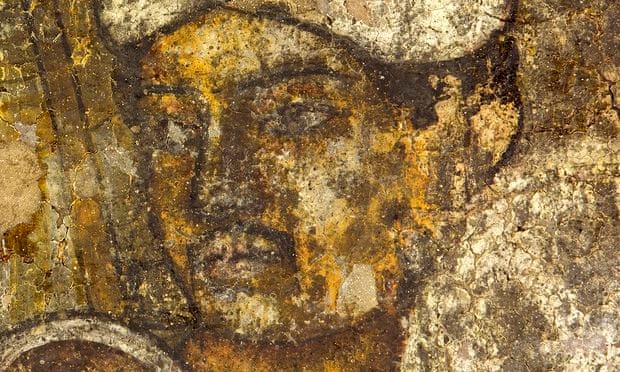
Detail from one of the murals in cave 10 of the Ajanta caves. Photograph: Prasad Pawar In the early summer of 1819, a British hunting party was heading through thick jungle near Aurangabad, in Maharashtra, western India, when the tiger they were tracking disappeared into a deep ravine. Leading the hunters was Captain John Smith, a young cavalry officer from Madras. Beckoning his friends to follow, he tracked the animal down a semi-circular scarp of steep basalt, and hopped across the rocky bed of the Wagora river, then made his way up through the bushes at the far side of the amphitheatre of cliffs. Halfway up, Smith stopped in his tracks. The footprints led straight past an opening in the rock face. But the cavity was clearly not a natural cave or a river-cut grotto. Instead, despite the long grass, the all-encroaching creepers and thorny undergrowth, Smith was looking at a manmade facade cut straight into the rockface. The jagged slope had been painstakingly carved away into a perfect portico. It was clearly a work of great sophistication. Equally clearly, it had been abandoned for centuries.A few minutes later, the party made their way gingerly inside, as Smith held aloft a torch of burning dried grass and his companions clutched their muskets. A long hall led straight into the rock, flanked on either side by 39 octagonal pillars. At the end rose the circular dome of a perfect Buddhist stupa carved, like everything else, out of the slope of the mountain.All over the walls, the officers could see through the gloom the shadowy outlines of ancient murals. On the pillars were figures of orange- and yellow-robed monks with green haloes standing on blue lotuses, while on the rock walls facing on to the side aisles were long panels of painting filled with elaborate crowd scenes, rather as if a painted scroll had been rolled out along the wall of the apse. In the light of the flickering flame the officers crunched over a human skeleton and other debris dragged into the cave by generations of predators and scavengers. The party advanced until they reached a pillar at the far end of the hall, next to the stupa. There Smith got out his hunting knife and inscribed over the body of a Bodhisattva (a previous incarnation of the Buddha) the words: "John Smith, 28th cavalry, 28 April 1819."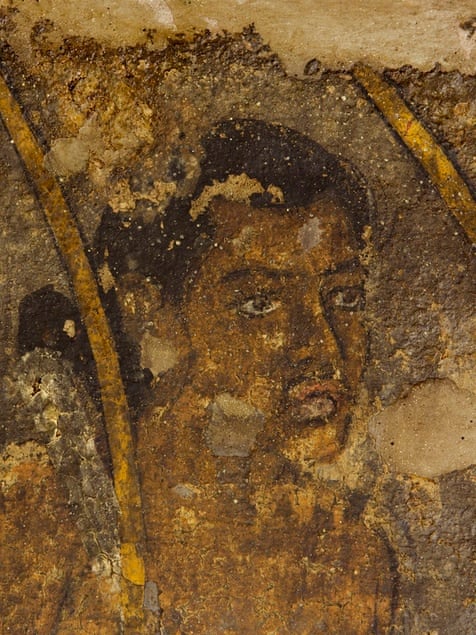
Otherworldly beauty ... A mural in cave 10 of the Ajanta caves. Photograph: Prasad Pawar In the decades to come, first other hunting parties, then later groups of Orientalists, archaeologists and Indologists followed in Smith's footsteps through the jungle to Ajanta as word spread that in this most remote spot lay 31 caves that collectively amounted to one of the great wonders of the ancient world. The walls told the Jataka stories of the lives of the Buddha in images of such extraordinary elegance and grace that they clearly represented a fragment of a lost golden age of Indian painting. They were utterly lovely – but they were also utterly alone: with a very few fragmentary exceptions, there is almost nothing else surviving from the ancient Indian past to compare them to. The murals of Ajanta are now recognised as some of the greatest art produced by humankind in any century, as well as the finest picture gallery to survive from any ancient civilisation. Even today, the colours glow with a brilliant intensity: topaz-dark, lizard green, lotus-blue.❦From almost the beginning, scholars working on the site came to the realisation that there were two quite distinct phases of work at Ajanta. The cave that Smith first walked into, later named cave 10, lay in the centre of the cliff face; it and the five others flanking it were datable by inscription to the first or second century BC.However most of the Ajanta caves, and almost all the murals, date from nearly 600 years later, during a second phase of construction. This was at the height of India's golden age, when in the Gangetic plain, the fifth-century Gupta dynasty was filling their capital of Kannauj with some of the greatest masterpieces of Indian sculpture, and when Kalidasa was writing his great play, The Cloud-Messenger.From this period date the rich picture cycles of wall painting in caves one and two. Here among handsome princes and bare-chested nobles, princesses with tiaras of jasmine languish love-lorn on swings and couches, while narrow-waisted dancing girls of extraordinary sensuousness, dressed only in their jewels and girdles, perform beside lotus ponds. Nearby are painted very different images of stark ascetic renunciation – a shaven-headed orange-robed monk lost in meditation, a hermit seeking salvation or a group of wizened devotees straining to hear the words of their teacher. Dominating everything are portraits of bodhisattvas of otherworldly beauty, elegance and compassion, eyes half-closed, swaying on the threshold of enlightenment, caught in what the great historian of Indian art, Stella Kramrisch, wonderfully described as "a gale of stillness".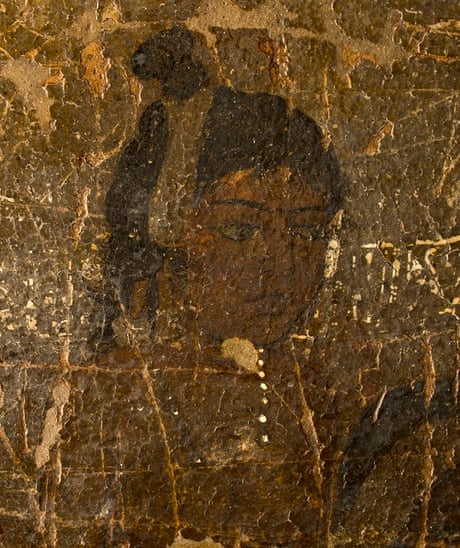
Striking ... the Ajanta cave murals. Photograph: Prasad Pawar prasadpawar>RAWSTUDIO>www.prasad/Pr Such was the celebrity of these fifth-century masterworks that most scholars, and almost all modern accounts of the Ajanta caves, have all but ignored the earlier picture cycles. These paintings were not only more fragmentary, they were also more smoke-blackened than the almost pristine later murals, and perhaps for this reason seemed to invite the attention of early graffiti artists and tourists who wanted to leave a record of their visit.By the time the Nizam of Hyderabad sent the leading art historian of his state, Ghulam Yazdani, to produce the first photographic survey of the murals in the late 1920s, the murals of caves nine and 10 had already been irreparably damaged. The Nizam also sent two Italian conservationists to help restore them. Unfortunately their efforts only obscured the murals further: they coated the pigments with a thick layer of unbleached shellac that sat on top of at least two existing Victorian layers of varnish. The shellac attracted grime, dust and bat dung, and quickly oxidised to a dark reddish brown that totally obscured the images from both travellers and scholars. Less than a century after being rediscovered by a British shooting party in 1819, the figures of caves nine and 10 had been lost again. For the rest of the 20th century they remained effectively hidden, invisible to the naked eye, forgotten by all.Then in 1999, Rajdeo Singh, the Archaeological Survey of India's (ASI) chief of conservation and head of science at Aurangabad, began work on the restoration of these murals. Manager Singh, as he is always known, had been in charge of conserving the paintings of Ajanta for a number of years, but the work in caves nine and 10 was, he knew, especially difficult, and of the greatest importance: "The paintings were so fragile that in some places there was a great fear even to touch them with the hand," he wrote later. "At some places the pigment was found completely detached from the ground plaster and stone surface."However a painstaking restoration of the paintings from 1999 onwards using infrared light, micro-emulsion and cutting-edge Japanese conservation technology succeeded in removing 75% of the layers of shellac, hard soot and grime from 10 sq m of the murals. "Particular care and precautions were taken not to alter even a grain of pigment," he wrote.Manager Singh's work revealed for the first time since the 1920s the images that are now on open display. Remarkably for so famous a site – Ajanta is one of a handful of world heritage sites in India, attracting 5,000 visitors a day – their wall paintings have never before been properly photographed.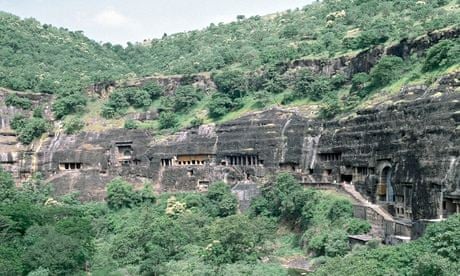
The Ajanta caves. Photograph: Getty I stumbled across them on a visit to the caves in March. The ASI does not have much of a tradition of public outreach, and even internally there is perhaps little recognition of what Manager Singh has achieved and uncovered. For his work is nothing short of a revelation: Singh has uncovered the oldest paintings of Indian faces – with the exception of a few prehistorical pictograms of stick men and animals left by paleolithic hunters in the wilds of Madhya Pradesh. They are also the oldest Buddhist paintings in existence, dating from only 300 years after the death of the Buddha.More exciting still, this earliest phase of work is not just very old, but very fine indeed and painted in a quite different style, and using markedly different techniques to that used in the rest of Ajanta. The murals of caves nine and 10 represent nothing less than the birth of Indian painting.❦The extreme antiquity of the caves is clear, though their exact dates remain elusive: from the paleographic evidence they can be securely dated to between the second century BC and the first century AD, but most scholars believe that between 90-70BC is the most likely period of construction. This meant they were excavated shortly after the collapse of Ashoka's great Mauryan empire, which once stretched from Kandahar to the Vindyas. They are roughly contemporary with the spectacular Buddhist stupas and gateways at Sanchi and Bharhut, built during a period of political disruption across India but also one of great artistic and intellectual ferment.Inscriptions in cave 10 record the many small patrons of these masterworks, like sponsorship tags on television today. One mentions a Kanhaka of Bahada, presumably a nobleman, others monks named Dharmadeva and Sikhabhadra, the latter "in honour of his mother and father". This was a period not of royal but of community patronage, and appropriately the murals were a crowded, vibrant narrative art, teeming with people and alive with drama.Cave 10 contains a supreme treasure that has only recently been identified: fragments of the oldest surviving painting of the life of the Buddha and an image of the first sermon at Sarnath. Next to the latter lies a depiction of the legend of Udayana, a tale of two rival queens, one virtuous and one evil. The most dramatic, and best preserved scenes however show two Jataka stories: the "Shyama Jataka" is about a forest dweller who was fatally hit by the poisoned arrow of the king of Varanasi. Next to it is the "Chaddanta Jataka", which tells of a virtuous six-tusked elephant that is killed at the instigation of a jealous and vindictive queen.In illustrating these stories, the artists of Ajanta open a window on to an age about which we know little. We see the costumes of this very early period: the king of Varanasi, for example, wears a white cotton tunic of strikingly central Asian appearance, wrapped around the waist with a cummerbund, while on his head he wears a turban. He has a bow and a full quiver of arrows. His guards are bare-chested and are armed with spears and bell-shaped shields decorated with half-moons and shining suns. The turbans of the different ranks are shown with great care and seem to be an important indicator of status, the different materials – some with red or gold stripes, others pure white – and the different styles of wrapping are delineated with the greatest care.Much about the clothing is identical to that worn by the sculptures at gateways of the Great Stupa at Sanchi, and there is the same interest in detail, yet the style is in feeling and temper subtly different. In Sanchi, the images are animated with a wonderful joie de vivre. Here there is a sadness in the programme of painting, which is concerned with justice, peace and non-violence: one image tells of a war breaking out over the Buddha's relics – something that went totally against the grain of everything he taught.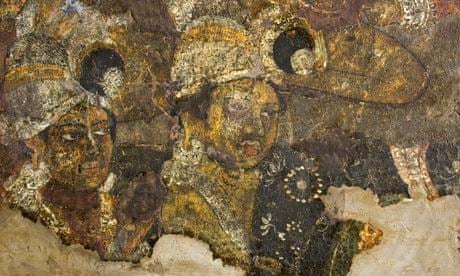
Two kings from oldest surviving painting of the Life of the Buddha. Photograph: Prasad Pawar There is also something very different in the style of these faces. Their physiognomy and the world in which they are depicted may be utterly Indian, yet the artist's long, bold brushstrokes, the use of perspective and three-quarter profiles, the play of light across the large brown eyes and cheekbones, and the technical aspects of the work with its choice of pigments and use of lime mortar all show a hint of Hellenistic influence.This is hardly a surprise: after all, at this period Indo-Greek kings controlled as far south as the Punjab and were deeply integrated into the Indian world. This intimacy, classicism and striking realism, combined with the haunting wistfulness of the features of these faces, is not a million miles away from the distant, melancholy world of the later first century AD encaustic wax mummy portraits from the Fayum region of Greco-Egyptian Egypt, which were also the products of the Hellenisation of the east. In both, we are in a world so lifelike that even today, even in reproduction, they can still make you gasp as you find yourself staring eyeball to eyeball with a silently watching soldier who could have fought the Bactrian Greeks, or a monk who may have seen the sculptures at Sanchi being carved.So realistic are the faces of the people depicted that you feel these have to be portraits of real individuals. There is none of the idealisation or otherworldliness you see in the later images of the bodhisattvas. Instead there is something deeply hypnotic about the soundless stare of these silent, often uncertain, Satavahana faces. Their fleeting expressions are frozen, startled, as if suddenly surprised by the king's decision to loose his arrow or by the nobility of the great elephant breaking through the trees. The viewer peers at these figures trying to catch some hint of the upheavals they witnessed and the strange sights they saw in ancient India. But the smooth, clean humane Indo-Hellenistic faces stare us down.Perhaps the most disconcerting thing about the people in these murals is that they appear so familiar. Two thousand years after they were painted these faces convey with penetrating immediacy the character of the different sitters: the alert guard, the king caught in the excitement of the hunt, the obedient son fetching water. Indeed, so contemporary are the features that you have to keep reminding yourself that these sitters are not from our world, they are depictions of a court that vanished from these now bare hills more than two millennia ago.Yet these are self-evidently the same people who inhabit western India today: looking at these images you cannot help but feel the great distance of time separating them from us; and yet we find in their eyes an emotional immediacy that is at once comprehensible. While the glass coverings were being removed to allow the photography for this piece, the guards joked among themselves about which painted figure looked most like which guard. The women on the cave walls wear the same bangles that the Banjara tribes of these hills still stack along their forearms, and their dupattas are decorated with fringes of taarkaam or Paithani still popular in Maharastra today, as are the fish-scale kham textiles that clothe the hunters in the Shyam Jataka. It is eerie to stare into the eyes of men and women who died more than 2,000 years ago; but odder still to feel that their faces are somehow reassuringly recognisable.