Saturday, 7 November 2015

The Silk Roads by Peter Frankopan review – history on a grand scale

From the Turkic steppe to the great sultans of Merv, a fearless and brilliant history of the world as seen from the east
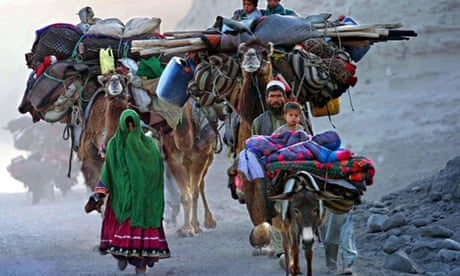

Afghan trading family Silk Road
 A nomadic Afghan trading family drives its camels along the ancient Silk Road. Photograph: Syed Jan Sabawoon/EPA

Twenty five years ago, as a young journalist fresh out of college, I drove under wintry cloud banks, through the snow-haunted valleys of Annandale and Eskdale, to interview Sir Steven Runciman in his ancient tower-house in the Scottish borders.
Runciman was the greatest medieval historian of our times, but he was always a most undonnish don. Despite long spells in the dank of the archives, his life still reads like something out of an Indiana Jones film or even a Rider Haggard novel: he was besieged by Manchu warlords in the city of Tianjin, but escaped to play a piano duet with the emperor of China; lectured Ataturk on Byzantium and was made a grand orator of the Great Church of Constantinople; smoked a hookah with the grand celebi efendi of the whirling dervishes, and correctly predicted the deaths of both King George II of the Hellenes and Fuad, the last king of Egypt, by reading their tarot cards.
But perhaps his most undonnish quality was his wish – and ability – to write wide-ranging books about big subjects and to do so in beautifully honed prose for a general audience, something that is still rare, but which in 1954 seemed a radical departure from the academic norm: “When Gibbon or Macaulay were writing,” Runciman told me, “the publication of one of their volumes was a great literary event. One of the tragedies of our time is that it is no longer considered relevant to write history well.” In the preface of his three-volume masterpiece, A History of the Crusades, Runciman threw down the gauntlet to his more workaday rivals: “I believe that the supreme duty of the historian is to write history, to attempt to record in one sweeping sequence the greater events and movements that have swayed the destinies of man". 
Runciman died 15 years ago, but he would greatly have approved of Peter Frankopan, the brilliant and fearlessly wide-ranging young Oxford historian who is in many ways the true heir to his mantle. Like Runciman, Frankopan is a multilingual Byzantinist whose first books were about the crusades; now he has taken on an even larger and more daunting chunk of history – nothing less than a history of the world, seen through the timely lens of east-west interaction.
The concept of a “Silk Road” is not an ancient one: it was first coined only in the late 19th century by the Prussian geographer Ferdinand von Richthofen, a cousin of the first world war flying ace the Red Baron. He used it to describe the trading routes that first linked China with the Mediterranean west, which he realised formed one of history’s great spaces of cultural transfer, economic change and intellectual fusion. Frankopan’s 650-page tome on the subject takes some of the most fascinating of Von Richthofen’s ideas and cross-fertilises them with those of Runciman to spectacular effect.
Runciman’s great insight was that the real heirs of Roman civilisation were not the crude chain-mailed knights of the rural west, but instead the sophisticated Byzantines of Constantinople and the cultivated Arabs of Damascus, both of whom had preserved the Hellenised urban tradition of antiquity long after it was destroyed in Europe: “Our civilisation,” he wrote, “has grown … out of the long sequence of interaction and fusion between Orient and Occident.” Frankopan shares Runciman’s love of the rich, cosmopolitan cultures of the eastern Mediterranean, and the way they seeded so many of the great ideas of the west – it was here, he writes, quoting the historian Sallust, that “Roman soldiers came of age: learned how to make love, to be drunk, to enjoy statues, pictures and art”. But he throws his net wider still, showing how the belt of territory between China and Constantinople was for much of history the centre of the world, and a place from which we drew so much of what has come to be regarded as “western civilisation”.
Traditionally, of course, it is a part of the world that rarely figures in Eurocentric histories: who, for example, now remembers those Turkish converts to Judaism, the Khazars, who dominated the trade and culture of the steppes from the 8th to the 10th century, when they were finally and savagely wiped out by the Rus Vikings, who after spilling “rivers of blood” and plundering the Khazar capital Atil were “gorged on loot and worn out with raiding”? Equally, how many of us recall the legendary greatness of the Seljuk sultans of Merv? The ruins of their once magnificent capital lie now amid the camel-coloured wastes of Turkmenistan: a scatter of mud walls, a few ambiguous foundations, the odd cracked dome of a mud-brick Sufi tomb forgotten on the outer edge of a polluted and provincial post-Soviet town. On one side a forest of smokestacks belches fumes into the desert; on the other a spread of barren collective farms extend towards the encroaching dunes: “If you meet a viper and a Mervi,” advises a local proverb, “kill the Mervi first, and the viper afterwards."
Yet in the 10th century, while Europe paralysed by Viking raids, Merv was a flourishing Silk Route capital, and the second city of Islam, trumped only by Baghdad with its 100 million citizens. It grew fabulously rich on the profits of the China trade and the tribute of an empire that extended southwards from Afghanistan to Egypt and the gates of Byzantium. Along with its great sister cities – Tashkent, Bukhara and Samarkand – Merv developed a complex culture, fostered in universities, and produced such genii as al-Biruni, who first computed the radius of the earth, the lyric poet Rudaki, and the great Ibn Sina – known in the west as Avicenna – who wrote 242 books of stupefying variety and whose Canon of Medicine became a textbook in the hospitals of Christian Europe for over 500 years.

Today, what draws most travellers to the oasis cities of the Silk Route is the breathtaking remoteness of these exotic-sounding places. Yet what most distinguished them in the early first millennium AD was the opposite: the fabulously wealthy and cosmopolitan nature of the societies that thrived there. The Middle East and central Asia were the centre of globalisation from the 1st century AD onwards: ideas of art, decorum, dress and religion passed backwards and forwards, mixing and melding to create the most unexpected innovations and fusions.
Undaunted by the complexity of the material, and the scale of the subject he has taken on, Frankopan marches briskly through the centuries, disguising his erudition with an enviable lightness of touch, enlivening his narrative with a beautifully constructed web of anecdotes and insights, backed up by an impressively wide-ranging scholarly apparatus of footnotes drawing on works in multiple languages.
If Frankopan is not afraid to take on big subjects, he is also quite unafraid to take on controversial ones, none more so than in his treatment of Islam. It was not the defeat of the Ummayad armies at Tours by Charles Martell in 732 that stopped the Arab advance into Europe, he writes. Rather, that in the west “prizes were few and far between: wealth and rewards lay elsewhere” – the east. He points out how, in the Middle Ages, Muslim scholars avidly investigating the science of the heavens and Earth were baffled by the lack of intellectual curiosity in Christendom. In an inversion of today’s Islamophobic prejudices, it seemed to Muslim scholars such as Al‑Mas’udi as if the Christian faith had destroyed science in Europe, “effaced the signs of learning, eliminated its traces and destroyed its paths”.
This is history on a grand scale, with a sweep and ambition that is rare. I learned a huge amount about subjects I thought I knew well: who would have guessed that Indian Buddhist monasteries once reached as far as Persia, Syria and the Gulf; that the Romans sent embassies as far as China; that Kashgar had a Christian cathedral before Canterbury; that the Chinese were the first to use toilet paper; that the “exceedingly savage” Huns wore robes made of field mice and ate raw meat “partially warmed by being placed between their thighs”; or that the Roman emperor Diocletian’s proudest achievement was the size of his cabbages?
Inevitably with such a massive panorama, there are a few places where Homer nods: in the Indian sections, Frankopan confuses The Mahabharata and The Ramayana, and he thinks the great Ellora caves were built by the Marathas in north India when they were actually 1,000 years older, and can be found inland from Bombay. But these are small quibbles. This is a remarkable book on many levels, a proper historical epic of dazzling range and achievement.
• To order The Silk Roads for £24 (RRP £30) go to bookshop.theguardian.com or call 0330 333 6846. Free UK p&p over £10, online orders only. Phone orders min p&p of £1.99.


Friday, 6 November 2015

Mysterious Symbols in Kazakhstan: How Old Are They, Really?

Editor's Recommendations

Wednesday, 4 November 2015

Rare Armenian Masterpieces to Go on Display for the First Time at the Bodleian Libraries

Armenia_Magi
OXFORD, UK — A new exhibition at the Bodleian Libraries celebrates more than 2,500 years of Armenian history and culture with a sumptuous display of manuscripts, books, sacred objects and everyday artefacts from the Armenian community that have been handed down through the generations.Armenian Manuscript
Armenia: Masterpieces from an Enduring Culture features treasures from the Bodleian’s magnificent Armenian collections alongside items from private and national collections in Armenia, the Netherlands and the UK.
Opening on 23 October, Armenia is the second exhibition to be held in the Bodleian’s newly renovated Weston Library. The Bodleian Library has been collecting Armenian manuscripts and printed books since the seventeenth century, but this is the first time items from the Libraries’ rich Armenian collection have gone on public display in a major exhibition.
Armenia: Masterpieces from an Enduring Culture showcases more than 100 stunning objects that demonstrate the enormous achievements of a nation with a rich, fascinating and often turbulent history. The ‘enduring culture’ in the exhibition’s title refers to the great antiquity of Armenian culture. This landlocked country situated along the route of the Great Silk Road boasts a long history spanning more than two and a half millennia, from its first mention, carved into stone, in the reign of King Darius I (c. 550-486 BCE) to the modern Republic of Armenia and the numerous diaspora communities worldwide. The endurance highlighted in this new exhibition also refers to the suffering and hardship which has befallen the Armenians. 2015 marks the centenary of the genocide perpetrated against the Armenian population of the Ottoman Empire by the Young Turk government during World War I.
Grigor Narekac‘i, Book of Prayers, Bodleian Libraries, University of Oxford/Courtesy of the Der Tavitian family
Image of Grigor Narekac‘i, Book of Prayers, Bodleian Libraries
In their honour, the Bodleian’s Armenia exhibition displays a rich cache of objects spanning more than two thousand years of cultural history: from coins minted in the first century BCE during the reign of King Tigranes II to sumptuously and more modestly decorated manuscripts from the Middle Ages. The diverse range of books, maps, art and artefacts on show reveals a culture that is both religious and secular. The exhibition also features the treasured objects of survivors of the 1915 genocide including traditional Armenian needlework and needlelace items, family photographs and an Armenian family’s century-old tea set.
‘The Bodleian Libraries is honoured to take part in the commemorations for the 100th anniversary of the Armenian Genocide by helping to share the history and culture of the Armenian people,’ said Bodley’s Librarian Richard Ovenden. ‘We have collected Armenian books and documents for over 400 years, and the University has taken seriously the study of Armenian culture for a very long time. Through this exhibition, which features items of exceptional beauty, we are able to share with a much broader audience the vibrancy and richness of this ancient culture.’
Highlights of the exhibition:
-A rare and outstandingly beautiful gospel illustrated by Mesrop of Xizan, an Armenian master of the 17th century.
-A venerated holy book on loan from a UK-based Armenian family who have passed down their copy through the generations. The book – known as The Narek – is an 18th century copy of The Book of Lamentation containing mystical prayer poems by Saint Gregory of Narek. This is the most venerated book in Armenian culture after the Bible, and healing powers are ascribed to it. Often called the ‘Saint of the House’, it is believed to protect the family with whom it resides.
-A brightly coloured gospel manuscript featuring a ‘hidden demon’ that has been rubbed out over the centuries by pious readers. Using hyperspectral imaging tools, conservators at the Bodleian have revealed the hidden demon and will display the newly-discovered image alongside the original manuscript.
-A collection of 20 ancient coins from a private collector and benefactor to the exhibition, which tell the story of Armenia’s tumultuous political and economic history.
-The only known copy of the first book printed in Iran, a book of psalms dating from 1638.
-The Bodleian’s oldest Armenian manuscript dating from the 11th century: a copy of John Chrysostom’s Commentary on the Epistle to the Ephesians.
Religious artefacts such as a silk altar curtain embroidered with silver thread, a priest’s staff, and a ceremonial brass bowl.
-Personal treasures that have been carefully kept and passed down through generations of Armenian families including a traditional needlework headdress, a woman’s needlelace collar, an Armenian family’s samovar (hot water vessel used to prepare tea), and personal photographs from families affected by the Genocide.
Ancient coins, Bodleian Libraries, University of Oxford/Private collection, reference Bedoukian 20, Bedoukian 19/34, Bedoukian 17/37
The exhibition will also feature videos of the Oxford Armenian Choir performing in the Weston Library and a short film titled The Blessing by artist Krikor Momdjian.
‘Armenian culture has shaped humanity and given it great gifts, from precious manuscripts, literature and art to religious and secular music,’ said Theo Maarten van Lint, Calouste Gulbenkian Professor of Armenian Studies at the University of Oxford. ‘In this exhibition, we present to the public the historical, artistic and other cultural Image of Throne vision of Ezekiel, M2587, Bodleian Librariesachievements of a people not often in the focus of the public eye, in an effort to educate, fascinate and create a dialogue between nations and peoples.’
Bible, Bodleian Libraries, University of Oxford
Scholarly interest in Armenian culture at the University of Oxford dates back at least 400 years, when the first Armenian texts entered the newly founded Bodleian Library through benefactions from Archbishop Laud (1573-1645). This year, the University commemorates the 50th anniversary of the establishment of an endowed Chair in Armenian Studies: the Calouste Gulbenkian Professorship. The current holder of the Professorship, Professor Theo Maarten van Lint, curated the exhibition with Robin Meyer, Lector in Latin and Greek Languages at the University of Oxford. The exhibition is the first major exhibition in the UK of Armenian materials in almost 15 years.
Armenia: Masterpieces from an Enduring Culture follows Marks of Genius, the inaugural exhibition at the Bodleian’s new Weston Library, which opened to the public in March 2015. The Armenia exhibition runs until 28 February 2016 and a programme of talks and events will be held over the course of the exhibition. Admission to the exhibition is free and booking is not required.
The Bodleian Libraries is grateful to Mr Raffy Manoukian for his generous support of the exhibition.
The exhibition is accompanied by a 276-page catalogue, Armenia: Masterpieces from an Enduring Culture, edited by the exhibition’s curators Theo Maarten van Lint and Robin Meyer (Bodleian Library Publishing, 2015). The publication was produced with the generous support of the Calouste Gulbenkian Foundation and The Hakop Kevorkian Fund.

Monday, 2 November 2015

Tomb Tells Tale of Family Executed by China's 1st Female Emperor

Editor's Recommendations


Photos: Tomb Reveals Murderous Tale of China Empress 


Xuastvanift: A confession book of Manichaean Uygurs

Huastuanift - Manihaist Uygurlarin Tovbe Duasi

MONDAY, NOVEMBER 2, 2015

Xuastvanift: a confession book of Manichaean Uygurs 


The British Library manuscript copy of Xuastvanift (Or.8212/178), a confession book of the Manichaean Uygurs.
The British Library manuscript copy can now be viewed on IDP. This follows publication in 2014 of a book on this text by Betül Özbat:
Huastuanift: Manihaist Uygurlarin Tövbe Duasi
[Xuastvanift — a confession book of the Manichaean Uygurs]
Türk Dil Kurumu Yayınları: Ankara 2014
PB, 256 pp., colour and B&W ills., 14TL.
ISBN: 9789751628985

Betül Özbat introduces her book below.
"This manuscript is one of the most important and complete texts among the Old Uygur Manichaean texts. It was first published by W. Radloff (1909) and A. von Le Coq (1910/1). After this scholars such as W. Bang and J. P. Asmussen also studied the text. A. von Le Coq’s publication (1911) was translated into Turkish in 1941 but there was no detailed study after this in Turkey. One of our main aims was to prepare a new publication on this text in Turkish in order to reach Turkish readers.
My book consists of two main sections. The first is an introduction containing brief information on Manichaean Uygurs, Manichaean literature, art, script and religion, as well as Sogdian people and their relationship with the Uygurs. The second part contains the text of Xuastvanift. This follows the text found on the longest extant manuscript which is in the Stein collection in London (Or.8212/178). There are more than twenty copies of the text but I only used other fragments from Berlin and St. Petersburg to supplement the main text. A transcription is given along with notes giving the source(s) of the text.
For example:
[337] k(ä)ntü özümüzni ämgätir biz (U7a, 1-2; L 299; Spb 139-140)
In this example, the number to the left in the square brackets indicates that this is the 337th line of the entire text. The number on the right in the round brackets indicates that this line corresponds to (respectively) the 1st and 2nd lines on the recto of Berlin U7 fragment; the 299th line on the London scroll, Or.8212/178; and the 139th-140th lines on the St. Petersburg manuscript.
A Turkish translation and the transliteration is given after the transcription. The book ends with the interpretation of some problematic points in the text, a glossary and appendix.
The appendix gives images of different manuscript copies of the Xuastvanift. The coloured images of the British Library scroll are the first to be reproduced — the previous publication by A. Von Le Coq had only black and white images."
Sponsorship enabling digitisation of the scroll was kindly provided by a Turkish scholar.

---------------------------------------------------------------------------------------------------------------------


If you want to know a little bit more, read this article in the Iranica on line


-------------------------------------------------------------------------------------------------------------


Dr. Stein's Turkish Khuastuanift from Tun-Huang, Being a Confession-prayer of the Manichaean Auditores

by Albert von Le Coq

This book is to view on the internet via the Hong Kong University Library, click HERE

Sunday, 1 November 2015

Penn Museum lecture: Amazons: Warrior Women in Myth, Art, and History


Amazons: Warrior Women in Myth, Art, and History

Amazons—fierce horsewomen-archers on the fringes of the known world—were the mythic archenemies of the ancient Greeks. Heracles and Achilles battled Amazon queens and the Athenians reveled in their victory over an Amazon army. But who were these bold barbarian archers on horseback who gloried in fighting, hunting, and freedom? Adrienne Mayor, Research Scholar, Stanford University Classics Department, reveals surprising details and new insights about the lives of flesh-and-blood women of the Eurasian steppes who were mythologized as Amazons.

Category