Saturday, 6 August 2016

Granite anchor stock from the Song Dynasty in Hong Kong waters


Paul Harrison, a conservator at the Hong Kong Maritime Museum, removes centuries of seabed concretions from the cannon.  Credit: Hong Kong Maritime Museum

In the waters around Hong Kong, divers recently recovered a 1,000-year-old granite anchor stock — the oldest maritime artifact ever found in the Chinese territory — and a European-made cannon from the early 19th century, which may have been used on a merchant ship to defend against pirates, according to archaeologists.
The recent discoveries hint that a trove of undiscovered relics could lurk beneath the waves of the harbor city.
"We see this as the tip of the iceberg," dive expedition leader Bill Jeffery, an archaeologist with the Hong Kong Underwater Heritage Group, told Live Science. "The Hong Kong SAR [Special Administrative Region] is 60 percent water, and yet nearly no archaeology has been done underwater here." [See Photos of the Seafaring Relics Found in Hong Kong's Waters]
The 6-foot-long (1.8 meters) granite stock — the upper crosspiece found on some anchors — was recovered from the seabed, beneath about 10 feet (3 m) of water, near the base of a cliff on Hong Kong's High Island.
It is the same style and material as anchor stocks used during China's Song Dynasty, which lasted from A.D. 960 to 1279, according to Encyclopedia Britannica. An anchor stock that dates back to the Song Dynasty is on display at the Maritime Silk Road Museum of Guangdong in Yangjiang, located about 200 miles (320 kilometers) southwest of Hong Kong, on the Chinese mainland.
Jeffery, a professor in the anthropology department at Guam University and a research associate at the Hong Kong Maritime Museum, said he was able to recognize the anchor stock during an initial dive at the High Island site because he had seen the one on display in Yangjiang.
“It just stood out from the rest of the natural rocks: you can tell it is man-made, with straight lines, and really nicely formed,” he said.
The 1,000-year-old granite anchor stock, lying on the seabed near Hong Kong's High Island.
Credit: Hong Kong Underwater Heritage Group 
Originally, the granite anchor stock would have been attached to a wooden shaft measuring between 6 and 10 feet (1.8 and 3 m) long, with wooden flukes designed to dig into the seabed, Jeffery said.
"We know that ships in the Song Dynasty used these types of anchors, although it could be from the Yuan Dynasty [A.D. 1271 to 1368] that came after," he said.
"In the Ming Dynasty [A.D. 1368 to 1644], the anchor changed to a very different shape — more like a [grappling hook] made of iron, because they were getting the technology to make larger objects out of iron," Jeffrey said.
He added that the anchor stock may be from one of the Chinese merchant vessels of the Song period that sailed south to trade in Hong Kong and the cities of the mainland near the Pearl River Delta. [Shipwrecks Gallery: Secrets of the Deep]
"People would have been trading up and down the Chinese coast and coming into the Pearl River, at least from the time of the Tang Dynasty [A.D. 618 to 907]. This anchor could be from a vessel that was trading over a long distance, or from a vessel connecting with larger ships to carry cargo [to and from the coast]," Jeffery said.
There is no sign of a shipwreck near the anchor stock, but broken pieces of pottery were found on the seabed nearby, Jeffrey said. He thinks these fragments date to sometime after the 17th century, which suggests the site may have been used as a temporary anchorage for many centuries, he said.
"They would be sleeping, cooking and living aboard, and so they'd carry pottery," Jeffery said. "All of the stuff we've seen is broken, probably washed overboard, or it was broken and then thrown overboard."
In a second recovery effort in July, a team of seven divers made 25 dives over two days to raise a cannon from the seabed just off the coast of Hong Kong's Basalt Island. The 1-ton, 6-foot-long (1.8 m) ship's gun is of a style called a "cannonade," or "gunnade," which is shorter and lighter than a standard 24-pound (11 kilograms) naval "long gun," Jeffery said.
The recovery boat raising the cannon from the water, with the yellow lift-bag still attached.
Credit: Hong Kong Underwater Heritage Group 
An early inspection found identification marks — the letters "ECL" and a British crown — inscribed on the 1-ton barrel by the foundry that made it, he said. [The 7 Most Mysterious Archaeological Finds on Earth]
Similar marks have been found on early 19th-century European cannons discovered in India, Japan and New Zealand, which could indicate they were made by a small foundry somewhere within the British Empire.
Because the cannons used by European navies were usually made by well-known foundries, it's likely the cannon found in Hong Kong was used on a merchant vessel, possibly as a defense against the pirates who menaced the waters around Hong Kong until the mid-19th century, Jeffrey said.
On a future expedition, the researchers from the Hong Kong Underwater Heritage Group hope to recover a second, smaller gun that was among the rocks of the seabed beneath the recently recovered cannon.
"We didn't get that because we ran out of time, but that will be interesting to bring up, because it's another piece of the jigsaw puzzle of this site," Jeffery said.
After up to two years of conservation work to remove centuries of built-up sediment, the researchers hope both cannons and the anchor stock will go on display at the Hong Kong Maritime History Museum, which sponsored the archaeological dives under licenses issued by the Hong Kong government.
Jeffery said that underwater archaeology in Hong Kong has been "very overlooked" so far. "Lots of archeology in Hong Kong has been done on land but they stop at the waterline, so really nothing's been done underwater."
Later this year, from Nov. 27 to Dec. 2, the Hong Kong Maritime Museum will host the third Asia Pacific Conference on Underwater Cultural Heritage.
"We hope that this may help to stimulate things in Hong Kong as well as Asia-Pacific in general," Jeffery said. "Hong Kong has 236 islands, so potentially there are a lot of shipwreck sites and other types of sites, perhaps even prehistoric sites, around the islands and along the coastline."
Original article on Live Science.

Photos: Seafaring Relics Discovered in Hong Kong's Waters


A Christian Sogdian, Syriac and English Dictionary

A Dictionary: Christian Sogdian, Syriac and English


  • Hardcover: 408 pages
  • Publisher: Dr Ludwig Reichert (30 May 2016)
  • Language: English
  • ISBN-10: 3954901757

Many works of Syriac literature were translated into Sogdian, a Middle Iranian language originating in the region of Samarkand and widely spoken along the so-called "Silk Road." This Christian Sogdian literature, which includes biblical, liturgical, ascetic and hagiographic texts, is chiefly known from a cache of manuscripts discovered in 1905 at the site of the ruined monastery of Bulayiq in the Turfan oasis. It is important for Syriac studies, since the Sogdian translations were often made on the basis of earlier recensions than those which survive in Syriac and since some texts are no longer extant in Syriac. It is no less important for Sogdian and Middle Iranian studies, since those texts whose Syriac originals can be identified provide a firm basis for the understanding of the Sogdian language; moreover, the material in Syriac script, with its elaborate system of vocalic points, is a unique source of information on the pronunciation of Sogdian. The present Dictionary is designed to be accessible both to Iranists, whether or not they know Syriac, and to Syriacists, whether or not they know Sogdian. It consists of two main sections followed by a comprehensive English index. Part 1, arranged by Sogdian lemmata, provides a complete listing of all words attested in published Christian Sogdian texts, both in Syriac and in Sogdian script, including variant spellings, full parsing of all inflected forms, and details of their equivalents in the most closely corresponding Syriac parallel text. In Part 2 the same material is arranged by Syriac lemmata. The two parts together make it possible to see what Syriac form or forms any Sogdian word can represent and how any Syriac word or idiom is translated into Sogdian. The dictionary thus fulfils a range of functions. Firstly, it will provide a reliable guide for anyone who wants to read the extant Christian Sogdian texts; secondly, it will assist future editors in identifying, restoring and translating Christian Sogdian texts; and thirdly, it will contribute to the study of the transmission of literature from Syriac into Sogdian and the techniques of the translators.

Monday, 18 July 2016

More about the Arctic Boy mummy

 The following article is a follow up of two earlier articles in the Siberian Times by Anna Liesowska:


Up-close laboratory pictures of ancient mummy as scientists recreate his life and times

By Anna Liesowska
15 July 2016
Probes taken by South Korean experts will reveal lifestyle of this Arctic boy from 800 years ago.

Our exclusive pictures show Korean scientists from Seoul National University, working on the human remains at the Scientific Centre of Arctic Research. Picture: Sergey Slepchenko
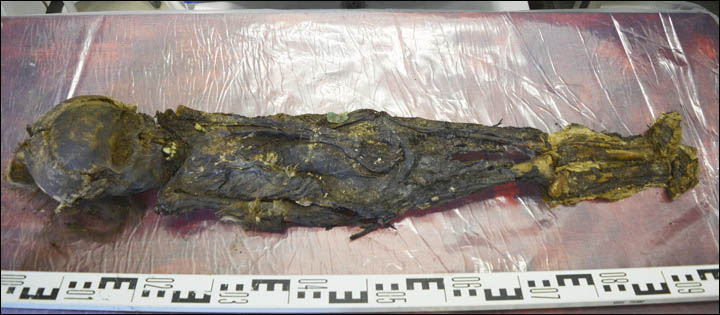
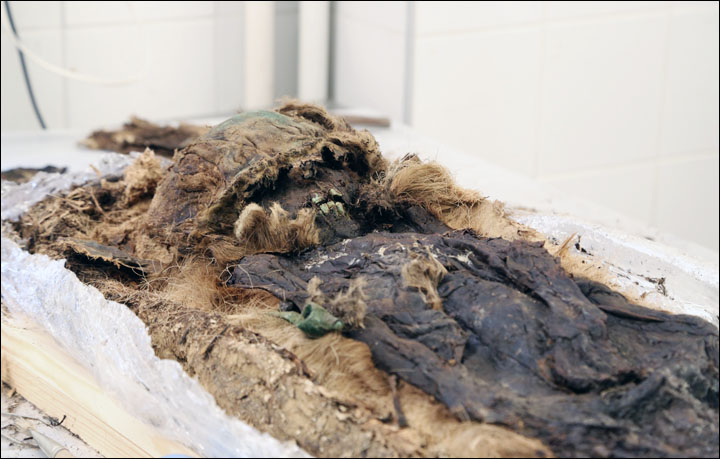
The latest tests on the mummified remains of this Medieval child from northern Siberia highlight the wealth of knowledge he can give us on the way he lived. Aged six or seven, he was encased in birch bark and copper, and found in an ancient necropolis close to the present day site of Salekhard, on the Arctic Circle. 
Our exclusive pictures show Korean scientists from Seoul National University, headed by leading international expert Professor Dong Hoon Shin, working on the human remains at the Scientific Centre of Arctic Research.
Russian expert Dr Sergey Slepchenko, from Tyumen, said: 'The main thing is that this mummy was preserved naturally and the internal organs were not removed, unlike with artificial mummies.'
Scientists take samples

Scientists take samples

Scientists take samples
'The main thing is that this mummy was preserved naturally and the internal organs were not removed, unlike with artificial mummies.' Pictures: Sergey Slepchenko, Vesti.Yamal
Tissue samples will reveal a mass of information about how this 800 year old boy once lived. Tests include histological analysis on the mummy's tissue and its changes. 
Study is also being made on histochemical and biochemical features and the research on stable isotopes. 
'All this will help us to learn as much as possible about the preservation status of Zeleny-Yar-mummies in general, and the lifestyle of this child - how he lived, what he ate,' he said. 'If we are lucky, we have a slight chance of a hint on how he died. The odds are not great, but we hope.'
Samples were also taken from previously undisclosed partially mummified bodies found at the same Zeleny Yar in the past year. 'For example, this year were found the remains of a young man with a mummified pelvis.
Professor Dong Hoon Shi (left) and Dr Sergey Slepchenko (right)
Professor Dong Hoon Shin (left) and Dr Sergey Slepchenko (right) are ready to work. Picture: Sergey Slepchenko
'The upper part of his body is badly preserved, but the pelvis is mummified, so we could take the samples from his bowel and bladder. That is - our main goal is to restore the picture of life of these people, to learn as much as possible about them.'
A myriad of other research is being conducted on this mummy, highlighting its importance to new revelations about life in the pre-historic Arctic. Hopes remain in scientific efforts to discover the DNA of the mummy, although the process is taking longer than expected. 
Already, local native groups from northern Siberian are having their DNA analysed in the hope of an 'Are you my mummy?' matching, as previously disclosed by The Siberian Times.
For example, local Nenets journalist Khabecha Yaungad is seen here giving a blood sample for genetic analysis. As he describes his family's past, there is an intriguing example of where the stories derived from oral history may meet scientific scrutiny. 
Khabecha Yaungad

Khabecha Yaungad
Local Nenets journalist Khabecha Yaungad is seen here giving a blood sample for genetic analysis. Pictures: Vesti.Yamal
'My forefather arrived here 700 years ago, and he was drowning in the river, but then he was washed up on a log, and my great-grandmother healed him,' he said, reaching back into the stories he had heard from his family's past. 
'And then he married her daughter. They began to think, which family name to give him? And the decided: 'There are thousands of shells on the riverbank. Let us call him Shell.' In the Nenets language, his family name means 'shell'.
South Korean scientists are also working on elaborate research to recreate the face of this medieval child. 'The degree of preservation is very good, so we think that the reconstruction will be successful,' said Dr Slepchenko. 
3D scanning

Bronze axe

Temple ring
Mikhail Vavulin scanned the mummy, temple rings and bronze axe, to create then a 3D model. Pictures: TSU
Other work is underway to create a 3D model of the mummy. Mikhail Vavulin, of the Artefakt Laboratory at Tomsk State University, said: 'Currently scientists from Salekhard are developing a plan for the mummy's conservation and restoration, so it was very important to make a scan before they start this work.'
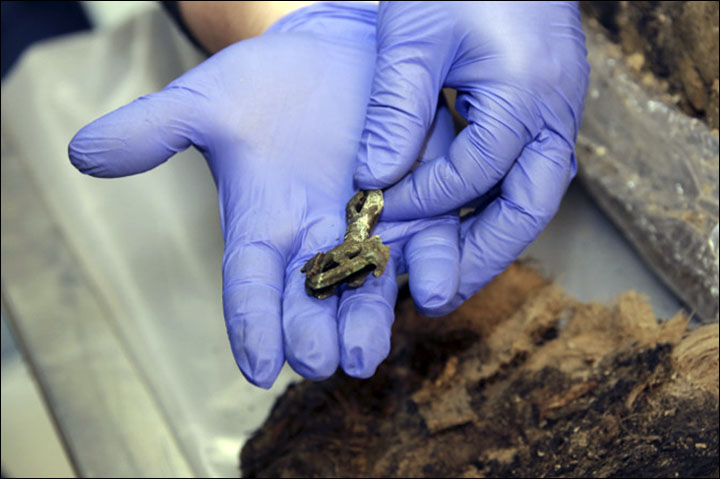
Temple rings and a bronze axe, found at the burial site, were also scanned.
Alexander Gusev, research fellow at the Centre for the Study of the Arctic, who headed the expedition on unearthing the mummy, said: 'The new opportunities in the creation of models of archaeological sites with the help of three-dimensional scanning were tested at Zeleny Yar for the first in 2013-2014.'
These digital models enable observation of the burial from any angle. 'Any researcher can see in all the details and from all angles what the scientists saw when making the excavations at the archaeological site,' he said.
Unwrapping the mummy

Unwrapping the mummy

Salekhard mummy

New Yamal mummy

Bronze pendant
The boy's remains are seen as being accidentally preserved aided by the form of burial in a cocoon of birch bark and copper. Picture: Alexander Gusev
Further new findings are that the boy was covered in reindeer 'fur' when he was buried for posterity. 'The upper layer was the skin of a rein deer, the lower layer was the 'underfur' of the same animal,' said Gusev.
'It is hard to say what the lower layer was originally: maybe the skin of a fawn or the specially processed skin of adult reindeer. 'We are working on this,' he said. 'In addition, there were the pelts of fox and arctic fox.'
The boy's remains are seen as being accidentally preserved aided by the form of burial in a cocoon of birch bark and copper. Our previous stories show how his face, including his teeth, became suddenly visible for the first time in around eight centuries. 

Sunday, 17 July 2016

Early Chinese settlers in Cape Breton (Canada) by Paul Chiasson

Written in the Ruins Paperback – 23 Jan 2016


Friday, 15 July 2016

Peter Frankopan - The Silk Roads: Questioning the Eurocentric view of history


LJMU's National Identity Lecture Series in association with the Centre for Port and Maritime History and the Centre for the Study of International Slavery presents Dr Peter Frankopan - The Silk Roads: Questioning the Eurocentric view of history.

Dr Peter Frankopan is a historian at Oxford University, where he is a Senior Research Fellow at Worcester College, Oxford and Director of the Oxford Centre for Byzantine Research. During this lecture he will talk about his best selling book 'The Silk Roads'.

Peter works on the history of the Mediterranean, the Balkans, the Caucasus, Russia and on relations between Christianity and Islam. He also specialises in medieval Greek literature, and translated The Alexiad for Penguin Classics (2009).

Peter often writes for the international press, including The New York Times, The Washington Post, The Guardian, MoneyWeek and has contributed to many TV and Radio documentaries. He was recently profiled in China Daily, China's largest English language newspaper, about his new book The Silk Roads: A New History of the World.

In December 2015, Silk Roads was named The Daily Telegraph's History Book of the Year 2015.


Thursday, 14 July 2016

Holding hands for 5,000 years, a couple with mysterious jade rings and dagger

Siberian Times by Anna Liesowska

13 July 2016
Bronze Age burial near Lake Baikal intrigues archeologists who have not yet revealed contents of leather pouch between man's kneecaps.
The man's skeleton had a ring made of rare white jade over one eye socket. Picture: Dmitry Kichigin
Experts speculation that this ancient couple are an elderly man and his wife or concubine, buried for eternity in a show of affection. There are some unique aspects to the couple who are believed to be from the Bronze Age Glazkov culture.
The man's skeleton had a ring made of rare white jade over one eye socket. Three more were on his chest. Archeologist Dr Dmitry Kichigin said: 'It was probably somehow connected with their ideas about the afterlife.'
Samples of the bone of the couple have been sent to Canada for radiocarbon analysis, but the Russian team involved in the excavations believe the couple to be 4,500 to 5,000 years old. 
Bronze Age couple burial

Bronze Age couple burial

Bronze Age couple burial
The site is a sacred burial place since Neolithic times overlooking the waters of Lake Baikal, the oldest and deepest lake in the world. Pictures: Dmitry Kichigin
'In the grave we found male and female skeletons, lying on their backs, heads to the west, hand in hand,' he said. The site is a sacred burial place since Neolithic times overlooking the waters of Lake Baikal, the oldest and deepest lake in the world.
The male skeleton is complete but rodents destroyed the upper part of the female. Near the woman was a 'massive' knife made of jade, some 13 centimetres in length and 7 cm in width. 
Pendants of red deer and musk deer teeth were found on the male skull, and around the feet. Most likely, they decorated the hat and footwear.
'Were they relatives, or an owner and his concubine?' asked the archeologist. For now the answer is unclear: he would like to conduct DNA tests to check if the pair were related, but this appears to be too expensive.
The burial unearthed this summer is located at a cape on Maloe More, the strait that  separates the mainland and the Olkhon island, close to Chernorud settlement, in some 260 kilometres to north-east of Irkutsk. 
Bronze Age couple burial

Bronze Age couple burial
'It  would be very interesting to find out the purposes the massive jade knife, which we found near the woman, was used for. Pictures: Dmitry Kichigin
The precise location is being kept secret for now to avoid amateur diggers wrecking a site which is likely to contain more burials, possibly older than this one. 
'We were lucky to find at least one skeleton in excellent condition, with implements and decorations - it is the dream of many archaeologists,' said Kichigin. 'It  would be very interesting to find out the purposes the massive jade knife, which we found near the woman, was used for. 
'We also found some metal implement in a small leather bag between male's kneecaps.' Analysis will begin on the finds in the autumn. 
'The cape, where we conducted excavations, was obviously a sacred place for ancient people,' he said. It was not a settlement but used for religious rites and as a graveyard from ancient times.
'We can expect a lot of interesting discoveries on this archaeological site, so we plan to continue our work next year.' 
The archaeological team led by Dr Kichigan is from Irkutsk National Research Technical University, with the assistance of Yuliana Yemelyanova, from the
Laboratory of Archeology, Paleoecology, and Life Support Systems of the Peoples of North Asia.
The burial unearthed this summer is located at a cape on Maloe More, the strait that  separates the mainland and the Olkhon island, close to Chernorud settlement. Picture: The Siberian Times
Map

Friday, 8 July 2016

Translating Chinese Tradition and Teaching Tangut Culture

Translating Chinese Tradition and Teaching Tangut Culture: 


Manuscripts and Printed Books from Khara-Khoto  (Studies in Manuscript Cultures)

Hardcover – 13 Nov 2015

Chennai’s ancient trade link with Rome unearthed

The Hindu, July 4, 2016

Deep connections:Students looking at an ancient ring found at Pattarai Perumbudhur.—Photo: B.Jothi Ramalingam

Romans used the city as a transit hub to trade with northern States

For ancient Romans, Chennai was not just another trading port town along the coastline. Instead, the city was a key transit hub for them to carry out their trade.
New findings have emerged after a team of archaeologists from the Tamil Nadu State Archaeology Department found broken pieces of roulette ware, a Roman royal household ware, at an excavation site in Pattarai Perambadur, a small village with around 600 farming families on the western outskirts of Chennai.
“Presence of roulette ware far away from the coastline is interesting because it indicates Romans traded beyond coastal towns,” R. Sivanantham, deputy director, Tamil Nadu State Archaeology Department, told The Hindu.
Funded by the State government , the three-month-long excavation, which ended last Tuesday, was monitored by the Commissioner of the Department, D. Karthikeyan. The team comprised J. Baskar, archaeological officer (Chennai); J. Ranjith, Arcot curator; and P. Baskar, epigraphist, Poompuhar.

Three sites excavated
Archaeologists said this was the first time evidence has emerged on Roman presence in western parts of the city, indicating they travelled away from the coastline. The three ancient sites – Nathamedu, Aanaimedu and Irularthoppu – in Pattarai Perambadur village were excavated with 12 trenches.
The team found most of the 200 antiques, including stone tools, pot shreds, beads made of ivory, glass and terracotta, conical jars and a ring well from Irularthoppu hamlet in three small trenches.

Palaeolithic age
They found an entire sequence of habitations since the early Palaeolithic age (10,000 years ago) to early Christian era.
Presence of rouletted ware, conical jars, hopscotch, lid knob of various sizes and a deer horn indicated that the site acted as transit route to the Romans for trading.
For instance, a two-feet-high conical jar with holes was among the findings. As per the Encyclopaedia of Indian Archaeology, such jars with holes were found mainly in ancient towns such as Bairat and Sambar in Rajasthan and in Vaishali (Bihar). Such jars were used to hold incense sticks.

First time in T.N.
Interestingly, the jar with holes has been found for the first time in Tamil Nadu, the team members said.
They believe that as it was an ancient town located along the Kosasthalaiyar, the site might have been a key link connecting the Romans with northern States via Andhra Pradesh. Pot shreds with boat graffiti found at the site also support this theory because transporting goods by boats was common during the ancient times, the team members said.
“As the site was located en-route Kancheepuram, a trading and cultural capital during the ancient times, the Romans, before proceeding northwards, might have halted there. Northern traders might have done the same before going to Kancheepuram,” said D. Thulasiraman, regional assistant director (retired) of the Archaeology Department.

Archaeologists have found rouletted ware, conical jars, lid knobs of various sizes and deer horn

Sunday, 3 July 2016

Ancient Shrine That May Hold Buddha's Skull Bone Found in Crypt

Live Science 30 June 2016 by Owen Jarus


Ancient Shrine That May Hold Buddha's Skull Bone Found in Crypt
A skull bone of the Buddha was found inside this gold casket, which was stored in a silver casket within the stupa model, found in a crypt beneath a Buddhist temple.
Credit: Photo courtesy of Chinese Cultural Relics
Archaeologists have discovered what may be a skull bone from the revered Buddha, Siddhartha Gautama. The bone was hidden inside a model of a stupa, or a Buddhist shrine used for meditation.
The research team found the 1,000-year-old model within a stone chest in a crypt beneath a Buddhist temple in Nanjing, China. Inside the stupa model archaeologists found the remains of Buddhist saints, including a parietal (skull) bone that inscriptions say belonged to the Buddha himself.
The model is made of sandalwood, silver and gold, and is covered with gemstones made of crystal, glass, agate and lapis lazuli, a team of archaeologists reported in an article published in the journal Chinese Cultural Relics.
Inscriptions engraved on the stone chest that the model was found in say that it was constructed during the reign of Emperor Zhenzong (A.D. 997-1022), during the Song Dynasty. Also inscribed on the stupa are the names of people who donated money and material to build the model, as well as some of the people who constructed the model. [See Photos of the Model Stupa Holding Buddha Remains]
While the inscriptions say that the skull bone belongs to the Buddha, it is unknown whether it really does come from him. In the journal article, archaeologists didn't speculate on how likely it is. The bone is being treated with great respect and has been interred in the modern-day Qixia Temple by Buddhist monks. 
This model of a stupa, which is used for meditation, was discovered beneath Grand Bao'en Temple in Nanjing, China. The 1,000-year-old stupa is made of sandalwood, silver and gold.
Credit: Photo courtesy of Chinese Cultural Relics 
Discovered beneath the Grand Bao'en Temple, the stupa model — which is 117 centimeters tall and 45 cm wide (nearly 4 feet by 1.5 feet) — was stored within an iron box, which, in turn, was stored within a stone chest.
An inscription found within the stone chest was written by a man named Deming about 1,000 years ago, saying that he is "the Master of Perfect Enlightenment, Abbot of Chengtian Monastery [and] the Holder of the Purple Robe" (as translated by researchers in the journal article). He tells the story of how the Buddha's parietal bone came to China. [Photos: 1,700-Year-Old Buddhist Sculptures Found in Shrine]
Deming wrote that after the Buddha "entered parinirvana" (a final death that breaks the cycle of death and rebirth), that his body "was cremated near the Hirannavati River" in India. The man who ruled India at the time, King Ashoka (reign 268-232 B.C.), decided to preserve the Buddha's remains, which he "divided into a total of 84,000 shares," Deming wrote. "Our land of China received 19 of them," including the parietal bone, he added.
The parietal bone was kept in a temple that was destroyed about 1,400 years ago during a series of wars, Deming wrote. "The foundation ruins … were scattered in the weeds," Deming wrote. "In this time of turbulence, did no one care for Buddhist affairs?"
Emperor Zhenzong agreed to rebuild the temple and have the Buddha's parietal bone, and the remains of other Buddhist saints, buried in an underground crypt at the temple, according to Deming's inscriptions. They were interred on July 21, 1011 A.D., in "a most solemn and elaborate burial ceremony," Deming wrote.
Deming praised the emperor for rebuilding the temple and burying the Buddha's remains, wishing the emperor a long life, loyal ministers and numerous grandchildren: "May the Heir Apparent and the imperial princes be blessed and prosperous with 10,000 offspring; may Civil and Military Ministers of the Court be loyal and patriotic; may the three armed forces and citizens enjoy a happy and peaceful time …"
The parietal bone of the Buddha was buried within an inner casket made of gold, which, in turn, was placed in an outer casket made of silver, according to the archaeologists. The silver casket was then placed inside the model of the stupa.
The gold and silver caskets were decorated with images of lotus patterns, phoenix birds and gods guarding the caskets with swords. The outer casket also has images of spirits called apsaras that are shown playing musical instruments.
The parietal bone of the Buddha was placed within the gold inner casket along with three crystal bottles and a silver box, all of which contain the remains of other Buddhist saints.
Engraved on the outside of the model are several images of the Buddha, along with scenes depicting stories from the Buddha's life, from his birth to the point when he reached "parinirvana," a death from which the Buddha wasn't reborn — something that freed him from a cycle of death and rebirth, according to the Buddhist religion.
A large team of archaeologists from the Nanjing Municipal Institute of Archaeology excavated the crypt between 2007 and 2010; they were supported by experts from other institutions in China.
Although the excavations received little coverage by Western media outlets, they were covered extensively in China. Chinese media outlets say that, after the parietal bone of the Buddha was removed, Buddhist monks interred the bone and the remains of the other Buddhist saints in Qixia Temple, a Buddhist temple used today. The Buddha's parietal bone and other artifacts from the excavation were later displayed in Hong Kong and Macao.   
When the bone traveled to Macao in 2012, the media outlet Xinhua reported that "tens of thousands of Buddhist devotees will pay homage to the sacred relic," and that "more than 140,000 tickets have been sold out by now, according to the [event organizer]."
An article detailing the discoveries was published in Chinese in 2015 in the journal Wenwu, before being translated and published in Chinese Cultural Relics.
Original article on Live Science.

Photos: Ancient Stupa Holding Bone of Buddha Discovered, click HERE

Saving Mes Aynak, the Movie

Can Afghan archaeologists take on the Chinese and the Taliban to save a 5,000-year-old archaeological site?


Movie viewable only outside the USAListen to this page using ReadSpeaker
A 5,000-year-old archaeological site in Afghanistan is under threat of demolition as a Chinese mining company, eager to access the world's largest untapped copper deposits, closes in.
China Metallurgical Group Corp (MCC) wants to extract the $100bn worth of copper lying beneath the ruins of the ancient Buddhist city of Mes Aynak. 
Only 10 percent of Mes Aynak has been excavated, though, and some believe future discoveries at the site have the potential to redefine the history of Afghanistan and the history of Buddhism itself.

Saving Mes Aynak  follows Afghan archaeologist Qadir Temori as he races against time to stop the crumbling monasteries and ruins from being destroyed. 

Temori and his fellow Afghan archaeologists face what seems an impossible battle against the Chinese, the Taliban and local politics to save their cultural heritage from likely erasure. 

FROM THE FILMMAKER
By Brent E. Huffman
Saving Mes Aynak is ultimately a story of hope.
This is a film that is optimistic for a better future for Afghanistan, a country plagued by over 30 years of perpetual war, yet containing one of the richest cultural histories in the world. This documentary is dedicated to Afghan archaeologists, like Qadir Temori, who face constant threats from the Taliban, private industry, and their own government to save the ancient archaeological site Mes Aynak.
Saving Mes Aynak stands not only as a reflection of these courageous efforts to protect and preserve invaluable cultural heritage, but also represents a voice for the voiceless - a vehicle where Afghans can speak out on camera against these injustices happening all around them. Now these passionate, courageous voices will finally be heard.
Some believe that future discoveries at the archaeological site have the potential to redefine the history of Afghanistan and the history of Buddhism [Al Jazeera]
I created Saving Mes Aynak to be a catalyst for change. My hope is that the documentary can actually save Mes Aynak by rallying international support to stop the destruction of this site scheduled for next year.
Mes Aynak, a 5,000 year-old treasure trove over 500,000 square meters in size, is truly one of the unseen wonders of the world. Comparable to Pompeii and Machu Picchu, these sprawling ruins feature hundreds of life-size or larger Buddha statues, dozens of temples, hidden caverns and thousands of priceless artifacts like birch-bark manuscripts, gold and copper coins, jewelry and intricate hand painted murals.
Mes Aynak is grand and awe-inspiring and has the magical ability to lure people (like me) from all over the world to fall in love with its mysterious beauty. Archaeologists estimate that only 10 percent of Mes Aynak has been discovered - only the tip of an enormous iceberg.
Who knows what still lays hidden, buried under a mountain of sand and earth? At the heart of the Silk Road, Mes Aynak was a melting pot of Asian and Middle Eastern cultures where travellers and Buddhists on pilgrimages could trade their wares, exchange cultural perspectives and even worship together at the same location.
Afghan archaeologists battle the Chinese and the Taliban in a bid to save a 5,000-year-old Buddhist site [Al Jazeera]
Ironically, Mes Aynak was also one of the earliest known copper mining centres in the world - where the precious material was mined and smelted using ancient technology used in coin production and in the creation of ancient Buddhist artifacts. If Mes Aynak were to be tragically destroyed, Saving Mes Aynak would be the only visual record that this wondrous city ever existed.
As a civilised society, we cannot let that happen.
When the towering Buddhas of Bamiyan were destroyed by the Taliban in 2001, the world gasped in horror. People shouted, "Why did this happen?" and, "Why didn't we stop it?"
The same tragic fate will soon happen to Mes Aynak unless we take immediate action. We have the power to stop this senseless destruction. It is my duty both as a filmmaker and as a global citizen to get this film seen by a massive global audience that can put pressure on the Afghan government to stop mining and save this incredible site for future generations.
Source: Al Jazeera