Thursday, 8 December 2016

Archaeology sheds light on Mongolia’s uncertain nomadic future

As a herding lifestyle practiced for millennia is threatened by contemporary climate change, archaeology offers a long-term perspective

Herders tend their flock in the midst of a winter storm.

 Herders tend their flock in a winter storm. Dry summers and cold, snowy winters linked with climate change have resulted in rising livestock death toll in winters, often numbering in the millions. Photograph: Orsoo Bayarsaikhan


Wednesday 7 December 2016

Around the world, traditional subsistence practices provide a resilient source of ecological knowledge that improves humanity’s ability to respond to environmental crises. In Central Asia, a herding lifestyle practiced for millennia is increasingly threatened by the speed and magnitude of climate change.
Although the global mean temperature is predicted to rise by 2C over the coming century, this trend will likely be more severe in high altitude and high latitude environments. In the subarctic steppes of Mongolia, nearly one-third of the population makes their living through migratory herding of livestock – sheep, goat, horse, cattle, camel, and yak. For these herders, the effects of climate change have been immediate and dramatic. Mongolia has experienced summer droughts, extreme winter weather, pasture degradation, a shrinking water supply, and desertification, leading to seasonal herd die-offs. These processes have a cascading effect, reinforcing other issues caused by human activity and globalisation. 
How will nomadic society respond to these obstacles? Archaeology offers a long-term perspective on the relationship between people and the environment.
In comparison to other parts of the continent, the grasslands of Mongolia are dry, cold, and inhospitable. Precipitation is infrequent and seasonal, making pastures susceptible to overgrazing. Horses, which can open snow-covered winter pastures for other livestock and move quickly over long distances, would have helped to mitigate the challenges of life in the Mongolian steppe.

In many areas of Mongolia, including Gobi-Altai province where this photo was taken, increasing numbers of livestock must be watered at fewer and fewer wells.
Pinterest
 In many areas of Mongolia, including Gobi-Altai province where this photo was taken, increasing numbers of livestock must be watered at fewer wells. Photograph: Caleb Pan/University of Montana

Archaeologists have long been aware of the ecological advantages to horse herding and riding, and used them to develop explanations for the origins of nomadic cultures made infamous by Genghis (Mongolian: Chinggis) and Khubilai Khan. One popular archaeological theory championed by Russian scholar Anatoly Khazonov1 argues that more sedentary herders developed horseback riding and seasonal migration as a way to cope with prolonged drought during the late second millennium BCE. If mobile herding societies first coalesced during a centuries-long dry spell, contemporary climate trends might not seem such a fatal threat to nomadic life. 
However, as researchers have acquired detailed record of ancient climate conditions, a different pattern has started to emerge –a link between wet, productive grasslands and the success of nomadic empires. Because water is the limiting factor for life in the Eastern Steppe, rain has a direct impact on the number of livestock an area can support. A recent investigation of paleoclimate records from the Tarim Basin of western China revealed that the great Mongol empire flourished during an anomalously wet period, linked to hemispheric cooling. “Increased carrying capacity for livestock translates into increased carrying capacity for herders,” says study co-author Dave Putnam of the University of Maine. 
Putnam and colleagues argue that cooler, wetter conditions prompted the southern expansion of grasslands and made long-distance military travel on horseback through arid regions easier – favouring the spread of pastoralism, and facilitating the Mongol conquests.
Putnam cautions that their work only demonstrates a correlation, and more data is needed to demonstrate causality. However, other recent work implies that this pattern is far older than the Mongol empire. 

Across the Mongolian steppe, bronze age standing stones are surrounded by dozens of small stone mounds, each containing the remains of a sacrificed horse. Study of these horses shows evidence for the region’s first nomadic horse culture circa 1200 BCE.
Pinterest
 Across the Mongolian steppe, bronze age standing stones are surrounded by dozens of small stone mounds, each containing the remains of a sacrificed horse. Study of these horses shows evidence for the region’s first nomadic horse culture circa 1200 BCE. Photograph: Jean-Luc Houle/Western Kentucky University.

The first direct evidence for widespread mobile pastoralism in Mongolia dates to the late bronze age, around 1200 BCE. Researcher Jean-Luc Houle at Western Kentucky University studied this early nomadic period, and found little evidence for ecological stress. Instead, he argued that these herders, who may have practiced the first horseback riding in Mongolia, seemed to have a healthy diet and an economy with enough surplus animals to conduct conspicuous ritual sacrifices – at some sites, the number of animals killed reaching into the thousands. Houle’s current studies suggest that the Xiongnu (another early empire known for prompting construction of parts of the Great Wall) also rose to power during a wetter interval at the end of the first millennium BCE.

Archaeologists excavate the skull of a 3,000-year-old domestic horse, buried next to a deer stone as part of a ritual sacrifice by early nomadic horsemen.
Pinterest
 Archaeologists excavate the skull of a 3,000-year-old domestic horse, buried next to a deer stone as part of a ritual sacrifice by early nomadic horsemen. Photograph: Julia Clark/American Center for Mongolian Studies

So if the first mobile herding societies (and many nomadic empires thereafter) developed and spread under a wetter climate, what does this mean for contemporary nomads facing unprecedented warming and desertification? 
The answer may be surprisingly complex. One man I spoke with, Jantsankhorloo, lives near Terelj national park not far from Mongolia’s capital Ulaanbaatar. He has seen many new challenges in his seven decades as a herder, many of them caused by human activity rather than climate. He notes that urban expansion, fencing, increased animal populations, and more traffic near the park have damaged grasslands and made subsistence more difficult. In mineral-rich areas, mining has also depleted local water sources. More than dry summers and difficult winters, he worries most about the loss of traditional knowledge among the younger generation. Many young people have left the countryside for the city, and no longer learn the skills of horsemanship and animal husbandry. In the coming years, the success or failure of Mongolian nomadic life may depend in large part on how people respond to and mitigate these anthropogenic problems. 

A herder on motorcycle in Bayankhongor province, Central Mongolia.
Pinterest
 A herder on motorcycle in Bayankhongor province, Central Mongolia. Photograph: William Taylor

Modern technology has also impacted herding. Many herders living in the drier, flatter Gobi regions have abandoned horses for Chinese motorbikes – enabling them to move farther distances with their animals, and cope with easily overgrazed pastures. Critics denounce the practice as “lazy” and un-Mongolian, expressing concerns about the effect it may have on the environment and livestock health. Even as technology helps herders cope with changing ecological parameters, it may also have unintended consequences.
With this whirlwind of social and technological change occurring alongside the changing climate, it’s unclear exactly how the future may play out for nomads in eastern Eurasia. Nonetheless, it seems unlikely that wet and productive environment that accompanied the emergence of horse culture in the region – and some of its greatest nomadic empires – will characterise the near future. As arid conditions stretch further northward, Putnam sees many herders “caught between a desert and a cold place” – with less biomass translating into reduced forage, and a narrowing window for nomadic life. As climate change endangers Mongolia’s herding traditions, it also threatens ecological knowledge essential to our collective resilience to environmental disaster. 
Further reading:
Houle, Jean-Luc. 2010. Emergent complexity on the Mongolian Steppe: mobility, territoriality, and the development of early nomadic polities. PhD dissertation, University of Pittsburgh.
Khazanov, Anatoly. 1984. Nomads and the Outside World. Madison, University of Wisconsin Press, pp. 89-97
Putnam, A et al. 2016. Little Ice Age wetting of interior Asian deserts and the rise of the Mongol Empire. Quaternary Science Reviews 131: 33-50.

Genghis Khan goes global

China Daily
By Wang Kaihao and Yuan Hui | China Daily | 2016-12-06

Genghis Khan goes global
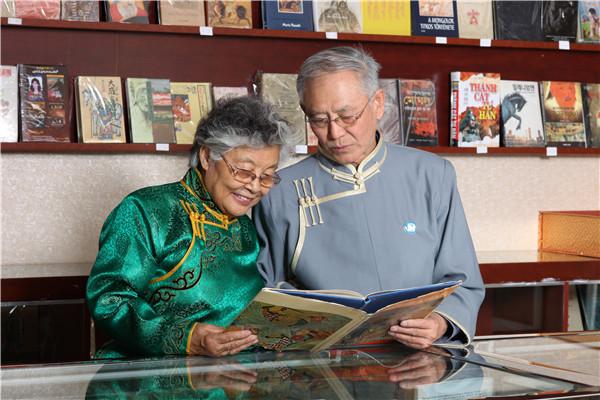
Baljinnyam and his wife, Zhang Jixia, read one of the books about Genghis Khan they've collected during their travels around the world over the past few decades. [Photo provided to China Daily]
For Baljinnyam, a man from the Mongolian ethnic group, rummaging through the world's bookshelves for the legends of his "emperor lord" is a pilgrimage.
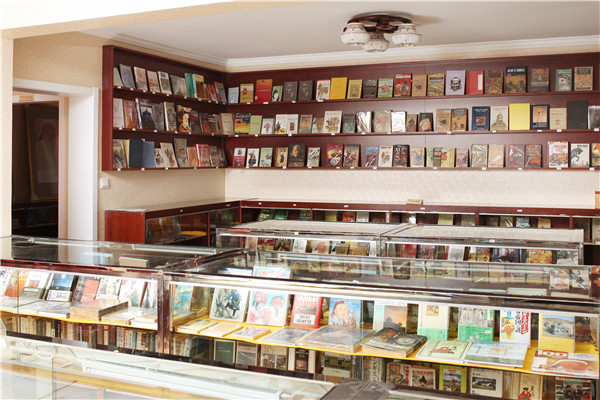
The 78-year-old, who lives in the Inner Mongolia autonomous region's capital, Hohhot, has collected about 12,000 copies of books in 58 languages, from home and abroad, related to Genghis Khan (1162-1227), the Mongol ruler who established a mighty Eurasian empire.
"Everyone in the Mongolian ethnic group admires Genghis Khan and treats him like a god," Baljinnyam says.
"But many of us don't know much about him as an individual. My impression of him was limited until I began to collect the written material."
In 1998, Baljinnyam retired from his job at a local newspaper. After that when he went to visit his younger daughter in Shanghai, he read a Washington Post story that quoted a public poll as saying Genghis Khan was "the most important man of the last millennium".
Many people in the West call the Mongol emperor a conqueror and an invader, so Baljinnyam says he was surprised to read such a "positive comment" in the Post.
"That inspired me to have a complete view of Genghis Khan."
Genghis Khan goes global
Baljinnyam's collection includes 12,000 copies of books in 58 languages. [Photo provided to China Daily]
He and his wife, Zhang Jixia, an ethnic Han, have traveled to more than 40 countries, starting from Japan, where their eldest daughter used to live.
They often gave popular tourist destinations a miss, instead focusing on local bookstores, libraries and flea markets for references about Genghis Khan.
"You cannot imagine how excited we were when we found a Bengali version of Genghis Khan's biography at an old book market in Bangladesh after days of looking around in vain," he recalls of their trip to Dhaka in 2012.
They were also surprised to find four different kinds of books on Genghis Khan in a small bookstore in Cape Town, South Africa, in 2013.
But not everywhere gave Baljinnyam what he was looking for.
He searched for such books in Cuba during one of his trips, but returned to China empty-handed. He later found out that Cuba, too, had books on Genghis Khan.
A son-in-law of Baljinnyam from Pakistan helped him get more than 100 such books from the Arab world.
Genghis Khan goes global
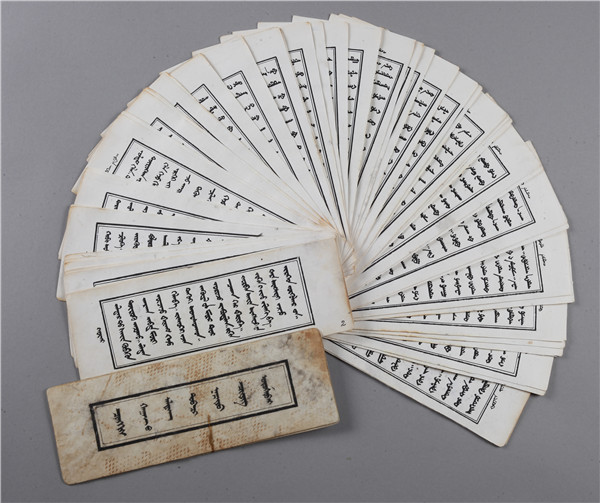
Publications about Genghis Khan and the history of Mongols written in Mongolian. [Photo provided to China Daily]
"Genghis Khan has become a cultural phenomenon across the globe," he says. "The books I've collected show that many overseas scholars have abandoned stereotypes in recent years and have gradually come to consider him an early advocate of globalization, which echoes with modern times."
In 2003, Baljinnyam published his first book, Genghis Khan in the Eyes of the World's Famous Figures, to summarize different opinions on the ruler. But he says it is more important to have original viewpoints rather than just echoing other people's thoughts.
He has published 12 books so far, and several are on his own explanation of The Secret History of the Mongols, which was written for Mongol royal families after Genghis Khan's death and is generally regarded as the most significant native Mongolian record of the emperor's life.
In 2013, he opened a private museum in Hohhot to exhibit his collection.
Baljinnyam says both his daughters are busy running their own businesses, and have little time for this.
But he acknowledges his daughters' focus on their careers helped to sponsor his travels abroad.
He has reached an agreement to move most of his collection to the new Genghis Khan Literature Museum.
Genghis Khan goes global
Publications about Genghis Khan and the history of Mongols written in Mongolian. [Photo provided to China Daily]
The 2,000-square-meter museum in Xilinhot-another city in Inner Mongolia, some 600 kilometers from Hohhot-is open to the public from 8 am to 9 pm daily.
"I have to get more people involved," Baljinnyam says of his endeavor.
According to Gao Mingrui, director of the museum, more books on the subject have been donated or bought as exhibits other than Baljinnyam's own collection.
More than 16,000 copies on Genghis Khan are now housed in the museum, which has attracted 37,000 visitors since its opening in June.
"We will begin research on the books, and are considering some of them as applicants for the national list of precious ancient books," Gao says.
The oldest book in the museum was published in 1573 during the Ming Dynasty (1368-1644).
Gao also says they are planning to hold a special exhibition on Genghis Khan in Taiwan in the future.


Monday, 5 December 2016

The ancient Asian treasures of two Americans in Paris


Visual arts: The ancient treasures of two Americans in Paris


SHAREADJUSTCOMMENTPRINT
Montreal has an exhibition of ancient jade, porcelain, fabrics and sculpture that is a world premiere, thanks to a curator who has created exhibitions for the Pointe-À-Callière museum. 
Jean-Paul Desroches, along with museum director Francine Lelièvre, discovered a collection of 5,000 works of Asian art accumulated over half a century by an American couple who have lived in Paris since 1966.
About 450 pieces — the best in the collection, according to Filippo Salviati, a lecturer in Chinese and Korean Art at the University of Rome — are in the exhibition From the Lands of Asia: The Sam and Myrna Myers Collection.
The exhibition is also a testament to how “old school collectors” follow their passions over many years, buying art they love and learning about what they had through study and consultation with scholars and dealers.
“The Myers were discreet collectors,” said Saliviati, who organized an exhibition of the couple’s jade collection in 2000. “No dealers or museum people knew the extent of their collection. ”


Prime minister’s coat (Gyu-lu che), a 17th century Tibetan tapestry. Assembled from different pieces of Chinese fabric, this garment was worn during important ceremonies. According to tradition, it represented the clothing worn by the ancient Tibetan kings who ruled Northwest China under the Xia dynasty (1032–1227). THIERRY OLLIVIER /  SAM AND MYRNA MYERS COLLECTION

The Myers were interested in Greek and Roman antiquity, but soon found themselves drawn to the jades, porcelains and silks of East Asia.
The collection of jade, which Salviati described in an interview as one of the three best private collections in the world, includes ceremonial weapons from Neolithic times — as early as 3300 BCE. The Chinese ascribed magical properties to jade, and dragons made of the material were intermediaries between heaven and earth.


A painted wood Noh actor, from Japan's Momoyama period (1573–1603).
A painted wood Noh actor, from Japan’s Momoyama period (1573–1603).THIERRY OLLIVIER/  SAM AND MYRNA MYERS COLLECTION

Part of the exhibition focuses on Buddhism, and the Myers’ collection starts with 4th-century stone figures from its origins in Northern India, and continues with objects of wood and bronze from China, Tibet, Korea and Japan. There is a marble lion — whose roar could awaken the world to the Buddha’s teaching — from China’s Tang dynasty (618-907) and a life-size painted wood Bodhisattva about 900 years old.
Another section of the exhibition is devoted to costumes from the 16thto the 19th centuries, a basis for the Myers’ education about the customs of societies throughout Asia. Silk fabrics reflected the wearer’s wealth and social status in China, and the colour and decoration changed from dynasty to dynasty. There are kimonos from Japan, samurai tunics that fit over armour, and the flamboyantly colourful garments of Uzbek traders.
There is also a large collection tracing the development of porcelain over 500 years, much of it recovered from shipwrecks. Some of the pieces were underwater for centuries, yet have retained their lustre.
Sam Myers recalled in an interview being frustrated by the breadth of the subject: “What makes this porcelain an object of the 17th century rather than the 19th?


A polychromed wood sculpture of Bodhisattva from China's Song dynasty, circa 1125. This divinity is associated with compassion and mercy. Artists from this time were expressing the body's sensuality while at the same time renouncing worldly things.
A polychromed wood sculpture of Bodhisattva from China’s Song dynasty, circa 1125. This divinity is associated with compassion and mercy. Artists from this time were expressing the body’s sensuality while at the same time renouncing worldly things. THIERRY OLLIVIER /  SAM AND MYRNA MYERS COLLECTION

“It took two years to learn the difference between blue and white porcelain,” he said. “Then you go beyond that, to the 12th to 15thcenturies. It’s a continual learning process, the experience of which is what makes collecting enjoyable.”
After they purchased their first pieces, Myrna Myers went to the École du Louvre as a student, where she met Desroches, curator of this exhibition.
“After they bought, they learned about it,” Salviati said. “They had the eyes of collectors; they could recognize quality and then they refined their knowledge.
“Shopping is the easy way to buy,” he said. “You just need money. The Myers had limited means and when the price was too high, they just walked away.”
The Myers sought advice from scholars as they continued to collect, Salviati said. “Old-school collectors cultivated relationships with scholars and dealers. This is the first time they have shared their passion with a much larger audience.”
Salviati noted that many museum shows serve to generate interest for a future auction: “Not this show. The Myers live with their art.”
“We can appreciate the beauty of much art, but we didn’t buy anything we didn’t want to live with,” Sam Myers said. “That’s true of everything we acquired.”
Myers said the movers were in his house for two weeks packing objects.


A porcelain kendi in the form of a phoenix, 16th century China. This phoenix kendi is especially remarkable because it is a rare combination of function and mystery, a kind of hybrid beast for which China has been known since Antiquity.
A porcelain kendi in the form of a phoenix, 16th century China. This phoenix kendi is especially remarkable because it is a rare combination of function and mystery, a kind of hybrid beast for which China has been known since Antiquity. THIERRY OLLIVIER /  SAM AND MYRNA MYERS COLLECTION

“I saw the empty spaces and felt bad, so the exhibition will travel no more than two years,” he said. “I am a lawyer, but I have one law book on my bookshelves. The rest is about art, and the row of porcelain objects on the top shelf is no longer there.”
When you search for quality, the value will rise over 50 years, not five months, Salviati said. The Myers acquired objects that would cost millions today. 
“Acquiring an object always begins with our reaction to it,” Sam Myers said. “You feel the mystery, the beauty and the power in the piece.”
From the Lands of Asia: The Sam and Myrna Myers Collection continues to March 19, 2017 at Pointe-à-Callière, the Montreal Archeology and History Complex, 350 Place Royale. More information: pacmusee.qc.ca.

Thursday, 1 December 2016

Susan Whitfield Lecture: “Beyond Scrolls and Codices: Manuscript Formats on the Eastern Silk Road”

This Mellon Sawyer seminar is an interdisciplinary collaboration dedicated to mapping cultural exchanges across Eurasia from roughly 400-1450 CE, by focusing on the development, distribution and sharing of manuscript technologies.

Schedule of Public Lectures

Mellon Sawyer lectures are open to the public and will take place on the University of Iowa campus, Iowa City. Note that UCC refers to University Capitol Center and IMU refers to the Iowa Memorial Union.


Friday 2 December 2016 – 8:30am-4:45pm / 166 IMU Iowa Theater (Iowa Memorial Union)
William Johnson
Classical Studies, Duke University
“From Bookroll to Codex”
This talk will, first, offer an overview of the literary bookroll in ancient Greece and Rome, with deep dives into how technical details of form interact with production (writers, scribes) and consumption (readers, society). That overview will be foundational for the second part of the lecture, in which we will turn to the much discussed issue of the transition from bookroll to codex. There too an overview will be offered— with, however, a focus not so much on the question of “why?” but on what this transition might  say about instability and changes in the larger cultural matrix, and, more specifically, how this shift in the idea of the book might relate to changing attitudes towards authorship and writing practices on the one hand, and use and reading practices on the other.

Susan Whitfield
Director, International Dunhuang Project, British Library
“Beyond Scrolls and Codices: Manuscript Formats on the Eastern Silk Road”
Manuscripts in the tens of thousand have been excavated from first millennium AD sites of the eastern Silk Road. On various local media — birchbark, wood, palm leaf, silk, paper and others — and in over twenty languages and scripts, they reflect the diversity of the cultures in this period and place. This paper introduces the range of manuscript formats, materials, languages and scripts, and discuss their diffusion along the Silk Road. It also considers the lack of diffusion of some unique formats used in specific contexts and only found for relatively brief periods.

Marina Rustow
Khedouri A. Zilkha Professor of Jewish Civilization in the Near East, Princeton University
“Fatimid State Documents, Serial Recyclers and the Cairo Geniza”Among the many unexpected finds the Cairo Geniza has yielded are hundreds—possibly thousands—of medieval documents of state in Arabic script. Among these are decrees, rescripts, petitions, tax receipts and fiscal accounts from period of the Fatimid caliphs in Egypt and Syria (969–1171). Most of these Fatimid state documents were reused for Hebrew-script texts, hence their survival in the discarded manuscript chamber of a medieval Egyptian synagogue. In most cases, we can only speculate on the path they took from the government offices where they were produced to the synagogue where they were preserved. Nonetheless—and perhaps paradoxically given that they did not survive in an archive—they offer glimpses of the complexity and sophistication of medieval Middle Eastern techniques of archiving and deacquisition, as well as informal scribal habits in one of the largest and best documented Jewish communities of the Middle Ages.

Myriam Krutzsch
Aegyptisches Museum, Berlin
“Papyrus as an Ancient Writing Material: Its Structure, Production and Classification”
This lecture touches on the history of  ancient Egyptian papyrus, its production and use as a writing material. The structure of the papyrus sheet is explained, from the source materials [fibers, leaf shapes] to the making the papyrus roll. Special emphasis is focused on the diverse typology and classification of sheet joins, the places where individual papyrus sheets are connected to form a roll or scroll. Knowledge of these typologies not only gives us insight into ancient production technologies, but also can be used as a valuable tool for determining previously uncertain provenance and dating.

Mark Barnard
Senior Conservator Emeritus, British Library
“The Dunhuang Diamond Sutra of AD 868: A Conservation Approach That Goes Back to the Original”The Diamond Sutra of AD 868 is the world’s earliest dated printed ‘book’. This paper scroll was one of 6,000 items that came from Dunhuang’s cave 17 during Marc Aurel Stein’s 2nd expedition of 1911 to Western China. Brought back to the British Museum, London in 1914 its importance was soon recognized as it was put on display in 1914 along with other treasures from Dunhuang. From early images, its condition looked poor, with heavy staining and paper loss. It had also been repaired in antiquity. We believe that it had been restored up to three times before by 1972 when it was transferred to the New British Library. This presentation will chart a 20-year conservation project that involved ground-breaking research and a fundamental reassessment of traditional East Asian scroll mounting, and developed a new approach to the conversation about and preservation of the Dunhuang archive.