Tuesday, 29 January 2019

National treasures returned: Kizil Grotto murals

CGTN By Xu Tingting and Zhang Wanbao   2018-07-20
From July 14 to September 2 two exhibitions revolving around a singular theme, the Buddhist grottoes of Kizil, Xinjiang are presented at M WOODS in Beijing. 
A program supported by the China National Arts Fund, Collected Reproductions of the Kizil Grottoes and Overseas Murals represents a culmination of twenty years of research led by Kucha Research Institute of Xinjiang. 
The other exhibition shares three murals originating from the sacred caves of Kizil. The two exhibitions explore the beauty and originality of Kizil Grottoes that located at the ancient Silk Road. 
The Kizil Grottoes
The Kizil Grottoes are located on the northern bank of the Muzal river, in Baicheng County, Xinjiang Uygur Autonomous Region. 
Known in China as one of the "Four Great Grottes" - a list including the Dunhuang Mogao Grottoes, the Yungang Grottoes, and the Longmen Grottoes, the Kizil Grottoes were registered as a UNESCO World Heritage Site in 2014. 
In the late nineteenth and early twentieth centuries, archaeological expeditions to the historical Western Regions of China attracted many foreign explorers. These expeditions removed the different number of murals and painted status from Kizil Grottoes. 
Currently, the majority of the overseas Kizil murals are in Germany, while the rest are scattered across institutions in Russia, France, Hungary, the United States, Japan and South Korea. Others belong to undocumented private collections or may be lost entirely. 

Replicas of the Kizil Grottoes and Overseas Murals 
By collaborating with other international institutions in possession of murals from the Kizil Grottoes, the Kucha Research Institute has led an initiative to digitize every piece and bring these into a central collection in Xinjiang.
The Kucha Research Institute of Xinjiang started research on the overseas collection of Kizil Grotto Murals in 1998. 
After twenty years of efforts, the Institute has documented 465 pieces from different museums in the world. Parts of these digital images are showing at M WOODS this summer. 
With the help of 3D digital scanning, researchers at the Institute have measured the murals and compared them with the pieces left in the original grottoes. Now many of their original locations have been identified. 
The exhibition not only presents images of the overseas murals but also replicas of two caves belonging to the Kizil Grottoes. 
The Return of National Treasures 
As the only public institution in the Chinese mainland to own original fragments from Kizil Grottoes, M WOODS presents these three masterpieces in this exhibition. 
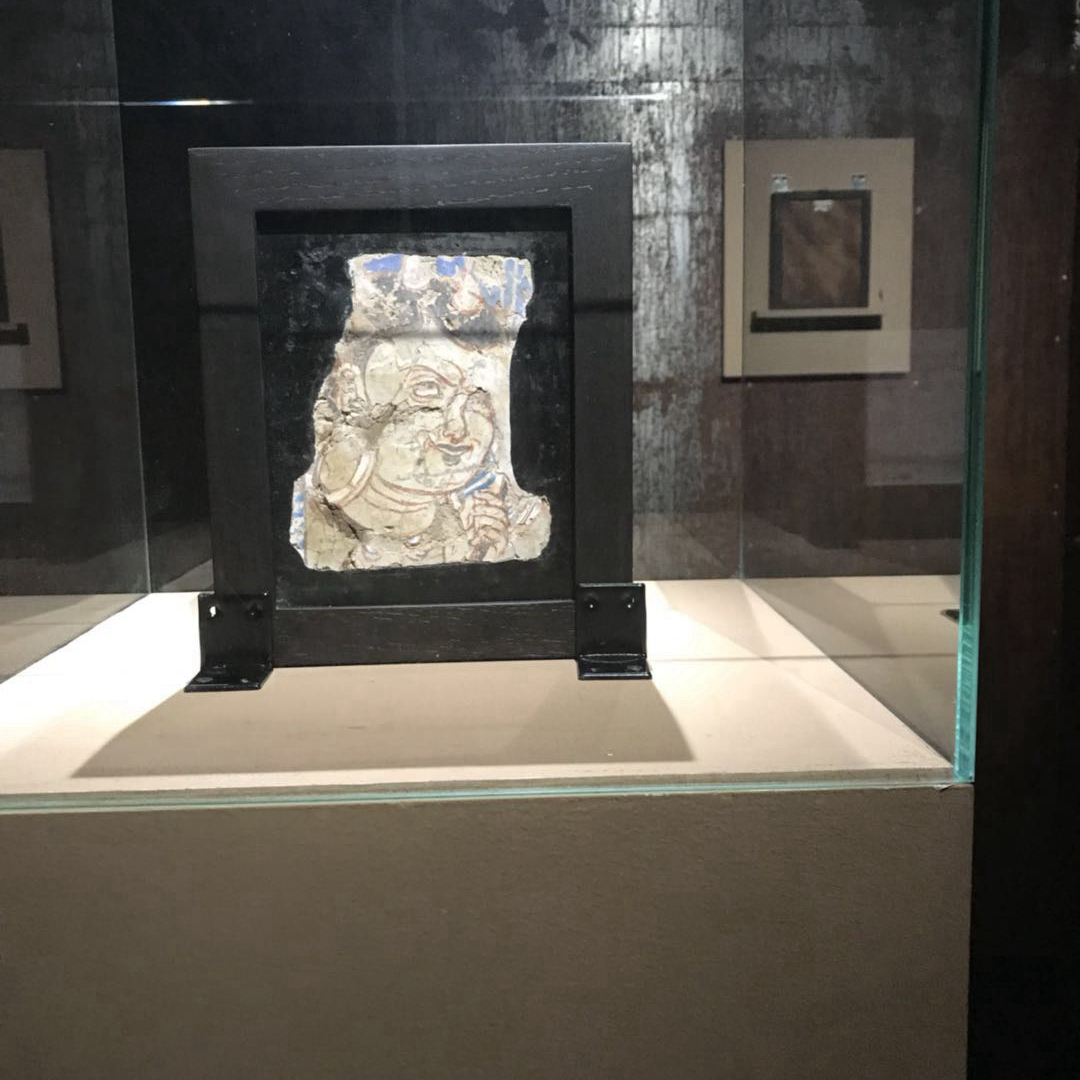
One of the three masterpieces: Mystery Figure with Five Hair Knots. /CGTN Photo
The returned three masterpieces are Head of a Deity, Mystery Figure with Five Hair Knots and also Millennium Smile, which has significant meaning in Kizil Grotto research and cultural transmission. 
One of the extraordinary pieces is Millennium Smile that depicts a royal family member from Ancient Kucha. Like Mona Lisa, a coy smile brightens her face, an enigmatic glance that has captivated viewers for over a millennium. 
Details are shown on the mural point to a talented painter with ample knowledge of Buddhism. This marvelous piece still has the power to move people's hearts. 
The original grottoes were sites for self-cultivation for monks. 
"The creation and collection of art is yet another self-cultivation, and art is timeless. Collecting fragments from the Kizil Grottoes is also a kind of self-cultivation." Founder of M WOODS Lei Wanwan said. 
(Video Credit: Zhang Wanbao; Music Credit: Sun Dawei)

The Politics of Reconstructing Ancient Grotto Murals from Xinjiang in China Today


Why did Beijing’s M WOODS museum recently mount two simultaneous exhibitions focusing on the ancient Buddhist site of Kizil, Xinjiang Province?


M WOODS, a private contemporary art museum based in Beijing’s 798 Art Zone, recently mounted two simultaneous exhibitions focusing on the ancient Buddhist site of Kizil, Xinjiang Province. Carved from the Baicheng County hillside between the 3rd and 8th centuries, the Kizil Buddhist grottoes are China’s earliest, large-scale Buddhist cave complex, and are regularly listed as one of China’s four most significant Buddhist art sites.
‘Collected Reproductions of the Kizil Grottoes and Overseas Murals’ was produced with the Kucha Research Institute of Xinjiang, who worked for 20 years tracing the whereabouts of countless mural fragments removed by foreign archaeologists a century ago and subsequently dispersed to public and private collections around the world. The institute obtained high-quality photographs of the mural fragments and found their original placement in the Buddhist grottoes. A selection of these were then mapped onto the walls of the ground floor exhibition hall at M WOODS, recreating the murals to scale, and a 1:1 replica of grotto no. 38 was constructed within this volume, giving audiences an approximate experience of what the Buddhist caves were like in situ.


On the first floor was its companion show ‘Monks and Artists’, consisting of three original mural fragments from the Kizil grottoes, acquired by M WOODS founders Lin Han and Wanwan Lei, and repatriated to China. Accompanying these original fragments are stone carvings from other civilizations along the Silk Road, and Kader Attia’s Open Your Eyes, part of his project shown originally at dOCUMENTA (13). However, M WOODS is the first and only institution in China to own original fragments from the caves. This begs the question: why did a contemporary art institution decide to devote its energies to a show of ancient religious art?
M WOODS founder Lin Han has repeatedly claimed that the Kizil exhibition is as contemporary as the museum’s show of Paul McCarthy videos, mounted this past spring. Contemporary, in this context, is synonymous with ‘relevant’ – and the Kizil murals reveal much about modern China. Although Kizil is well within China’s current borders, most of its murals show scarcely any Chinese influence at all, but rather Gandharan, Indian and Persian characteristics, demonstrating the incredible cultural fluidity of the Silk Road. Today, the Silk Road is being used as a blueprint for China’s massive international trade scheme, the Belt and Road Initiative, while Xinjiang, home to Kizil and much of the Silk Road, is undergoing a period of extreme religious and political tension, as the Chinese government has exerted tight control over the Uyghurs, the Muslim minority population there.


Ever since the Han Dynasty (206 BCE – 220 CE), China has attached enormous strategic importance to its Western Regions, consisting of the Hexi Corridor in Gansu Province and Xinjiang, as a vital trade lifeline. Whether the area now called Xinjiang was part of the Chinese empire has always been a barometer of China’s political fortunes. The Kizil murals were painted during a Chinese power vacuum, after the collapse of the Han Dynasty and before the Tang Dynasty reasserted its influence in the region. It is precisely this lack of Chinese cultural influence that makes them so unique. Their stunning colours derive from minerals such as lapis lazuli from Afghanistan, and their inventive compositions are untethered from strict Buddhist conventions, revealing a wide range of Asian sources. The artists who created the murals were far away from their own territories, and were able to take inspiration from each other.
Equally important, however, is seeing the negative historical and cultural space of this exhibition. In 1906, many of them were cut from cave walls by Albert von Le Coq, a German archaeologist, and brought to the Museum for Asian Art in Berlin; other explorers followed, and murals appeared in Russia, Japan and the US. The removal and dispersal of the murals runs reverse to the globalization that once brought wealth to Xinjiang. Foreign powers found little resistance when they plundered Chinese cultural heritage during the turbulent years of the early 20th century. The feeling of loss this history brings is compounded by the reconstructed grotto at M WOODS, marked by the scars of excavation. The sculpture of a Buddha figure is missing from its niche, leaving behind a white shadow.


The contradictions of the Kizil murals makes their exhibition at M WOODS and the 20 years of study conducted by the Kucha Research Institute of Xinjiang all the more essential. Xinjiang itself is a place of contradiction and conflict, and understanding its present requires a deeper knowledge of its past.
‘Monks and Artists’ and ‘Collected Reproductions of the Kizil Grottoes and Overseas Murals’ ran at M WOODS, Beijing, from 14 July – 2 September 2, 2018.

Colin Siyuan Chinnery is an artist and curator based in Beijing, China. He is a contributing editor of frieze.

Monday, 28 January 2019

One of best and definitely funniest archaeological lectures ever given


I long hesitated if I would include this lecture by Irving Finkel in my blog as it has no obvious links to the Silk Road or other related areas, but this lecture definitely has a number of qualities which makes it outstanding in its field and so witty, funny, interesting and informative that anyone interested in history and archaeology should have it seen at least once in his lifetime!

Most interesting, it has a link with the current exhibition in the British Museum:" I am Ashurbanipal King of the World, King of Assyria" (which is still on till 24 February 2019!!)

For your information Irving Leonard Finkel (born 1951 is a British philologist and Assyriologist. He is currently the Assistant Keeper of Ancient Mesopotamian script, languages and cultures in the Department of the Middle East in the British Museum, where he specialises in cuneiform inscriptions on tablets of clay from ancient Mesopotamia.

In 2014, Finkel's discovery of a cuneiform tablet that contained a Flood narrative similar to that of the story of Noah's Ark, described in his book The Ark Before Noah, was widely reported in the news media. The ark described in the tablet was circular, essentially a very large coracle or kuphar and made of rope on a wooden frame. The tablet included sufficient details of its dimensions and construction to enable a copy of the ark to be made at about 1/3 scale and successfully floated, as documented in a 2014 TV documentary.

Great journeys across the Pamir mountains

Editors: Huaiyu Chen and Xinjiang Rong

  • Hardcover: 250 pages
  • Publisher: BRILL; Lam edition (26 April 2018)
  • Language: English
  • ISBN-10: 9004362223

Drawing upon numerous manuscripts from China and Central Asia, the articles presented in this volume by leading scholars in the field examine a broad range of topics on the multi-lingual, multi-religious, and multi-ethnic communities along the Silk Road in the medieval period, and cover such topics as the social history of Kucha, book history in Dunhuang, the spread of Manichaeism, the political history of Turkic and Khotanese Kingdoms, and the travelogue of the Buddhist pilgrim Xuanzang. They demonstrate that Han Chinese, Khotanese, Sogdians, Tocharians, Tibetans, and Uyghurs have all contributed to constructing a sophisticated international network across Asia. 
Contributors are: Bi Bo, Chao-jung Ching, Jean Pierre Drège, Ogihara Hirotoshi, Xiaohe Ma, Nicholas Sims-Williams, Xinjiang Rong, Tokio Takata, Xiaofu Wang, Wenkan Xu, Yutaka Yoshida, Lishuang Zhu, Peter Zieme

Sunday, 27 January 2019

Archaeology and Conservation Along the Silk Road


Paperback – 12 Nov 2018


by Gabriela Krist (Editor), Liangren Zhang (Editor)

  • Paperback: 215 pages
  • Publisher: Bohlau Verlag (12 Nov. 2018)
  • Language: English
  • ISBN-10: 3205200446

Supported by Eurasia Pacific Uninet, the second international conference on 'Archaeology and Conservation along the Silk Road' was jointly organized by Nanjing University China and Institute of Conservation, University of Applied Arts Vienna and held in May 2016 in China. Silk Road showcases the trans-continental cultural movements between Europe and Asia and this event encouraged researchers to reflect on popular as well as otherwise under-represented topics. This volume includes selected papers from the conference and merges aspects of archaeology with conservation. Subjects vary from field drawings, unique local techniques, spread of diseases and epidemics to DNA studies assessing population migration and mixture. Next Silk Road conference is planned for 2018 to carry forward the initiative of learning and exchange of knowledge.

Barbarians at the Wall by John Man


by John Man

  • Hardcover: 320 pages
  • Publisher: Bantam Press (13 Jun. 2019)
  • Language: English
  • ISBN-10: 1787632059

The people of the first nomadic empire left no written records, but from 200 BC they dominated the heart of Asia for 400 years. They changed the world. The Mongols, today’s descendants of Genghis Khan, see them as ancestors. Their rise cemented Chinese unity and inspired the first Great Wall. Their heirs under Attila the Hun helped destroy the Roman Empire.

We don’t know what language they spoke, but they became known as Xiongnu, or Hunnu, a term passed down the centuries and across Eurasia, enduring today in shortened form as ‘Hun’. Outside Asia precious little is known of their rich history, but new evidence reframes our understanding of the indelible mark they left on a vast region stretching from Europe and sweeping right across Central Asia deep into China.

Based on meticulous research and new archaeological evidence, Barbarians at the Wall traces their epic story, and shows how the nomadic cultures of the steppes gave birth to a ‘barbarian empire’ with the wealth and power to threaten the civilised order of the ancient world.

John Man is a historian with a special interest in Asia and the nature of leadership. His books, published in over twenty languages, include bestselling biographies of Genghis Khan, Kublai Khan and Attila the Hun, as well as histories of the Great Wall of China, the Mongol Empire and the Amazons.


Ships of the Silk Road

Ships of the Silk Road 

Hardcover – 24 Jan 2019

India in the Persianate Age: 1000-1765


  • Print Length: 608 pages
  • Publisher: Penguin (4 July 2019)
  • Sold by: Amazon Media EU S.à r.l.
  • Language: English

The Indian subcontinent might seem a nearly complete and self-contained world. Protected by vast mountains and seas, it created its own religions, philosophies and social systems. And yet this ancient land and its varied societies experienced prolonged and intense interaction with the peoples and cultures of East and Southeast Asia, Europe, Africa, and especially, Central Asia and the Iranian plateau between the eleventh and eighteenth centuries. 
Richard M. Eaton's wonderful new book tells this extraordinary story with relish and originality. His major theme is the rise of 'Persianate' culture - a many-faceted transregional world informed and stabilized by a canon of texts that circulated through ever-widening networks across much of Asia. Introduced to India in the eleventh century by dynasties based in eastern Afghanistan, this culture would become thoroughly indigenized by the time of the great Mughals in the sixteenth, seventeenth, and eighteenth centuries. This long-term process of cultural interaction and assimilation is reflected in language, literature, cuisine, attire, religion, styles of rulership and warfare, science, art, music, architecture, and more. 
The book brilliantly elaborates the complex encounter between India's Sanskrit culture ('the Lotus') - an equally rich and transregional complex that continued to flourish and grow throughout this period - and Persian culture ('the Lion'), which helped shape the Delhi Sultanate, the Mughal Empire, and a host of regional states.


Richard M. Eaton has over a long and varied career published a number of ground-breaking books on India before 1800, including major works on the social roles of Sufis, slavery, Indian biography, the growth of Muslim societies along Bengal's eastern frontiers, the social history of the Deccan, and the place of Islam in the sub-continent's history. The Lotus and the Lion draws on a lifetime of teaching and research. He is Professor of History at the University of Arizona.

A Thousand Years of the Persian Book: A Curator's Tour


The exhibition "A Thousand Years of the Persian Book" opened in March 2014 and ended in September 2014 in the Library of Congress in Washington. 
Hirad Dinavari gives a guided tour showcasing the most exquisite Persian manuscripts, lithographs, early imprints and modern printed works in the Library's collections. Hirad Dinavari is Iranian world reference specialist in the Library's African and Middle Eastern Division and a co-curator of the exhibition, "A Thousand Years of the Persian Book." For transcript and more information, visit http://www.loc.gov/today/cyberlc/feature_wdesc.php?rec=7179

From Oxus to Euphrates: Sasanian Empire Symposium


On the 7th of june 2017 in the Library of Congress in Washington several experts participated in an all-day symposium on the legacy of the ancient Persian Sasanian Empire (224-651 A.D.). 
The Sasanians ruled a large empire in Central and Western Asia, stretching from the Oxus River to the Euphrates and from the Hindukush to Eastern Arabia, for over 400 years (224-651 B.C.). 
Known as Iranshahr (the Domain of Iran), it was a powerful empire that engendered much of what came to be known as the Iranian culture in the medieval and modern periods. For transcript and more information, visit http://www.loc.gov/today/cyberlc/feature_wdesc.php?rec=7943

The Mongols by Timothy May

The Mongols 

(Past Imperfect) 

Paperback – 30 Mar 2019


  • Paperback: 128 pages
  • Publisher: Arc Humanities Press; New edition edition (30 Mar. 2019)
  • Language: English
  • ISBN-10: 1641890940

The Mongols emerged from obscurity to establish the largest contiguous empire in history. Although they are now no longer viewed as simply an unbridled force of destruction, it remains unclear as to how they succeeded in ruling a empire that stretched from the Sea of Japan to the Black Sea. This book investigates how the Mongol adopted and adapted different ruling strategies from previous Inner Asian empires as well as Chinese and Islamic Empires to rule an empire in which they were a distinct minority, and also investigates the processes by which this empire fragmented into an increasing number of states, many of which lasted into the seventeenth and eighteenth centuries.

Saturday, 26 January 2019

The oldest, dateable depiction of the Buddha in human form


From The British Museum: Curator's Corner Season 4 Episode 6


Curator Sushma Jansari reckons she's in charge of 'one of the most important objects in the entire British Museum' - and she's not wrong. The Bimaran Casket currently holds the record for the earliest dateable depiction of the Buddha in human form.

Wednesday, 9 January 2019

MFA Conservation: Guanyin, Bodhisattva of Compassion


“Guanyin, Bodhisattva of Compassion” (early 12th century) is the centerpiece of our Song Dynasty Gallery. Here, conservator Abigail Hykin shares discoveries made about the sculpture’s history during an 18-month restoration project, which involved UV imaging, x-radiography, radiocarbon dating and other techniques.


Published on Nov 10, 2016

Thursday, 15 November 2018

"Gandhara - Buddhism culture figure and form" exhibition in Matsudo Museum Japan


市制施行75周年・開館25周年記念特別展「ガンダーラ-仏教文化の姿と形-」のご案内


市制施行75周年・開館25周年記念特別展「ガンダーラ-仏教文化の姿と形-」

  • 期間
    2018年9月22日(土曜)から11月25日(日曜) 9時30分から17時(入館は16時30分まで)
    ※無料観覧日 11月3日(土曜・文化の日)、11月23日(金曜・勤労感謝の日)
  • 内容
    仏教美術のふるさとガンダーラ。仏像・彫刻をはじめとする美術品、シルクロードの交易品から、遙かなる仏教文化の世界をよみがえらせます。さらに、日本で華開く仏教文化の始まりについて、発掘された資料から探ってみます。
  • 会場
    松戸市立博物館 企画展示室  
  • 観覧料
    一般300円 高校・大学生150円 小中学生無料 (11月3日・23日は観覧無料デーです)
    常設展共通券 一般500円 高校・大学生250円

関連イベント・講演会のご案内


Reading Sima Qian from Han to Song: The Father of History in Pre-Modern China


Hardcover – 25 Oct 2018


  • Hardcover: 420 pages
  • Publisher: BRILL (25 Oct. 2018)
  • Language: English
  • ISBN-10: 9004372938

IFather of Chinese History, Esther Klein explores the life and work of the great Han dynasty historian Sima Qian as seen by readers from the Han to the Song dynasties. Today Sima Qian is viewed as both a tragic hero and a literary genius. Premodern responses to him were more equivocal: the complex personal emotions he expressed prompted readers to worry about whether his work as a historian was morally or politically acceptable. Klein demonstrates how controversies over the value and meaning of Sima Qian’s work are intimately bound up with larger questions: How should history be written? What role does individual experience and self-expression play within that process? By what standards can the historian’s choices be judged?

Table of Contents:

Introduction
  Structure of the Book
  Historians, Lineages, and Confucian Scholars: Good Problems in Translation

Part 1: Contextualization

1 A Record of Doubts and Difficulties
  Overview
  Sources and Attribution
  Who is the Honorable Senior Historian?
  Autobiography and Authenticity
  Chu Shaosun: A Third Author?
  Extreme Textual Damage and Loss
  A Conclusion Leading Onward
2 Sima Qian’s Place in the Textual World
  Aspects of Self-Description
  Early Views of the Shiji
  The New Historical Tradition
  Sima Qian in the Realm of Literary Prose

Part 2: Autobiographical Readings

3 Subtle Writing and Piercing Satire
  Sources for Sima Qian’s Biography
  Early Autobiographical Readings
  Six Dynasties Developments
  Autobiographical Readings in the Tang
4  Creating and Critiquing a Sima Qian Romance
  A Reversal of Verdicts
  Su Shi’s Gentlemen and the Shiji
  Blaming Emperor Wu
  Backlash: Three Southern Song Critiques

Part 3: Reading Truth in the Shiji

5 A “True Record”
  On the Term “True Record”
  Issues of Historical Truth in the Shiji: Early Views
  Wang Chong and “Real Events” in the Shiji
  Against “Defamatory Text” Readings
  Dangers of “Straight Writing” in the Tang
  Song Dynasty Developments
6 Finding Truths in the Shiji’s Form
  The Overall Form of the Shiji
  Intention and Invention in the Shiji’s Five Sections

Conclusion

Esther Sunkyung Klein, Ph.D. (2010), Princeton University, is a lecturer in Chinese Studies at the University of Sydney. She has also published on authorship and dating of the Zhuangzi, Wang Chongs epistemology, and ancient Chinese cosmogonies.