Saturday, 4 May 2019

Silk Road Exhibition April 11th- July 14th National Museum of China- Beijing

China stages exhibition to show cultural exchanges along Silk Road

By Qu Song (People's Daily)    16:47, April 16, 2019
An exhibition of treasures from national museums of 12 countries along the Silk Road was staged at the National Museum of China in Beijing on April 11.
Featuring 234 items of relics, the exhibition displays the stories of cultural exchanges along the land and maritime Silk Roads.
The exhibition aims to provide an opportunity for people across the world to share the diversity of human civilization, said Wang Chunfa, curator of the National Museum of China.
By displaying the fusion of arts and skills of the countries along the Belt and Road, the exhibition promotes Silk Road spirit and reveals the future trend of the world – the building of a community of shared future for mankind, Wang remarked.
Visitors watch cultural relics from Russia at the exhibition. (Photo/People’s Daily Online)
The exhibition is divided into two sections: the land Silk Road and maritime Silk Road, introducing cultural relics from 13 countries including China, Cambodia, Japan, Kazakhstan, Latvia, Mongolia, Oman, Poland, Republic of Korea, Romania, Russia, Slovenia, and Tajikistan.
The relics include both national historic treasures and exotic items that carry the history of trade and cultural exchanges along the ancient Silk Road.
According to the exhibition, China started exchanges with the western Eurasia as early as in the prehistoric age. The artifacts of Turbino culture that originated from Russia are reliable evidences. They have been found multiple times in northwest China’s Gansu and Qianghai provinces as well as central China’s Henan province. The barbed spear of Turbino culture collected by the National Museum of China and the leaf-like spear sent from Russia resembled with each other.
Photo shows a barbed spear, artifact of Turbino culture, collected by the National Museum of China. (Photo from the official website of the National Museum of China)
Photo shows a leaf-like spear sent from Russia at the exhibition. (Photo from the official website of the National Museum of China)
The eastern section of the Silk Road was unclogged by Emperor Wu of Western Han Dynasty (206 BC-9 AD) in the late 2nd century BC, and the channel was later joined by the Roman Empire from the western end.
During a long period of history, the Silk Road served as a relatively safe and effective channel for trade and cultural exchanges between the east and the west. Ever since, the communication and exchanges between the two parts of the world kept on.
A Chinese-style porcelain plate made by Iran now collected by the National Museum of Poland is a record of the trade and cultural exchanges along the Silk Road.
Such record can also be reflected by a Chinese cup manufactured in the Tang Dynasty (618-907) unearthed in Latvia which, according to experts, may have traveled all the way through Central Asia,Bulgaria, and Scandinavia through trade, and ended up onto the shore of the Baltic Sea.
Photo shows an Iran-made Chinese-style porcelain plate collected by the National Museum of Poland. It is a record of the trade and cultural exchanges along the Silk Road. (Photo from the official website of the National Museum of China)
Photo shows the only Chinese cultural relic unearthed in Latvia – a single-handle cup made in Tang Dynasty (681-907) (Photo from the official website of the National Museum of China)
In 1913, Edouard Chavannes, a renowned French sinology, proposed the concept of maritime Silk Road for the first time. The maritime trade channel is also called maritime porcelain road and maritime spice road as porcelain and spice were the major goods traded along the route.
A plaque carved with the language of Hadhramaut collected by the National Museum of Oman recorded the booming frankincense trade of the kingdom of Ḥaḍramawt at that time.
Photo shows a plaque carved with the language of Hadhramaut collected by the National Museum of Oman. (Photo from the official website of the National Museum of China)
The history of the Silk Road still has a profound influence even today, said the National Museum of Korea in the foreword of the exhibition.
All regions covered by the network could eliminate misunderstanding, live in harmony and achieve common prosperity through communication and cooperation, and the Silk Road is a core concept that helps the Republic of Korea, China and Japan, all situating at the eastern end of the Silk Road, understand the cultural traditions of each other, foreword of the exhibition.
Photo shows a Tang tri-color glazed pottery collected by the National Museum of Korea. (Photo/chnmuseum.cn)
In Nov. 2018, the National Museum of China hosted the First Conference of the International Alliance of Museums of the Silk Road, and signed a cooperation agreement under the proposal of Chinese President Xi Jinping, said Wang.
The exhibition, as a concrete step to implement the agreement, will last until July 14, 2019, Wang added. 

Monday, 1 April 2019

Nepal: The Great Plunder


Investigating how antiquities stolen from the Himalayas end up in museums and private collections around the world.


On the global art market, Himalayan statues of religious deities fetch millions of dollars. But to the Nepalese, they are living gods who have been stolen from their communities.

In this exclusive Al Jazeera investigation, 101 East senior presenter and reporter Steve Chao takes viewers on a breathtaking journey across the Himalayas, to reveal how the art world's hunger for ancient artefacts is destroying a centuries-old culture.
As he seeks to expose the international black market in religious treasures, Chao travels across Nepal from its capital Kathmandu to remote and ancient Buddhist temples in Mustang.
Since the 1980s, authorities estimate thieves have plundered tens of thousands of Nepalese antiquities. About 80 percent of the countries religious artefacts have been stolen and sold into the $8bn-a-year illegal black market in art.
But as 101 East discovers, the Nepalese are now taking a stand and demanding a stop to the plunder of their greatest treasures.
Local guide Tashi Bista says the thefts are hurting communities and their ability to worship.
"When thieves look at our centuries-old statues and deities, they see millions of dollars of profit. To us, they are living, breathing gods," he says. "The thieves are destroying an ancient way of life for us."
Posing as a prospective buyer, Steve Chao goes undercover to meet black market art dealers and learn how they bribe officials to falsify papers so that they can export antiques from Nepal.
After showing his undercover filming to Nepalese police, Chao helps authorities conduct a sting on some of the country's most prominent antique dealers, leading to their arrests.

Set against a stunning natural backdrop, this is the story of how treasures from an ancient time are being stolen and sold to the highest bidder, leaving a culture in peril.

Friday, 29 March 2019

The Obsidian Polar Trade Route

Proof of a 2,000 kilometre polar trade route in volcanic glass dating back at least 8,000 years

By The Siberian Times reporter
07 March 2019
The conclusion is that ancient people used dog sleds to cover these remarkable distances 'at the ends of the earth'. Picture: Alexander Kutsky
But how? 
The discovery is breathtaking. 
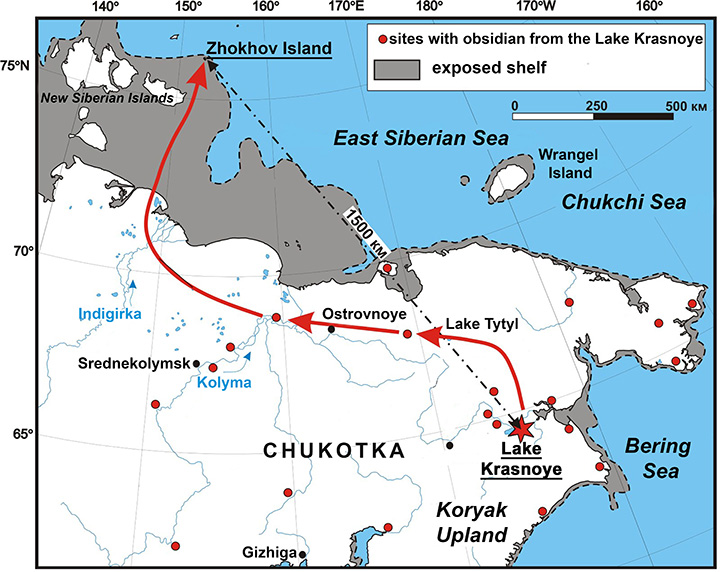
As the crow flies this is a journey of some 1,500 km but as scientist Yaroslav Kuzmin told us ‘the actual distance that obsidian ‘walked’ is at least 2,000 km. 
‘This is not just long-range but ultra-long-range transport of raw materials.’
This Great Ice Road was in operation four times as long ago as the famous Silk Road in Central Asia, and it was twice as old as the Egyptian pyramids. 
Map
The distance between the exchange points is about 700 km. Picture: Elena Pavlova
The conclusion is that ancient people used dog sleds to cover these remarkable distances 'at the ends of the earth'.
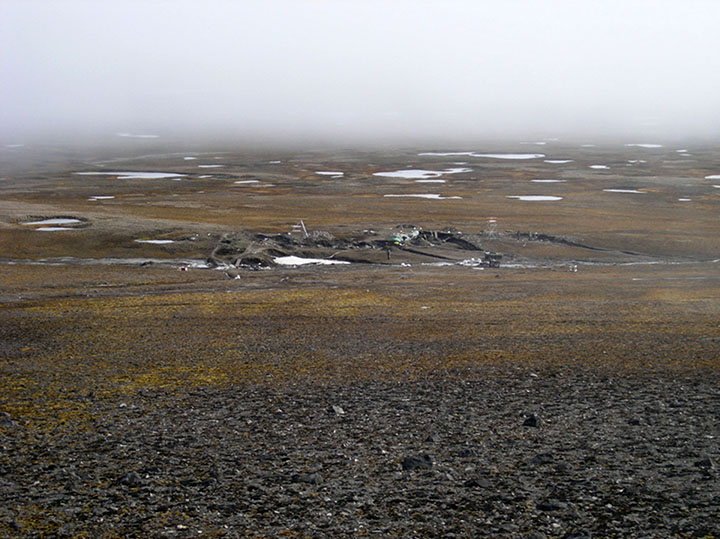
At the time Zhokhov Island - now part of the De Long Islands in the New Siberian archipelago - was connected to the Siberian mainland, and the climate was milder than today.
Yet the distance is still stunning.
Obsidian was used by ancient people at a famous site on Zhokhov for tools: the black or green volcanic glass, an extrusive igneous rock, was a material of choice. 
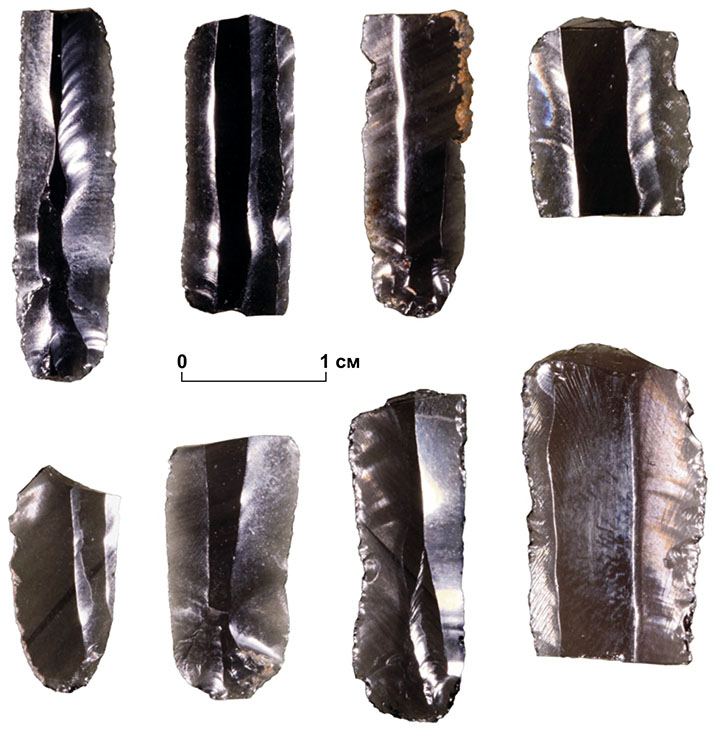
Obsidian implements from Zhokhov site
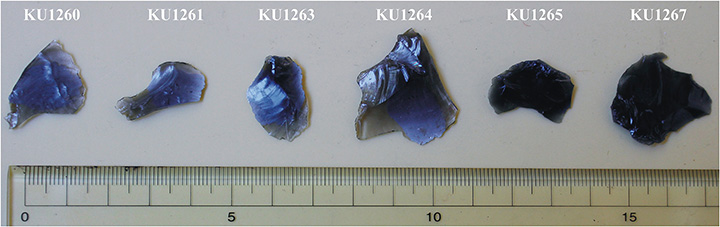
14 obsidian implements from the Zhokhov site were analysed to identify their provenance. Picture: Elena Pavlova
Some 79 tools have been found at the site on the island. 
A scientific article in Antiquity reveals how a random 14 of these were analysed to identify their provenance. 
They were examined using non-destructive X-ray fluorescence (XRF) to compare the obsidian with known sources in northeastern Siberia.
The geochemistry of the Zhokhov artefacts shows with 90 per cent confidence that it came from a source at Cape Medvezhiy on Lake Krasnoe in Chukotka.
‘The archaeological data from Zhokhov therefore indicate a super-long-distance Mesolithic exchange network,’ conclude the international team of researchers in the Antiquity paper.
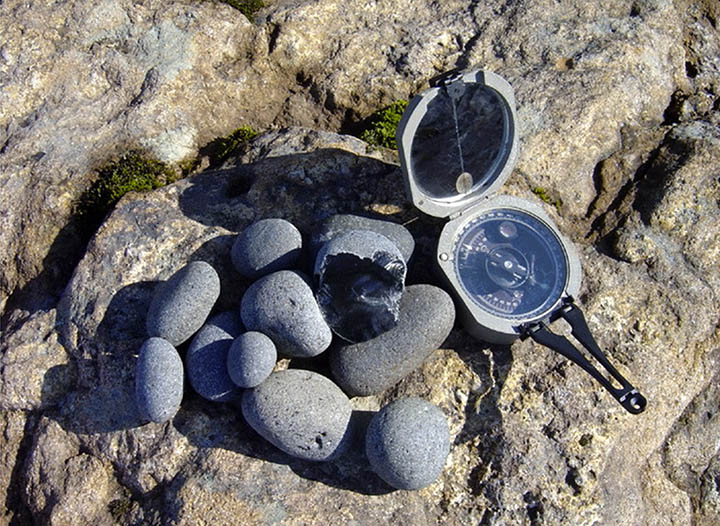
Obsidian pebbles from Krasnoye Lake

Lake Krasnoye
Top: Obsidian pebbles found on the shored of the Lake Krasnoye. Bottom: Lake Krasnoye. Pictures: Yaroslav Kuzmin, Evgeny Basov
The scientists doubt the ancient people themselves carried the obsidian all this way. 
More likely was an ancient exchange, or trading, system.
The article states: 'In winter time, such a journey required particular skills and technology, such as skiing or the use of snow shoes, both of which were common elsewhere in the Arctic from at least the Early Holocene. 
‘While journeys on foot were costly in terms of time, labour and energy, walking allowed for the creation of an exchange network, the scale of which could be expanded significantly by the use of transportation, such as watercraft or animal-powered systems. In both the prehistoric and modern Arctic, the latter is evidenced by sledges pulled by dogs or reindeer. 
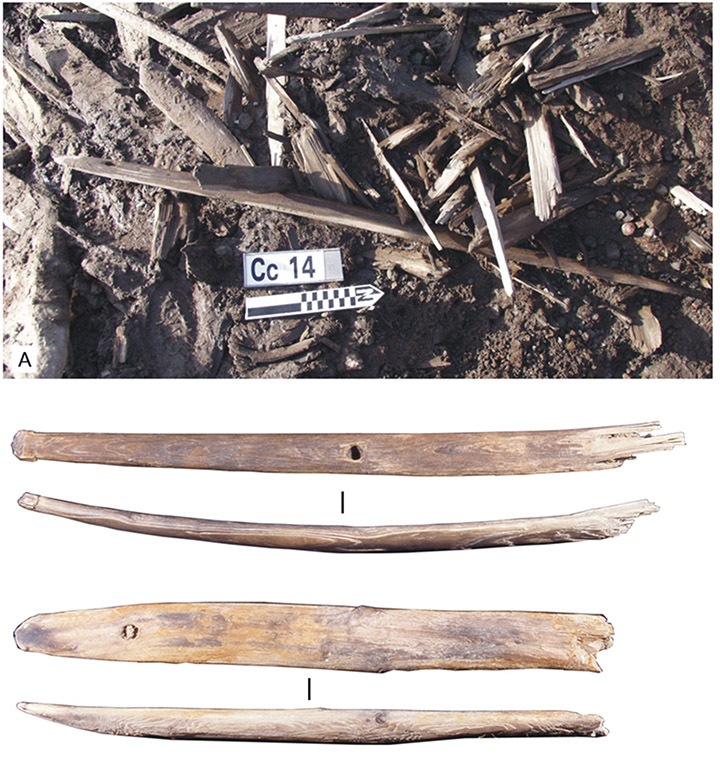
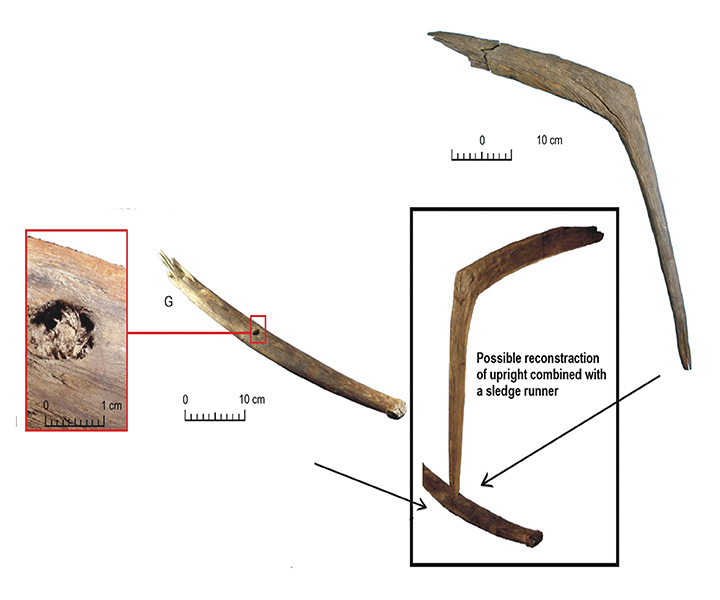
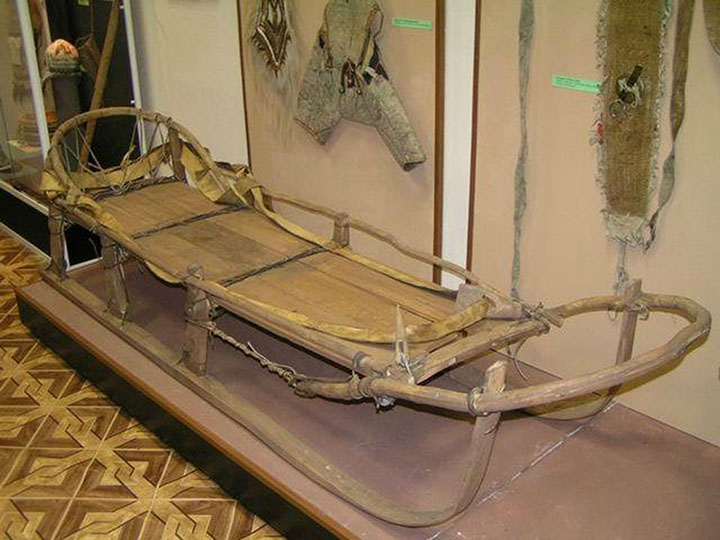
Parts of the sledge found on Zhokhov site

Model of binding
Parts of sledges found on the Zhokhov site. Pictures: Vladimir Pitulko
‘The most suitable season for the use of animals for transport during the occupation of the Zhokhov site would probably have been in early spring (March and April), when snow is still solid and the days are longer than in the winter. Indeed, today, the popular Beringia dog-sled race — a super-long-distance expedition of over 1000 km —normally takes place during this time of the year.
'The Zhokhov site has yielded the world’s oldest evidence for wooden sledge runners and other sledge component parts. 
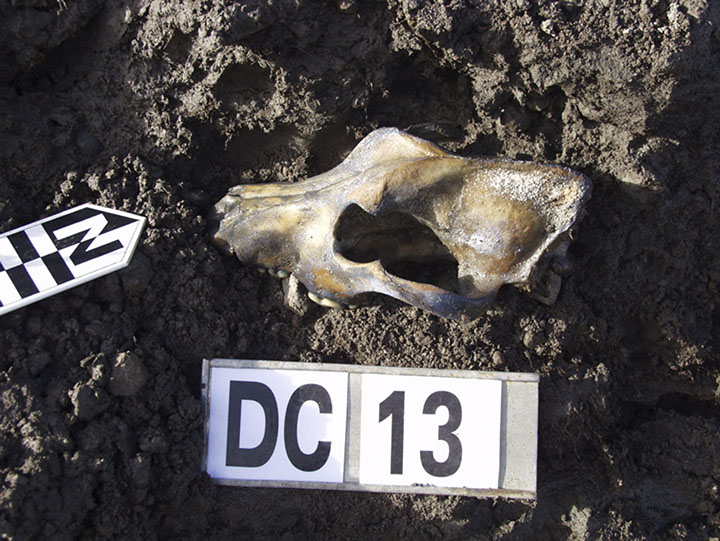
‘Reconstructions from faunal remains of canine body weight and size show that these animals were similar to modern Siberian huskies. 
‘Sledge transport formed an important part of the subsistence technology of the Zhokhov site’s inhabitants. 
Dog's skull found on Zhokhov Island

Siberian huskies
‘Reconstructions from faunal remains of canine body weight and size show that these animals were similar to modern Siberian huskies.‘ Pictures: Vladimir Pitulko, Anikish
It also should be stressed that these people were skilled travellers, who regularly visited today’s New Siberia, Faddeyevskiy and Kotel’nyy Islands to the south and west of the site—as indicated by the presence of raw materials procured from these locations.' 
They believe that ‘dog-sled technology, the environment and phenology have remained largely the same in the East Siberian Arctic regions for millennia, regardless of developments such as the introduction of metals, pottery or other innovations. 
‘Dog-sled technology undoubtedly played an important part in raw materials exchange networks, as evidenced by the presence of Chukotka obsidian at the Zhokhov site. 
‘Although virtually no obsidian has been found in the Early Holocene archaeological record between the Zhokhov site and Chukotka, a connection between these two areas clearly existed by c. 8000 BP.’
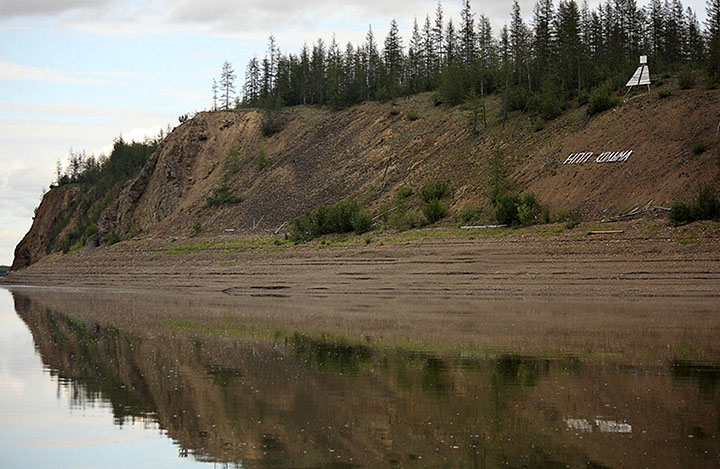
Obsidian flakes from Kolyma river

Lower reaches of Kolyma river
Obsidian flakes found on Kolyma river. Pictures: Yaroslav Kuzmin, YSIA
They believe there were staging posts on the exchange route and note that ‘obsidian artefacts have been found in the Malyy Anyuy River basin (in western Chukotka) and in the lower course of the Kolyma River’.
They suggest that ‘it is possible that raw obsidian was transported to the Malyy Anyuy River basin in the Middle–Late Holocene (Neolithic and Bronze Age) as unmodified nodules…
‘The distance between the Lake Krasnoe source and utilisation sites is around 450–500km in a direct line. Fewer obsidian artefacts are found in and around the Kolyma River mouth, which is approximately 850km from the source.’ 
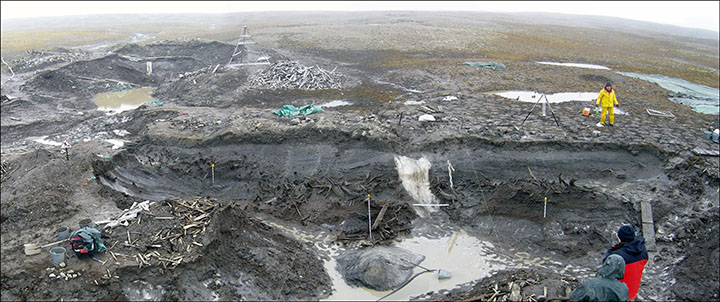
Zhokhov Island

Zhokhov Island
Excavations at Zhokhov Island. Pictures: Vladimir Pitulko, Elena Pavlova
Kuzmin said: 'It is unlikely that the ancient people made trips to such long distances; most likely there has been an exchange or a primitive trade of obsidian. Sites at the mouth of the Kolyma and, possibly, at the mouth of the Indigirka could serve as intermediate points. 
‘In this case, the distance between the exchange points is about 700 km.
’It is quite surmountable in early spring dog sledding.' 
The experts believe ‘it is possible that some types of ‘trade hub’ existed in the Siberian Arctic for the exchange of valuable resources, such as stone raw materials, furs and other items’.
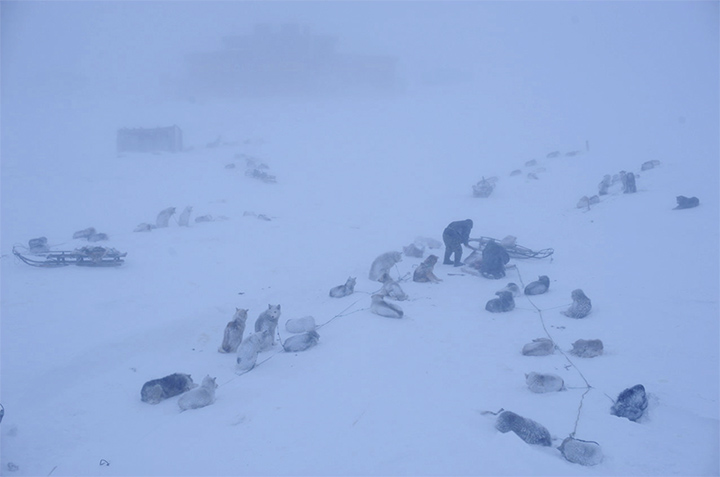
Chukchi dog sledge

Dog sledge in blizzard

Chukchi dogs
It was around 7,800 years ago that the the territory of Zhokhov became detached from the mainland. 
They conclude: 'Early Holocene super-long-distance obsidian exchange in the High Arctic is now scientifically demonstrated. Such an exchange system is a remarkable example of a subsistence strategy in use in northern Siberia at that time, if not earlier. The presence of other Mesolithic sites on the north-eastern Siberian Arctic mainland testify — indirectly — to the active contact between human groups across this region.'
The international team of researchers comprised Vladimir Pitulko (St Petersburg), Yaroslav Kuzmin (Novosibirsk), Michael D. Glascock (USA), Elena Pavlova (St Petersburg) and Andrei Grebennikov (Vladivostok).

Thursday, 28 March 2019

Art & Archaeology of the Silk Road Symposium 2017


     at Portland State University October 11-13, 2017

This international conference featured keynote presentations by:
Daniel Waugh, director of the Seattle Silk Road Project and editor of the journal of the Silkroad Foundation
Annette Juliano, Professor of Asian Art at the Newark branch of Rutgers University
Matthew P. Canepa, Professor of Art History, University of Minnesota
They reappraised key questions after shifts over the last two decades within the field, with presentations from an international range of leading scholars in the field.

Wednesday, 27 March 2019

Origins of the Silk Roads


Origins of the Silk Roads 

Lecture by Rowan Flad, John E. Hudson Professor of Archaeology, Department of Anthropology, Harvard University
on October 24, 2018 at the Geological Lecture Hall of the Peabody museum in Cambridge
Approximately 4,000 years ago, the peoples of China and Eurasia gradually began to develop networks of interaction and exchange that radically transformed the cultures of both regions. These networks eventually gave rise to the Silk Road trade routes connecting the East and West. Rowan Flad will examine the archaeological evidence—from the Qijia Culture of Northwest China—that documents the agricultural, metallurgical, and technological innovations that resulted from the earliest trans-Eurasian exchanges, and how studies of the Silk Road origins are being reinvigorated by China’s One Belt, One Road initiative

Monday, 25 March 2019

New article about the "Shigir Idol" from the Siberian Times

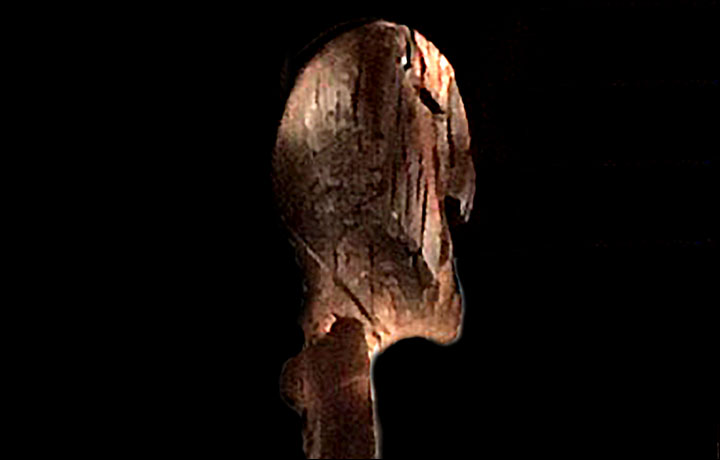
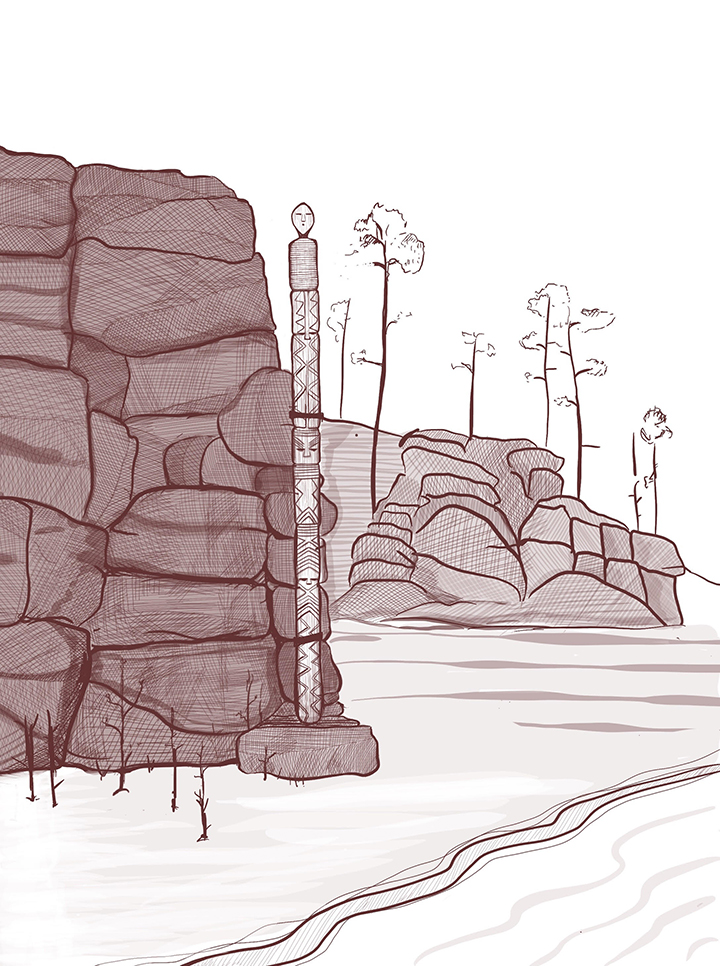
The Shigir Idol, depicting the ‘ancient spirit world’, originally stood tall beside a paleo-lake

By Anna Liesowska
26 February 2019
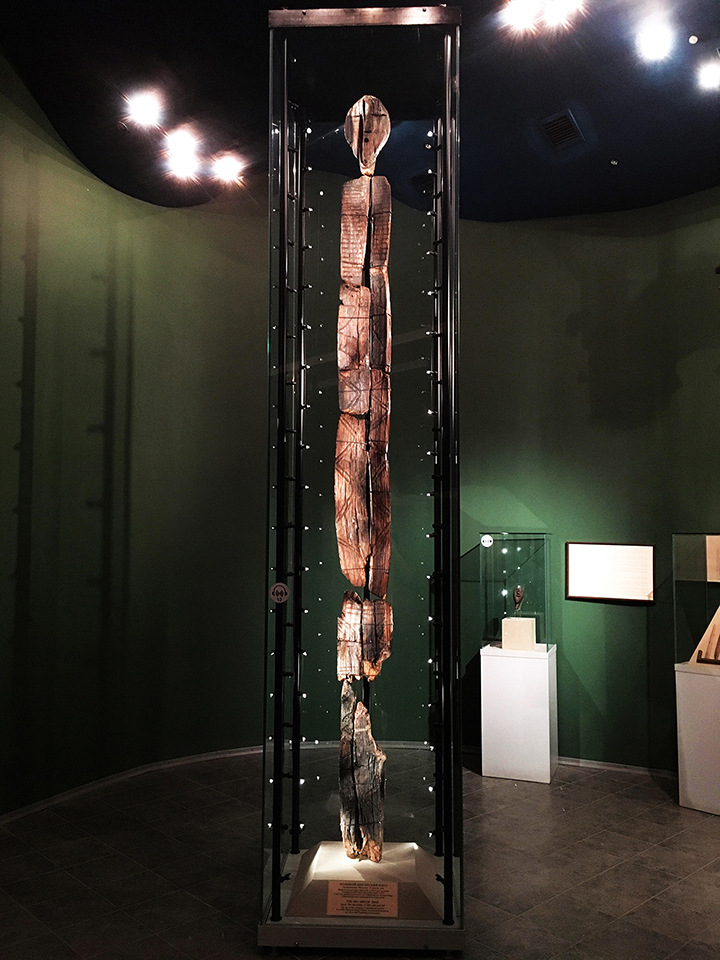
The stunning idol is three times as old as the Egyptian pyramids. Picture: Olga Gertcyk, The Siberian Times
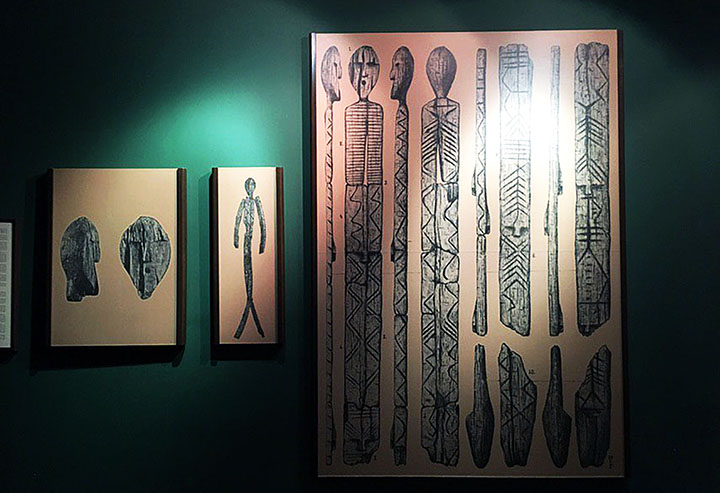
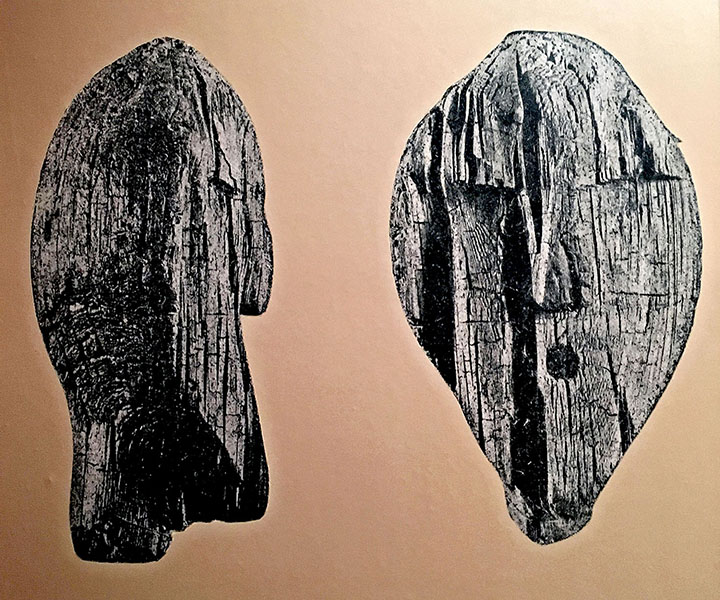
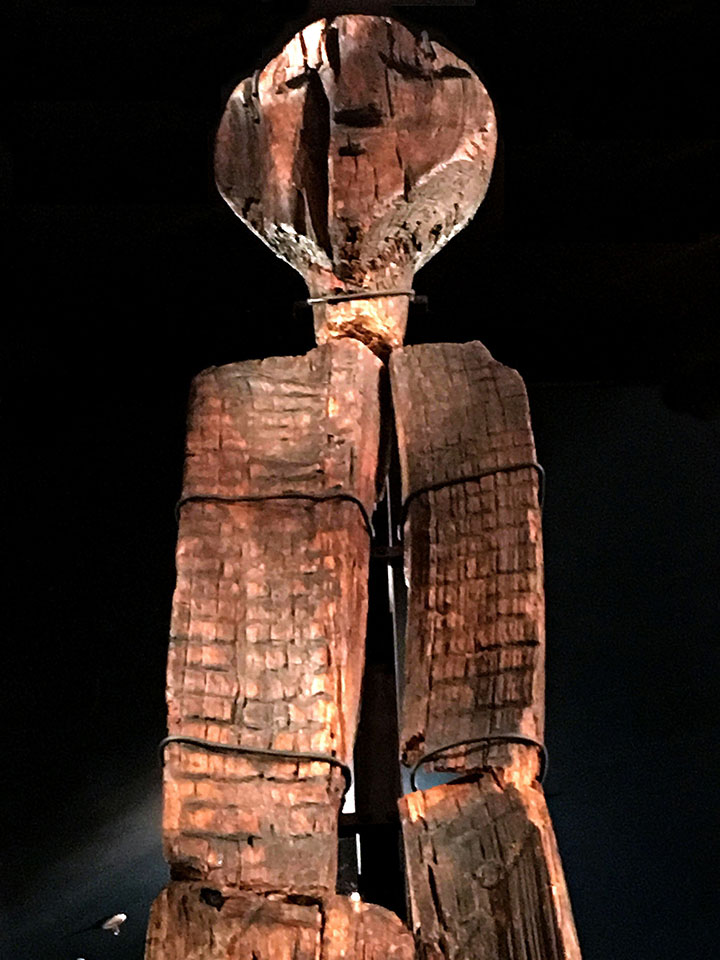
With its evocative main face and O-shaped mouth, its mysterious zigzag etched lines, the Shigir Idol is now accepted as one of the world’s oldest examples of monumental art. 
All the more remarkably, it is made of larch not stone yet still survives, thanks to it falling into a peat bog, once a paleo-lake, in which it was superbly preserved. 
Now experts who know it best are suggesting some intriguing new theories about this ancient relic found late in the 19th century by tsarist gold prospectors.
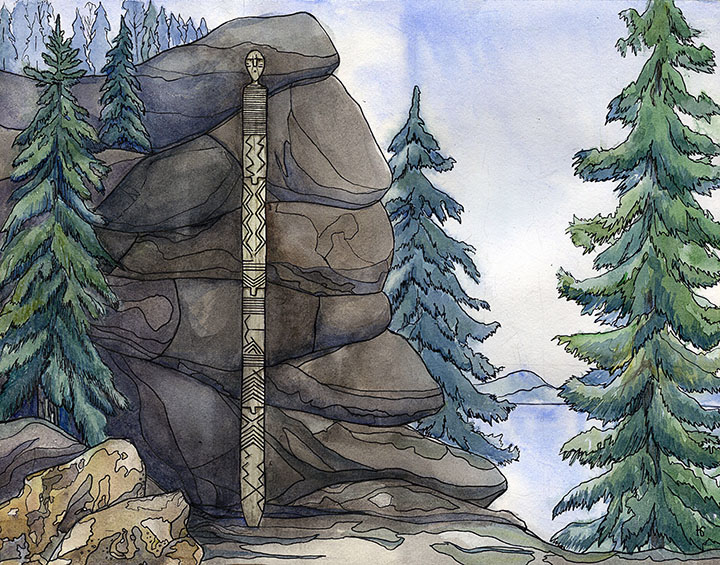
One is that it is believed to have stood tall over the long-gone Shigir paleo-lake.  
Another is that it held this position for a mere 20 or so years. 
While some scientists have suggested it resembles a Totem pole, experts insist the lower part of the Shigir Idol was not - as might be expected - dug into the ground to support it. 
Rather, it was propped up against a tree or perhaps more likely against a rock face on the shore of the water.
The worlds oldest wooden statue

The worlds oldest wooden statue

The worlds oldest wooden statue
The stunning idol is three times as old as the Egyptian pyramids. Drawings: Nina Belanova, Sasha Skulova. Picture: Olga Gertcyk, The Siberian Times

The idol has already shattered our understanding of early ritual art by the hunter-gatherers at the end of the Ice Age, all the more so when tests revealed last year proved it to be older - it was created some 11,500 or 11,600 years ago - than previously understood. 
It reveals a depth of artistic talent unexpected before the onset of famers. 
Now Dr Mikhail Zhilin, leading researcher of the Age Archeology Department in Institute of Archaeology, Russian Academy of Sciences, has told The Siberian Times: ‘Based on the the facts I can clearly say that it was not dug into the ground, like Totem poles.
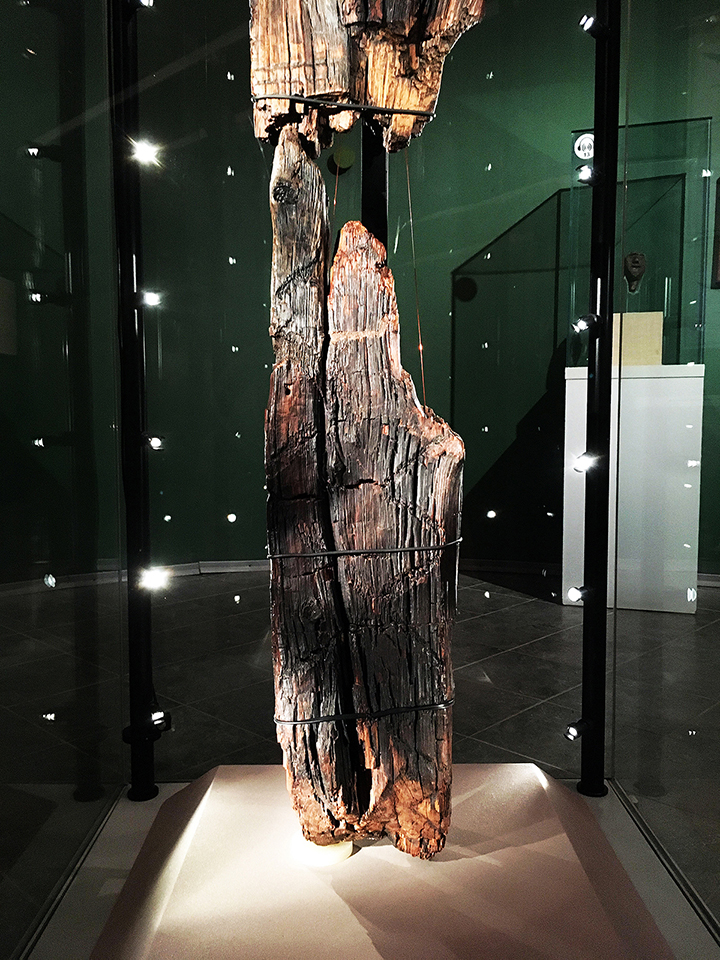
’It was standing on a relatively hard, presumably stone, pedestal, because the lower part got flattened by strong pressure, and this sculpture was quite heavy. 
‘According to the dendrologist Karl-Uwe Heussner, the Shigir Idol stood like this on shore of a large Shigir paleo lake for about 20 years; then a large crack appeared in the middle, followed by a series of smaller cracks. 
‘The Idol fell into the water, floated for about a year, then sank to the lake's bottom and formation of peat around it began.' 
The worlds oldest wooden statueq

The worlds oldest wooden statue
The Idol was made from a larch tree 11,600 years ago. Picture: Olga Gertcyk, The Siberian Times. Drawing: Sasha Skullova
The idol may have been tied by strapping to harness it in place but was not held by another structure. 
‘We did not find any trace of a counterforce,’ said Dr Zhilin. ‘If supporting beams or forks were used, it would leave clear traces, but we do not see them. 
‘There was an idea previously that the idol could be put on a raft and was floating on the lake. 
‘We have no data to confirm this. 
‘It was definitely standing on some stone base  in the open air and there were no supports.’
He surmised: ‘There are two options - it could be leaned against some rock or a tree. 
‘You just need to remove several branches from, say, pine or fir tree, to get the suitable space for the idol; a leather strap might have fastened it into place or something alike to rawwhide straps that would not leave any significant traces.
'I tend to think that it was standing near the water, in quite a secluded place.' 
The worlds oldest wooden statue
The Idol is now kept at the Sverdlovsk Regional History museum in Yekateriburg. Picture: Olga Gertcyk, The Siberian Times

Dr Zhilin has also clarified claims based on earlier an scientific research publication that this Mesolithic Age idol depicts demons. 
‘I presume that some journalists caught the word 'demon' in our publications, and took it out of the context,’ he said. 'It actually has a very wide range of meanings even in English, from devil to good genius. Given the Idol was created 11,500 years ago, we can't yet, or possibly ever, say just what it depicted. We don't have enough context.'
'These could have been some kind of spirits - not deities, because we think that deities appeared later.’
'While we can't be sure on what the Idol depicted, we mustn't underestimate people who created it. 
'They had all the necessary tools and skills, plus a rather complex view of the world which to them was populated with spirits. Not only animals or trees, even stones were animated.  
given that we do not known the context 11,500 years ago, we cannot say exactly what they depicted

The worlds oldest wooden statue
The world's oldest wooden statue. Pictures: Olga Gertcyk, The Siberian Times

‘We think it was something close to animism', Dr Zhilin said. 
'I see in these images unity and diversity of the world that surrounded the creators of the Idol, which clearly wasn't divided into the kind and evil spirits.' 
'We are a long way from unravelling the ancient code left by the creators of the Shigir Idol. There is nothing in the world similar to the Idol, no written data left. 
'There are interpretations that it could be something like a Totem pole, but it is only a suggsetion. It could have also been a hidden sacred place, yet there are not enough facts to support any of these suggestions.’
The Shigir Idol is on display at the Sverdlovsk Regional History Museum in Yekaterinburg. 
THE WORLD'S OLDEST WOODEN STATUE


The Steppe and the Sea: Pearls in the Mongol Empire

by Thomas T Allsen


  • Series: Encounters with Asia
  • Hardcover: 240 pages
  • Publisher: University of Pennsylvania Press (May 3, 2019)
  • Language: English
  • ISBN-10: 0812251172

  • In 1221, in what we now call Turkmenistan, a captive held by Mongol soldiers confessed that she had swallowed her pearls in order to safeguard them. She was immediately executed and eviscerated. On finding several pearls, Chinggis Qan (Genghis Khan) ordered that they cut open every slain person on the battlefield. Pearls, valued for aesthetic, economic, religious, and political reasons, were the ultimate luxury good of the Middle Ages, and the Chingissid imperium, the largest contiguous land empire in history, was their unmatched collector, promoter, and conveyor. Thomas T. Allsen examines the importance of pearls, as luxury good and political investment, in the Mongolian empire—from its origin in 1206, through its unprecedented expansion, to its division and decline in 1370—in order to track the varied cultural and commercial interactions between the northern steppes and the southern seas.
    Focusing first on the acquisition, display, redistribution, and political significance of pearls, Allsen shows how the very act of forming such a vast nomadic empire required the massive accumulation, management, and movement of prestige goods, and how this process brought into being new regimes of consumption on a continental scale. He argues that overland and seaborne trade flourished simultaneously, forming a dynamic exchange system that moved commodities from east to west and north to south, including an enormous quantity of pearls. Tracking the circulation of pearls across time, he highlights the importance of different modes of exchange—booty-taking, tributary relations, market mechanisms, and reciprocal gift-giving. He also sheds light on the ways in which Mongols' marketing strategies made use of not only myth and folklore but also maritime communications networks created by Indian-Buddhist and Muslim merchants skilled in cross-cultural commerce.
    In Allsen's analysis, pearls illuminate Mongolian exceptionalism in steppe history, the interconnections between overland and seaborne trade, recurrent patterns in the employment of luxury goods in the political cultures of empires, and the consequences of such goods for local and regional economies.

    Review


Sudden Appearances: The Mongol Turn in Commerce, Belief, and Art

Roxann Prazniak is professor of history at the Robert D. Clark Honors College, University of Oregon. 
  • Series: Perspectives on the Global Past
  • Hardcover: 304 pages
  • Publisher: University of Hawaii Press (March 31, 2019)
  • Language: English
  • ISBN-10: 0824876571

An era rich in artistic creations and political transformations, the Mongol period across Eurasia brought forth a new historical consciousness visible in the artistic legacy of the thirteenth and fourteenth centuries. Historicity of the present, cultivation of the secular within received cosmologies, human agency in history, and naturalism in the representation of social and organic environments all appear with consistency across diverse venues. Common themes, styles, motifs, and pigments circulated to an unprecedented extent during this era creating an equally unprecedented field of artistic exchange. Exploring art’s relationship to the unique commercial and political circumstances of Mongol Eurasia, Sudden Appearances rethinks many art historical puzzles including the mystery of the Siyah Kalem paintings, the female cup-bearer in the Royal Drinking Scene at Alchi, and the Mongol figures who appear in a Sienese mural.
Drawing on primary sources both visual and literary as well as scholarship that has only recently achieved critical mass in the areas of Mongolian studies and Eurasian histories, Roxann Prazniak orchestrates an inquiry into a critical passage in world history, a prelude to the spin-off to modernity. Sudden Appearances highlights the visual and emotional prompts that motivated innovative repurposing of existing cultural perspectives and their adjustment to expanding geographic and social worlds. While early twentieth-century scholarship searched for a catholic universalism in shared European and Chinese art motifs, this inquiry looks to the relationships among societies of central, western, and eastern Asia during the Mongol era as a core site of social and political discourse that defined a globalizing era in Eurasian artistic exchange. The materiality of artistic creativity, primarily access to pigments, techniques, and textiles, provides a path through the interconnected commercial and intellectual byways of the long thirteenth century.
Tabriz of the Ilkhanate with its proximity to the Mediterranean and al-Hind seas and relations to the Yuan imperial center establishes the geographic and organizational hub for this study of eight interconnected cities nested in their regional domains. Avoiding the use of modern geographic markers such as China, Europe, Middle East, India, Sudden Appearances shifts analysis away from the limits of nation-state claims toward a borderless world of creative commerce.

Tuesday, 5 February 2019

Buddhist Art of Gandhara: In the Ashmolean Museum

by David Jongeward

  • Hardcover: 336 pages
  • Publisher: Ashmolean Museum Publications (18 Feb. 2019)
  • Language: English
  • ISBN-10: 1910807222

Buddhist Art of Gandhara is a scholarly catalogue of the Ashmolean Museum's important but still largely unpublished holdings of the Buddhist sculpture and related art of the historic Gandhara region (modern North West Pakistan / East Afghanistan) in the early centuries AD (c. 0-600 AD). This region was a major centre of Buddhist culture and facilitated the transmission of Buddhism and its art from India via the Silk Road to Central Asia, China and the Far East. The book contains introductory essays, with additional illustrations, suitable for the general reader as well as the specialist.

Contents: General introduction; 1. Stupas and reliquaries; 2a. Life panels; 2b. Panels and fragments; 3a. Buddhas; 3b Bodhisattvas; 4. Stuccos; 5. Bronzes; 6. Deities; 7. Household objects; Bibliography, Index.

Formerly a lecturer in anthropology, David Jongeward is an acknowledged authority on the art of Gandhara. He previously catalogued the Gandhara collection of the Royal Ontario Museum (2003), and edited a major book on Gandharan reliquaries (2012). He now works as a freelance scholar, with affiliations to the University of Toronto.

Thursday, 31 January 2019

Silk Roads and Steppe Roads of Medieval China: History Unearthed from Tombs

The 2016 Rostovtzeff Lectures were delivered by Jonathan K. Skaff (Shippensburg University).
  • "A Slave Road? Sogdian Merchants and Foreign Slaves at Turfan,"
  • "Sogdians or Borderlanders?, Part I: Lives Revealed in Epitaphs,"
  • "Sogdians or Borderlanders?, Part II: Death Rituals Revealed in Tombs," 
  • "A Tang Dynasty Ally in War and Ritual: The Tomb of Pugu Yitu (635-678) in Mongolia,"                                                                                                                                     


"A Slave Road? Sogdian Merchants and Foreign Slaves at Turfan," 
Tuesday, March 29, 2016 
To watch this first lecture, press HERE

Dr. Jonathan Skaff is a Visiting Research Scholar at ISAW who will deliver the annual M.I. Rostovtzeff Lectures in Spring 2016. Skaff is a Professor of History at Shippensburg University of Pennsylvania, where he also has served as Director of International Studies. He developed a lasting fascination with Eurasian cultural connections after teaching English in Shanghai in the mid-1980s and traveling through northwest China, Pakistan, India, Nepal and Tibet. Since receiving his doctorate from the University of Michigan in 1998, his research has investigated medieval China’s frontier interactions with Inner Asia. Most prominently, his book, Sui-Tang China and its Turko-Mongol Neighbors: Culture, Power and Connections, 580-800 (Oxford University Press, 2012) revealed previously unrecognized cultural connections between China and peoples of the Eurasian steppe involving diplomacy, warfare, ideology, and political networking. A Chinese translation is forthcoming from the Social Sciences Academic Press.
Skaff’s Rostovtzeff lectures, entitled Silk Roads and Steppe Roads of Medieval ChinaHistory Unearthed from Tombs, comprise four case studies that use paper documents, stone epitaphs and artifacts excavated from tombs to illuminate China’s interactions with Eurasia. “Silk Roads” is the popular name for east-west land routes—linking East, South, and West Asia and serving as conduits transmitting luxury goods, technology, religion, and artistic motifs. “Steppe Roads” is a term coined by David Christian, who defines them as north-south routes linking the Eurasian steppe’s vast pastoral grasslands with the agricultural regions to the south that facilitated exchanges of goods such as Chinese silks and Mongolian horses. The lecture series argues that the Silk and Steppe Roads were networks through which Eurasian peoples, who perceived their societies to be unique, spun overlapping and entangled webs of culture. The transit hubs of Silk and Steppe Roads were particularly active sites of cultural contestation, experimentation, and mutual influence that had an impact on the historical development of China and Inner Asia.
The first lecture entitled "A Slave Road? Sogdian Merchants and Foreign Slaves at Turfan" introduces the Silk Roads through a case study of Sogdians living as a minority at the Chinese oasis city of Turfan in the six and seventh centuries. The Sogdians were early inhabitants of modern Uzbekistan and Tajikistan who spoke an Iranian dialect, and began to migrate eastward by the fourth century CE to settle in cities and towns on the Silk Roads. The lecture will update Skaff's previous publications on Sogdian farmers and merchants at Turfan by considering recently-discovered paper documents and epitaphs.

"Sogdians or Borderlanders?, Part I: Lives Revealed in Epitaphs," 
Tuesday, April 5, 2016
To watch this lecture, press HERE

The second lecture “Sogdians or Borderlanders?, Part I: Lives Revealed in Epitaphs” will return to the topic of immigrants, but in this case two lineages with the same surname of Shi who settled at Guyuan in China’s Ningxia Hui Autonomous Region where the Silk Roads and Steppe Roads intersect. These people were locally powerful elites serving a succession of China-based dynasties as military officers, imperial bodyguards, horse breeders and translators in the sixth and seventh centuries. Their existence literally came to light when archaeologists excavated six tombs at Guyuan in the 1980s and 1990s containing burial goods and seven engraved stone epitaphs written in Chinese. A scholarly consensus has developed that both lineages had Sogdian origins, but this lecture along with the third lecture in the Rostovtzeff series will challenge and complicate this conclusion.


"Sogdians or Borderlanders?, Part II: Death Rituals Revealed in Tombs," 
Tuesday, April 12, 2016
To watch this third lecture, press HERE

The third lecture “Sogdians or Borderlanders?, Part II: Death Rituals Revealed in Tombs” will return to the topic of immigrants, but in this case two lineages with the same surname of Shi who settled at Guyuan in China’s Ningxia Hui Autonomous Region where the Silk Roads and Steppe Roads intersect. These people were locally powerful elites serving a succession of China-based dynasties as military officers, imperial bodyguards, horse breeders and translators in the sixth and seventh centuries. Their existence literally came to light when archaeologists excavated six tombs at Guyuan in the 1980s and 1990s containing burial goods and seven engraved stone epitaphs written in Chinese. A scholarly consensus has developed that both lineages had Sogdian origins, but this lecture along with the second lecture in the Rostovtzeff series will challenge and complicate this conclusion.


大唐故右驍衛大將軍金微州都督上柱國林中縣開國公仆固府君墓志銘並序 / 公諱乙突,朔野金山人,蓋鐵勤之別部也。原夫石紐開基,金峰列構,疏枝布葉,擁 / □塞而推雄,茂族豪宗,跨龍城而表盛。亦有日磾純孝,泣畫像於漢宮,日逐輸忠, / 委□□於鑾邳。求諸史諜,代有人焉。祖歌濫拔延,皇朝左武衛大將軍、金 / 微州都督。父思匐,繼襲金微州都督。並志識開敏,早歸皇化,覘風請謁,匪 / 獨美於奇肱,候日虔誠,本自知於稽顙。公幼而驍勇,便習馳射,彎弧挺妙,得自乘 / 羊之年,矯箭抽奇,見賞射雕之手。及父歿傳嗣,遂授本部都督,統率部落,遵奉 / 聲教。回首面內,傾心盡節。俄以賀魯背誕,方事長羈,爰命熊羆之軍,克剿犬羊之 / 眾。公乃先鳴制勝,直踐寇庭,無勞拔幟之謀,即取搴旗之效。策勛敘績,方寵懋官, / 詔授右武衛郎將,尋授護軍,封林中縣開國子,俄除左武衛大將軍。至麟德二年,/鑾駕將巡岱岳,既言從塞北,非有滯周南,遂以汗馬之勞,預奉射牛之禮。服既榮 / 於飾玉,職且貴於銜珠,厚秩載隆,貞心逾勵。及東征靺鞨,西討吐蕃,並效忠勤,亟 / 摧凶丑。裒錄功績,前后居多,尋除右驍衛大將軍,依舊都督,加上柱國,林中縣開 / 國公,食邑一千戶。頻加寵授,載踐崇班,邁彼氈裘之鄉,參茲纓冕之列。光 / 膺啟國,既錫茅土之封,趨步升朝,且曳桃花之綬。方謂高情壯志,媲金石而同堅,/ 豈圖脆質小年,與風露而俱殞。奄辭白日,長歸玄夜。以儀鳳三年二月廿九日遘 / 疾,終於部落。春秋卌有四。/ 天子悼惜久之,敕朝散大夫、守都水使者天山郡開國公麴昭,監護吊祭, / 賻物三百段,錦袍金裝帶弓箭胡祿鞍韉等各一具。凡厥喪葬,並令官給,並為立 / 碑。即以其年歲次戊寅八月乙酉朔十八日壬寅,永窆於纈碖原,禮也。生死長乖,/ 哀榮畢備,深沉苦霧,方結慘於鬆塋,飋[風+日]悲風,獨含淒於薤鐸。對祁連而可像,寄□勒而有詞,述德表功,乃為銘曰:/西歭蔥山,北臨蒲海,土風是系,英杰攸在。葉貫箭鋒,花分騎彩,孫謀有裕,祖襲無 / 改。束發來儀,腰鞬入侍,/ 天德斯溥,人胥以洎。獻款畢同,輸忠靡異,臨危效節,致果為毅。疇庸啟邑,疏爵命 / 官,從軍擁旆,拜將登壇。赫弈光顯,榮名可觀,方奉 / 明時,遽歸幽穸。壯志何在,瓌容共惜,鶴隴俄封,雞田罷跡。月落無曉,雲來自昏,鳥 / 切響於鴻塞,人銜悲於雁門,庶清塵而不泯,紀玄石而長存。


"A Tang Dynasty Ally in War and Ritual: The Tomb of Pugu Yitu (635-678) in Mongolia," 
Tuesday, April 19, 2016
To watch the fourth episode, press HERE

The final lecture “A Tang Dynasty Ally in War and Ritual: The Tomb of Pugu Yitu (635-678) in Mongolia” takes the audience along the Steppe Roads from China to Mongolia to investigate another recently discovered tomb and epitaph. The history of Mongolia is little known between the First Türk (552–630) and Second Türk (682–742) Empires. Chinese historical records claim that the Tang Dynasty exerted suzerainty over Mongolia during the interregnum through vassal rulers, but offer few details after 660. Likewise, Uighur Empire (744-840) inscriptions assert an earlier period of rule over Mongolia in alliance with the Tang. The recent excavation of Pugu Yitu’s tomb and Chinese-language epitaph shows that an alliance endured through the 670s and throws new light on cultural connections between China and Mongolia.