Sunday, 19 August 2012

Marco Polo skeptic has her say


China Daily by Andrew Moody 17-8-2012
 Marco Polo skeptic has her say
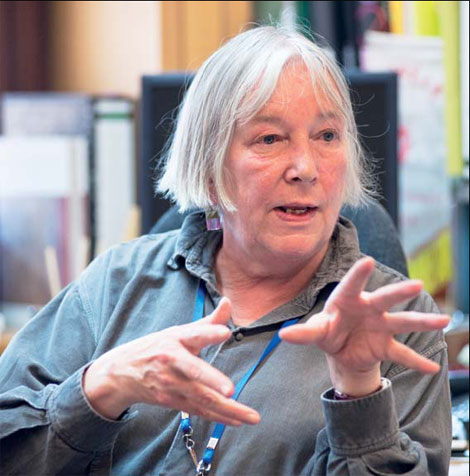
Frances Wood, head of the Chinese collection at the British Library, says Marco Polo's tales were a second-hand travel guide. Nick J. B. Moore / For China Daily
Frances Wood stirred controversy by claiming that Italian never went to the Middle Kingdom
Frances Wood, head of the Chinese collection at the British Library, seems almost too unassuming to have exposed a celebrated figure in Chinese history as a possible fake. She remains best known, however, for her book, Did Marco Polo Go to China?, which argued he didn't and that the Venetian merchant explorer's tales were in reality merely a second-hand travel guide.
"Yes, people got very cross about it actually. Everybody likes him. Every school child in China learns about this little man who walks all the way across the Gobi desert," she says.
Wood, 64, draws an unlikely parallel between the Chinese attachment to Marco Polo and other figures who they have taken to their bosom such as former US president Richard Nixon and former British prime minister Edward Heath.
When she was a student in China in the 1970s, Wood says, her friends said they liked Nixon "because he recognized China" and Heath for similar reasons. "It is the same kind of thing with Marco Polo," she says with a wry smile.
Wood argues that Polo, if he existed, was a remarkably unobservant traveler since he makes no mention of foot binding, tea drinking or chopsticks.
"People say he wouldn't have used chopsticks. They would have given him a spoon or something like that. In Europe at that time they were beginning to experiment with the fork and so you think he might have been interested in the way people ate," she says.
The eminent curator points out that although he is famous in Venice now, no one made a fuss of anyone called Marco Polo at the time.
"There were two or three Polo families. There was a house he was supposed to have returned to from China. However, the Polo family moved into it long after he was said to have come back. If he had gone back there all ragged from his 20 years of travels, the people who did live there would probably have kicked him out."
She says it is more likely The Travels of Marco Polo was some purloined database of Middle East traders who had a long history of doing business in China.
"Polo uses either Persian or Turkish nouns for everything and not Chinese or even Mongol names. This might mean whoever created this thing is using a Persian guidebook for merchants since there had been many Persian people traveling and trading in China since the Tang Dynasty (AD 618-907)," she says.
Wood, who combines enthusiasm with a certain matter-of-fact manner, is curator of some of the most valuable Chinese printed works in the world, including the Diamond Sutra, the world's earliest printed book dating back to the 9th century, on which she has recently produced a book with conservationist Mark Barnard.
It was discovered in a cave in the Gobi desert by British archaeologist Aurel Stein in 1907.
Marco Polo skeptic has her say
"I have done an enormous amount of work with that over the last 20 to 30 years because as China opened up, Chinese scholars wanted to come and look at the material so we have done as much as we can to make it possible for them to do that," she says.
A large part of the British Library Chinese collection comes from Hans Sloane, the doctor and collector whose vast treasures formed the basis of the British Museum.
It also includes a collection of Oracle Bones that were discovered in Shandong province by missionaries in the 19th century and bought by the British government.
"They are the Shang Dynasty (c. 16th century to 11th century BC) archive or records, if you like. They are about 3,000 years old," she says.
Some of the British Library collection comes from the looting of the Summer Palace in Beijing by Anglo-French forces in 1860.
She insists, however, that most of the collection has been assembled by more acceptable means.
"The vast majority, you know, 99.9 percent of our collection was acquired perfectly legitimately through dealers. A lot was bought by Anthony Panizzi, the great librarian here, in about 1840 when he purchased a big collection of early Ming and Qing Chinese fiction which had come in from Paris," she says. "We are still acquiring. We get a lot through dealers and also private people."
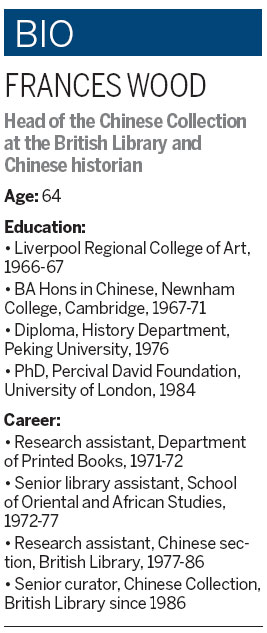
Wood, herself the daughter of the Keeper of Printed Books at the British Museum (the British Library became a separate entity in 1972), originally studied art in Liverpool but switched to reading Chinese at Cambridge.
"I was quite good at languages and I think I chose Chinese completely out of a hat, but I am terribly pleased I did. I could have chosen Arabic, which I think would have been terribly depressing," she says.
Her first experiences of China were in the 1970s, which she chronicles in an engaging book called Hand-Grenade Practice in Peking: My Part in the Cultural Revolution. The throwing of hand-grenades, which were not live, was a Saturday morning compulsory sport.
"When I went in 1971, I remember waking up in the center of Beijing and hearing a funny noise outside and looking out of the window and seeing flocks of sheep being driven to market. It could have been a tiny country town," she says.
"I think the opening-up of China to the rest of the world is a good thing generally, although I am terribly sad that with globalization everything looks the same. You go to China and see the same shops you see here."
After university, she pursued her current career beginning as a research assistant at the British Museum in 1971 and eventually moved to the new British Library in 1986.
She is a foremost authority in her field and had the rare honor for a Sinologist, at least, of appearing on the BBC Radio 4 Desert Island Discs program usually reserved for those of celebrity status, in 2010.
She used to visit China three or four times a year but now less so but maintains her Chinese by her daily work of poring over Chinese documents.
"My work involves working with Chinese books so that is good and we also have a lot of Chinese visitors and delegations. We had a Chinese calligrapher who came last Friday with his English son-in-law who he could only communicate with in sign language. And so that was quite fun."
Wood says China hasn't demanded any of its great printed works back, unlike the Greeks with the Elgin Marbles at the British Museum. The vast majority of valuable Chinese books remain in China and the British Library has concordats with Peking University and the National Library of China.
"I don't think people are of the view, 'it's ours, we must have it back'. They just want to know where it is and whether to make their own digital images. Book are not as sensitive as certain artifacts."
Wood plans to retire next year at 65, although she will carry on working on updating the library's catalogue of 7,000 titles.
Huang Tiantian contributed to this story.
andrewmoody@chinadaily.com.cn

Amluk-Dara stupa: Excavators discover unique complex


Published: August 2, 2012
Sheltered by the great Mount Elum, the Amluk-Dara stupa is an ancient relic. PHOTO: COURTESY ARCHAEOLOGY COMMUNITY TOURISM PROJECT
SWAT: It is often said that Pakistan, particularly the north, is a tourist paradise waiting to happen.
Local and foreign excavators revealed on Wednesday that a unique part of a previously-discovered site of the Gandhara civilization at Amluk-Dara, Swat, has been uncovered jointly by Italian Archaeological Mission in Pakistan and Khyber-Pakhtunkhwa’s (K-P) Directorate of Archaeology and Museums.
Sheltered by the great Mount Elum, the Amluk-Dara stupa is an ancient relic two kilometres from the main road which travels from Barikot to Buner and stands with ancient majesty and can be seen from the surrounding mountains.
Excavators working on the site that dates back to the third century recently discovered an entire complex surrounding the four-metre long stupa — which was first discovered by the Hungarian-British archaeologist Sir Aurel Stein in 1926. It was later studied by Domenico Faccena in the 60s and 70s.
“Actually, Amluk-Dara is not a new discovery but a re-discovery. Sir Aurel Stein in 1926 reported the ruins and wrote that the main stupa was possibly one of the best preserved pieces of Buddhist architecture he had ever seen in Gandhara.  The main stupa with its sacred area was founded around the third century and lasted until 10th or 11th century,” said Dr Luca Maria Olivieri, director of the Italian Archaeological Mission in Pakistan.
Remarkably, the archaeological site lasted until a time when 90% of the Buddhist sites in the Swat Valley had already been abandoned. “Certainly, the site was visited by Chinese pilgrim Xuanzang in the 7th century but unfortunately the text of Xuangzang could not be translated very well which creates some doubts, so now we are looking forward to reading the new translation by professor Max Degg, which is under progress,” revealed Dr Olivieri.
The ancient relic was vandalised and looted by archaeological smugglers where until recently illegal excavation was going on. “Though the site was already selected for excavation by the Archaeology Community Tourism (ACT), we were requested by K-P’s Archaeology Department to start the activity a bit earlier than planned after the police arrested some smugglers on the spot.”
Sculptures or fragments of the sculptural decoration of the stupas, interesting architecture – including a small pyramid-roofed shrine built just in the middle of the main stupa’s staircase – stucco decorations, potsherds and painted Shahi pottery dating back to the 7th-11th century were discovered during the excavation.
The site is partly acquired by K-P’s Archaeology Department and partly leased by the ACT. Along with Udegram, Barikot, Balo Kale and Abba-Saheb China, the site will be handed over to K-P’s Archaeology and Museum Department along with trained watch-keepers in April 2014 soon after the completion of the project. “That will be a very important step in order to provide continuity and sustainability to the ACT’s results,” Dr Olivieri added.
“It is, without a doubt, a very important excavation. As smugglers were actively busy in illegal digging, we requested the Italian Archaeological Mission to start their activity earlier. Now the site is completely protected,” said Faizur Rehman, curator at the Swat Museum.
He added that further excavation was required to expose the entire site which could potentially become a rich tourist point.
Published in The Express Tribune, August 2nd, 2012.

Saturday, 18 August 2012

Maury Kravitz: 1932- 2012

Amateur historian led expeditions in search of Genghis Khan's grave site
Maury A. KravitzAugust 05, 2012|By Graydon Megan, Chicago Tribune
Maury A. Kravitz
Maury Kravitz was a lawyer, a gold trader and a student of history, but he was best known for his fascination with 13th century Mongolian leader Genghis Khan, a fascination that led to four expeditions in search of the emperor's grave site in Mongolia.
"I got a call in early 1995 … about some cockamamie scheme to look for a burial site in Mongolia of Genghis Khan," said John Woods, a professor of history at the University of Chicago, adding that the call led to a lunch with Mr. Kravitz.

"Although the scheme seemed strange, he was so magnetic that I couldn't turn away," said Woods, who soon got involved in an effort to raise funds for an expedition. Though that early effort didn't raise any money, Mr. Kravitz by 2000 had convinced a small group of investors to put $1.2 million into funding expeditions over four summers.
The expedition located a grave site in Mongolia with artifacts from Genghis Khan's time, Woods said. But the professor also said he didn't know if it is "the right place." Woods said that if time, money and the political climate had allowed, there were other likely sites to explore.
Mr. Kravitz, 80, died of complications from chronic obstructive pulmonary disease Tuesday, July 31, in Highland Park Hospital, according to his wife, Mona. He had lived in Highland Park for more than 40 years.
Mr. Kravitz was born in Philadelphia. He moved to Chicago when he was 7 or 8 after his father, a writer, took a job with a Jewish newspaper. He grew up on the West Side and attended Marshall High School before attending the University of Illinois at its old Navy Pier campus.
He went on to The John Marshall Law School in Chicago but was drafted after his first year. He served three years with the Army in Germany before returning to finish law school in 1959, the same year he married the former Mona Wallace.
Mr. Kravitz later left law for the Chicago Mercantile Exchange, where he became a successful gold and currency trader and later an options and futures trader.
As an amateur student of history, Mr. Kravitz had other interests besides Genghis Khan. He had in his basement an accurate diorama of the Battle of Omdurman, the 1898 conflict that made Sudan part of the British Empire. The display included thousands of miniature fighters, mounts and equipment.
But his main focus over many years was Genghis Khan, a title meaning "emperor or ruler of an oceanic or far-reaching area."
Genghis Khan's given name was Temujin — the name Mr. Kravitz gave his sailboat and used for his vanity license plate. Genghis Khan — pronounced "Jengis" — lived from about the middle 1100s to1227. He united the nomadic tribes of northeast Asia, assembled one of the largest empires in history and is considered the founding father of modern-day Mongolia.
Mr. Kravitz, who assembled a library of more than 400 volumes on Genghis Khan and the Mongolian Empire, said in a 1994 Chicago Tribune story that his admiration for Genghis Khan grew out of his ability to overcome obstacles to become the most important ruler of his era.

Friday, 17 August 2012

Public Lecture: Gramophones in Central Asia

From  the IDP website:

Between 1902 and 1917, the Gramophone Company of London sent several of their recording engineers on epic journeys across the southern regions of the Tsarist Russian Empire, where they recorded the various cultures and ethnic groups they encountered. What resulted was an intimate view of pre-Soviet life, from the Caucasus mountains to the deserts of Russian Turkestan, in the form of several thousand commercial gramophone discs.
The names of many of the recording artists have passed into legend in their home countries, and their influence continues to reverberate. Using extensive archive documentation from the UK and elsewhere, Will Prentice will explore the hidden stories of the artists and recording engineers, and ask in what ways the recordings reflect the social history of the region.
Will Prentice received his MMus in ethnomusicology from Goldsmiths College, University of London in 1999. For the last 13 years he has worked as a sound archivist for the British Library, where he is currently Head of Technical Services within the Sound & Vision department.

Wed 5 Sep 2012, 13.00 - 14.00

Foyle Suite, Centre for Conservation, The British Library

Friday, 10 August 2012

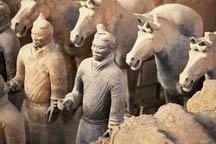
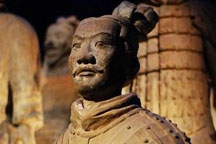
CCTV: 3rd Exploration of China's Terracotta Army unveiled


New secrets of Terracotta Army released
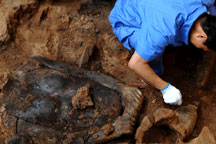
Archaeologists have also uncovered evidence of fire. The remains of burnt wood and hemp strings show that the figures were attacked not long after they were placed around the tomb.
Many believe that person to be Xiang Yu -- a prominent military leader who led battles against the Qin dynasty.
The excavation pit has been damaged before. Besides water and fire, there was human-caused damage as well. This can be key to local historical studies."
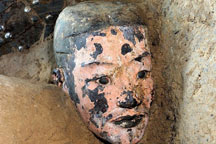
The total number of painted figurines found in this session has surpassed our expectation, this is quite a surprise to all.
Some of the finds have amazed the team. For the first time, defensive armor has been uncovered - including this shield, made of Rattan.
The clay figurines in the Terracotta warriors site all wear helmets and armour, those discovered at the "Baixi" site are all topless. Some even have "beer bellies", while others are very slim.
A hole has been found inside the "number one pit", which appears to have been made by thieves. The terracotta warrior site was plundered at some point in history.


For more information, go to CCTV

Monday, 23 July 2012

Antique Art from China, Tibet and Japan in Prague


The National Gallery in Prague holds an unexpectedly representative collection of Oriental art. Hosted in Kinský Palace right in the city centre, the museum shows a wide range of Asian art objects, including neolithic chinese bronze objects, jades, funery art from China, terracotta statues and horses, buddhist paintings and sculptures from China, Tibet, India, Southeast Asia and Japan, Chinese cinnabar lacquer works, emaille cloisonné objects, chinese and japanese ceramics and porcelains and many many more objects worth a visit.
Surprisingly, the Czech Republic holds one of the largest collections of works from Qi Baishi in the West, including more than one hundred of his paintings housed by the National Gallery in Prague alone. For researchers working on Qi Baishi, the museum in Prague is certainly an important source of information.
The collection of buddhist art contains some impressive pieces. One of the most striking figures is a large wooden depiction of Luohan Kashyapa. The figure dates back to 10/11th century, Liao dynasty, China. It is 99cm high and is believed to be one figure of a buddhist trias from an temple in that time China. Kashyapa would have been placed at the right side of the buddha accompanied by Ananda on the Buddha´s left. Given the fact, that this figure is a wooden artwork with about one thousand years of age, this piece is really impressive!
Interesting for collectors of antique buddhist figures, there are a few examples of early buddhist sculpture exhibited, resuming the styles of Northern Wei dynasty, around 500 A.D. These small bronze figures, sometimes with traces of gilding, are beautiful examples of stylistic transformations at that time, when Buddhism was just spreading around Silk Road reaching north and far eastern Asia.
Permanent exhibition of the Art of Asia and the Ancient Mediterranean from the Collections of the National Gallery in Prague and the National Museum. „The Art of the Old World“, Kinský Palace Prague, listed in VCM – Virtual Collection of Masterpices.
Go to the museum´s website: Collection of Oriental Art of the National Gallery in Prague
(Pictures courtesy of National Gallery in Prague)