Thursday, 22 January 2015

Ancient ship wreckage discovered in Xi'an


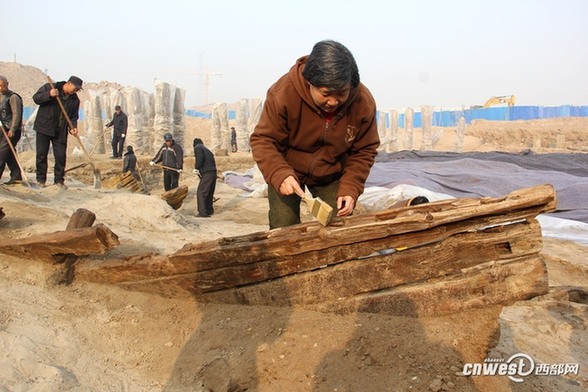
Archaeologists discovered the wreckage of an ancient ship subsequent to the discovery of the ruins of five large-scale ancient bridges in the old course of the Weihe River in the northern suburbs of Xi'an, capital of Northwest China's Shaanxi province, on Jan 16.

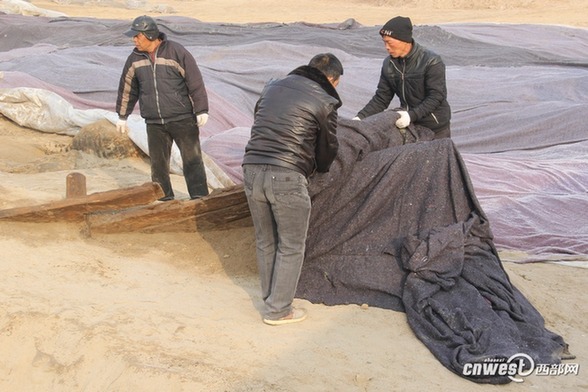
 Archaeologists clean the wreckage of an ancient ship at the ruins of No. 1 bridge in the old course of the Weihe River in the northern suburbs of Xi'an, capital of Northwest China's Shaanxi province, Jan 16, 2015. [Photo/cnwest.com]

According to archaeological materials, few ancient ships were found in Shaanxi, with only one unearthed in the Lintong district of Xi'an.
To keep the ruins warm, archaeologists covered the wreckage with canvas, and they did not begin cleaning the wreckage until 10 o'clock when the temperature in the area rose.
So far, as the body of the ancient ship has not been completely revealed, it's impossible to proceed with carbon-14 dating, which may reveal when the ship was built.
Archaeologists faced another puzzle. As the wreckage was discovered buried under the earth at two different sites, there is no way to make sure it belongs to two ships or just one that had broken into two parts.
Liu Rui, leader of the archaeological team for the Weihe River ruins, said that they will take three days to clean the wreckage of the ancient ship.
Adjacent to the wreckage, archaeologists also found traces of "sao", or a mattress used to build dykes in the ancient times.
Archaeologists cover the wreckage with canvas to keep it warm at the ruins of the No. 1 bridge in the old course of the Weihe River in the northern suburbs of Xi'an, capital of Northwest China's Shaanxi province, Jan 16, 2015. 


Part of the wreckage of an ancient ship is revealed at the ruins of the No. 1 bridge in the old course of the Weihe River in the northern suburbs of Xi'an, capital of Northwest China's Shaanxi province, Jan 16, 2015. 


Traces of "sao", or a mattress used in dyke construction in ancient times, are seen at the ruins of the No. 1 bridge in the old course of the Weihe River in the northern suburbs of Xi'an, capital of Northwest China's Shaanxi province, Jan 16, 2015. [Photo/cnwest.com]


Wednesday, 21 January 2015

Yuan Dynasty tomb murals most likely Mongolian


For the video, Click HERE

CCTV.com.20 January 2015
Elaborately depicted murals created during the Yuan dynasty, some 700 years ago, have been found in a tomb in Hengshan county, north Shanxi province.

The tomb was discovered last year when a heavy downpour washed away the top stone. After excavation work by archaeologists, the remarkable appearance of the murals are now revealed for the public's pleasure.


The tomb is located along a mountain slope in Luo Ge Tai village of Hengshan County. It is composed of a pathway with a dome-shaped chamber. Pictures are painted on the walls of the chamber. A mural depicts the tomb-owner seated with his five wives, the background being a check-patterned screen. Their outfits and the vessels on the table in front of them shed light on the ethnicity of the tomb-owner.

"He is most likely a Mongolian, but from their clothes, furniture, and all the things painted on the mural, we can still see the influences of the Han culture. So the tomb-owner might also be Han, but wearing Mongolian clothes," excavation team leader Miao Yifei said.

Seven of the 24 Stories of Filial Piety, which are popular legends, especially in northern China, were painted in the surrounding areas of the main picture.

Filial Piety stories were widely portrayed in Yuan dynasty tombs in north Shanxi province and the central area of Inner Mongolia Autonomous Region. It indicates an active cultural exchange between these three provinces during that time, and similar customs that brought it about.

"The murals are both beautifully painted and in very good condition, just thinking that they've been there for some 700 years," Miao said.

The discovery of the tomb and murals reveals much about Yuan dynasty archaeology in the provinces of Shanxi and Shanxi, and the Inner Mongolian Autonomous region.

Tuesday, 20 January 2015

Exhibiting Buddhist Cave Temples and Their Art

From Dunhuang, China, to the Getty Center, Los Angeles: Opportunities and Challenges of Exhibiting Buddhist Cave Temples and Their Art

Date

Thu Jan-29-2015, 6:00pm

Location

Levinthal Hall, Stanford Humanities Center

Program / Series

Silk Road Buddhism 

Co-sponsor

Stanford Humanities Center

Mimi Gardner Gates

Director Emerita, Seattle Art Musuem

In 2016, the Getty Center, Los Angeles, will feature the first major US exhibition about the Buddhist Grottoes of Dunhuang located on the Chinese Silk Road.
How to create an engaging visitor experience which conveys not only the extraordinary beauty of the Buddhist art at Dunhuang, but also evokes the spiritual power of the site and its myriad devotional images?  This talk will discuss original works of art from the Library Cave at Dunhuang - hanging painted banners and embroideries, artists' sketches and pounces, hand-copied sutras and prints, such as the Diamond Sutra, d. 868, as well as full-scale, hand-painted replica caves.
Free and open to the public

Speaker's Bio


Mimi Gardner Gates, now Director Emerita, was Director of the Seattle Art Museum for fifteen years (1994-2009).  Under her leadership, the Olympic Sculpture Park was created; the downtown museum was expanded; and the artistic program achieved a high level of excellence.

Mimi Gates is a scholar of the history of Chinese art with a B.A. from Stanford University and a Ph.D. from Yale University.  Prior to moving to Seattle, she was Curator of Asian Art (1975-1986) and Director (1987-1994) of the Yale University Art Gallery.  In the field of Chinese art she has taught, published essays and organized numerous exhibitions, including Porcelain Stories, From China to Europe (Seattle Art Museum, 2000).  At the Seattle Asian Art Museum, she created the Gardner Center for Asian Art and Ideas.  She is currently working on an exhibition project at The Getty Center in Los Angeles for 2016 entitled Cave Temples of Dunhuang: Buddhist Art on China’s Silk Road.

Currently she serves on the boards of Heritage University, Copper Canyon Press, Northwest African American Museum, Terra Foundation for American Art, San Francisco Asian Art Museum, and the Yale University Art Gallery.  Mimi chairs The Dunhuang Foundation and the Board of Managers of the Blakemore Foundation.  She is a former fellow of the Yale Corporation.

Monday, 19 January 2015

Rare mural paintings found in Yuan Dynasty tomb

China.org.cn January 19, 2015
A view of mural paintings found in a tomb of Yuan Dynasty (1271-1368) in Hengshan county, Northwest China’s Shaanxi province, Jan 18, 2015. Archaeologist said the delicate mural paintings showing a banquet of tomb owners differ from other mural paintings found in the area and will help study history of the dynasty in North Shaanxi. [Photo provided by Shaanxi Provincial Institute of Archaeology]


Sunday, 18 January 2015

Taxila

SRF.ch  12 Januar 2015
Terror, islamistischer Fundamentalismus, Chaos: Das bringen viele Menschen mit Pakistan in Verbindung. Kaum bekannt ist, dass Pakistan vor mehr als 2000 Jahren ein buddhistisches Zentrum war. Ein Besuch in der ehemaligen Hauptstadt des Gandhara-Reichs, 30 Kilometer ausserhalb von Islamabad. 
Mit Gras bewachsenes, altes Steingebäude.Bild in Lightbox öffnen.
Bildlegende:Die Dharmarajika Stupe in Taxila wird noch heute von Buddhisten aus der ganzen Welt besucht. KARIN WENGER/SRF 
Erhöht neben einer Schnellstrasse und hinter hohem Gras trohnt ein 15 Meter hoher halbkugelförmiger Sakralbau: eine Stupa. Der König hatte sie in Taxila vor mehr als 2300 Jahren als Grab- und Erinnerungsmal erbauen lassen. Taxila war damals die Hauptstadt des Gandhara-Reichs. Noch heute kommen Buddhisten aus China, Japan, Sri Lanka und Thailand hierher, um zu beten.

Die ersten Darstellungen des erleuchteten Buddhas

Mit Gras bewachsenes, grosses Steingebäude.Bild in Lightbox öffnen.
Bildlegende:15 Meter hoch ist die halbkugelförmige Stupa von Dharmarajika. KARIN WENGER/SRF 
Doch viele sind es nicht. Pakistan ist kein Tourismus-Land und die meisten Bewohner der islamischen Republik interessieren sich nicht für ihr buddhistisches Erbe. An diesem Tag sitzen nur ein paar Schafhirten unter einem Baum in der Nähe der Stupa. Er komme jeden Tag hierher, um sich auszuruhen, sagt einer der Hirten. Aber was dieser Steinhaufen genau sei, wisse er nicht. Bestimmt sei er alt und wichtig.
Der Buddhismus ist aus dem heutigen Indien ins Gandhara-Reich gelangt. Von dort breitete er sich bis nach Ostasien und Japan aus. In Gandhara, das den Norden des heutigen Pakistans und Teile Afghanistans umfasst, entstanden die ersten bildlichen Darstellungen des erleuchteten Buddhas. Ein wichtiger buddhistischer Bildungsort entstand.

Neu eröffnetes Archäologie-Museum im Swat-Tal

In Gandhara verschmelzten die Kulturen aus dem Osten und Westen. Angesiedelt auf der Seidenstrasse und der Handelsstrasse zwischen Indien und China prägten persische, griechische, römische und asiatische Einflüssen das Reich. Das griechische Vermächtnis Alexanders des Grossen ist bis heute sichtbar: in der schachbrettartigen Planung der alten Städte, in den Toga-ähnlichen Kleidern Buddhas. Und manche Studien sagen gar, im genetischen Erbe der hellhäutigen, grossgewachsenen Paschtunen mit den scharfgeschnittenen Gesichtszügen.
Kaputte Steinfigur eines BuddhaBild in Lightbox öffnen.
Bildlegende:Buddha-Statue in den Ruinen des Klosters Jaulian bei Taxila. KARIN WENGER/SRF 
Auch viele der Buddhas, die auf Stehlen und Reliefs verewigt wurden, weisen die feinen Gesichtszüge auf. Beinahe 3000 der wertvollen Kunstobjekte der Gandhara-Zeit sind im neuen archäologischen Museum im Swat-Tal ausgestellt. Der Kurator Faizul Rehman führt stolz durch die Ausstellung. Er zeigt auf ein Steinrelief, auf dem Buddha auf einem Pferd die Welt verlässt.

Den Taliban schutzlos ausgeliefert

Er sei stolz auf das buddhistische Erbe, auch wenn das einige im Tal anders sehen würden, sagt der Kurator. Dann wendet er sich einer Landkarte des Tals zu, die mit blauen Punkten gesprenkelt ist: 1400 buddhistische Stupas und Klöster gab es im Swat-Tal. Bei vielen von ihnen haben die archäologischen Grabungen noch nicht einmal begonnen, so Faizul Rehman weiter.
Bereits in den 1950er-Jahren begann ein italienisches Team von Archäologen mit Ausgrabungen. Ein italienischer Architekt baute wenige Jahre später das erste Museum in Mingora. Doch als die Taliban 2007 die Macht im Tal übernahmen, vertrieben sie auch die Archäologen. Die Kunstgegenstände konnten noch rechtzeitig aus dem Museum gerettet werden. Aber das Museumsgebäude sei den Taliban schutzlos ausgeliefert gewesen, erinnert sich der Kurator.

Steinhaufen oder ein Werk des Teufels

Im Februar 2008 sprengten die Terroristen ein Fahrzeug vor dem Museum in die Luft. Das Gebäude erlitt schweren Schaden. Erst nachdem die Taliban 2009 vertrieben waren, kehrten auch die italienischen Archäologen zurück. Sie bauten das Museum wieder auf.
Die Füsse von zwei Statuen, der Rest ist nicht mehr zu sehen.Bild in Lightbox öffnen.
Bildlegende:Überreste von Statuen in Dharmarajika. KARIN WENGER/SRF 
Anfang Dezember wurde es jetzt wieder eröffnet. Doch die ausländischen Besucher brauchen eine Spezialbewilligung. Und die lokale Bevölkerung sieht in den buddhistischen Überresten im besten Fall Steinhaufen, wie die Schafhirten. Und im schlimmsten Fall ein Werk des Teufels, das beseitigt werden muss. Einige Bewohner haben Stupas abgetragen, um mit den Steinen Häuser zu bauen. Andere haben sie zerstört, um auf dem frei gewordenen Platz Gemüse anzubauen.
Vergessen scheint, dass der Islam erst im 11. Jahrhundert ins Swat-Tal eingezogen war. Aus Sicht der Archäologie ist er eine neue religiöse Erscheinung. Aus buddhistischer Sicht die Bestätigung, dass sich alles wandelt – auch in Pakistan.

Sendungsbeitrag zu diesem Artikel

Saturday, 17 January 2015

Fayaz-Tepa in Central Asia (Uzbekistan)


Larry Stout sent me the following mail:
You know the famous paintings of "Tocharian donors" at the Kizil caves near Kucha, Xinjiang, which are said to date from the sixth century CE.  Today, while exploring on Google Earth, I stumbled onto images of a strikingly similar painting from an archaeological site called Fayaz Tepa at Termez, Uzbekistan), said to date from the first century BCE -- thus some 600 years older.  However, the (rather imaginative) restoration of the latter "donors" shows them apparently bringing tribute to a king, whose feet, like those of the tribute-bearers are turned out, as those of Kanishka are shown on Kushan coins.

I was not familiar with this painting and this site and looked it up at the internet and found the following quite beautiful pictures from Nicola e Pina.


Background information about Fayaz- Tepa in Central Asia (Uzbekistan)

Fayaz-Tepa, Termez
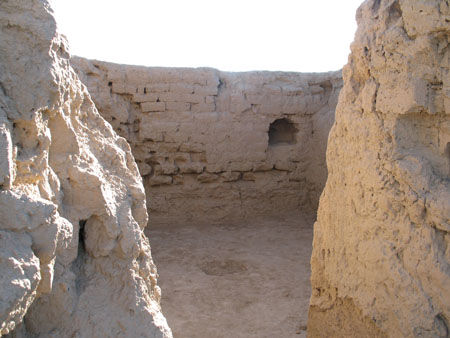
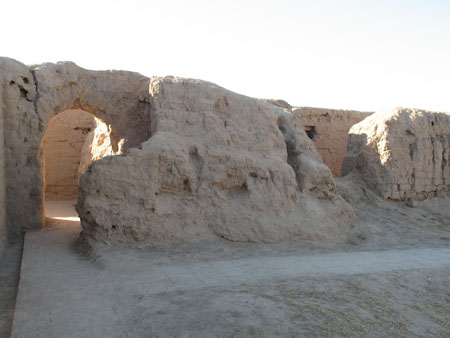
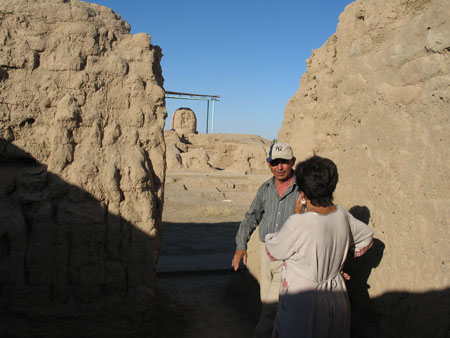
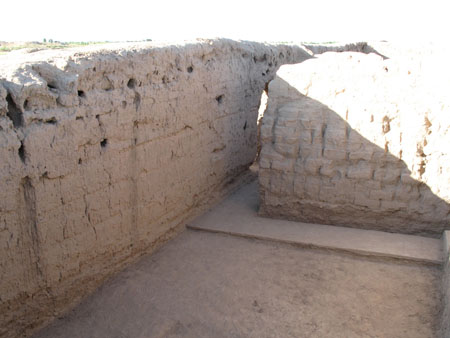
From ancient times the territory of Central Asia has been a crossing point not only of many caravan roads and ways, but also a place where different religions coexisted in ancient times: Zoroastrianism, Buddhism, Manichaeism. At present, several Buddhist temples survived in Uzbekistan. Among the most famous are Airatam, Kara-Tepa and Fayaz-Tepa.
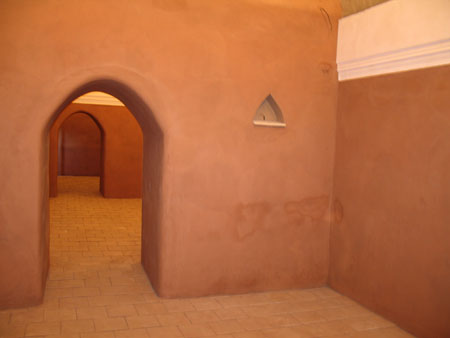
Fayaz-Tepa complex was discovered in 1963 by the archaeologist L. Albaum during excavations near the Buddhist temple on the Kara-Tepa hill in the heart of the old Termez. This temple complex is characterized by rich paintings and well-preserved sculptures. The complex is U-shaped series of corridors, cells and sanctuaries. Separately, there is a Buddhist dagoba, which is also of great interest.
Fayaz-Tepa, Termez
Fayaz-Tepa, Termez
Fayaz-Tepa, Termez

The building itself can be divided into three parts. One part is accommodation and ancillary buildings. Another one was the original dining room with kitchen, and a third one was used for performance of religious rites. Fayaz-Tepa is not only an iconic monument of Buddhism in Central Asia, but also of great value as one of the few monuments of Buddhist pictural art, which adorns the walls of the complex.
The walls along the temple were covered with paintings depicting the Buddha image variations. The walls of the sanctuary were decorated with images and story lines, one of which is the image of the two Buddhas, with images of women on both sides. The fact that the image of Buddha in Fayaz-Tepa is considered one of the most ancient images to have survived to the present date, and dates back to 1st century BC is of special importance.
Fayaz-Tepa, Termez
Fayaz-Tepa, Termez
Fayaz-Tepa,Termez
The sculptures discovered by archaeologists in Fayaz-Tepa are also noteworthy. In particular, this is the statue of Buddha sitting under the sacred bodhi tree, and two monks standing on both hands. All this is included in the arch, resting on Corinthian columns. The sculpture was carved from limestone and covered with gold leaf. Today, this sculpture is one of the most valuable exhibits of the State Museum of History of Uzbekistan.
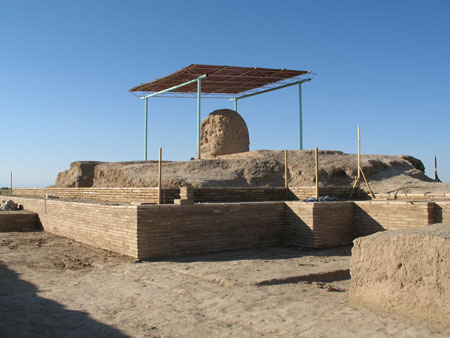
A giant dagoba of 10 meters high was discovered near the temple. There is a small dagoba inside of it of 3 meters high. This finding dates back to the 1st century AD.
In the 3rd century BC Termez was invaded by the Sassanid army, resulting in destruction of many Buddhist temples, including Fayaz-Tepa. At the time of archaeological excavations the building was heavily damaged and was under a huge layer of sand and dust. Today Fayaz-Tepa hosts a museum, research and restorations are underway.

Fayaz-Tepa pictures

Fayaz-Tepa, Termez
Fayaz-Tepa, Termez
Fayaz-Tepa, Termez
Fayaz-Tepa, Termez
Fayaz-Tepa, Termez
Fayaz-Tepa, Termez


Ruins of ancient bridges discovered in Xi'an


View of the north end of the ruins of No. 1 bridge of Chucheng Gate in the northern suburbs of Xi'an, capital of Northwest China's Shaanxi province, Jan 15, 2015.

ChinaDaily.com.cn    16 January 2015
Chinese archaeologists have found five large ancient bridges in Xi'an, the capital of Shaanxi province after 10 months of excavation. 
The archaeological excavations started in February and lasted till the end of 2014 on the ruins of Weiqiao, a group of bridges built during the Western Han Dynasty (206 BC-AD 24).According to Liu Rui, excavation team head and research associate with the institute of archaeology of Chinese Academy of Social Sciences, Weiqiao was an important transport hub that linked the dynasty capital of Chang'an (now Xi'an city) with its outside regions.
The excavations were jointly carried by the archaeologists from the institute of archaeology of Chinese Academy of Social Sciences, Shaanxi provincial institute of archaeology and Xi'an institute of cultural relics and archaeology.
Wang Zhiyou, research associate with Shaanxi provincial institute of archaeology, said according to the unearthed wooden bridge piles, experts speculate that the bridges would be more than 880 meters in length and more than 15.4 meters in width.
"The discovery of the bridges is of great value for the protection of the ruins of ancient Chang'an city and the study of the transportation history of the Qin (221 BC-207 BC)," Liu said.
Excavations on the ruins are ongoing.

View of the ruins of No. 1 bridge of Chucheng Gate in the northern suburbs of Xi'an, capital of Northwest China's Shaanxi province, Jan 15, 2015. [Photo/Chinanews.com]


 View shows the ruins of No. 1 bridge of Chucheng Gate in the northern suburbs of Xi'an, capital of Northwest China's Shaanxi province, Jan 15, 2015. [Photo/Chinanews.com]

 View shows an eaves tile unearthed at the ruins of No. 1 bridge of Chucheng Gate in the northern suburbs of Xi'an, capital of Northwest China's Shaanxi province, Jan 15, 2015. [Photo/Chinanews.com]

 View of a stone rammer unearthed at the ruins of No. 1 bridge of Chucheng Gate in the northern suburbs of Xi'an, capital of Northwest China's Shaanxi province, Jan 15, 2015. [Photo/Chinanews.com]

View of the ruins of No. 5 bridge of Chucheng Gate in the northern suburbs of Xi'an, capital of Northwest China's Shaanxi province, Jan 15, 2015. [Photo/Chinanews.com]

Friday, 16 January 2015

Rediscover and Celebrate the Silk Route Trade Heritage of Kargil

I47/ Munshi Aziz Bhat Museum, 
Munshi Enclave, 
Lakore, Kargil - 194193, 
Ladakh (Jammu & Kashmir), 
India

A family-operated, Public Museum dedicated to preserving the life and legacy of Munshi Aziz Bhat – A Silk Route trader, pioneer, visionary, social entrepreneur, collector, patriot, husband and father.


Our museum offers anyone who visits, a rare glimpse into the Indian and Central Asian trader culture of the 19th and early 20th centuries. Through its collection of artefacts and mercantile items, the museum exhibits the range of goods and services that were transported on the many maritime and overland trajectories of the Silk Routes. Apart from the commerce, the Silk Route memorabilia at the museum is an enduring peek into the lives of the many merchants, horsemen, herders, pilgrims, artisans, nomads and farmers who traversed these trader routes and evolved a culture that saw its ultimate demise with the growth of mechanised trade and reorganization of boundaries in the post-independence era.

Daastan-e-Resham Raasta – The Silk Route and its Stories 

The Silk Route, became eponymous with its most valued piece of trade, Silk from China, but items of every description for daily as well as luxury use were despatched from Asia to many ports and towns in Africa, Europe and the Americas, receiving produce and manufactured items from these, in return.
The overland and sea Silk Routes which were famous even in the reign of Alexander the Great and the Han Dynasty in China, expanded to become the centuries-old, multidirectional,  transcontinental thoroughfare for the movement, on horseback, donkey, mule, yak and foot,  of spices, salt and pepper; herbs, fruits and nuts; silk wool and cotton textiles; horse draping and equine accessories; finished garments, bags, buttons, caps and hats made of willow, cotton, leather and wool; pots and pans;  carpets; silk, wool, cotton and leather accoutrements; precious and semi-precious stones; jewellery, metal ware, ceramics and  of course – people!
In her account of the trans-Karakoram trade in the nineteenth and twentieth centuries, Janet Rizvi remarks how paradoxically development and technological progress have rendered the mountain barriers between different regions not less but more formidable than they were before. Earlier, “ancient routes, crossing savage ranges by high and often glaciated passes, could be negotiated by the feet of traders and pilgrims and their pack-animals…one such trail, trodden regularly by traders up to a mere 50 years ago, but today unthinkable as a regular route was that which breasted the Himalayas and the Karakoram, and created a commercial link between northern India and the part of Central Asia now known as Sinkiang. In fact, it was not much of a route as a whole complex of routes”. The Silk Routes, always combining both maritime and overland trade ways, spanned centuries and continents, making possible cultural, industrial and technological exchanges of goods and ideas among peoples across the world.
Hence, the fibres that bound this irrepressible network of trade were indeed not just of rare and expensive cloth. It was a veritable mix of traders, their goods and finery as well as protocols and life of the trading route that rendered it extensive and thriving! If we forage through history, we can find a story for each silent artefact.

Ek Tajir : Who was Munshi Aziz Bhat?

Munshi Aziz Bhat rose to prominence during the period 1880-1950 when all trading activity in Kargil, both retail and large scale trading was run and controlled by Punjabis and Hoshiarpuri Lalas. In the years between 1866 and 1948, he managed to rise as a large scale trader in the region.
Munshi Aziz Bhat joined Revenue department as a Patawari, but quit his job in 1915 to try his luck in business. In August 1915, he in partnership with a Punjabi Sikh merchant Sardar Kanth Singh started a retail cum whole sale shop with a buffer money of 6000 silver coins which is equal to Rs. 600,000 these days. Luck favoured them and by the end of the year they had made an annual profit of Rs 9000. In the year 1920, his partnership with Sardar Kanth Singh ended and he established his own large scale trading business with the help of his two older sons and a cousin. The enterprise was called “Munshi Aziz Bhat And Sons” with a successful trade extending in all the four directions. In the meanwhile, he was also appointed as the official petition writer of the Maharaja of the Jammu and Kashmir state for Baltistan Wazarat.

Ek Sarai: Kargil and the Silk Route

Munshi Aziz Bhat built the first ever inn in Kargil for the central Asian traders that came to be known as the Aziz Bhat Sarai. The Sarai was constructed in 1920 and was the main hub of activities which was a depot for goods going in all directions not only the silk route but also to  Tibet, India and Baltistan routes.( Janet Rizvi, Ladakh the cross road on Himalayas p:260). Janet Rizvi.
The Sarai is a three storied square building in old Kargil Bazar that used to also house the seven shops from where Aziz Bhat operated his business. The ground floor of the inn was used to keep horses and straw. The first floor to keep the goods of the traders and the third floor was used for their boarding and lodging. It can still be found in Kargil on the banks of river Suru in old Caravan Bazar.
This Sarai is considered the only surviving inn of the Silk route in Ladakh and North-west India and the discovery and range of mercantile items here, as opposed to just antique artefacts, has been an unprecedented find in recorded history.

The re-discovery – Two brothers rediscover an inn

The Aziz Bhat Sarai was part of the family possessions and property bequeathed by Munshi Aziz Bhat to his family. However, it remained under lock and key for almost half a century before the chance discovery of nothing less than a treasure prompted efforts that culminated in the establishment of the museum.
The story reads like the blurb of a mystery treasure novella. Two brothers contemplate what to do with an old dilapidating family property oblivious to the virtual treasure inside!  They rummage through it with the intention to dismantle and come across a host of assorted goods one day ( much like in a movie, the servant comes across a piece of turquoise, reports back and is rewarded for it!)
In fact, the brothers do not realize the importance of the treasure they have come upon. On the classic persuasion of a fortuitous encounter with a researcher, Jaqueline, who immediately recognizes the value of the contents, they eventually decide to not only safe-keep the memorabilia, but intensify efforts to house them in a museum in a designated house-space. But for not the intervention and advice of Jaqueline and family elders, the artefacts would have been forever lost as pieces of expensive antiques sitting in a shop.
All the artefacts were thus gleaned and curate from the mercantile items found at the Sarai, family possessions and relics, and donations from local and other interested parties.
In fact, rumour has it, that there are still objects of value in the old, rickety Sarai and the we are planning another excavation soon!
Thursday, 15 January 2015

Ancient golden artefacts found in Almaty Kazakhstan

Excavations of a burial mound in Alatau district of Almaty have uncovered unique golden artifacts, Tengrinews reports citing the City Department of Culture.

Archaeological research was conducted by an expedition from the museum of history of Almaty in the burial mound of Kok Kainar. Three historical artefacts were found. One of them is a golden figurine of a feline predator.

"It is made of two pressed embossed plates connected into a single sculptural figurine. It can be refereed to as a "playing kitten" for its pose. Dated back to the 4th century BC, the figure probably represented an element of a magical composition of a headwear. The artifact was found in the mound number 2 of Kok Kainar burial," the Department said.

The second finding is a golden plate with a picture of a bird. "The plate depicts a bird of prey, its head turned to the left, with a large beak, and wings unfolded. The bird is depicted against the background of strawberries. This image is treated as a heraldic symbol," the Department explained.

The last finding was a bronze mirror with a handle and a round bronze disc with a protrusion. The disk of the mirror and the ring are soldered together. This artifact was found in the burial mound number 1 and dates back to period from the 2nd century BC and the 2nd century AD.

All of these artefacts are kept in the Museum of History.

By Dinara Urazova