Tuesday, 24 February 2015

Kushan, Kushano-Sasanian, and Kidarite Coins

Kushan, Kushano-Sasanian, and Kidarite Coins
Spring 2015
by David Jongeward and Joe Cribb with Peter Donovan
List price: US$150
ISBN-13: 978-0-89722-334-8 
Hardback, 1 vols, 414pp

The Kushan Empire was a vast inland empire that stretched across Central and South Asia during the first to fourth centuries AD. The origins of Kushan dynasty continue to be debated, and precise dates, especially for the late Kushan kings, remain elusive, but the coinage reveals the Kushan dynasty as a major force in the cultural and political history of the ancient Silk Road.
Kushan coinage began c. AD 50 with issues of the first Kushan king, Kujula Kadphises(c. AD 50-90). The first Kushan coins were based on Greek, Scythian and Parthian coin designs already current in the territory of present day Afghanistan and Pakistan. Under Kujula Kadphises’ son Wima Takto (c. AD 91-113) and grandson Wima Kadphises (c. AD 113-127) the coinage system was gradually centralized to serve the entire Kushan empire, stretching from Uzbekistan and Tajikistan to northern India. Gold and copper denominations were established during the reign of Wima Kadphises which were maintained through the reigns of ten more kings until the demise of the Kushan empire in the mid-fourth century AD.
This catalogue presents all the Kushan coins in the American Numismatic Society, with selected illustrations, detailed descriptions and commentary. The production system of Kushan coinage is presented with major revisions of chronology and organization compared with previous publications. This presentation has been based on the latest coin-based research, including die studies and site find analysis. The coins are classified by ruler, metal, mint, production phase, denomination, type and variety. Introductory essays present the historical and cultural contexts of the kings and their coins. All the ANS gold coins and a selection of copper coins are illustrated. This catalogue also features two series of coins issued by the Kushano-Sasanian and the Kidarite Hun rulers of former Kushan territory because they followed and adapted the Kushan coinage system.
The authors intend this catalogue to be a tool for scholars and collectors alike for understanding, identifying, and attributing these fascinating coins that represent four centuries of Central and South Asian ancient history.

Expected ship date: Spring 2015

Mummy Found Hiding Inside Ancient Buddha Statue

mummy buddha
During routine restoration, researchers discovered a surprise hidden in an ancient gold-painted Chinese Buddha statue: a mummy hidden inside. The mummy was once the Buddhist monk Liuquan, according to text found with the statue.
Credit: ©Ben Heggelman (Meander Medical Centre, Amersfoort) / Universityhospital Mannheim

A Chinese statue of a sitting Buddha has revealed a hidden surprise: Inside, scientists found the mummified remains of a monk who lived nearly 1,000 years ago.
The mummy may have once been a respected Buddhist monk who, after death, was worshipped as an enlightened being, one who helped the living end their cycle of suffering and death, said Vincent van Vilsteren, an archaeology curator at the Drents Museum in the Netherlands, where the mummy (from inside the Buddha statue) was on exhibit last year.
The secret hidden in the gold-painted statue was first discovered when preservationists began restoring the statue many years ago. But the human remains weren't studied in detail until researchers took scans and samples of tissue from the mummy late last year.
statue is now on display at the Hungarian Natural History Museum in Budapest. [Image Gallery: Inca Child Mummies]
Mysterious history
The papier-mâché statue, which has the dimensions, roughly, of a seated person and is covered in lacquer and gold paint, has a murky history. It was likely housed in a monastery in Southeastern China for centuries. It may have been smuggled from the country during the Cultural Revolution, a tumultuous period of social upheaval in Communist China starting in 1966 when Chairman Mao Zedong urged citizens to seize property, dismantle educational systems and attack "bourgeois" cultural institutions.
buddha mummy statue
A gold-painted papier-mâché statue of the Buddha contained the mummified remains of an ancient Buddhist monk who lived during the 11th or 12th century. Here, a researcher inspects the statue.
Credit: © Drents Museum


The statue was bought and sold again in the Netherlands, and in 1996, a private owner decided to have someone fix the chips and cracks that marred the gold-painted exterior. However, when the restorer removed the statue from its wooden platform, he noticed two pillows emblazoned with Chinese text placed beneath the statues' knees. When he removed the pillows, he discovered the human remains.
"He looked right into the bottom of this monk," van Vilsteren told Live Science. "You can see part of the bones and tissue of his skin."
The mummy was sitting on a rolled textile carpet covered in Chinese text.
Researchers then used radioactive isotopes of carbon to determine that the mummy likely lived during the 11th or 12th century, while the carpet was about 200 years older, van Vilsteren said. (Isotopes are variations of elements with different numbers of neutrons.)
In 2013, researchers conducted a CT scan of the mummy at Mannheim University Hospital in Germany, revealing the remains in unprecedented detail. In a follow-up scan at the Meander Medical Center in Amersfoort, Netherlands, the researchers discovered that what they thought was lung tissue actually consisted of tiny scraps of paper with Chinese text on them.
The text found with the mummy suggests he was once the high-status monk Liuquan, who may have been worshipped as a Buddha, or a teacher who helps to bring enlightenment after his death.
Last year, the mummy was on display at the "Mummies – Life Beyond Death" exhibit at the Drents Museum in Netherlands, before moving to the Hungarian Natural History Museum in Budapest.

Common practice
Mummies from this period are fairly common in Asia. For instance, researchers in Mongolia recently found a 200-year-old mummified monkstill in the lotus position, the traditional cross-legged meditative pose.
It's not clear exactly how Liuquan became a mummy, but "in China, and also in Japan and Laos and Korea, there's a tradition of self-mummification," van Vilsteren said.
In some cases, aging Buddhist monks would slowly starve themselves to eliminate decay-promoting fat and liquid, while subsisting mainly on pine needles and resin to facilitate the mummification process, according to "Living Buddhas: The Self-Mummified Monks of Yamagata, Japan," (McFarland, 2010). Once these monks were near death, they would be buried alive with just a breathing tube to keep them holding on so they could meditate until death.

"There are historical records of some aging monks who have done this practice," van Vilsteren said. "But if this is also the case with this monk is not known."

For more information, read HERE

Monday, 23 February 2015

Locating the Rock of Aornos


The Nation, 31 January 2015 by Llewelyn Morgan                                                                    
 If you thought the British in India in the nineteenth and twentieth centuries were stretching every sinew to deprive Indians of their right to self-determination, think again. Because what a lot of them spent a remarkable amount of time and energy doing waslocating the Rock of Aornos.
This mountain, somewhere to the west of the Indus in what is now Khyber Pakhtunkhwa, was the site of a famous victory by Alexander the Great in 327/6 BC, but that was about as much as anyone knew: ancient writers generally aren’t too hot on geographical precision. Still, it was a rare visitor to the territory beyond the river who didn’t see fit to express his firm opinions on the matter. Aornos was at Ranigat, or near Attock, or maybe Tarbela .James Abbott, the political officer who gave his name to Abbottabad, scrutinized the mountains to the west of the river, presumably with a telescope: British jurisdiction in his day (the 1850s) only reached as far as the Indus, and he couldn’t get any closer. Nevertheless Abbott’s candidate for Aornos, Mt Mahaban, was the favourite for a while until Aurel Stein’s visit to Swat in 1926. In On Alexander’s Track to the Indus, Stein made a powerful case for Pir Sar, a mountain ridge further up the Indus, and there generally the question rested.
The Europeans who set eyes upon the Indus in the nineteenth century were a motley bunch, imperial functionaries, spies, deserters, mercenaries. But almost to a man they were obsessed with Alexander and any evidence they could find of his presence in this part of the world, whether the coins with Greek inscriptions that Alexander’s successors minted, or the physical landmarks of Alexander’s campaigns acrossCentral and South Asia. There was intense debate about the location of Alexandria in the Caucasus, for example, a city founded by Alexander before he crossed the Hindu Kush in 329BC. It’s now securely identified as Begram, the site of the airbase north of Kabul, but many in the nineteenth century were convinced it was Bamiyan. The most famous of travellers beyond the Indus, in his own day at least, was Alexander Burnes, author of the bestselling Travels into Bokhara. Burnes lost a day on his travels to Bokhara on the banks of the river Beas in the Punjab, searching fruitlessly for the twelve huge altars that Alexander had erected to the Olympian Gods at the point of his furthest advance into India.
But Aornos was the great prize. The capture of the fortress-mountain, so impregnable it was said even Hercules had failed to conquer it, was one of Alexander’s very greatest exploits. 
It’s worth wondering why Alexander was so very important to these men. They had all received good classical educations (Abbott’s argument for Mt Mahaban is full of quotations of the Latin and Greek sources, for example), so he was a European hero they had read about since childhood. It helped also that most of them had a very rosy picture of Alexander’s campaigns in Asia. According to Josiah Harlan, an American soldier of fortune in Afghanistan in the 1830s, he was “a European philanthropist” who “performed feats that have consecrated his memory amongst the benefactors of mankind, and impressed the stamp of civilization on the face of the known world.”Alexander was a model for men who believed, as these men did, that they too were bringing “civilization” to backward peoples: Harlan was an extreme example of this, increasingly incapable of distinguishing himself from Alexander of Macedon. But Alexander was also, I think, something familiar in the very alien and disorienting terrains and cultures where these men found themselves. If these European interlopers could convince themselves that Alexander had been there before they had—had even left his mark on this exotic landscape—that made them less anxious about their own presence in places they really didn’t belong.
Harlan’s assessment of Alexander was romantic nonsense, needless to say. In reality Alexander campaigned with remorseless brutality, and left unimaginable chaos in his wake. The academic Horace Hayman Wilson, writing in the 1840s, pointed out that the ferocious campaigns attributed to Alexander “would have been held up to execration had they been narrated of a Jangiz or a Timur, but are passed over almost unnoticed by historians when they are narrated of the type of classical civilization, a Greek.” Absolutely right, but Wilson’s was a very lonely voice at the time, and much later even a man of immense humanity like Aurel Stein seemed to lose all objectivity when Alexander was mentioned, reverting perhaps to the excitement of the schoolboy who first heard of Alexander’s exploits. In the 1990s the TV historian Michael Wood travelled toPirSar and met an old man who still remembered Stein: ‘He spoke a lot about Iskander...’
PirSar, Stein’s candidate, undoubtedly fits well with the ancient accounts of the capture of Aornos, and most writers on Alexander still accept Stein’s identification. But I happen to prefer another theory which identifies Aornos as Mt Elam, near Barikot. I like it because it juggles the ancient accounts pretty well, but mainly because it allows another voice to be heard besides that of Alexander and the triumphant Greeks. 
Let me try to explain myself.
Giuseppe Tucci was an Italian expert on Buddhism who spent a lot of time in Swat investigating the Buddhist and other archaeological remains there. He had a chequered history, a bit too close to Mussolini, and a bit too close also to the regime in Japan in the 1930s, whose militarism was more Buddhist in inspiration than most people appreciate. But Tucci’s research in Swat gave him something that other Aornos hunters, armed with their classical texts, didn’t have, and that is an understanding of the culture and beliefs of the people Alexander encountered when he invaded, the victims of the Aornos campaign as opposed to the Greek victors. 
The ancient sources describe people from all around taking refuge, in face of the Macedonian onslaught, on this mountain top, only for Alexander to capture it amid predictable scenes of carnage. Tucci was convinced that, if the people of this area had needed to take refuge from an invader, they would have gone to a sacred place, and evidence suggests that Mt Elam was a holy mountain for the people of Swat from time immemorial. There is a story of the Buddha associated with the place: we’re told by the Chinese traveller-monk Xuanzang, who climbed Elam in the seventh century AD, that in an earlier life the Buddha was happy to die here in return for hearing just half a verse of the Buddhist teaching. Elam is also a place of pilgrimage for Hindus, sacred to Rama, whose name has been written on a rock at its summit. Even the tale told by the Greeks of Hercules’ attempts to capture Aornos hints at a local myth of a god’s abode assaulted by another god or demon.
The ancient accounts of the capture of Aornos are predictably violent: Alexander’s troops reached the summit as the defenders had begun to make their escape, and massacred many of them as they fled. “Others, retreating in panic, perished by throwing themselves down the precipices,” the Greek historian Arrian records. If Tucci was right, what Alexander’s troops were doing was attacking the most sacred place of the Swati peoples, the abode of their god or gods, somewhere to which they would only resort in absolute desperation.Tucci suggests that the name that the Greeks heard as “Aornos” was in the local language “aarana”, “a common name for any sheltered place.” If Aornos is Elam, a tale of exceptional military prowess becomes more like a story of the impact of war on civilian populations.
Incidentally, I’m glad to see that Tucci’s theory, even if it’s generally overlooked by historians of the ancient world, is well known where it matters. Malala describes gazing at Mt Elam from her bedroom window in Mingora, “a sacred mountain” to which the Swati people fled as Alexander approached “believing that they would be protected by their gods because it was so high.” I’m sure she’s right about this, as she is about so many things.

Sunday, 22 February 2015

Brill's Encyclopedia of Buddhism


It has been evident for many years that no authoritative, reliable, and up-to-date reference work on Buddhism yet exists in any language. 
Brill’s Encyclopedia of Buddhism aims to fill that gap with a comprehensive work, presented in two phases: a series of six thematic volumes including an index volume, addressing issues of global and regional importance, to be followed by an ever-expanding online resource providing access both to synthetic and comprehensive treatments and to more individuated details on persons, places, texts, doctrinal matters, and so on.
Illustrated with maps and photographs, and supplemented with extensive online resources, the print version of the thematic encyclopedia will present the latest research on the main aspects of the Buddhist traditions in original essays written by the world’s foremost scholars. 
The encyclopedia aims at a balanced and even-handed view of Buddhist traditions, presenting the most reliable accounts of well-known issues and filling gaps in heretofore-neglected areas. In doing so, it emphasizes that Buddhism is simultaneously constituted by a plurality of regional traditions and a far-reaching phenomenon spanning almost all of Asia, and more recently far beyond as well.
Volume I, which will appear in 2015, surveys Buddhist literatures, scriptural and nonscriptural, and offers discussions of the languages of Buddhist traditions and the physical bases (manuscripts, epigraphy, etc.) available for the study of Buddhist literatures. 
Subsequent volumes will address issues of personages, communities, history, life and practice, doctrine, space and time, and Buddhism in the modern world.

ISBN13: 
9789004283435
Expected Date: 
July 2015
Format: 
Hardback
Publication Type: 
Pages, Illustr.: 
approx. 750 pp.
Imprint: 
Language: 

The Conservation of a 5th century Buddhist Gandharan Manuscript

Separation Anxiety:
The Conservation of a 5th century Buddhist
Gandharan Manuscript
February 21, 2000
(click on small images to go to full page images with captions)
"Then, in the midst of the gods of the heaven of the thirty-three, a son of a god was dwelling in the Sudharma, the palace of the gods. In a huge heavenly mansion, surrounded by great divine opulence and great groups of divine young women, he played with them and made love. After he had enjoyed this divine opulence, during the night, he heard a voice:
"The son of a god will die on the seventh day. When he has died, he will be reborn again in the Indian continent, and there too he will expense seven states of rebirth. After experiencing seven states of rebirth, he will be reborn in Hell.
If even once in a hundred times he is reborn as a man, he will be poor and blind -- by him this was heard."
So begins the translation of one of the 5th century Buddhist sutras found within a recently discovered early manuscript.
The Project
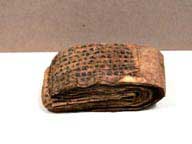
Fig. 1
In the fall of 1998, a professional numismatist, with a specialty in Classical antiquity, brought an early manuscript to my studio for consultation. (Fig.1) The elongated leaves were brittle, compressed together, water damaged, and folded into a tight "S" curve, like a wad of dollar bills after the wash cycle. This manuscript was found in the Bhamiyan cave region in modern Afghanistan, purportedly from the 5th century, on birch bark, and written in the Kharoshti script.
The owner's hope was that the manuscript leaves could be opened and separated, in order to be translated. He explained to me that this manuscript was extremely rare, and that the owner hoped to discover any missing links to the history of early Buddhism.
Ethical ConsiderationsBut before agreeing to take this project on, I had several philosophical and ethical questions. I am familiar with many types of Asian books and manuscripts; and have considerable experience examining and treating early Buddhist sutras on paper & Indian palm-leaf manuscripts. (Fig. 2) These Indian and Himalayan manuscript types provoke inquiry and ethical considerations, especially issues regarding the treatment of sacred objects. As with most ethical questions, there are a wide variety of answers, depending on the opinions of religious and museum specialists.
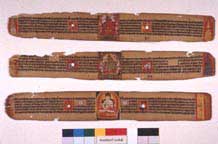
Fig. 2
When Buddhist sutras are found inside sculptures, conservators and curators often disagree on the appropriateness of removing these rolled-up documents from their consecrated compartments and treating them individually as works on paper. Additionally, some published accounts insist on the importance of having a religious official re-consecrate the sutras prior to insertion back into the sculptural cavity.
Indian palm-leaf manuscripts present fewer ethical problems for the conservator, as they are often collected individually for their illustrated images, and many beautiful examples exist in museums, libraries, and private collections. Palm leaf manuscripts were probably in use as early as the 2nd century, but no extant leaves survive earlier than the 10th century. Because palm-leaf is still used today in India for certain religious writings, much is known about the manufacture and treatment of the material.
Birch Bark
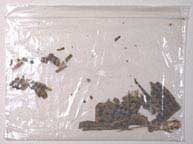
Fig 3
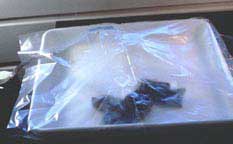
But what about birch bark? Prior to the day last fall when I first examined this manuscript, I was completely unfamiliar with the material as a support for writing. Admitting this to the client in our initial meeting, I took several slides, and was given a small bag of manuscript fragments (Fig. 3) in order to begin research and testing on an appropriate treatment methodology. To be honest, I didn't have very high hopes, and, as I talked to colleagues about the project -- I couldn't find anyone else in conservation familiar with this type of early manuscript. I was anxious about treating this object for many reasons: the object was purportedly from the 5th century, it might be a missing link to the history of Buddhism, and it was also extremely valuable. So, research and testing had to resolve whether this treatment would provide the desired results.
Initial research 
Before commencing a literature survey, I consulted several colleagues who had great experience with manuscripts, early non-paper collections, and Indian art in general. Colleagues familiar with papyrus were particularly helpful, and other colleagues tried to convince me that the manuscript must be on palm-leaf, which was my initial error as well. A particularly helpful consultation was with Nancy Turner, Manuscript Conservator at the J Paul Getty Museum. I brought my slides and my fragments up to her lab, and we examined them under the microscope, and they were, in fact, bark. We could clearly see the laminated layers of very thin barks and examine the inks and written inscriptions very clearly.
The literature survey was sparse but useful, with a great deal of historical data, but little information on conservation treatment.
History of birch bark as a material for writing
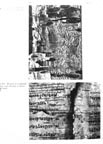
(Fig. 4) The research in Butterworth's Conservation of Manuscripts and Paintings of South-East Asia, revealed that birch-bark (called bhoja-patra) was a primary writing material along with palm-leaf in India before paper. Birch bark was mentioned as a writing material by the Greek historian Q. Curtius, noting its wide use during Alexander's invasion by Hindus. Early extant manuscripts date to the 2nd and 3rd centuries, written in the Kharoshti script. Fragments survive from a range of time periods, and the material is described throughout Indian literature. Bhoja-Patra's use diminished in the Mughal period when paper replaced it as a writing material, but it still has a sacred status in India today.
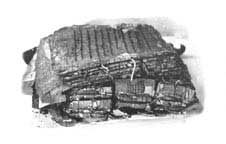
Fig 4
Despite its status as a sacred material, all of the literature focused on bhoja-patra's use as a support for writing. Buddhist sutras were written by monks, and often sponsored by donors, who might be high lamas or officials. The manuscripts are not illustrated and have no history of association with consecrated sculptures or images. Bhoja-patras were literally the Ancient database of Buddhism in India.
Gandhara
The manuscript brought to my studio, now called the "Los Angeles manuscript" was found in the Bamiyan cave region of modern Afghanistan. In ancient times, this area was part of Gandhara, the region invaded by Alexander the Great in 326 BCE. Gandhara became a second Holy Land of Buddhism, and most extant sculpture from the region took the form of Buddhist cult objects, Buddhas and Boddhisattvas, (Fig. 5) like this Boddhisattva sculpture from the 3rd century in the Norton Simon Museum, or architectural ornament of Buddhist monasteries. Because of the strong influence of the Greeks and Romans, Gandaran sculpture reveals many Western classical elements, including the treatment of the robe and its heavy folds, and the physiognomy of the central figure. Interaction through caravan trade routes and the Silk Route in particular maintained these stylistic exchanges.
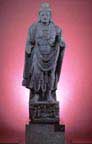
Fig 5
Fig 6
Bamiyan Caves
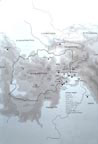
One of the greatest sites in Gandhara is Bamiyan, a mountain valley in north-central Afghanistan. (Fig. 6) A high cliff forms one side of the valley and is honeycombed with monastic dwellings, bounded on either side by colossal Buddhas in niches cut out of the rock. The largest, depicted here, is 174 feet high, and in the Gandharan style. (Fig. 7) The region is full of monasteries, stupas, and caves, some with rich interior depositories of paintings, murals, and manuscripts.
Fig. 7Fig. 8
In the studio
The literature states that the inner bark of the birch tree was used for writing. (Fig. 8) After being peeled off the tree, the bark was dried. Oil was then applied over it and it was polished. Layers were joined together by a natural gum. Finally it was cut to a suitable size and kept in between wooden covers. The ink used for writing on birch bark was "Indian black, a carbon ink. It was prepared by burning almond shells to charcoal, which was then boiled with cow's urine. This ink is said to have a special brilliance and is fast to washing." Tests have shown birch bark sheets to be typically 0.2 - 0.5 mm thick, and contain a cellulose content of 38%. Additionally, birch bark is highly soluble in organic solvents, but not soluble in cold water.
Fig 9
Initial research complete, I began to test the fragments in the studio. (Fig. 9) The inks proved stable, as predicted in the literature, and the birch bark itself became supple in high humidity and contact with water, without staining. Bolstered by these results, I agreed to take on the project.
Treatment
Once we had the manuscript in the studio, we began detailed written and photographic documentation prior to treatment. (Fig. 10) I had decided to use humidity to attempt to open, separate, and flatten the leaves. But before I describe the steps employed, I would like to read the only historical account I could find in the literature for separation.
It reads:
"In the 1930's, the Musee Guimet in Paris had acquired bundles of birch bark found at Bamiyan in Afghanistan. Any attempt to open the sheets was resulting in the breaking of the sheets into small bits. Water vapor had no effect on separating them. Finally, hot paraffin oil was used to soften and separate the stuck sheets. The reason for choosing paraffin was its clarity and preservative quality. The fragments were immersed in cold oil which was then heated on a slow fire for some time until a light smoke started coming from the oil. In this condition it was possible to detach the leaves from one another with the help of a pair of tweezers. The mud split up easily and each piece was cleaned, drained and laid on a sheet of glass. Each fragment, along with the oil, was sealed in glass. The edges of the glass sheets were sealed with paraffin wax."
They go on to point out the primary disadvantage of this treatment is their weight and bulky storage requirements, but clearly there are other disadvantages!
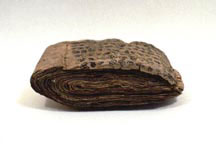
Fig. 10Fig. 11
The Conservation Treatment
Since the inks were stable, and the bark impervious to water staining, I began humidifying the manuscript using an ultrasonic humidification chamber made from a photo tray and plastic sheeting and maintaining 80% relative humidity (RH). (Fig. 11) While watching carefully for excess precipitation, the manuscript underwent humidification in this fashion for several days. To my great satisfaction, the leaves began to relax, but were not wet. I continued to humidify the manuscript in this fashion for another 72 or more hours, which allowed me to begin carefully manipulating the "block".
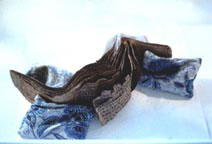
Fig 12
Fig 13
As you can see, I was able to begin to open the entire manuscript from its tight "S" configuration to a looser shape. (Fig. 12) Maintaining a minimum of 70 - 80% RH, the entire block not only began to open, but the outer leaves began to separate as well. (Fig 13) Soon I was able to begin separating the outer most leaves with the mechanical aid of a Teflon coated microspatula and removing them completely from the block. Despite all of this humidification, the leaves were still extremely brittle and fragile, and great care had to be employed. Also -- most leaves were split down the center, and had many other fractures and loose attachments. At many times in this project, more than one pair of hands and eyes were needed, both to handle the delicate leaves, and double check accurate collation of a manuscript in a non-Roman alphabet.
Once the first group of 6 outer leaves were removed, they were placed on a damp blotter and Gore-Tex layer, and gently held in place until the top of the "blotter sandwich" could be placed on top. Needless to say, this first group's successful separation was extremely exciting around the studio, and I called the owner with the initial good news.
We continued the treatment, and subsequent leaves also separated in this fashion, followed by further humidification once flat, followed by flattening between dry cotton waterleaf blotters. In the end, the leaves opened up to approximately 2 inches high by 14 inches wide, from the original 2 x 3 inch folded object.
Presentation
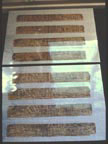
Fig 14
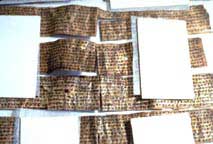
Since the goal of this project was translation of the manuscript(s), I recommended Mylar encapsulation without repair of the individual leaves. This way, the leaves would remain flat and could be handled, and there would not be any repair tissues obscuring any text. We designed a 14 x 18" Mylar package, dividing each sheet into four rows to accommodate the manuscript leaves. Each package contained two Mylar sheets and horizontal rows of double stick tape. (Fig 14) The bottom Mylar sheet was clamped to the work table, and, working together, we would bring over each manuscript leaf one at a time, in order; lift the tape paper, and seal down the "row" to lock in the leaf. I was so afraid of losing the order or flipping the leaves, since I don't read Kharoshti or Sanskrit, that we were extremely careful about collation.
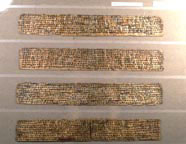
Fig 15

Success
In the end, the treatment was a great success. (Fig. 15) All of the leaves separated, and remained flat in their encapsulated packages. There were fragments and areas of birch-bark leaf loss, just like any ancient material like papyrus, but all the scraps and fragments were saved and encapsulated in the precise order of the original folded object.
Translation
After the final meeting with the very pleased owner, and the work was released from the studio, the manuscript was taken away for translation. After being photographed, transparencies were sent to Richard Salomon, the author of Ancient Buddhist Scrolls from Gandhara, a publication of the British Library. This book came out in June 1999, six months after my research and treatment. In the book, Mr. Saloman states:
"As the Dead Sea Scrolls have changed our understanding of Judaism and early Christianity, so a set of 29 scroll fragments acquired in 1994 by the British Library promise to improve our  knowledge of the history of Buddhism".
This surprising discovery in 1994 revealed over two dozen texts which had not been identified with previously known texts in other Buddhist languages and traditions.
After Mr. Saloman's initial consultation, it was sent to Dr. Gregory Schopen at UCLA, who translated the manuscript. This was the result: the 40-odd leaves or fragments were two complete books, or texts, and the technical name for the script is "upright Calligraphic Gupta". The larger text was a previously known Buddhist sutra and the equivalent of 37-40 leaves. The transliteration and translation were sent to me along with the information that the "smaller of the two books, which Dr. Schopen has dubbed the "Los Angeles Manuscript", consists of a seven page incantation apparently unknown in contemporary manuscripts and thus of significantly more interest to scholars." This manuscript is now in the process of being published by Dr. Schopen, and is every bit the "missing link" to history as the owner had hoped.
I would like to thank the many colleagues and associates who assisted me in my research and treatment, and in the preparation of this paper. In particular, thanks to aNancy Turner, Manuscript Conservator at the J. Paul Getty Museum, for her consultation, and my studio associate Micol Hebron. In addition, I would like to thank Dr. Page duBois, Professor of Classical Studies and Comparative Literature at UC San Diego, Indian art specialists Christine Knoke at the Norton Simon Museum and Dr. Stephen Little at the Art Institute of Chicago, and the LACMA Conservation Center for use of their library and resources.

Susan Sayre Batton
Art Conservation & Consulting Services
Los Angeles, California
suesayre@aol.com


Bibliography
Agrawal, O.P., Conservation of Manuscripts of Southeast Asia.
Butterworth.

Agrawal,. O.P., "Investigations for preservation of birch-bark manuscripts",
Preprints of ICOM Committee for Conservation, Vith Triennial Meeting, Ottawa (1981) Paper.

Filliozat, Jean, "Manuscripts on birch-bark (Bhurja patra) and their
preservation", The Indian Archives, 1 (1947) 102-8

Harle, J.C., The Art and Architecture of the Indian Subcontinent. 
Penguin Books.

Friday, 20 February 2015

Islamic coins found in a Viking Age grave from Norway

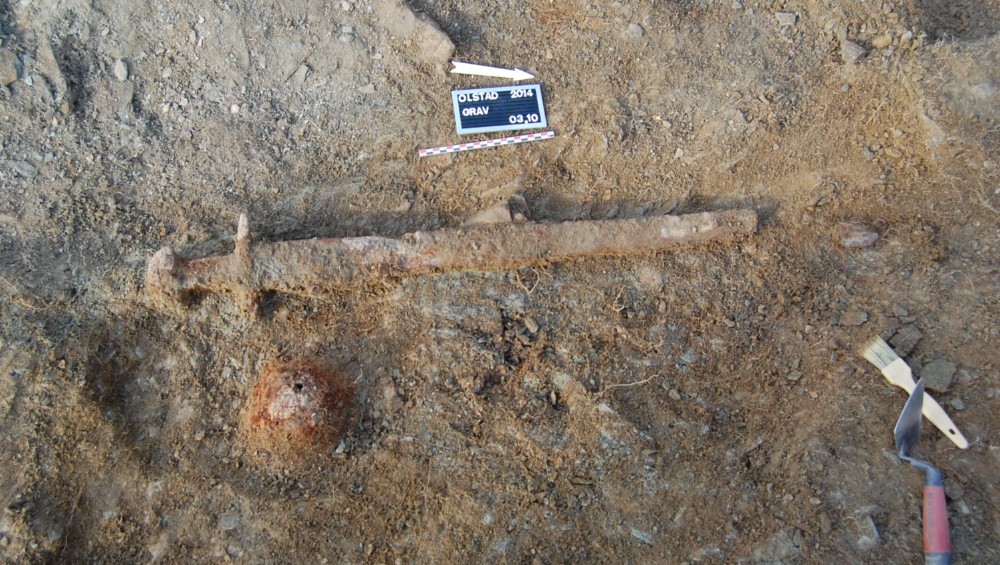
Viking sword
The Viking grave (PHOTO: RAGNAR VENNATRØ / NTNU / SCIENCE MUSEUM)
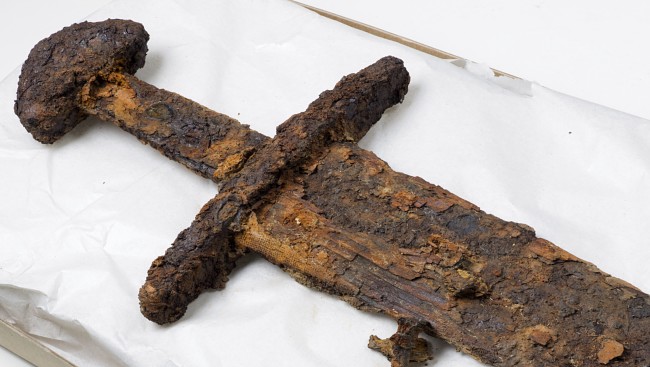
Archaeologists have uncovered a Viking Age grave in Skaun, Norway that most likely contained the remains of a warrior. The person died in circa 950 AD and was buried with their weapons, which included a well preserved sword and shield boss.
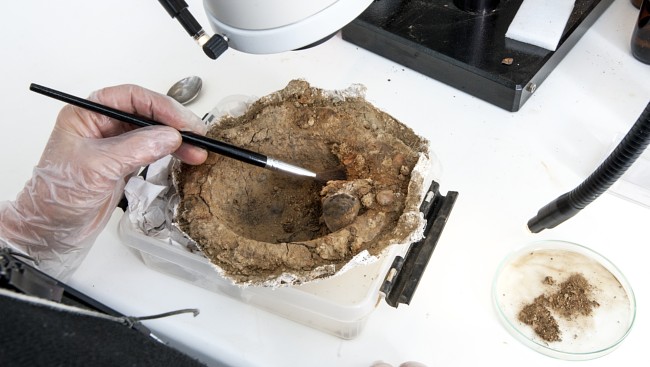
Viking shield boss
Remains of a leather purse were found inside the shield boss. (PHOTO: ÅGE HOJEM / NTNU / SCIENCE MUSEUM)
The wooden part of the shield had decayed and disappeared in antiquity but the metal boss survived. It contained a strike mark on its surface, most likely delivered by an axe or sword, indicating that it had been used in combat. More surprisingly, the shield boss also contained a number of Islamic coins, which had been hidden inside a leather bag.
Viking sword norway
Sword fully cleaned. Remains of an inscription and textiles have emerged (PHOTO: ÅGE HOJEM / NTNU / SCIENCE MUSEUM)
According to archaeologist Ingrid Ystgaard, the coins may indicate ‘that this person visited the eastern part of the Viking world, possibly a town such as Holmgard in what today is Russia‘.
Source: NRK 

Die alten Seidenstrassen zwischen China und Syrien

Die alten Seidenstrassen zwischen China und Syrien


  • Paperback: 84 pages
  • Publisher: Vero Verlag (27 Nov. 2014)
  • Language: German
  • ISBN-10: 3737206570

"Die ersten direkten Handelsbeziehungen, die im Altertum zwischen China und den Iranisch-Turanischen Ländern bestanden haben (114 v. bis 23 n. Chr. und 87 - 127 n. Chr.), sind für die Erweiterung der geographischen Kenntnisse der Chinesen von unermesslicher Tragweite gewesen. Während früher ihr Gesichtskreis kaum weiter als bis zu den Grenzen ihres Mutterlandes gereicht hatte, erfuhren sie, als Tschang K'ien von seiner grossen Expedition nach den Ländern am Jaxartes und Oxus zurückkehrte, zum ersten Male von der Existenz grosser Kulturvölker im Westen; mit diesen traten sie bald, nachdem Tschang K'ien die Wege durch das Tarimbecken und über die Pamirpässe für einen geregelten Verkehr gebahnt hatte, in nähere Berührung, wodurch sie neue Länder kennen lernten; und als um 100 n. Chr. der Verkehr seinen Höhepunkt erreichte, sammelten sie eifrig Nachrichten über die Syrer, da diese damals mehr als manche anderen Handelsvölker auf die Einfuhr der chinesischen Seide bedacht waren, um sie in ihren Industriestädten zu den verschiedensten Geweben zu verarbeiten. Dass die Chinesen auf diese Weise mit einer von ihnen erst jetzt entdeckten Welt engere Fühlung gewannen, hatten sie nicht zum wenigsten der weisen Politik einiger ihrer Kaiser, die dem damals herrschenden Hause der Han angehörten, zu danken. Am eingehendsten haben sie, von Handelsinteressen geleitet, die für den Verkehr zugänglichen Länder Zentralasiens erforscht." [...] Vorliegender Band bietet einen wunderbaren historischen Überblick über die alten Seidenstrassen zwischen China und Syrien. Dieses Buch ist ein unveränderter Nachdruck der längst vergriffenen Originalausgabe von 1910.

Thursday, 19 February 2015

Golden Coins Discovered in Genghis Khan's City Of Karakorum, Mongolia


Gold coins belonging to the era of legendary Genghis Khan have been discovered in the ancient capital of Karakorum (Qara Qorum) in Mongolia along with several items made of coral, pearl and turquoise.

Genghis Khan founded Karakorum in 1220. After his exploits on the Eurasian steppes, the city became the center of a substantial and growing empire.
Karakorum lies 360 kilometers southwest of Ulan Bator, on Mongolia's main east-west route.
The city has been razed several times since Genghis Khan's day. But in Mongolia, Karakorum remains a powerful symbol of past glory.


The excavations in the area have been conducted over the past 15 years and now archaeologists of the Mongolian-German Karakorum Expedition have displayed the findings preserved in the Karakorum museum.


During the excavation works performed in 2014 in the ancient capital Karakorum by the expedition, many interesting findings including gold coins of Genghis Khan's era were unveiled," reports Business standard.

"Gold coins belonging to the era of legendary Genghis Khan have been discovered in the ancient capital of Karakorum in Mongolia along with several items made of coral, pearl and turquoise. Archaeologists of the Mongolian-German Karakorum Expedition have displayed the findings preserved in the Karakorum museum. During the excavation works performed in 2014 in the ancient capital Karakorum by the expedition, many interesting findings including gold coins of Genghis Khan's era were unveiled. "A consecrated placement of relics in a stupa to Khans of the 13th century was found underneath the entrance stand of the temple named 'Great temple of Tsogt'," archaeologists were quoted as saying by Mongolian news agency MONTSAME. The consecrated placement consisting of nine treasures wrapped in silk, crop and fruit was put inside a big vase with clay cap. Treasures were represented by two gold coins, three silver coins and several items made of coral, pearl, turquoise, copper and steel. One of the two gold coins is made in Samarkand and belonged to the Genghis Khan period while silver coins were made during the Mongke Khan rule. The archaeologists from Mongolia and Germany are now preserving these artifacts in the Karakorum museum for further research. A project has already begun for the construction of an open museum for preserving the archaeological remains of the temple. Genghis Khan was the founder and emperor of the Mongol Empire that existed during the 13th and 14th centuries and became the largest contiguous empire in history after his demise."
Business Standard 27 November 2014

First silver coins with the first mention of the Mongolian capital and also the first known coin that bears the name of Karakorum "Qara Qorum". The year 635 Islamic or Christian era 1237-8. The coins deciphered by Dr Stefan Heidemann, University of Jena, Germany.


Treasures were represented by two gold coins, three silver coins and several items made of coral, pearl, turquoise, copper and steel.
One of the two gold coins is made in Samarkand and belonged to the Genghis Khan period while silver coins were made during the Mongke Khan rule.
The archaeologists from Mongolia and Germany are now preserving these artifacts in the Karakorum museum for further research.
A project has already begun for the construction of an open museum for preserving the archaeological remains of the temple.
Genghis Khan was the founder and emperor of the Mongol Empire that existed during the 13th and 14th centuries and became the largest contiguous empire in history after his demise.

The Life and Times of Sultan Mahmud of Ghazna

The Life and Times of Sultan Mahmud of Ghazna


  • Paperback: 288 pages
  • Publisher: Cambridge University Press; Reissue edition (11 Dec. 2014)
  • Language: English
  • ISBN-10: 1107456592

Originally published in 1931, this book presents a historical account regarding the life and times of Mahmud of Ghazni. Detailed information is given on Mahmud's seventeen expeditions into northwestern India, with a particular emphasis on their geographical setting. Additional sections discuss the context of his rise to power, his administrative systems and perceptions of his character. Comprehensive notes are included throughout, together with extensive appendices, incorporating a chronological summary and a bibliography. This book will be of value to anyone with an interest in Islamic history and Mahmud of Ghazni.