Monday, 26 December 2016

The Old Uyghur Agama Fragments Preserved in the Sven Hedin Collection


Sunday, 25 December 2016

Women in Mongol Iran: The Khatuns, 1206-1335

Women in Mongol Iran: The Khatuns, 

1206-1335

Hardcover – 28 Feb 2017


Saturday, 24 December 2016

In Charlotte USA from Nov. 19, 2016- April 30, 2017 exhibition about Genghis Khan

In Discovery Place Science in Charlotte USA is an exhibition called Genghis Khan from November 19, 2016 till April 30, 2017.
The following article from Charlotte Magazine is about this exhibition.

PHOTOGRAPHS BY ANDY SMITH
THE NEWEST EXHIBIT at Discovery Place takes viewers 10,000 years in the past, with a figure that can either divide or seem obscure to audiences, depending on the country. Genghis Khan (running through April 30) chronicles the life of the conqueror, the broader Mongol Empire, and the several ways he influenced the world. His empire popularized the concepts of paper money, tactics in war, passports, pants, forks, and even chopped meat.


The exhibit is curated by revered paleontological figure Don Lessem, known primarily for his work in writing and discussing dinosaurs. Lessem was an advisor on the first Jurassic Park film, as well as Disney properties that also deal with the Mesozoic beasts. In a Q&A with the magazine, Lessem talks about the origins of Genghis Khan.
(Writer’s note: I’ve been an armchair paleontologist since I was a child, and I’ve followed Dino Don for decades, so there’s going to be a bit of biased nerdiness in this one. My apologies.)
Charlotte Magazine: My understanding is that this exhibit is rooted in visiting Mongolia for dinosaur digs. Can you tell me about that?
Don Lessem: 
The first trip I took to Mongolia was back in 1990, and it’s full of dinosaurs, but it’s also the place where Genghis Khan is revered as a god-like figure. For me, I grew up with no education about him; I just thought he was a barbarian. So the contrast with the Genghis Khan that they know with the one we don’t know was so fascinating to me that I thought, I have to find a format for this. I saw so many artifacts that were fascinating to me there, too. So it was only a matter of seven years to put together an exhibit around it. (Laughs.)
CM: When you’re preparing something that’s more paleontological than archeological and with human artifacts, what is it like to work with recorded history?
DL:
 We had the curators from the Smithsonian and Mongolian experts. And then there’s the politics of it; they all fight with each other. You have to sort out among all the different opinions to find the story. But it’s exciting and it was challenging, to say the least, to deal with the Mongolian government, which changes about every week.
CM: When you’re dealing with objects that are 10,000 years old, how do you prepare those things for an exhibit?
DL:
 Well, Mongolia is a third-world country, so there’s very preservation done with objects. I would go in and see mummies that were sitting a trailer with no work done on them at all. We had to bring the experts in to repack everything, and we tried to send them back to Mongolia when their time was up in a much-better preserved state than when we got them. You owe it to them to do that. But that’s actually true with dinosaurs, as well, when you get them from third-world countries in a cardboard box, and they shouldn’t travel that way.
We received a mummy for this exhibit, and it arrived in a cardboard box without a head. We received a telegram that a head was arriving in another box. And then they changed governments again and wanted the mummy back.
CM: How does the feel to hold these objects, whether they’re 10,000 years old or 65 million years old? Do you feel the same reverence for both?
DL:
 It’s hair-raising. Because this is new to me, I actually have more excitement in holding these things that I know are part of an important history of a country. I feel like I’m more part of a mission, because he is so misunderstood, and so key to our world history and we don’t know it.
Dinosaurs have lots of proponents and people love them, so I’m already helping a cause. Here, I’m hoping to start one.

Friday, 23 December 2016

Buddhist Illuminated Scripts of Ancient Korea

From: Ancient History Encyclopedia

by  
published on 20 November 2016
The Goryeo (Koryo) kingdom ruled ancient Korea from 918 CE to 1392 CE, and it oversaw a flourishing of the arts, literature, and architecture. One of these developments was the production of finely crafted illuminated Buddhisttexts. Painted laboriously by Buddhist monks, they spread the sacred texts of Buddhism and their production aided the monk's meditation and progression towards enlightenment. 
Amitabha Sutra Frontispiece

Buddhism made significant contributions to the arts in ancient Korea from sculpture to poetry, but one of the most time-consuming and meritorious was the hand-copying of sutras or sermons attributed to the Buddha. The two most popular choices of sutra were the Hwaomgyong or Avatamsaka sutra and the Pophwagyong or Lotus sutra. Such was the popularity of these scripts that a Royal Sutra Scriptorium (Sagyongwon) was established to meet demand in the 12th century CE. Here not only monks but professional calligraphers worked to produce these popular religious texts. Production was still going strong in the early 14th century CE when king Chungnyol (r. 1274-1308 CE) split the workload into two branches: the Kumjawon and Unjawon, Scriptoriums of Gold and Silver Letters, respectively.
BRIGHT DYES WERE USED & OFTEN EVEN SILVER & GOLD, ESPECIALLY ON THE SPECTACULAR FRONTISPIECE, WHERE THERE WAS A LARGE PANORAMIC IMAGE.
These illuminated manuscripts or sagyong formed scrolls and folded books. The art form was also present in China and Japan, but those produced in the Goryeo dynasty are particularly intricate and splendid such was the level of state endorsement of Buddhism. The scripts were written by monk-scribes expert in calligraphy, who gained great merit for their work in helping the spread of Buddha's teachings, as did the person who commissioned it. Both could expect a more promising future life because of their spiritual endeavour. They were written on hanji, the especially fine paper produced from the inner bark of the mulberry tree, which was considered the highest quality paper in Asia. The paper was usually dyed a deep indigo, but sometimes white or pale yellow hanji was used.
The text was written in Chinese characters (haeso), with 15-17 characters on each vertical line. Bright dyes were used and often even silver and gold, especially on the spectacular frontispiece, where there was a large panoramic image, typically of Buddha preaching alongside his followers in paradise. The scene is picked out in gold set along fine iron wiring and bordered by Buddhist symbols such as the cakra wheel (symbol of Buddhist Law) and the vajrathunderbolt (symbol of the power of Buddha's words).
Avatamsaka Sutra Frontispiece

The front and back covers were decorated with posang tangcho, large flowers known as 'precious visages.' The title of the text was written within a rectangular box down one edge of the front cover, usually written in gold lettering. As Buddha's words were contained within, the title was enclosed in a mantra corresponding to the siddham seed character om, meaning the 'lion's roar', ie: Buddha's own voice. The first page of the book indicated who had originally translated the Sanskrit or Pali text, and there is sometimes a royal inscription too. The last page indicates the date of writing and who commissioned the text and why. The motivation for composition ranged from such lofty and desperate aims as saving Korea from invasion to personal salvation, well-being, or even just to make money. Only rarely was the name of the monk who actually created the text noted.
Many illuminated sutras were carefully stored in specially-made boxes of decorated wood or bronze, and some were even placed in tombs or buried at the foot or within stone pagodas at temple sites. One example of the latter is the stone pagoda at Kuhwangni, Gyeongju, built in 692 CE by the Silla king Hyoso. An illuminated sutra was placed within the pagoda in 706 CE by King Seongdeok in memory of his predecessor and the Queen mother Sinmok.
Buddhist Illuminated Manuscript, Goryeo Period

A great many of the Goryeo illuminated scripts ended up abroad, for they were highly prized by the Chinese, Japanese, and Mongols. When the kingdom was obliged to pay tribute to China, illuminated scripts were often a part of it. The monks themselves were sometimes sent to work abroad too, as one passage in the 15th-century CE official Goryeo history Goryeosa (Koryo sa) indicates:
In March of the 16th year of King Chungnyol (1290), the Chinese emperor ordered the writing of gold and silver sutras, and selected excellent monk scribes, therefore 35 Korean monks were dispatched to the Yuan court...In April of the same year, 65 Koryo monks, sutra-writers, were dispatched to Yuan... (Portal, 88)
In Japan many illuminated sutras were kept in their own Buddhist temples, indeed the oldest surviving example, dating to 1006 CE, resides in the Bunkacho in Tokyo. Besides those remaining in Korea, the British Museum in London has a particularly fine example of the Amitabha sutra. The frontispiece shows a panoramic scene where Buddha and bodhisattvas welcome new souls to paradise. It is painted in silver and gold and dates to 1341 CE, as indicated on its inscription. The text also notes that it was written by a monk called Chonggo for his mother. 
This article was made possible with generous support from the British Korean Society.

ABOUT THE AUTHOR

Mark Cartwright
Mark holds an M.A. in Greek philosophy and his special interests include ceramics, the ancient Americas, and world mythology. He loves visiting and reading about historic sites and transforming that experience into free articles accessible to all.

Tuesday, 20 December 2016

New Jack Weatherford: Genghis Khan and the Quest for God

Genghis Khan and the Quest for God: How the World's Greatest Conqueror Gave Us Religious Freedom


Hardcover – 25 Oct 2016


Review in the New York Times by Simon Winchester  9 December 2106

Empire of Tolerance


Genghis Khan seated on his throne with his wife, as depicted in a 15th-century Persian work.CreditDeAgostini/Getty Images 
GENGHIS KHAN AND THE QUEST FOR GOD
How the World’s Greatest Conqueror Gave Us Religious Freedom
By Jack Weatherford
407 pp. Viking. $28.
Thirty-one years ago, while on a railway journey between London and Hong Kong, I stopped off in Mongolia and to a briefly illustrative encounter.
At the time the British had the sole Western embassy in Ulan Bator — at 30 Peace Street, if I remember — and I thought I might interview the ambassador and present him, as it was early December and he was said to cut a lonesome and homesick figure, with a Christmas plum pudding. I rang the mission’s doorbell and must have looked faintly taken aback when it was opened by a young man of evidently Caribbean origin.
“Don’t be startled,” he said cheerfully, in a broad Welsh accent. “I’m Trevor Jones, first secretary. From Cardiff. I think I’m the only black man in the diplomatic service, and look see, they pack me off to bloody Ulan Bator!”
Continue reading the main story
Back in 1985 that set the tone. Mongolia. Utterly out there. Grass. Ponies. Wrestling. Forgotten. Of no importance. Genghis Khan maybe. A brute. Otherwise, a place consigned to geographical oblivion in the minds of most.
That was then. Now, thanks in large part to the restored reputation of Genghis and the many successor Khans — a restoration achieved in no small part thanks to the literary diligence of Jack Weatherford — Mongolia has come roaring back, being currently a highly modish place to visit (tourism has tripled in the last decade), a place to revere, be amazed by and in awe of. As a minuscule country that for a few shining centuries — rather like Britain, six hundred years later — expanded and held sway around a goodly part of the globe, from Vietnam, Burma and China to Hungary, Thrace and Poland.
Weatherford (an anthropologist whose fathomless wellsprings of curiosity once led him to clerk in a Capitol Hill porn store to write a book that remains discreetly unlisted on the Also By page here) would like us to believe that those centuries of Mongol rule did indeed shine, and were, as far as imperial adventures go, among the best of their kind.
It was in an earlier best-selling volume that Weatherford persuasively argued that the 25-year blitzkrieg mounted by Genghis and his cavalries — who, in “the most extensive war in world history” beginning in 1206, swept mercilessly and unstoppably over the Altai Mountains to their west and the Gobi Desert to their south — brought civilization, fairness, meritocracy and avuncular kindliness to legions of undeserving satrapies across Eurasia. Those who believed Genghis to be a tyrant of monstrous heartlessness have thus lately come to think otherwise: Weatherford’s writings present us revisionist history on a grand scale, but one as scrupulously well researched (with ample endnotes) as such an intellectual overhaul needs to be.
Now, with “Genghis Khan and the Quest for God” he has taken his thesis still further, arguing with equal fervor and conviction that the Khan, though godless himself, favored total religious freedom for his subjugated millions. While his empire encompassed “Muslims, Buddhists, Taoists, Confucians, Zoroastrians, Manichaeans, Hindus, Jews, Christians and animists of different types” (Weatherford’s passions for lists can sometimes seem like stylistic overkill), he was eager that all should “live together in a cohesive society under one government.” No walls to be built, no immigration bans, no spiritual examinations.
To be reminded of such secular civility is one thing; but what is most remarkable about this fine and fascinating book is Weatherford’s central claim that the Great Khan’s ecumenism has as its legacy the very same rigid separation of church and state that underpins no less than the American idea itself. The United States Constitution’s First Amendment is, at its root, an originally Mongol notion.
Many might think this eccentric in the extreme, until we learn that a runaway 18th-century best seller in the American colonies was in fact a history of “Genghizcan the Great,” by a Frenchman, Pétis de la Croix, and that it was a book devoured by both Benjamin Franklin and Thomas Jefferson. Moreover, the quoted rubric of the Mongol and United States laws is uncannily similar: Among other passages, Mongol law forbids anyone to “disturb or molest any person on account of religion,” and Jefferson, after reading its strictures, went on to suggest in his Virginia Statute for Religious Freedom, a precursor of the First Amendment, that “no man shall . . . suffer on account of his religious opinions or belief.”
The link between Genghis and Jefferson may seem tenuous to the point of absurdity; but Weatherford argues his case very well — and in doing so offers further amplification of the notion that so many of the West’s claimed achievements in fact have their true origins in the East, and that countries like Mongolia, far from being, as those hapless British diplomats once believed, at the utter ends of the earth, are very much more central than most of us nowadays like to imagine. In a sense we are all Mongols; we are all one.

A Tang Shipwreck and Early Trade in Asia

Asia Society Museum Presents 'Secrets of the Sea: A Tang Shipwreck and Early Trade in Asia'

NEW YORK; December 9, 2016 - Asia Society Museum in New York presents a selection of 76 artifacts from the wreck of an Arab merchant ship discovered in Southeast Asian waters. On view for the first time in the United States, the artifacts and exhibition explore the robust exchange of goods, ideas, and culture among ancient China, Southeast Asia, and the Islamic Middle East. Secrets of the Sea: A Tang Shipwreck and Early Trade in Asia is on view from March 7 through June 4, 2017.
"The contents of the Belitung shipwreck testify to the scale and sophistication of contact between ancient Islamic and Buddhist peoples more than a thousand years ago. Secrets of the Sea: A Tang Shipwreck and Early Trade in Asia presents some of the most important archeological revelations of the twentieth century,” said Boon Hui Tan, Asia Society Vice President for Global Arts & Cultural Programs and Director of Asia Society Museum. “By shining a light on the rich cultural and commercial links among Asia’s disparate ancient empires hundreds of years before the arrival of the Europeans to the region, this exhibition challenges widely held Eurocentric conceptions of globalization, migration, and trade in the region. It is proof that globalization is a very old concept in Asia.”
Secrets of the Sea: A Tang Shipwreck and Early Trade in Asia features precious cargo—bound for the Abbasid Caliphate, an empire that included present-day Iran and Iraq, and produced in China during the Tang dynasty (618–907)—including ceramics, gold and silver vessels, bronze mirrors, and other artifacts. Discovered in 1998 off of Belitung Island, Indonesia, the ship’s contents were miraculously protected from erosion and breakage by tight and ingenious packing as well as the conditions of the silty floor of the Java Sea. Until the discovery of this ship, it was believed that the Tang traded primarily through Central Asian land routes, mainly on the Silk Road. The discovery of the ship’s cargo confirmed the significant maritime trade route. Most of the works in the exhibition have never traveled outside Asia.
Highlights in the exhibition include a magnificent ewer and other glazed stoneware objects with copper green splashes over white slip, which were highly desirable in the Middle East, from the largest cache of this type of ware recorded to date. A Chinese blue-and-white stoneware dish, with a lozenge motif that was common in the Middle East, is one of three from the shipwreck, all of which were created around 830 and thus are some of the earliest known complete examples of Chinese blue-and-white ceramics. The cobalt-blue pigments used, imported from the Abbasid Caliphate, had previously been found only in the Middle East and had not yet appeared in China. The exhibition also boasts rare and imperial-quality silver boxes and gold vessels, which were likely used in trade negotiations and as diplomatic gifts.
“The artifacts exhibited will expose American audiences to the rich narratives of the two great trading powers of the ninth century—Tang China and the Abbasid Caliphate—and highlight ancient Asia’s early advances into industrial production for the export market,” noted Kennie Ting, Director of the Asian Civilisations Museum, Singapore.
Exhibition organization
The exhibition begins with an exploration of the shipwreck’s 1998 discovery—by fishermen in shallow waters—that includes color photography of the wreck and documentary video footage. The show goes on to consider the rise of early global trade in Chinese goods, particularly blue-and-white ceramics, and advances in mass production, as well as the appetite in Southeast Asia and the Middle East for luxury exports from China.
Secrets of the Sea: A Tang Shipwreck and Early Trade in Asia is jointly organized by Asia Society and the Asian Civilisations Museum, Singapore. Objects are from the Khoo Teck Puat Gallery, Asian Civilisations Museum, Singapore. The Tang Shipwreck Collection was made possible by the generous donation of the Estate of Khoo Teck Puat in honor of the late Khoo Teck Puat. A fully-illustrated catalogue by the Asian Civilisations Museum accompanies the exhibition, and includes scholarly essays on the background and historical context of the Belitung and other shipwrecks in Southeast Asia, China’s maritime exports in the late Tang period, and the role of Arab traders along the Spice Route during the late first millennium. The curator of the New York exhibition is Adriana Proser, John H. Foster Senior Curator for Traditional Asian Art at Asia Society.
Related programs
A number of related programs have been organized to coincide with Secrets of the Sea, including:
• “The Belitung Shipwreck: Sojourns in Tang Dynasty History and Art,” symposium on April 22 at the Tang Center for Early China at Columbia University. Keynote presentation on April 21 at Asia Society.
• “Connecting Empires: Shipwrecks, Ceramics, and Maritime Trade in Ninth-Century Asia,” Asia Society Members Lecture on March 7 by Stephen Murphy, curator at the Asian Civilizations Museum, Singapore.
• Special family day developed in conjunction with the exhibition bringing the discovery and cargo of the shipwreck to Asia Society’s youngest visitors.
Exhibition support
Secrets of the Sea: A Tang Shipwreck and Early Trade in Asia is made possible by the generous support of Oscar Tang and Agnes Hsu-Tang, Ph.D. Major support for this exhibition is provided by the Mary Griggs Burke Fund and the National Heritage Board, Singapore.
Support for Asia Society Museum is provided by the Asia Society Global Council on Asian Arts and Culture, Asia Society Friends of Asian Arts, Arthur Ross Foundation, Sheryl and Charles R. Kaye Endowment for Contemporary Art Exhibitions, Hazen Polsky Foundation, Mary Livingston Griggs and Mary Griggs Burke Foundation, and New York State Council on the Arts.
About the Asian Civilisations Museum
Located by the historic Singapore River, the Asian Civilisations Museum (ACM) is devoted to preserving the cultural heritage of Asia, especially the ancestral cultures of Singaporeans. These include China, Southeast Asia, India, and the Islamic world. More recently, the museum has focused on the long historical connections between cultures. As one of the National Museums of Singapore under the National Heritage Board, the Asian Civilisations Museum seeks to promote a better appreciation of the rich history that has created Singapore’s multi-ethnic society. For more information, visit www.acm.org.sg.
About Asia Society Museum
Asia Society Museum presents a wide range of traditional, modern, and contemporary exhibitions of Asian and Asian American art, taking new approaches to familiar masterpieces and introducing under-recognized arts and artists. The Asia Society Museum Collection comprises a traditional art collection that includes the initial bequests of Mr. and Mrs. John D. Rockefeller 3rd, and a contemporary art collection. Through exhibitions and public programs, Asia Society provides a forum for the issues and viewpoints reflected in both traditional and contemporary Asian art, and in Asia today.
Founded in 1956, Asia Society is a nonprofit, nonpartisan, educational institution headquartered in New York with state-of-the-art cultural centers and gallery spaces in Hong Kong and Houston, and offices in Los Angeles, Manila, Mumbai, San Francisco, Seoul, Shanghai, Sydney, Washington, D.C., and Zurich.
Asia Society Museum is located at 725 Park Avenue (at 70th Street), New York City. The Museum is open Tuesday through Sunday from 11:00 A.M. to 6:00 P.M. and Friday from 11:00 A.M. to 9:00 P.M. Closed on Mondays and major holidays. General admission is $12, seniors $10, students $7; and free for members and persons under 16. Free admission Friday evenings, from 6:00 P.M. to 9:00 P.M. The Museum is closed Fridays after 6:00 P.M. in July and August. 

Tuesday, 13 December 2016

Findings Show the Maritime Silk Road is Far From a New Idea

Findings Show the Maritime Silk Road is Far From a New Idea

Archeologists working in suburban Shanghai have unearthed findings that show the shipping center was a Maritime Silk Road trading hub over 1,000 years ago. 
The findings were discovered in the ruins of Qinglong Town in the Qingpu District of Shanghai and include 6,000 porcelain artifacts and hundreds of thousands of porcelain fragments that originated from Fujian, Jiangxi, Zhejiang, and provinces in south China. The artifacts date back to the Tang (618-907) and Song (960-1279) Dynasties. Today, the Maritime Silk Road, which is officially designated the Twenty First Century Maritime Silk Route Economic Belt, refers to a strategic initiative by the Chinese to increase investment and improve collaboration between users of the historic Silk Road.
Director of the archaeologist institute at the Shanghai Museum, Chen Jie, who led the excavation team, said in a press conference: “After comparison, we found the unearthed porcelain goods from Fujian at the Qinglong ruins were very similar to those discovered in the Korean Peninsula and Japan. This shows the porcelain was transported to Qinglong from south China kilns and then exported to the Korean Peninsula and Japan by sea.” The unearthed porcelain also confirms historical records that indicate Qinglong Town played the role of a port on the maritime Silk Road. 
At the site, archeologists also discovered a Buddhist tower foundation constructed between 1023 and 1032. Under the foundation they discovered a mysterious box which contained a statue of the founder of Buddhism, Sakyamuni, along with a number of ancient coins. Excavation of the ruins is ongoing, and Shanghai also intends to apply for state heritage protection status for the site.
During the early Qing Dynasty (1644-1911) Qinglong town (azure dragon town) was once surrounded by sweet wormwoods and located along the main road connecting the historic economic powerhouse Shanxi province with Inner Mongolia. The town prospered after troops participating in a rebellion left a cache of military supplies in the home of a family named Wang, as they were fleeing Beijing.
Extensive records regarding Qinglong town were discovered among other historical Shanghai documents prior to the site being unearthed during a project to dredge the river during the late 1980s. According to local folklore, the leader of the Wu Kingdom constructed warships known as Green Dragons at the port there and then used them to defeat the Wei Kingdom during the Three Kingdoms Period (220-280 CE). Suzhou Creek, as the river is known today, was called Green Dragon River, or Qinglong River at the time. Between the seventh and twelfth centuries, Qinglong town was a port connecting the Yangtze River and the East China Sea and would have exported numerous ceramic works. As the river filled with silt, causing the estuary to shift east, Qinglong town’s strategic location was gradually lost, causing its decline starting in the fourteenth century. The town center also moved eastward, and gradually grew into what is today modern Shanghai’s old city center.

Sunday, 11 December 2016

Ocean Explorers, wonderful exhibition at the Arab World Institute in Paris

Exhibitions

Ocean Explorers

From Sindbad to Marco Polo
  • An exhibition organised in collaboration with the MuCEM, the Museum of European and Mediterranean Civilizations in Marseilles.

"Kitab-i Bahriye (Le Livre de la mer) de Piri Reis vers 1670, Turquie ottomane Nour Foundation 

Guided by the legendary Sindbad the Sailor, the geographer al-Idrīsī, the explorer Ibn Baṭṭūṭah, and many others, set sail—with the Arabs, the masters of the seas, and the great European sailors who sailed on their maritime routes—on a wonderful voyage of discovery extending from the Mediterranean to the Indian Ocean. From the beginning of Islam to the dawn of the seventeenth century, it is a maritime adventure that visitors can see and experience in an exceptional immersive itinerary that combines sound effects, images, and optical devices.

Extraordinary travel diaries have related the fruitful maritime exchanges that flourished in the seas of the Old World. Visitors will be able to view these wonderful accounts—the common thread of the exhibition—in the most famous travel diaries. These accounts will take the exhibition’s visitors on a journey at the crossroads of African gold and Western silver, Greek coins and Golconda diamonds, glassware from Alexandria, Venice, and Bohemia, and porcelains, silks, and spices from China and the Moluccas.

Set sail with Sindbad, the sailor in The Arabian Nights, on a voyage to discover the strange and terrifying world of the sea, over which flies the formidable roc (legendary bird). It is inhabited by sea monsters, represented in the wonderful miniatures from the ’Aja’ib (the Wonders of Creation), by the Persian scholar al-Qazwīnī. Statuettes, paintings, ex-votos, and Latin and Arab miniatures will be presented to highlight the mystical dimension, in religious traditions, of the dangers of the sea. Maritime travel was a divine—and very real—undertaking. This is attested by the accounts of the Arab geographer and traveller from Andalusia, Ibn Jubayr (1145–1217), who describes the terrible sinking of a vessel, against a backdrop of images of storms.

Sailors had to learn to master the sea before setting sail. In a relaxed atmosphere, under the guidance of the sailor and cartographer Ibn Majid (1432–1500), visitors will learn about the art of sailing, see wonderful navigation instruments, and discover the development of vessels, in a journey of discovery complemented by many models. Thanks to the development of cartography, sailors were able to better master the seas, as attested by the author of a famous map of the world: the geographer al-Idrīsī (circa 1100–1165), against a backdrop of medieval Latin and Arab cosmographies, maps and portolanos, world maps, and other astronomical treatises, and beneath a didactic and interactive sky. 

Our guides on this journey are Marco Polo (1254–1324), the famous Italian merchant, and Ibn Baṭṭūṭah (1304–1377), one of the greatest explorers in the Middle Ages; the latter’s adventures on the seas will be related to visitors in a shadow theatre. These three figures will enable us to appreciate the extraordinary history of maritime exchanges, from the time of the caliphs to the dominance of the trading cities. From the outset of Islam, the Arabs took control of the maritime routes, from the Arabian-Persian Gulf to China. Items found in the Belitung shipwreck, the exceptional remains of an Arab vessel discovered in Indonesia, ceramics, objets d’art, manuscripts, and various coins will illustrate this chapter in history. This was followed by a period of European expansion and the beginning of globalisation, which is evoked by the last guides on our journey, the Chinese navigator and diplomat Zheng He (1371–1433) and the Portuguese navigator Vasco da Gama (c.1460–1524). Major maritime trading companies then emerged. This is where our journey draws to an end ...

Friday, 9 December 2016

The Old Man and the Book

Xin Wen, Ph.D. candidate in the Committee on Inner Asian and Altaic Studies, describes manuscripts discovered in the Dunhuang caves that tell us about one man’s personal experience of the fall of the Tang Dynasty.
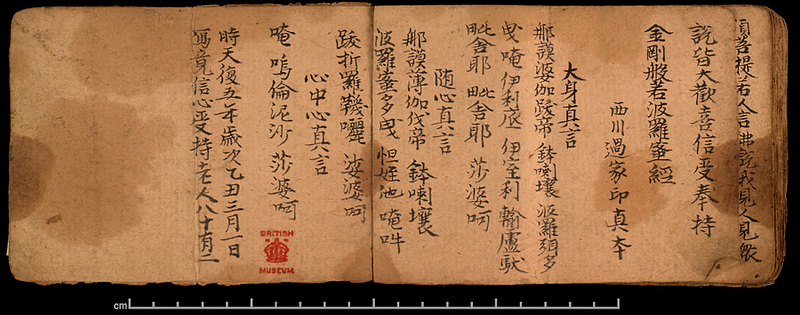
On the eighth day of April in 905 (1st day of the 3rd month), an un-named, 82-year-old man copied the Chinese version of the Diamond Sūtra onto a small codex (Figure 1). This copy is the earliest one in a group of at least a dozen similar copies of Diamond Sūtra made by this same man between 905 and 911. In the early 11th century, all of these codices were sealed in the “library cave” of Dunhuang, an oasis town on the edge of eastern Central Asia, and re-discovered in 1900.
Figure 1: The end and the colophon of the 905 copy of “Diamond Sūtra” (Stein 5534). Image courtesy of British Library’s International Dunhuang Project
Around the same time, one thousand miles away, the Tang dynasty (618–907) fell. This event marks not only the official end of an imperial world system that ruled much of Eastern Eurasia for the previous three centuries, it is also a key moment in the seismic “Tang-Song transition” in the political as well as cultural histories of China. Was this man aware of the fall of the Tang? Did the great medieval cultural transition of China leave any traces in his life or the books he copied?
There is indeed no reason to assume that the fall of the Tang would have any impact on him. Physical distance was not the only thing that separated this man from Chang’an, the capital of the Tang. As a late 10th century Dunhuang geographical manuscript titled A Path to India (西天路竟) shows, the trip from central China to Dunhuang (see Figure 2) would take one through various towns in modern Ningxia and Gansu provinces. None of these places, in the early 10th century, were under the direct rule of the declining Tang empire. Many of them, such as the Uyghur state of Ganzhou, were ruled by non-Chinese regimes. So even though the state of Dunhuang still adhered to nominal vassal status, it was in no way under the control of the Tang.
Figure 2: First Section of “A Path to India”
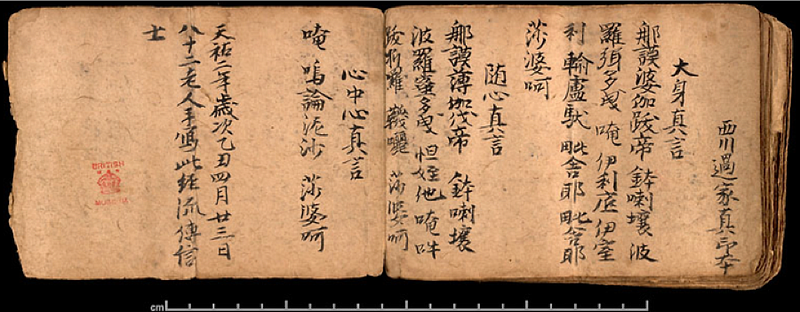
Yet in the copies of the Diamond Sūtra by this man, the fall of the Tang does find the subtlest of expressions. Such expression is only clear when one understands how he perceived of time according to official Tang rules. Because of the distance between Dunhuang and the capital Chang’an, the news of a new reign name of the Tang — the standard system of dating in pre-modern China — often reaches him very slowly. The copy shown above, for instance, was written “in the 5th year of the Tianfu reign.” But the Tianfu reign only officially lasted for four years, and the year 905, according to the official Tang government, should have been the 2nd year of the Tianyou reign. Between this first copy and the second copy he made 53 days later (Figure 3), however, he became aware of this change in reign names, and switched the year to the “2nd year of the Tianyou reign.”
Figure 3: The second copy of Diamond Sūtra (Stein 5444). Image courtesy of British Library’s International Dunhuang Project
In 907, he abandoned the use of reign names altogether, and switched to the apolitical ganzhi system (a way of reckoning time using sixty unique combinations of terms). Importantly, this action occurred a few months before the dethronement of the last Tang emperor by Zhu Wen (852–912) and the official end of the Tang. The news of Zhu’s new dynasty therefore could not have been the reason for this change. Why did he make this change? Did he already sense the imminent fall of the Tang a few months before it actually occurred? There is no way for us to know the answer. The last time residents of Dunhuang switched to the ganzhi system en masse as their method of dating was when the Tibetan empire conquered Dunhuang in the late 8th century. Therefore, from this small change, it appears that this man in Dunhuang may have been cognizant of the political drama unfolding in Central China. He was connected to Central China in ways we cannot know.
Another way he was connected to Central China is hinted at in his colophons. According to his own notes, this man made the copies of the Diamond Sūtra on the basis of “an authentic version printed by the Guo family in Xichuan (modern western Sichuan) 西川過家印真本” (See Figure 1). As the 868 copy of Diamond Sūtra (Or.8210/P.2) — often seen as the earliest extant printed book in the world — shows, this text was already printed in Dunhuang in the mid-9th century. Yet this man used the print imported from Sichuan, some 1300 miles away. This Sichuan version is no longer extant, but judging from the copies this man made on its basis, this version must have been in codex form, and contained a different set of mantra (zhenyan 真言, Buddhist hymn) at the end of the text. The man might have found this text more appealing for these reasons, or perhaps the 868 copy or similar copies printed in Dunhuang were simply unavailable to him?
Whatever the reason for copying from an imported print, his copies show that the transition from manuscript to printing — a significant component of the broader cultural shifts in the “Tang-Song transition” — is a lot more complicated than is sometimes assumed. In a manner that seems to reverse technological progress, he used printed texts and made them into manuscripts. Interestingly, however, he did identify the printed version as “authentic (印真本 or 真印本),” perhaps recognizing the apparent stability of printed text in comparison to the variability of manuscript. This model of the dissemination of books in the era of transition, in which printed texts were being disseminated trans-regionally, while manuscripts were copied locally, might help raise new questions about the social impact of printing in Middle Period China.
But perhaps more important than complicating our existing historiographical narratives about the era, this series of copies of the Diamond Sūtra offers some rare glimpses into the life of an ordinary person that are sometimes profoundly touching. He prayed in later colophons that his old ox will be reborn in the pure land of the west, and will not suffer being reborn as an animal again (Stein 5544). He prayed too for his enemies and debtors, so that their offenses as severe as defiling a monastery might be absolved (Stein 5450). At the end of a 906 copy, he left the following colophon (Figure 4):
八十三老翁刺血和墨,手寫此經,流布沙州一切信士,國土安寧,法輪常轉,以死寫之,乞早過世,餘無所願。
This 83-year-old man mixed blood with ink, and copied this sutra by hand in order that it be distributed to all the faithful ones in Shazhou (Dunhuang). May the land of the state be peaceful, and the wheel of the dharma turn in perpetuity. I copied it with (the wish for) death. Other than a swift departure from the world, there is nothing more that I desire.
Figure 4: Pelliot chinois 2876. Image courtesy of British Library’s International Dunhuang Project
The apparently resolute wish for the other world and his sensitive perception about this world are not necessarily contradictory. By mixing his blood with the ink and stressing that the text was copied by hand, his own body became deeply entangled in the process of making this text. Hence, although a copy of the Diamond Sūtra, this text differed fundamentally from mass-produced printed texts made by the Dunhuang government at the time. Perhaps only in this way could he hope to compete with the well-funded projects of printing in the race for merit?

Xin Wen previously spent a summer researching at the British Library’s Asian and African Studies center, funded by Harvard’s Fairbank Center. Read his account on Manuscripts and Digital Humanities at the British Library.