China is set to spend more than 700 million yuan in an effort to revamp the Eastern Qing Tombs, a royal mausoleum complex from the country’s last imperial dynasty northeast of Beijing, a report said on Wednesday.
The Beijing Times reported that the mausoleum 125 kilometres northeast of Beijing had been severely damaged in two major looting incidents, and the wooden structure and coffins in some of the tombs had been left open to the elements, Wang Zhaohua, deputy director of the Administrative Bureau of Cultural Relics at the mausoleum, told the newspaper.
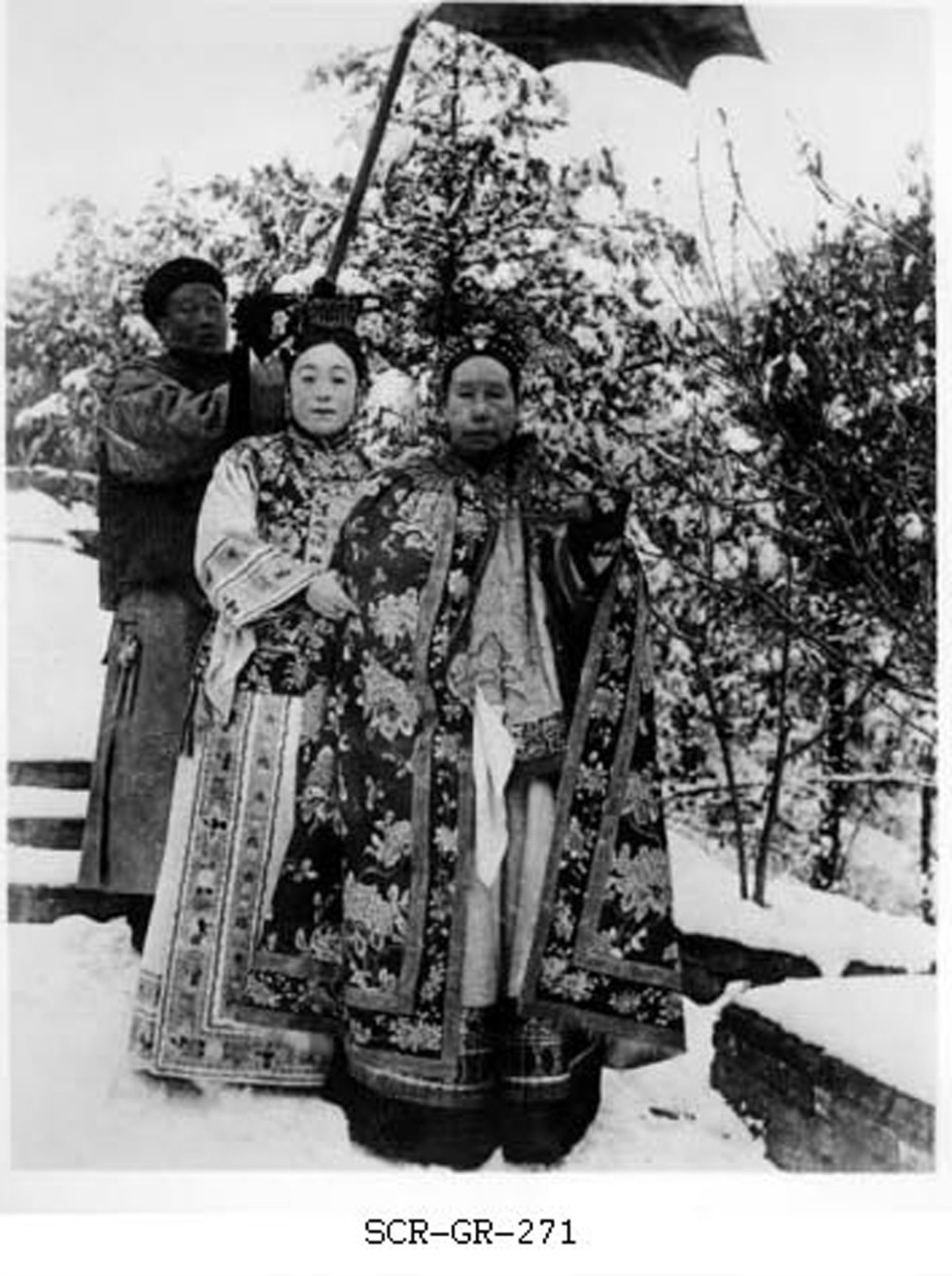
The restoration project will cover the tombs of eminent Qing emperors, such as Kangxi and Qianlong, and Empress Dowager Cixi, whose corpse was ravaged when a warlord ordered a looting of the complex in 1920s.
Wang said the empress’s corpse, which was discovered intact, had now turned mummified. Her coffin, which was made of Pheobe zhennan – a rare and extremely durable wood, sealed and painted with 49 layers – was designed to protect her body from decay, but had begun to deteriorate when looters forcefully opened the underground tomb and exposed it to outside temperatures and humidity.
The project will aim to create an environment with low oxygen levels to restrain bacterial growth in a bid to preserve the coffin.
Emperor Qianlong’s tomb is also at risk, suffering from leaks and flooding, Wang said.
The Eastern Qing Tombs are the largest and best preserved mausoleum complex in China, with five emperors, 15 empresses, 136 imperial concubines, three princes and two princesses of the Qing dynasty found buried there. The revamp of the mausoleums of Qing emperors and empress will cost more than ten million yuan each, according to Wang.
The complex was first looted on a large scale in 1928 by warlord Sun Dianying, who pretended that he was leading his army there to practice military manoeuvres. One team of tomb raiders blew up the entrance and doorways of the underground palace of Yuling, where the remains of Qing Emperor Qianlong were laid to rest. The raiders took away any object of value and pried open the coffins of the emperor, his two empresses and three imperial concubines, leaving their skeletons scattered around. Researchers are now only able to identify just one of the six corpses, as they were badly mixed.
Another group of soldiers opened the tomb of Empress Dowager Cixi. Robbers pulled her body from the tomb to reach jewels hidden under her corpse, and an imperial robe, shoes, socks and jewellery that she wore were all stolen, as well as a massive pearl put in her mouth to keep her body from decomposing. Even her undergarments did not survive and were removed in the raid.
The second looting occurred in 1946 during China’s civil war, where the complex was left almost unguarded. Only Xiaoling, the tomb of Emperor Shunzhi, was spared from looters, thanks to prevalent folk tales suggesting that the emperor was not buried there.
Two thousand years ago, Buddhist not Christian art was our guiding light – and had all the best nativity scenes
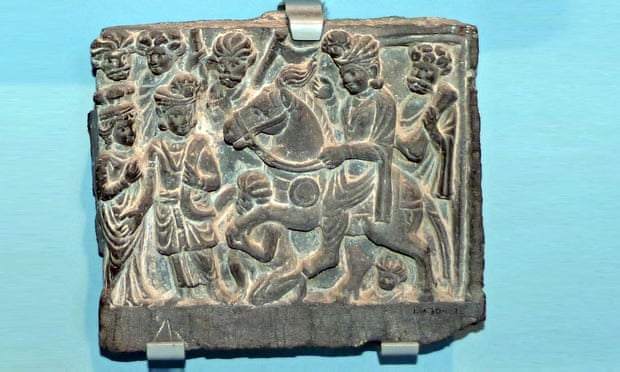
The great departure of Buddha: stone relief, c.100-300 from Gandhara, showing Prince Siddhartha Gautama on horseback. Photograph: Universal History Archive/Rex Features
A crowd of people gather round a man on a horse, in an ancient stone relief that roars with life. Is this Christ entering Jerusalem? Or even a nativity scene – a wise man heading for Bethlehem perhaps?
In fact, it is an image of Prince Siddhartha setting out from his father’s palace. This masterpiece of Buddhist art was carved in Gandhara, on the borders of modern Pakistan and Afghanistan, some time between the second and fourth centuries AD. But like many other artworks from ancient Gandhara, it uncannily resembles early Christian art. Indeed, it is evidence of a fascinating encounter of east and west.
This is a time of year when we pay a lot of attention to Christian art, if only because nativity scenes look so, well, Christmassy. So here’s an unusual Christmas fact: 2,000 years ago, Buddhism led the way in religious art. It set out the power of sacred imagery and showed how art can deepen piety. Christianity soon took up the same idea of art as a religious powerhouse. But why do early Christian images, such as ivory nativity scenes, look so similar to the art of Gandhara ?
It is because both traditions were influenced by ancient Greece and Rome. The conquests of Alexander the Great led to a Hellenistic kingdom in Afghanistan. Later, the Roman Empire traded with merchants travelling the Silk Road towards China. Gandhara was open to the influence of classical civilisation, and this is dramatically visible in its art.
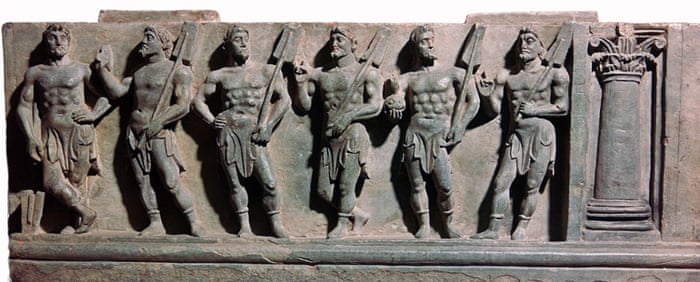
An Indian sculpture of a group of marine deities in Gandhara style, c.1st century, from the British Museum’s collection.Photograph: Print Collector/Getty Images
Works from ancient Gandhara in the V&A and the British Museum in London include reinterpretations of Greek myth, classically posed statues and imported bronzes. There is no doubting these Greek and Roman echoes in the Buddhist art of Gandhara. One portrait of a Buddhist monk in the V&A looks just like a Roman senator.
There was no contradiction between Buddhism and Greek philosophy. In fact, the ideals of Plato had a lot in common with the Buddhist search for enlightenment. Contact over hundreds of years had deepened such similarities.
Christianity, too, fed on classical art for its images. The style of Roman sarcophagi was adopted for Biblical scenes. Yet Christian art took centuries to find its true power. Buddhism was the first great religion to use art to win souls. It drew on classical sources to create something new, moving and profoundly beautiful. The greatest triumphs of Gandhara-style classicism were the colossal Buddhas at Bamiyan, made in the sixth century and destroyed by the Taliban in 2001.
But the deepest connection between Buddhist and Christian art is that they both tell stories. Gandharan reliefs tell stories from the life of the Buddha in pictures. The V&A, for instance, owns a work from Gandhara that depicts the birth of the Buddha. How’s that for a nativity?
In the season when Christian art gets looked at more than any other time, it is worth remembering that it is just part of a global continuum of religious art. Buddhism paved the way for the nativity scenes circulated at this time of year and, I believe, ultimately inspired them.
The Exhibition explores the years 1400 – 1450, a pivotal 50 year period that transformed China during the rule of the Ming dynasty.
In this film we hear from the exhibition’s co-curators Jessica Harrison-Hall, British Museum and Professor Craig Clunas, University of Oxford who lead through the exhibition room at a time demonstrating some the finest and most historically important objects ever made in China.
The exhibition features a range of these spectacular objects – including exquisite porcelain, gold, jewellery, furniture, paintings, sculptures and textiles. Many of the objects have only very recently been discovered and have never before been seen outside China.
The carefully selected objects in this exhibition shed new light on this important part of world history that is little known in Europe. China’s internal transformation and connections with the rest of the world led to a flourishing of creativity from what was, at the time, the only global superpower.
The film is chance to see how AHRC funded research has shaped and informed the exhibition from the outset and how the funding has facilitated international exchange and partnership working with 21 international lenders including 10 Chinese institutions.
The following institutions all loaned objectrs or material to the exhibition:
首都博物馆 Capital Museum
湖北省博物馆 Hubei Provincial Museum
南京市博物馆 Nanjing Municipal Museum
南京博物院 Nanjing Museum
中国国家博物馆 National Museum of China
故宫博物院 The Palace Museum
山东博物馆 Shandong Museum
上海博物馆 Shanghai Museum
山西博物院 Shanxi Museum
四川博物院 Sichuan Museum
Arthur M. Sackler Gallery, Smithsonian Institution
Ashmolean Museum, Oxford
Board of Trustees of the Royal Armouries
Bodleian Libraries, University of Oxford
Muban Foundation
Musée Cernuschi, Musée des Arts de l’Asie de la ville de Paris
Nasser D. Khalili Collection of Islamic Art
National Folk Museum of Korea 국립민속박물관
National Museum of Korea 국립중앙박물관
Philadelphia Museum of Art
Private Collection
Royal Artillery Historical Trust
Sir Percival David Foundation of Chinese Art
Smithsonian American Art Museum
Staatliche Museen zu Berlin, Museum für Asiatische Kunst
The British Library
The J. Paul Getty Museum, Los Angeles
The Metropolitan Museum of Art, New York
Victoria and Albert Museum
Published on Oct 10, 2014
Curator Jessica Harrison-Hall introduces the British Museum’s collection which tells the history of the world for the world, with particular focus on ceramic works and the current BP exhibition Ming: 50 years that changed China at the British Museum 18 September 2014 – 5 January 2015
PESHAWAR: Archaeologists have discovered Buddhist sculptures and heads during the excavation in Haripur district.
Khyber Pakhtunkhwa archaeology and museums directorate director Dr Abdul Samad on Friday said sculptures and heads dating back to second to fifth century AD had been discovered during excavation at Buddhist stupa known as Bhamala Buddhist Complex near Khanpur.
He said during excavation, precious coins of Kushan period were also found around the stupa.
Dr Samad said the Bhamala archaeological site had been declared national and world heritage site located near Khanpur dam.
He said the ruins dated back to fourth century BC.
“The ruins are situated near Khanpur dam. The stupa is cross-shaped and looks like an Aztec Pyramid,” he said.
The director said the Bhamala site was partially excavated in early 1930 by Sir Jan Marshal.
He said fresh excavation at the archeological site had been initiated by the Hazara University, Mansehra.
Dr Samad said during excavation done by archaeologists, conservators, diggers, and treasury hunters, mostly terracotta sculptures had been discovered.
He said a training and capacity building programme for students and field staffs of the directorate of archaeology and museums had initiated at the field training school (Bhamala) to inform archaeological excavators about the latest techniques and methods of excavation.
The director said more than 50 participants, including students of various educational institutions, took part in the training, which would continue for months at the field training school. He said the first batch had so far completed training.
“The leading foreign scholars and archaeologists belonging to United States and UK have offered to extend services in the training programme,” he said.
Dr Samad said the capacity building training programme lasted four-months in which more than 50 members of field staffs, mostly archaeologists, conservators, draftsmen, conservation assistants, photographers and students of archaeology from various educational institutions participated.
He said a survey had been initiated of different archaeological sites in Buner district.
ARTouch Consulting interviewed Ms. Jan Stuart (Keeper of Asia Department of British Museum) and one of the two curators of the exhibition Ms. Jessica Harrison-Hall. The interview transcripts is on Beijing Youth Daily http://www.artouchconsulting.com/2318...
‘Marco Polo,’ Netflix’s shiny new epic, may not live up to the lofty, unfair “Game of Thrones”comparisons foisted on it by the media. But the young property, created by showrunner John Fusco, still gets a lot right in its eminently watchable, dramatically flawed first season. “Marco Polo” is easily Netflix’s most ambitious production to date, featuring a massive budget and epic scope. The young show offers spectacular production values, sumptuous world-building, riveting set pieces, and a cast of game actors who inhabit compelling, if underdeveloped characters.
Perhaps more importantly, “Marco Polo” the show does for TV what Marco Polo the man did for Europe: It introduces the East to the West. For the first time, a mainstream, high-profile American TV series explores Asian history, politics, and culture, while employing an almost fully Asian cast. While this makes “Marco Polo” both impressive and important, the show’s various compelling elements do not yet cohere into a dramatically satisfying whole. The season’s narrative eventually frays and loses momentum due to unrigorous story logic and inconsistent character motivation.
Most Americans probably know Marco Polo from that really fun swimming pool game he invented. But it turns out, Marco was also a merchant traveler who spent over twenty years in the famed court of Mongol Emperor Kublai Khan. Marco eventually returned to Italy and relayed his Eastern experiences to the Western World through his famous writings, which still exist today.
“Marco Polo” the series follows Marco’s (Lorenzo Richelmy) early years with Kublai (Benedict Wong), beginning with his conscription into the Mongolian imperial court. The pilot depicts Marco’s initial conscription as an imprisonment: Marco’s greedy, merchant father Niccolo (Pierfrancesco Favino) sells a bewildered teenage Marco into Kublai’s “service” (i.e. slavery) in exchange for permission to conduct business along the Great Khan’s famed trade network, the Silk Road. Apparently, blood is not thicker than trade routes. A betrayed and stupefied Marco – who only recently met dear old dad for the first time – is promptly stripped and tossed in a Mongolian cell. Thanks, pops.
Many in the court react to Marco with fear and loathing, derisively referring to him as “The Latin.” Yet Kublai is taken with his new toy, charmed by the novelty of having a “round-eyed” European in his court and also by Marco’s intelligence, honesty, curiosity, and eloquence (in many languages, including Mongolian). Kublai has Marco trained in the ways of the court: horse riding, calligraphy, dress, manner, etc. Marco is even given a fight-mentor, Hundred Eyes (Tom Wu), who is equal parts Pai Mei from “Kill Bill,” Syrio Forel from “Game of Thrones,” and Denzel from “Book of Eli.” Hundred Eyes trains Marco in swordplay, archery, Kung Fu, and general bad-assery, all while being completely blind (if that sounds preposterous, Wu sells it better than Denzel did). Oh, by the way, this show has Kung Fu – a ton of it. If the series is part Eastern ‘Game of Thrones,’ then the other part is ‘Crouching Tiger, Hidden Dragon’ – a film which clearly inspires the superb choreography, editing, and overall aesthetic of “Marco Polo’s” myriad epic fight sequences.
Marco rises in Kublai’s court, arousing the ire and jealousy of insecure Crown Prince Jingim (Remy Hii)and scheming finance minister Ahmad (Mahesh Jadu). Marco navigates the court’s tricky political waters while gaining military and diplomatic responsibilities, before eventually finding himself in some major jeopardy late in the season – partially due to his own hubris and partially due to the political forces aligned against him. Along the way, Marco befriends Kublai’s bastard son Byamba (Uli Latukefu), beds Byamba’s eventual love interest, Warrior Princess Khutulun (Claudia Kim), and falls hard for the mysterious “Blue Princess” Kokachin (Zhu Zhu), who is harboring a dangerous secret of her own.
If all that sounds a bit meandering and unfocused… well, it is. Marco may be the show’s titular character and protagonist, but he doesn’t have an abundance of agency or drive. Similar to the protagonist of another hot Netflix property, “Orange is the New Black,” Marco often functions as a passive observer on his own show, bearing witness to the maneuverings of more powerful and driven individuals than himself (much as the real Marco Polo did).
The season’s true narrative anchor is Kublai’s relentless quest to overthrow the Song Dynasty, thus uniting all of China and Mongolia under his rule. The Emperors and armies of the Song Dynasty have resisted the Khan’s attacks for over thirty years, shrewdly hiding behind their massive, impenetrable city wall. Kublai loses patience as the season progresses and becomes single-mindedly determined to break down the Song’s wall or die trying.
When the Song’s elderly emperor dies, villainous chancellor Jia Sidao (Chin Han) seizes power and steers the Song Dynasty towards open warfare with the Khan. Sidao is such a moustache-twirling, war-mongering baddie that he orders his own peace envoy slaughtered, framing the Khan for the deed, to ensure war with Mongolia and consolidate political power. If that’s not evil enough, the good Chancellor also sends his own sister, imperial consort Mei Lin (Olivia Cheng), on an undercover suicide mission to Kublai’s famed pleasure dome; Naturally, Sidao forces his sister into capitulation by threatening and even torturing her young daughter, graphically breaking the girl’s feet on screen.
While Mei Lin tries to keep her daughter alive by becoming the Khan’s favorite concubine and spying for her brother, Sidao fights a two front war: a military war against the Mongols and a political war within his own walls against the Empress Dowager (Tan Kheng Hua) – wife of the late Song Emperor. The show’s various power players make their moves – some die, some don’t – eventually culminating in an exciting, cinematic climactic battle between Mongol and Song.
Kublai’s war with the Song is overly predictable and revels in well-worn plot beats, but nevertheless provides “Marco Polo” with a much-needed dramatic foundation to structure the season around. The story is elevated by “Marco Polo’s” impressive recreation of ancient Mongolia and Song China. The show’s meticulous set and costume design immerses viewers in a lavish, fully realized historical backdrop. The show’s evocative portrayal of Kublai’s famed palace, imperial city, and pleasure dome will be catnip for history buffs.
The writers and actors have also created a host of distinct, compelling characters to build a series around. As Marco, Mr. Richelmy is eminently likeable, exuding charm, intellectual curiosity, and magnanimity. Marco is our clear identification point as a Westerner being immersed in an exotic Eastern kingdom. This technique (thrusting an outsider into a unique new culture) is a classic way to structure a pilot, since it allows for natural world-building and exposition, as various characters explain the culture’s rules and values to the outsider (and, by extension, to the audience). We learn about the Great Khan’s realm as Marco does.
Mr. Wong imbues the Khan with the requisite gravitas, charisma, and egomania expected of such a legendary historical figure. The Khan is also complex and fascinating: On the one hand, he’s amazingly tolerant of all religions and cultures, welcoming them into his kingdom; on the other, he’s a ruthless, megalomaniacal, shockingly brutal conqueror. That brutality becomes increasingly evident as the season progresses, and the Khan loses himself in his war. Hii and Latukefu give solid, evocative turns as Kublai’s sons Jingim and Byamba. Latukefu captures Byamba’s loyalty and ferocity, while Hii palpably conveys the backbreaking emotional pressure of growing up as the heir to the Mongolian Empire.
But the show’s women are the ones who really stand out. Ms. Cheng is captivating as Mei Lin – a famed concubine with secret deadly Kung Fu prowess. Mei Lin is gifted with the most compelling story line of the season’s first half, as she scrambles to save her daughter by entrenching herself undercover in Kublai’s pleasure dome. Joan Chen is commanding, cunning, thoughtful, and manipulative, yet somehow still likeable as Empress Chabi – the Khan’s favorite wife (and also one of his chief advisors). And Claudia Kim inhabits Warrior Princess Khutulun with vivaciousness and energy, though the material doesn’t provide Kim with a storyline worthy of her performance – Khutulun spends much of the season wrestling (yes, literally) random guys and flirting with Byamba. Zhu Zhu is endearing and vulnerable as Blue Princess Kokachin, but like Kim, Zhu Zhu hasn’t been utilized in a coherent or dramatically satisfying story.
Unfortunately, “Marco Polo’s” large cast, sweeping scope, and abbreviated 10-episode 1st season make it tough for the show to explore many of these characters with an abundance of depth. Future seasons will need to dig deeper beneath the surface of these compelling yet under-explored characters. Sidhao is particularly one-note as the season’s principal antagonist, and Chin Han’s sneering performance frequently lets the character descend into cardboard villainy.
In addition, a number of characters lack clear and convincing motivation, undermining realism. For instance, Marco’s steadfast loyalty to the Khan is under-explained and tough to believe, particularly late in the season after he’s witnessed the Khan’s brutality firsthand. It’s also hard to understand Marco’s complete infatuation with the Blue Princess; he seems to be hopelessly in love with her, despite barely knowing or interacting with her. This makes their romance difficult to invest in. More egregiously, late in the season, a minor, thinly developed character inexplicably sacrifices his life to save a prominent character he barely knows from execution, without any clear rhyme or reason. This resolves a key plotline with an artificial deus ex machina, rather than an organic, dramatically satisfying resolution.
Where “Marco Polo” really falls short of “Thrones” is its lack of commitment to rigorous story logic. “Marco Polo” constantly realigns its political power structure without letting viewers know how or why these changes have taken place. For instance, Sidhao’s growing political civil war with the Dowager Empress seems to shift at random: In one episode, Sidhao has all the power, leaving the Empress begging for scraps; in the next episode, Sidhao is being pushed out the door, forcing him to execute a daring gambit to reclaim power; at the start of the next episode, he’s already lost that power again, without explanation; in another episode, he gets all his power back by defeating the right person in Kung Fu. The show fails to provide viewers with enough basic clarity or consistent logic to understand why events unfold as they do, making the show’s court intrigue and political story lines difficult to invest in.
The show’s lack of clarity and rigorous logic undermines individual scenes, as well as whole plotlines. For instance, in one scene, two of the show’s most accomplished Kung Fu masters are engaged in an epic fight; in the next scene, the characters have somehow gone their separate ways unharmed, without explanation, despite the fact that one of them was under explicit orders to assassinate the other. Logic gaps like this will undermine an audience’s immersion in the story.
“Marco Polo” has drawn a ton of heat for its abundance of nudity, sex, and “sexposition,” just as its supposed progenitor “Game of Thrones” once did. While “Marco Polo’s” nudity may be a touch excessive, especially early in the season, the writers have every right to explore Kublai’s famed, fascinating pleasure dome, which the historical Polo discussed in his writings – and frankly, there’s no way to do this without a whole bunch of sex and nudity.
I’ll say one last thing about the media’s ubiquitous “Thrones” comparisons, which I have now clearly perpetuated, and then be done with it. “Game of Thrones” is not the only show to revel in medieval-style warfare, politics, and court intrigue; it’s merely the best. And if every new series, like “Marco Polo,” found itself instantly compared to the best show ever in its chosen genre, the disappointment would be inevitable and sweeping across the television landscape—at least to those parties making these hasty, unfair comparisons.
Overall, “Marco Polo” offers meticulous yet decadent world-building, stirring performances, and a whole lot of action, sex, violence, politics, and intrigue. The writers have established a strong foundation for the series and can hopefully use season 2 to dig deeper into the characters, while applying clearer, more rigorous logic to its political story lines.
Welcome to East Asian History in its new electronic form. East Asian History is an international refereed journal publishing scholarly research on all aspects of historical studies in East Asia. This new online format enables authors to include sound and film files and photomedia within their articles, enlarging the journal’s scope into fields of historical documentation, such as cinema or music history, previously limited by print publishing.
This online form of East Asian History is a collaboration between The Australian Centre on China in the World at the Australian National Universityand the Leiden University Institute of Area Studies at Leiden University in The Netherlands, and is jointly edited by Remco Breuker (Leiden) and Benjamin Penny (ANU). The editorial board comprises three scholars from each university: Geremie R. Barmé (ANU), Katarzyna Cwiertka (Leiden), Roald Maliangkay (ANU), Ivo Smits (Leiden), Tessa Morris-Suzuki (ANU) and Barend ter Haar (Leiden).
East Asian History was published in print from 1991 to 2008 (issues 1-36), and was edited by Geremie R. Barmé (to 2007), and Benjamin Penny (from 2007). The journal’s predecessor, Papers on Far Eastern History, was published by The Australian National University’s Research School of Pacific and Asian Studies from 1970 to 1990. When Papers on Far Eastern Historybecame East Asian History the new journal employed an original and striking format that the new online version of the journal has adapted and developed in the new medium.
East Asian History will be published twice each year. Articles published in the journal are submitted to double-blind peer review unless otherwise stated. Final selection of papers is at the discretion of the editors.
To cite this journal, please use page numbers from the PDF versions.
Contact us
East Asian History
Australian Centre on China in the World
ANU College of Asia and the Pacific
Building 188
Fellows Lane
ANU ACT 0200 eastasianhistory@anu.edu.au
A special examination recently occurred in the Meander Medical Center. A nearly 1,000 year old mummy received a CT scan and had samples taken with an endoscope. Several hospital employees helped with this unique project in their free time.
Picture: Jan van Esch / Meander Medisch Centrum
The leader of this study is the Amersfoort resident Erik Bruijn, an expert in the field of Buddhist art and culture and guest curator at the World Museum in Rotterdam. Gastrointestinal and liver doctor Reinoud Vermeijden and radiologist Ben Heggelman received the Chinese mummy at the hospital for internal examination on September 3rd. The mummy was part of the Mummies exhibition earlier this year and dates from the 11th or 12th century.
The mummy is the mummified body of the Buddhist master Liuquan, who belonged to the Chinese Meditation School. The discovery of the mummy is of great cultural significance. It is not only the only one of its kind, but also the only Chinese Buddhist mummy that is available for scientific research in the West.
Picture: Jan van Esch / Meander Medisch Centrum
With an endoscope made specially available by Surgical Technologies in Didam, Vermeijden took samples of a yet unidentified material and examined the thoracic and abdominal cavities. He made a spectacular discovery – among all kinds of rotten material in the space where there had one been organs, he found paper scraps that are printed with ancient Chinese characters. Heggelman took a CT scan that beautifully shows how the mummy looks inside and took samples of bone material for DNA testing.
The research will be published in the monograph that will appear on Master Liuquan. The mummy has since been taken to Hungary where it will be on display at the National Museum of Natural History in Budapest until May 2015.
The Yuan Dynasty (AD 1271–1368) was the first dynasty in Chinese history where a minority ethnic group (Mongols) ruled. Few cemeteries containing Mongolian nobles have been found owing to their tradition of keeping burial grounds secret and their lack of historical records. Archaeological excavations at the Shuzhuanglou site in the Hebei province of China led to the discovery of 13 skeletons in six separate tombs. The style of the artefacts and burials indicate the cemetery occupants were Mongol nobles. However, the origin, relationships and status of the chief occupant (M1m) are unclear. To shed light on the identity of the principal occupant and resolve the kin relationships between individuals, a multidisciplinary approach was adopted, combining archaeological information, stable isotope data and molecular genetic data. Analysis of autosomal, mitochondrial and Y-chromosomal DNA show that some of the occupants were related. The available evidence strongly suggests that the principal occupant may have been the Mongol noble Korguz. Our study demonstrates the power of a multidisciplinary approach in elucidating information about the inhabitants of ancient historical sites.




 “Marco Polo” the series follows Marco’s (Lorenzo Richelmy) early years with Kublai (Benedict Wong), beginning with his conscription into the Mongolian imperial court. The pilot depicts Marco’s initial conscription as an imprisonment: Marco’s greedy, merchant father Niccolo (Pierfrancesco Favino) sells a bewildered teenage Marco into Kublai’s “service” (i.e. slavery) in exchange for permission to conduct business along the Great Khan’s famed trade network, the Silk Road. Apparently, blood is not thicker than trade routes. A betrayed and stupefied Marco – who only recently met dear old dad for the first time – is promptly stripped and tossed in a Mongolian cell. Thanks, pops.


