Archeologists have unearthed a massive tomb complex in a southwest suburb in Beijing, according to the Beijing Institute of Cultural Heritage on Monday.
They said the complex is a rare discovery given its size, time span and location.
The 70 hectare archeological site consists of 129 tombs built over 1,100 years, spanning from the East Han Dynasty (25-220) to Tang Dynasty (618-907) and Liao (907-1125).
It was first discovered in Sanhezhuang village in Daxing district in 2010, and so far, 75 tombs have been unearthed and cleared up.
Some of these tombs have exquisite murals depicting people and furniture, and artifacts found so far have included pottery, porcelain, lacquer ware, and other funeral paraphernalia.
Archeologists said the complex is of great significance for the study of culture and history of Beijing area.
The site was discovered due to a planned residential complex slated for construction on top of the site.
A 2014 municipal cultural relics protection measure mandates that all plots of land must be screened for relics before development.
We are pleased to invite you to the Woodenfish Project Buddhism in China seminar this summer. Renowned professor scholar Mark Blum from UC Berkeley will join us in Kumarājīva Temple (鳩摩羅什寺) in Wuwei (武威), Gansu (甘肅) to lecture on the Mahāyāna Mahāparinirvāṇa Sūtra. The sutra was translated in Wuwei in the 5th century.
Our stay in Wuwei will be followed by a trip to Dunhuang (敦煌) where in addition to visitng the Mogao caves we will meet with the president of the Dunhuang Research Institute (敦煌研究院) and visit other important sites in the vicinity.
Section One. Nirvana Sutra
The section will focus primarily on the material contained in volume 1 of Mark Blum’s translation of the Mahāyāna Mahāparinirvāṇa Sūtra. (大般涅槃經, The Nirvana Sutra Vol. 1. Berkeley: Bukkyo Dendo Kyokai America, Inc. 2013) This material covers the first ten of forty fasciles of the Dharmakṣema translation (T.374). The lectures will cover a variety of topics related to the Sūtra, including its name and setting, its relationship to Buddhism as a whole and to the Mahāyāna movement, and the doctrine of buddha-nature, tathāgatagarbha, icchantika and vegetarianism.
A syllabus and suggested preparatory readings will be provided the successful applicant.
Mark L. Blum took his degree in Buddhist Studies from the University of California, Berkeley where is is currently Professor of Buddhist Studies and also Shinjo Ito Distinguished Professor of Japanese Studies. He is the translator of The Nirvana Sutra Volume 1 from the Bukkyo Dendo Kyokai, and is currently working on the remaining three volumes of the sutra. He is also author of Origins and Development of Pure Land Buddhism (2002) and coeditor of Rennyo and the Roots of Modern Japanese Buddhism (2005), both from Oxford University Press, and co-editor of Cultivating Spirituality: A Modern Shin Buddhist Anthology from SUNY Press, and numerous articles. His research interests generally focus on changes in Buddhist thought and ritual in East Asia, particularly in the areas of tathāgatagarbha, Pure Land Buddhism, conceptions of death, ethics, and the impact of modernity on Buddhism in Asia. He currently writing a history of nianfo/nenbutsu that will include discussion of its use in music, dance, poetry, and theatre. His is also translating the Shandao commentary on the Guanwuliangshou jing and the Japanese language writings of Hōnen.
Section Two. Dunhuang
This section will consist of a research trip to the oasis town of Dunhuang, best known for the remarkable Mogao caves, a treasure-trove of Buddhist art and the site of one of the 20th century’s most important archeological discoveries, the Dunhuang manuscript.
The trip includes:
Extended visit to the Mogao caves, a major site of Buddhist art in China and the world.
Meeting with the president of the Dunhuang Research Institute
Learn about the history of and current research on Dunhuang
Visit the Han dynasty outposts of Yangguan and Yumenguan
Experience Yardang National Geopark
Program
June 7th. Arrival. Meeting in the evening
June 8th - 12th mid-day. Lectues on the Nirvana Sutra with Mark Blum
June 12th evening. Night train to Dunhuang
June 13th - 16th. Visit to the grottoes, Dunhuang academy and other sights in the vicinity
June 17th. Departure.
Fee
Following the tradition of the Woodenfish Project, the section on the Nirvana Sutra will be free of charge. The second part cost $1200 USD and will cover transportation, accommodation, entrance fees and most meals. Neither the Woodenfish Project nor the Liangyou Institute will make profit from this. The participant can choose to only join one of the sections.
Our partner
Woodenfish Project Buddhism in China 2015 is organized in cooperation with Liangyou Institute (良友書院), a non-profit organization based in Beijing. Established in 2013, Liangyou Institute aims to continue the traditional academy-style education in a modern urban setting, providing lectures and workshops with prominent academics and artist. They maintain the study of the six classical arts: Rites (禮), Music (樂), Archery (射), Charioteering (禦), Calligraphy (書) and Mathematics (數). The director of Liangyou Institute, Mr. Meng Fanjia (孟繁佳), is the 74th generation descendent of Mencius and head of the Mencius Clan Association of China.
Students: Transcript of grades, letter of recommendation (optional)
Academics: CV
You will first get an email confirming that we have received your application (give us a few days) We will then try to get back to you within one week with a response.
Deadline: April 30th
Applications will be accepted on rolling basis so we encourage you to apply early to enhance your chances of acceptance.
Marco Polo divise les historiens : le célèbre aventurier a-t-il vraiment arpenté la Chine au XIIIe siècle ? Pourquoi en effet ne mentionne-t-il pas la muraille de Chine dans ses récits ? Éléments de réponse dans ce documentaire captivant. Des chercheurs mettent en doute le périple chinois de Marco Polo, notamment la Britannique Frances Wood qui s'étonnait de ce que le voyageur ne mentionnât point la muraille de Chine dans ses récits. De plus, de nombreux compatriotes du marchand vénitien voyaient ce dernier comme un hâbleur et un mythomane. Le sinologue Hans Ulrich Vogel et la professeure de littérature Marina Münkler sont partis sur les traces de l'aventurier pour mener l'enquête. De Venise à Pékin en passant par Yangzhou et Quanzhou, ils ont fouillé les archives de la Cité des Doges, étudié les tombeaux de marchands italiens établis dans l'empire du Milieu, retrouvé des chroniques d'auteurs du XIIIe siècle faisant état du passage d'un certain Buolo à la cour de Chine, et visité les sites historiques auxquels Marco Polo fait référence. L'équipe a même rencontré des sauniers qui continuent de travailler comme à l'époque du Vénitien. Quant aux récits de ses périples, ils sont largement dus à Rusticien de Pise, auquel il s'était confié au cours d'un séjour en prison à Gênes en 1298. L'écrivain italien les avait alors couchés sur le papier dans un mélange de langue d'oil et de pisan. Le Monde 14 March2015
Gabriele Wengler éclaircit les zones d’ombres entourant le voyage en Chine de l’explorateur (samedi 14 mars, à 20 h 50, sur Arte).
Quand il meurt à Venise en janvier 1324, à près de 70 ans, Marco Polo est un homme riche et célèbre. Mais suspect d’avoir assis sa notoriété sur un mensonge. A t-il réellement parcouru les espaces chinois à la fin du XIIIe siècle ou n’est-il qu’un imposteur qui a habilement recyclé les informations de voyageurs authentiques ? Ayant, avec le concours de Rustichello de Pise, romancier qui partage sa captivité dans les prisons génoises, fait la relation de son voyage en Orient et de son long séjour à la cour du mongol Kubilai Khan, il s’est d’emblée attiré la méfiance de détracteurs, étonnés déjà de son retour à Venise après près de vingt-cinq ans d’absence (1271-1295). Tenu par certains pour un affabulateur, il n’a pas convaincu ses contemporains malgré l’immense succès de son livre, devenu au fil des éditions depuis 1298 Il Milione, Le Devisement du Monde ou Le Livre des merveilles.
Et voilà qu’à la toute fin du XXe siècle, une sinologue anglaise, Frances Wood, reprend la thèse de l’imposture. Selon elle, le Vénitien n’aurait pas dépassé Constantinople. Et pour étayer son propos, elle pointe les ruptures dans la restitution de l’itinéraire emprunté, logique caravanière pour longer le désert inhospitalier de Taklamakan en Asie centrale, puis notations anarchiques sur les étapes après Dunhuang, comme l’absence de mention de la monumentale muraille qu’il a dû voir en route pour Yangzhou.
Précision formidable
C’est oublier qu’alors, les fortifications, en argile, étaient fortement dégradées et que nombre de voyageurs observent le même silence, impensable lorsque la dynastie Ming, plus tard les aura restaurés en les habillant de pierre. On reste plus pensif quand on oppose la précision formidable avec laquelle Polo parle du papier en fibre de mûrier qui sert aux échanges monétaires et l’absence de mention de l’imprimerie ou de la cérémonie du thé. Mais sans doute est-ce l’indice que c’est bien là l’observation d’un marchand plus que d’un ethnologue…
Pour son documentaire Gabriele Wengler semble avoir choisi son camp et accrédite l’idée d’un témoignage authentique. Il est vrai que les pièces administratives impériales, ici croisées par les universitaires chinois avec les informations du Livre des merveilles, sont éloquentes. Et les trois années que le Vénitien, protégé des rivalités de cour par un éloignement judicieux de Khanbalik (« la ville du khan ») – que Marco Polo nomme Cambaluc –, passe à Yangzhou s’avèrent capitales pour évaluer l’information de première main du voyageur occidental sur l’administration fiscale du district et la gestion du sel, cet « or blanc » que le khan l’a chargé de superviser.
Bonne joueuse, Frances Woods maintient l’intérêt de sa démarche pour remettre au centre des débats un texte fondamental pour la découverte de la Chine au regard de l’Occident. Bien sûr, avant Marco Polo, d’autres ont fait le voyage vers ces terres lointaines – et notamment le franciscain Guillaume de Rubrouck (1215-1295), parti évangéliser la Mongolie au milieu du XIIIe siècle et qui en a laissé un récit précieux, Voyage dans l’Empire mongol, ou, bien sûr, Niccolo et Matteo Polo, le Père et l’oncle de Marco, que le premier empereur mongol, Kubilai déjà, reçut peu après son accession au pouvoir. Mais c’est le témoignage de cet explorateur atypique, qui entend chanter les dunes et rechigne à se placer au cœur de l’action, au grand dam de son scribe Rustichello, que Christophe Colomb embarque pour ses voyages transatlantiques. Comme un viatique nécessaire. Et c’est là la vraie grandeur d’Il Milione.
Source: Dawn.com Published in Current Affairs on Thursday, March 12, 2015
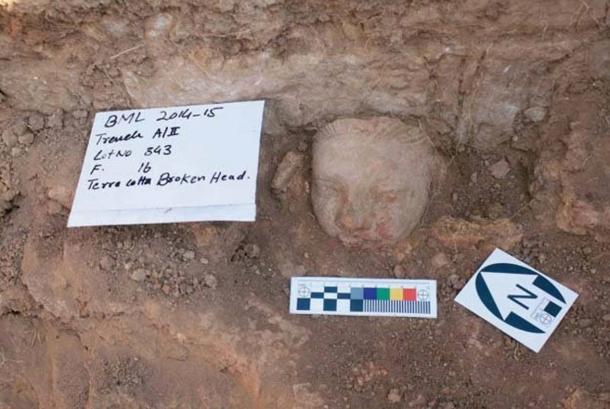
The Bhamala Buddhist Archaeological Complex in Pakistan has revealed a wealth of history and treasure dating back 2,000 years. Excavations have recently uncovered more than 500 “terracotta artifacts, stucco sculptures, architectural elements, copper coins, iron nails, door sittings, pottery and 14 coins from the Kushan era,” reports The Express Tribune.
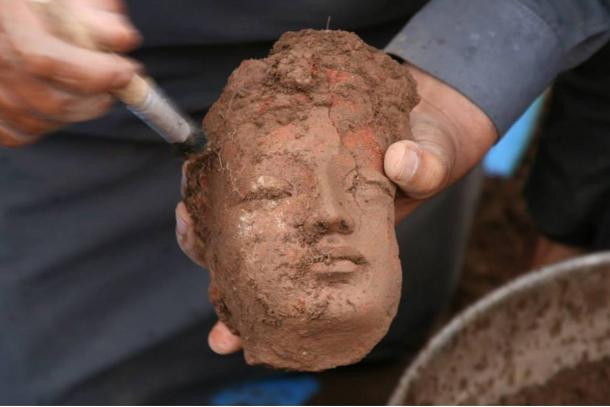
According to The Express Tribune the site is believed to date back 2,000 years, and pending laboratory tests on recent finds, Bhamala might be found to be even older. Newly recovered artifacts, like the clay Buddha heads unearthed at the site, may date back to the 3rd century A.D.
Clay head unearthed at Bhamala, Pakistan. Credit: Archaeological Research and Conservation Program: India and Pakistan
Some of the discoveries have suffered damage due to illegal excavations and looting over the years.
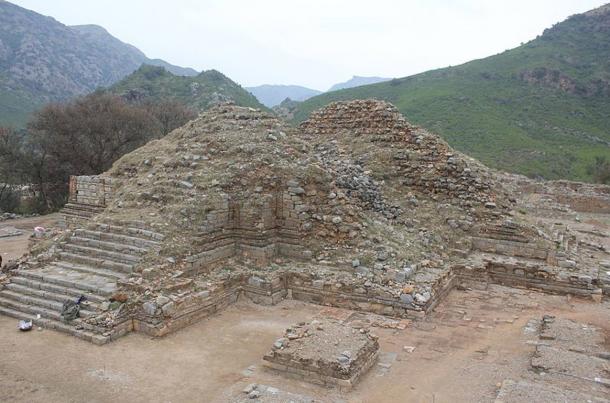
The stupa monument at Bhamala. Stupas are mounded spiritual sites, usually containing Buddhist relics. Muhammad Zahir/Wikimedia Commons
The Bhamala stupa is unique as the largest surviving example of its particular shape in the region. It is described as cross shaped, like an Aztec pyramid, and such constructions have only been seen in Kashmir.
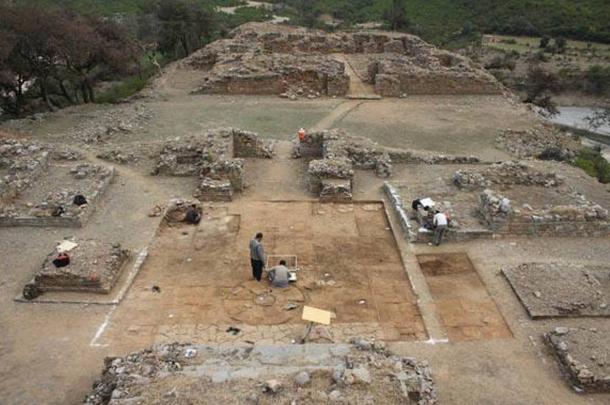
Excavations at Bhamala stupa. Credit: Archaeological Research and Conservation Program: India and Pakistan
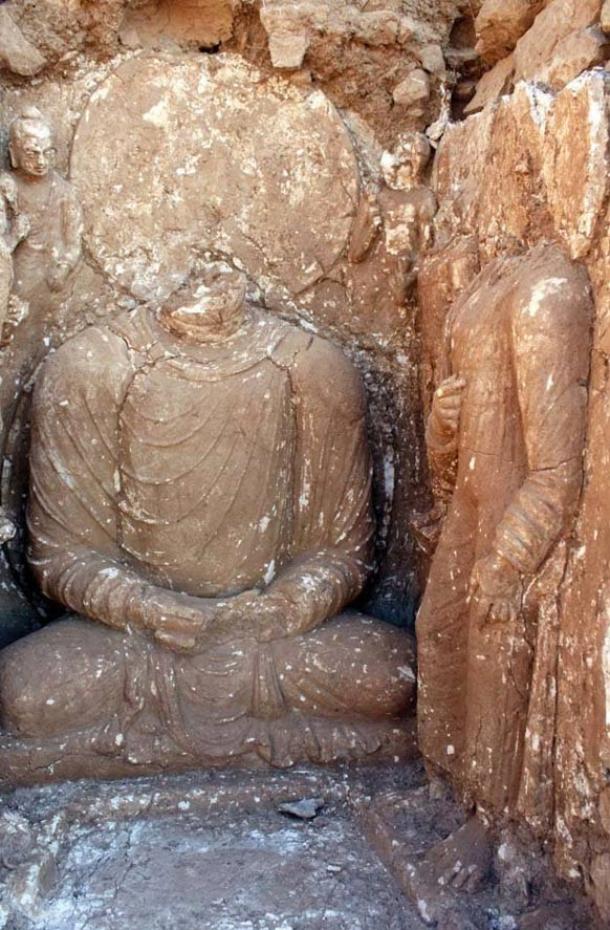
Dr. Abdul Samad, director of the Department of Archaeology, Hazara University says of the artifacts, “The most remarkable discovery from Bhamala was the Maha Puri Nirvana (death of Buddha) statue measuring 14 meters in length. It is the largest such example [depicting the death scene] found in the Gandhara civilization.”
Damaged stucco sculptures of Buddha at Bhamala. Credit: K-P Directorate of Archaeology & Museums
Stucco sculpture of a head, uncovered during excavations at Bhamala. Credit: K-P Directorate of Archaeology & Museums
First excavated by British archaeologist Sir John Marshall in the early 1900’s, the UNESCO World Heritage Nominated Site of Bhamala in Haripur, Pakistan has been undergoing field study since 2013 by the The Archaeological Research and Conservation Program India and Pakistan (ARCPIP).
Marshall revealed a Buddhist Stupa and parts of a monastery, but modern projects using the latest excavation techniques have discovered new artifacts and fresh insights, including evidence of past settlements on site. Researchers can show that Bhamala was used by Buddhists hundreds of years ago. Excavations are reportedly on hold until next year, but it is hoped that further investigations will reveal more of the priceless artifacts and heritage of Pakistan.
Dr. Samad told The Express Tribune last year, “Material found in Bhamala can be used to find answers to the innumerable questions about the change in Buddhist culture, development and contact in this region which have remained unanswered.” Featured Image: Excavation and conservation at the world heritage site of Bhamala, Haripur, Pakistan. Credit: K-P Directorate of Archaeology & Museums
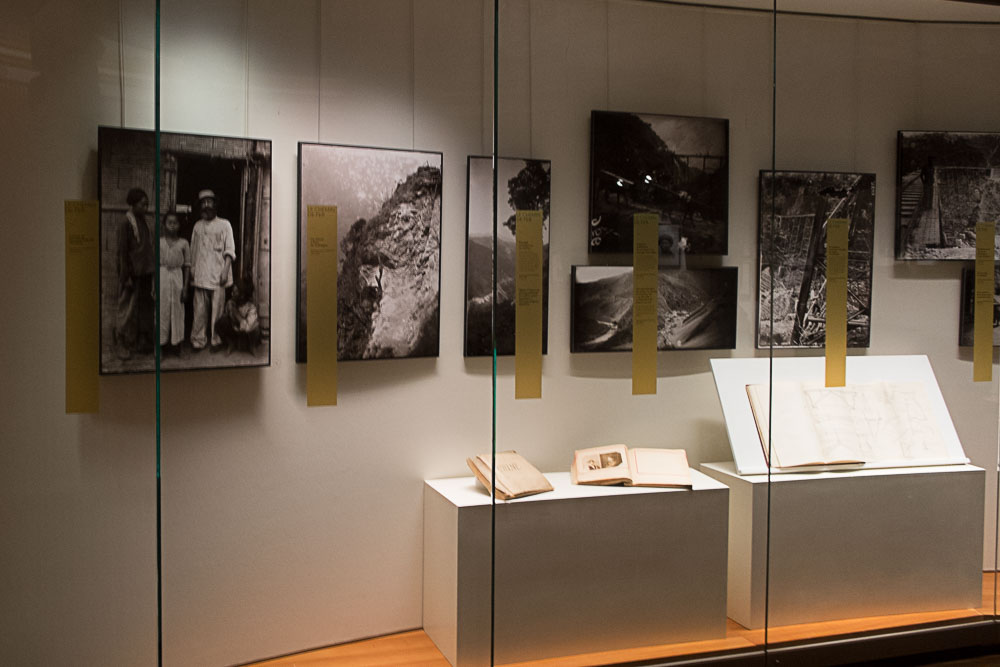
En ce moment, la « petite » exposition du Musée Guimet est consacrée, tenez-vous bien le titre est long « Un train pour le Yunnan – Les tribulations de deux Français en Chine, 65 photographies d’Auguste François et de Georges-Auguste Marbotte ». L’exposition se tient au 2ème niveau de la bibliothèque.
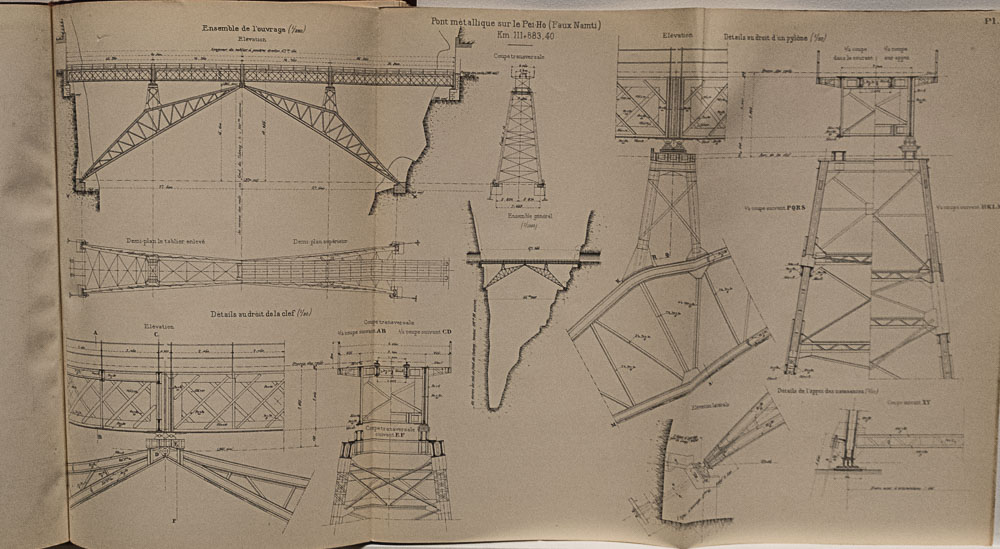
Le thème est la construction du chemin de fer Lao Cai – Kunming sur la ligne Saigon- Cholon. Ça ne vous dit sans doute rien, mais vu la région, on sent vite que ça va être compliqué de poser les 470 km de rail, et que cela va couter cher en monnaies sonnantes et trébuchantes et en vies humaines.
Georges-Auguste Marbotte est l’un des ingénieurs sur le chantier et quand on voit le cadre de travail, on se dit qu’il a dû avoir du mal à pratique son art. Les terrains sont essentiellement verticaux, le transport assuré par des porteurs ou des chars à bœufs capables de monter les escaliers taillés dans la pierre. Les éléments des ouvrages sont donc forcément assez contraints : 80 à 100 kilos max et moins de 2 m 50 de long.
Ici les tirages sont assez contrastés, à tel point que certains deviennent assez peu lisibles d’autant que l’éclairage n’est pas toujours adapté et les verres pas suffisamment traités anti-reflets.
Mais finalement le plus intéressant dans l’exposition est peut être la vie du deuxième compère, Auguste François, diplomate, rétif à la politique, un peu aventurier, et excellent photographe. En poste de consul, son travail consiste surtout à éviter les problèmes entre occidentaux et chinois (et entre occidentaux tout court car la perfide Albion rôde). Sur la question ferroviaire, il est chargé des négociations avec les pouvoirs locaux. Par sa fonction, il se déplace beaucoup et promène son objectif avec lui : beaucoup de portraits, mandarins, militaires, juges en train de siéger, mais aussi des scènes de rues, porteurs d’eau, épouillages, lanterne magiques, marchés. Il est aussi un peu ethnologue et ses images illustrent le fait que près de la moitié des ethnies non Han se concentre au Yunnan.
Il photographiera aussi les émeutes anti-occidentales du début du siècle (pour le coup, il manque un peu d’historique), qui semblent avoir lieu un peu après la révolte des Boxers. Ces événements lui vaudront une heure de gloire quand il assurera, par son sang-froid, la sortie de ses compatriotes.
Les tirages sont très beaux, très doux et les négatifs semblent avoir été remarquablement conservés.
Mon seul regret est qu’on ne comprend pas bien, les liens (s’ily en eut) entre les 2 hommes.
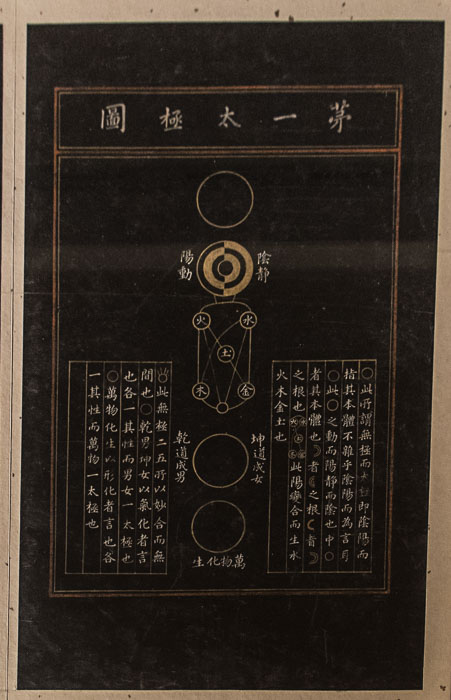
Pendant que vous êtes sur place et, si vous avez déjà parcouru l’exposition sur les Hans, Restez au 2ème étage pour voir les estampages des décors muraux des tombes et chapelles funéraires des Hans de l’Est. Comme vous pouvez le voir sur ces images, les pièces sont remarquablement conservées !
Cette technique est utilisée depuis le V et VI ème siècle APJC en Chine pour conserver et diffuser ces images.
Tarif : 7.5 euros, l’entrée aux collections permanentes donne accès aux petites expositions.
UBC Buddhist Studies Forum and Department of Art History, Visual Art and Theory proudly present a lecture by Professor Eugene WANG of Harvard University:
Abstract: Mysteries abound about the tomb of the First Emperor of China. For one thing, why do the terracotta warriors face east while the emperor’s “spirit carriage” heads toward the west? If the armored terracotta soldiers were placed to defend the tomb, why were they not given helmets? Professor Wang will unravel these questions for you in his lecture.
About the author: Eugene Y. Wang is the Abby Aldrich Rockefeller Professor of Asian Art at Harvard University. His extensive publications cover a full range of Chinese art history from the early funerary art to modern and contemporary art and cinema. He has received Guggenheim, Getty, and ACLS Ryskamp Fellowships. His book Shaping the Lotus Sutra: Buddhist Visual Culture in Medieval China garnered the Academic Achievement Award (2006) from Japan. He is the art history editor of the Encyclopedia of Buddhism (2004). He has served on the advisory board of the Center for Advanced Study of Visual Art, National Gallery of Art, Washington, D.C. and the editorial board of The Art Bulletin. His current research encompasses issues of art without spectators, visual programming (i.e., how images add up), material forms of intelligence, and inter-subjectivity effects.
I am excited to announce I have taken up an invitation from Simon J. Cook to write an essay we have titled Voices from the Twelfth-Century Steppe, for publication at Rounded Globe.
I hope to make a case study on writing historical fiction from a source. I hope to introduce you to the intimacies of that source.
In my early years with Amgalant, I turned for companionship to T.H. White, in communion with his Malory: talking to Malory, inserting Malory passages in his novel, living with the original writer and his work. I was living with my original, in much the same way. Besides, there is no book dearer to me than The Once and Future King— through which I discovered the Source. Straight after the Once and Future, while I was still quite young, I went to Malory – taught to do so by T.H. – and not in a bastardised modernisation, whose mother was a hamster, but the OUP, with original spellings, where knights garnysshe themselves for battle (often with a sprig of oregano). If there’s been a more important event in my life, I don’t know what it is. When I came to write historical fiction, to be so devoted to my source, I owe to the imprisoned knight and his modern counterpart who prayed for him.
My mission, which I have chosen to accept, has been assigned me in the book description:
Voices from the Twelfth-Century Steppe by Bryn Hammond
Bryn Hammond has written some astonishingly good historical novels. Her ‘Amgalant’ series brings to life the twelfth-century Steppe as no scholarly history could hope to do. Yet Hammond has immersed herself in her sources; her books are born of painstaking research and breathe a discipline of imagination rarely encountered in historical fiction.
In this scholarly meditation, a digression from her usual writing, Hammond reflects upon the relationship of her own craft to that of the academic historian. Focusing her discussion around The Secret History, the primary Mongolian source for the history of Genghis Khan, composed in the thirteenth century, Hammond asks what it means to discern different voices in what is essentially a communal history constructed from an oral account. What does the novelist as creative writer bring to this text? What might she hear that eludes the careful ears of the academic historian?
eta: Dec 15, 2015
In the meantime, have a look at Rounded Globe, its aims and offerings. Simon J. Cook left employment in an institution (I mean a university, not a madhouse) to pursue independent scholarship. With my commitment to independent publishing – in essence, to be free from anti-creative pressures – I am in sympathy with this; as I am with his idea of accessible scholarship. Out now is Simon’s book, J.R.R. Tolkien’s Lost English Mythology, with other titles due through the year.
This is the first volume by multiple authors in our series entitled The Silk Road: Interwoven History. This volume one, ?Long-distance Trade, Culture, and Society,? examines the history of the Silk Road from antiquity to modern times in different regions, while focusing on diverse topics, such as the Parthian Empire, Bactria, Turkmen music, medieval maritime trade, and so on. The wide-ranging articles are trying to address the extent to which the Silk Road played an important role in the history of the cultural contacts between the East and West.
Contents:
Tim Williams “Mapping of the Silk Road”;
Leonardo Gregoratti “Parthian Empire and the Political Role of the Silk Road: Romans, Jews, Nomads, and Chinese”;
Rachel Mairs “Heroes and Philosophers? Greek Personal Names and their Bearers in Hellenistic Bactria”;
Eivind Heldaas Seland “Preconditions of Palmyrene Long-distance trade: Land, River, and Maritime routes in the first three centuries CE.”;
Ulrike-Christiane Lintz “Survey of Judaeo-Persion Tombstone Inscriptions from Djām, Cnetral Afghanistan”;
Djamilya Kurbanova “History of Musical Culture of Turkmenistan: From Ancient Merv to Modern Times”;
Borbala Obrusanszky “Nestorian Christianity in the Ordos in Inner Mongolia";
Bin Yang “Cowry Shells and the Emergent World Trade System (1500 BCE-1700 CE)”;
Michael Laver “The Maritime Silk Road: Silver and Silk in Japan's Trade with Asia in the 16th /17th Centuries”;
Gerald Roche “Village Ritual and Frontier History on the Northeast Tibetan Plateau: the Mangghuer Nadun.”