Thursday, 25 June 2015

Where the Silk Roads Meet: Foreign Religions in Quanzhou in the Age of Marco Polo

Written by Samuel Lieu.
The Silk Road as an artery for the exchange of goods, people, ideas and religions reached its apogée during the time of the Mongol Empire under Qinggis (Genghis) Khan. Beginning in 1206 with the unification of all the tribes in Mongolia under his rule, Khan created a world empire stretching from the Pacific to Central Europe. The Mongols expanded eastwards into North China in 1215 and westwards into Khwarizm in Central Asia. Merchants from China were therefore able to travel along the Silk Road to Persia, and when 450 of them were executed on the charge of espionage, Qinggis invaded. By 1231, the Mongols were in control of most of Persia and of Asia Minor. The earlier conquest of Constantinople by Frankish Crusaders in 1204 had ushered in a new phase of Mediterranean history, which included the establishment of numerous Venetian trading colonies in the Levant and also into the Black Sea region. Among them were two members of the Polo family, Niccolo and his brother Maffeo, who were established at the Crimean port of Sudak in 1260 where they were well positioned for trade with Mongol-held territories in the so-called Golden Horde. Kubilai Khan (reigned 1260-1294), the grandson of Qinggis, requested that the two merchants visit him at his capital (which was then in Karakorum) and that they bring skilled artisans from Europe with them. The two returned to the West and, after what seemed like an interminable delay, returned to the lands under the control of Kubilai in the mid-1270s together with the young Marco (Marcus), the son of Niccolo.
The conquest of Southern China between 1277 and 1280 made Kubilai Khan Emperor of the whole of China and founder of the Yuan Dynasty (1280-1368). It was this extension of his rule into China proper that enabled the Polos to travel through the heartland of China, acting as Kubilai’s special envoys. Marco would later claim that for three years he acted as governor of Yangzhou – a city then much visited by other Italian merchants.
Marco Polo at Quanzhou
In 1278, the young Venetian traveller Marco and his uncle Maffeo began a journey from Khanbaliq (modern Beijing), which would take them through the part of the Kingdom of Cathay known as Manzi, i.e. China south of the Yangzi River. The same journey would also take Marco to Yangzhou, where he claimed to have held a senior administrative position. Shortly after the Polos had crossed the Yangzi, Marco noted that two Nestorian churches had been established in the mercantile city of Zhenjiangfu by the bishop Mar Sargis (Sergius), who also governed the city on behalf of the Mongols. What is fascinating about this encounter is that the activities of Mar Sargis were reversed after the expulsion of the Mongols; a record of his confiscations has survived in a Chinese text. Doubters or deniers of Marco Polo’s sojourn in China should bear this rare coincidence in mind. On their way, the Venetians also came across a secretive sect which exhibited some features of a vestigial Christianity at the city of Fuzhou. A delegation of this sect was duly sent to Kublai Khan and the sect was subsequently claimed by leaders of several major religious sects in China; however, these delegates aligned themselves with the Christians.
Quanzhou (Zayton) as a centre of Nestorianism under the Mongols
The final destination of the Polos was Qaunzhou (also known as Zayton after the zhitong tree), then the most important seaport on the South China coast. It was from Quanzhou that the Venetians left China for good c. 1292. Quanzhou today has only a river port, as her once famous harbour has fallen victim to thick layers of silt, but the city nevertheless ranks third behind Xi’an and Beijing in the possession of the largest number of medieval buildings and historical relics. Since 2001, a team of Australian scholars under the leadership of Professor Sam Lieu has been working on the Manichaean and Nestorian remains in both Quanzhou and in the nearby county of Jinjiang, where there is known Manichaean site.
The Manichaean shrine on Huabiao Hill at Jinjiang had been known to scholars since the middle of the last century, but civil strife in China followed by foreign aggression and revolutionary conflict meant that the site was not properly studied until the late 1970s. The shrine, built using the cliff-face as a back wall, possesses the only known statue depicting Mani as the Buddha of Light.
The religion of Mani (c. 216-276 CE) came to China from Iran along the Silk Road and was adopted by Uighur mercenaries in the service of the Tang Government. Through the patronage of the Khagan, the religion was sufficiently well established among the indigenous population for it to survive the expulsion of foreign religions in 845 CE. The religion went underground in South China, where the cosmopolitan seaports like Quanzhou gave it shelter. The shrine on Huabiao Hill was not built as a Manichaean shrine, but was taken over by the sect during the period of Mongol rule in South China. Epigraphical evidence and archaeological findings of inscribed pottery clearly identify the presence of the sect as the principal occupant of the site well into the sixteenth century. What is most extraordinary is that the well-preserved statue of Mani as the Buddha of Light led to the creation of a new Buddhist sect, centred on the worship of the statue of Mani as Buddha at the beginning of the last century.
In 2000, the site was visited by delegates attending an important conference on the Maritime Silk Road held in Quanzhou as part of the UNESCO Integrated Study of the Silk Roads project, despite the fact that Manichaeism clearly came to China by land and not by sea. The epigraphical evidence harks back to the period when Parthian and Old Turkish were used as the primary languages of the Manichaean sect. This survival of the link with the terrestrial Silk Road has been confirmed by the more recent discovery of a large hoard of Chinese Manichaean texts at Xiapu, also in the province of Fujian, which were clearly derived from Parthian.
AppleMark
                      Image of Mani at Huabiao Hill (Photo: Sam Lieu)
The remains of the Church of the East (also known erroneously as Nestorians) at Quanzhou came to light in the course of the Sino-Japanese War of the last century, but they were little studied until the Australian team began to systematically photograph and analyse the many fine funerary monuments and tomb inscriptions. The latter exist in a plethora of languages: Chinese, Phagspa, East Turkic in Syriac script and also in Uighur script, and even one inscription in Latin – the tombstone of Andrew of Perugia, a Catholic missionary bishop who died and was buried in Quanzhou in 1332 CE. The decipherment of the texts in East Turkic presented many problems, and alternative readings are likely to emerge for years to come. The fine quality of the funerary remains show without doubt that the Turkic-speaking Christians who served under the Mongols, and were the governing class in Quanzhou, were a wealthy community with their own monastic church. The most intriguing of the tomb inscriptions is one dedicated to Mar Solomon, who died in 1313 CE, and who had the title of ‘Bishop of Christians and Manichaeans’. Such a feat of ecumenism is hard to find anywhere outside the Mongol empire and the most likely explanation is that the secretive sect which the Polos encountered at Fuzhou were in fact Manichaeans, and the bishop of South China (Manzi) found himself in charge of two antithetical sects thanks to the intervention of the famous Venetian visitors to China.
china 2
Photograph of a Christian tomb inscription in East Turkic language and written in the (Nestorian) Syriac script discovered in 2002. (Photo: Sam Lieu)
Samuel Lieu is a Professor of Ancient History and Co-Deputy Director Ancient Cultures Research Centre at Macquarie University. Image credit CC by Rajesh/Flickr
Notes
In order to alert the learned world of this remarkable and continuing discovery of Christian and Manichaean remains in Quanzhou, the Australian team established a website at the early stages of their project, which can be viewed at here.
The main results of the Australian team were published in the form of a major monograph located here.

  1. N.C. Lieu et al,. Medieval Christian and Manichaean Remains from Quanzhou (Zayton) = Corpus Fontium Manichaeorum : Series Archaeologica et Iconographica 2 ISBN: 978-2-503-52197-8http://www.brepols.net/Pages/ShowProduct.aspx?prod_id=IS-9782503521978-1

Wednesday, 24 June 2015

Just out: Complexity of Interaction along the Eurasian Steppe Zone in the first Millennium CE

Complexity of Interaction along the Eurasian Steppe Zone in the first Millennium CE

Jan Bemmann/Michael Schmauder (eds.)

Bonn Contributions to Asian Archaeology, 
Volume 7     
(Bonn 2015).

€ 111,00 - ISBN 978-3-936490-14-5


Since 1999 the Institute of Pre- and Early Historical Archaeology Bonn University conducts archaeological research in Mongolia under the umbrella of the German Mongolian Karakorum expedition in collaboration with the Mongolian Academy of Sciences and the German Archaeological Institute.

With a first preliminary report on the excavations in Karakorum the publication series Bonn contributions to Asian Archaeology was started in 2002. 

The series, edited by Jan Bemmann, covers a broad spectrum of Inner Asian Archaeology and reflects the actual research interests of the Bonn University Institute of Pre- and Early Historical Archaeology, its conferences and projects: 

For more information, click HERE

  • Volumes 1 and 2 concentrate on the excavations in the craftsmen quarter Karakorum, the capital of the Mongol Empire.
  • Volume 3 and 5 deal with the archaeology of the Xiongnu who established the first steppe empire.
  • Volume 4 gives the only overview in English on current archaeological research in Mongolia.
  • Volume 6 is concerned with belt plaques form northern China (5th to 1st centuries BCE). 


The latest volume 7 was just recently published: 
Jan Bemmann/Michael Schmauder (eds.), Complexity of Interaction along the Eurasian Steppe Zone in the first Millennium CE. Bonn Contributions to Asian Archaeology, Volume 7 (Bonn 2015). 

Table of content


NOMADIC EMPIRES – MODES OF ANALYSIS
NIKOLAI N. KRADIN, Nomadic Empires in Inner Asia
NICOLA DI COSMO, China-Steppe Relations in Historical Perspective
J. DANIEL ROGERS, Empire Dynamics and Inner Asia
CLAUDIO CIOFFI-REVILLA, WILLIAM HONEYCHURCH, J. DANIEL ROGERS, MASON Hierarchies: A Long-range Agent Model of Power, Conflict, and Environment in Inner Asia
PAVEL E. TARASOV, MAYKE WAGNER, Environmental Aspects of Chinese Antiquity: Problems of Interpretation and Chronological Correlation

XIONGNU, THE HAN EMPIRE, AND THE ORIENTAL KOINE
BRYAN K. MILLER, The Southern Xiongnu in Northern China: Navigating and Negotiating the Middle Ground
URSULA B. BROSSEDER, A Study on the Complexity and Dynamics of Interaction and Exchange in Late Iron Age Eurasia
MAREK JAN OLBRYCHT, Arsacid Iran and the Nomads of Central Asia – Ways of Cultural Transfer

INNER AND CENTRAL ASIA FROM THE TURKS TO THE MONGOLS
SERGEY A. VASYUTIN, The Model of the Political Transformation of the Da Liao as an Alternative to the Evolution of the Structures of Authority in the Early Medieval Pastoral Empires
of Mongolia
MICHAEL R. DROMPP, Strategies of Cohesion and Control in the Turk and Uyghur Empires
ETIENNE DE LA VAISSIÈRE, Away from the Otuken: A Geopolitical Approach to the seventh Century Eastern Turks
SÖREN STARK, Luxurious Necessities: Some Observations on Foreign Commodities and Nomadic Polities in Central Asia in the sixth to ninth Centuries 
PETER B. GOLDEN, The Turkic World in Maḥmud al-Kashghari
THOMAS O. HÖLLMANN, On the Road again – Diplomacy and Trade from a Chinese Perspective
MICHAL BIRAN, The Qarakhanids’ Eastern Exchange: Preliminary Notes on the Silk Roads in the eleventh and twelfth Centuries
JÜRGEN PAUL, Forces and Resources. Remarks on the Failing Regional State of Sulṭānšāh b. Il Arslan Ḫwārazmšāh
TATIANA SKRYNNIKOVA, Old-Turkish Roots of Chinggis Khan’s “Golden Clan”. Continuity of Genesis. Typology of Power

NOMADIC INTERACTION WITH THE ROMAN AND BYZANTINE WEST
MISCHA MEIER, Dealing with Non-State Societies: The failed Assassination Attempt against Attila (449 CE) and Eastern Roman Hunnic Policy
TIMO STICKLER, The Gupta Empire in the Face of the Hunnic Threat. Parallels to the Late Roman Empire?
MICHAEL SCHMAUDER, Huns, Avars, Hungarians - Reflections on the Interaction between Steppe Empires in Southeast Europe and the Late Roman to Early Byzantine Empires
WALTER POHL, Huns, Avars, Hungarians – Comparative Perspectives based on Written Evidence


 ISBN 978-3-936490-14-,  708 pages, 176 figures, 12 tables, 
price: € 111,00 free shipping, 
Orders can be placed at sekretariat.vfgarch@uni-bonn.de or via telefax to +49 228 737466. Book stores, institutes and university members may order on invoice without pre-payment.

More links:
The Institute’s research in Inner Asia http://www.vfgarch.uni-bonn.de/research-inner-asia

Saturday, 20 June 2015

Masterpieces of Chinese Painting from the Metropolitan Collection


Han Gan (Chinese, active ca. 742–756). Night-Shining White (detail), ca. 750. Tang dynasty (618–907). China. Handscroll; ink on paper; 12 1/8 x 13 3/8 in. (30.8 x 34 cm). The Metropolitan Museum of Art, New York, Purchase, The Dillon Fund Gift, 1977 (1977.78)


           Metropolitan Museum, New York

           September 12, 2015–April 24, 2016

Over the last forty years, the Metropolitan's collection of Chinese painting and calligraphy has grown to be one of the greatest in the world. Replete with masterpieces dating from the Tang dynasty (608–917) to the present, the collection encompasses the vast historical sweep of the brush arts of China, from serene Buddhist scriptures to bombastic court portraits to lyrical scholars' paintings.
This exhibition, presented in two rotations, will highlight the gems of the permanent collection in a chronological display, with an emphasis on works from the Song (960–1279) and Yuan (1271–1368) dynasties.

Chinese Textiles: Eight Centuries of Masterpieces from the Met Collection


Unidentified Artist (Chinese, 14th–15th century). Welcoming Spring (detail), 15th century. Ming dynasty (1368–1644). China. Silk embroidery on silk gauze; 84 x 25 in. (213.4 x 63.5 cm). The Metropolitan Museum of Art, New York, Purchase, The Dillon Fund Gift, 1981 (1981.410)


Chinese Textiles

Eight Centuries of Masterpieces from the Met Collection

September 12, 2015–June 19, 2016

Asia 100 logo
Purchase advance tickets to avoid waiting in admission lines. Exhibitions are free with Museum admission.
This installation, which explores the cultural importance of silk in China, will showcase the most important and unusual textiles from the Museum's collection. In addition to three rare pieces dating from the Tang dynasty (618–906), when China served as a cultural hub linking Korea and Japan to Central and West Asia, and, ultimately to the Mediterranean world, the exhibition also includes eleventh- and twelfth-century tapestries from Central Asia, as well as contemporaneous Chinese examples of this technique.
Spectacular embroideries—including an imperial fourteenth-century canopy decorated with phoenixes and flowers, and a monumental late seventeenth- or early eighteenth-century panel showing phoenixes in a garden—will also be on view, together with theatrical garments, court costumes, and early examples of badges worn at court to designate rank.


Friday, 19 June 2015

Accounts (from the 10th C) of China and India and Mission to the Volga

 Two Arabic Travel Books

Accounts of China and India and Mission to the Volga

Edited and Translated by Tim Mackintosh-Smith

By Ahmad Ibn Fadlan

Edited and Translated by James

Montgomery

328 pages
2 maps
December, 2014
ISBN: 9781479803507

Two Arabic Travel Books combines two exceptional exemplars of Arabic travel writing, penned in the same era but chronicling wildly divergent experiences. Accounts of China and India is a compilation of reports and anecdotes on the lands and peoples of the Indian Ocean, from the Somali headlands to China and Korea. The early centuries of the Abbasid era witnessed a substantial network of maritime trade—the real-life background to the Sindbad tales. In this account, we first travel east to discover a vivid human landscape, including descriptions of Chinese society and government, Hindu religious practices, and natural life from flying fish to Tibetan musk-deer and Sri Lankan gems. The juxtaposed accounts create a jigsaw picture of a world not unlike our own, a world on the road to globalization. In its ports, we find a priceless cargo of information; here are the first foreign descriptions of tea and porcelain, a panorama of unusual social practices, cannibal islands, and Indian holy men—a marvelous, mundane world, contained in the compass of a novella. 
 
In Mission to the Volga, we move north on a diplomatic mission from Baghdad to the upper reaches of the Volga River in what is now central Russia. This colorful documentary by Ibn Fadlan relates the trials and tribulations of an embassy of diplomats and missionaries sent by caliph al-Muqtadir to deliver political and religious instruction to the recently-converted King of the Bulghars. During eleven months of grueling travel, Ibn Fadlan records the marvels he witnesses on his journey, including an aurora borealis and the white nights of the North. Crucially, he offers a description of the Viking Rus, including their customs, clothing, tattoos, and a striking account of a ship funeral. Mission to the Volga is also the earliest surviving instance of sustained first-person travel narrative in Arabic—a pioneering text of peerless historical and literary value.   
 
Together, the stories in Two Arabic Travel Books illuminate a vibrant world of diversity during the heyday of the Abbasid empire, narrated with as much curiosity and zeal as they were perceived by their observant beholders. 
REVIEWS
  • "This welcome volume is one of the first in a new series that will be of inestimable value to both scholars and general readers."
    —The Silk Road
  • "The volume offers two samples of Arabic travel writing from the same era but chronicling wildly divergent experiences...These stories illuminate a world of diversity during the heyday of the Abbasid period."
    — Islamic Horizons


    The Chinese through Abbasid eyes

    Middleeasteye.net  9 June 2015 by Jan Keulen
    A recent translation of a 1100-year-old report by an Arab adventurer allows us 
    to see Tang Dynasty China through 9th century Arab eyes
    Merchants and adventurers from Iraq and the Gulf explored Asia and reported on foreign customs and societies. 
    Above, the massacre of Guangzhou in 878 when rebels attacked Arab and Persian merchants in China. 
    (histoireislamique.wordpress.com)


    They were keen and curious observers. More than a millennium ago merchant-informants and officials at the service of the Abbasid caliph, from Baghdad or Basra, put to paper eyewitness accounts of North Europeans (Vikings), Indians, Chinese and people from today’s Cambodia, Indonesia and Sri Lanka. The Abbasid Caliphate ruled all of West Asia and North Africa from 750 AD until about 1000, when it began to weaken.
    “Baghdad was one of the biggest cities in the world,” says Dr Maaike van Berkel, associate professor in Medieval History at Amsterdam University. Van Berkel, a specialist in the Abbasids’ empire, recalls that the City of Peace, as it was called, had probably around half a million inhabitants. “But that’s still gigantic and beyond compare to the towns and cities at the time in Europe. Baghdad was an important economic and trade centre. There were commercial contacts with Charlemagne’s empire in Europe but even more with China, India and Central Asia.”
    “From all over the Middle East people came to Baghdad; it was the most important religious, intellectual and scientific centre of that part of the world,” Van Berkel says. “Geographers knew in detail about the Dar al Islam (home or abode of Islam), a vast area that extended from what is now Spain to Pakistan and Afghanistan. They mapped the roads and rivers, the cities, the natural environment, the administration, the people…. They were also pretty knowledgeable about India but much less so about Europe.”
    The recently translated Accounts of China and India by Abu Zayd al-Sirafi and other chroniclers gives a fascinating insight into the interconnectedness and mobility of the Abbasid era. For today’s readers, removed in time and place, some of the writers’ observations may seem bizarre and implausible. But in most of their akhbār  - credible reports of what they saw and heard -  one can easily recognise modern Indians and Chinese.

    Journalism of its day

    Tim Mackintosh-Smith, who translated Accounts of China and India into English and who himself is an accomplished travel book writer, compares akhbār with today’s journalism and its style reminds him of an “online, interactive travel website”.
    Abu Zayd wants to drive home that the Accounts do not describe a fantasy world, but are merely a portrayal of the truth as they percieved it. He claims to have “avoided relating any of the sort of accounts in which sailors exercise their powers of invention but whose credibility would not stand up to scrutiny in other men’s minds”. His motto is "the shorter the better", reminding us of today’s journalism’s slogan KISS: "keep it short and simple".
    Abu Zayd’s travel accounts reflect the Arab-Islamic drive under the early Abbasid dynasty to explore eastward and especially to connect to China. In the Accounts’ introduction, the second Abbasid caliph and builder of Baghdad, Al-Mansour, standing at the bank of the river, is quoted as saying: “Here is the Tigris, and nothing bars the way between it and China!” Arab ships would sail eastward one season, when the winds blew that way, and back west when the mawsim – the Arabic word that in English became “monsoon” - caused winds to take the Arab vessels back home.
    The main Abbasid terminal of the monsoon trade was Siraf in the Gulf, birthplace of Abu Zayd al-Sirafi, in what is now Iran. From Siraf ships crossed the Gulf to call at the Omani ports of Suhar or Muscat and continue to India, China, the Malay Peninsula, Java or even further. The main Chinese port was Khanfu, nowadays the megapolis of Guangzhou. While the Abbasid explorers discovered China, the Chinese were discovering the “West”, and their chroniclers described the maritime route to Iraq and to Bangda, as they called Baghdad.

    Tang Dynasty 'socialism'

    The apogee of the Abbasid caliphate coincides with the heydays of the Tang Dynasty in China (619-907). In the Accounts imperial China is painted as a highly organised and regulated society. The government cares for the wellbeing of its citizens. If a sick person is poor, “he is given the cost of his medicine from the public treasury”. 
    The citizens pay a fair poll tax when they reach the age of 18. Old people do not have to pay taxes but receive a pension. Every city has a school and a teacher and the children of the poor are fed from the public treasury. “The Chinese, whether poor or rich, young or old, all learn to form letters and to write.” It sounds like socialism avant la lettre.
    Abu Zayd lauds the “admirable governance” of the Chinese. They have rule of law. Right is done “wherever it is due” and no blind eye is turned to “the misdeeds of those of high status”. A eunuch chief of finance controls the state finances. The state’s income consists of the poll tax and the exclusive rights of the ruler to sell salt and tea. The Arabs didn’t know tea before travelling to China. In the Accounts Abu Zayd describes tea as “a plant that they drink with hot water and that is sold in every city for large sums of money. To prepare it, water is boiled, then the leaves are sprinkled on it, and it serves them as an antidote to all ailments.”
    The Arab travellers were amazed by how industrious the Chinese were. “Of all God’s creation, the Chinese are among the most dexterous at engraving and manufacturing and at every kind of craft. Indeed, no one from any nation has the edge on them in this respect.”

    Clash of hygiene habits

    But not everything was admirable in Arab eyes. They were horrified by the lack of hygiene of the Chinese. The Chinese use “only paper, not water, to clean their backsides after defecating” and do not clean their teeth and hands before eating. The Arab chroniclers were disgusted by some of the sexual practices of the non-Muslims. They couldn’t approve of the Chinese habit to have sexual intercourse with their women even when they were menstruating and of their highly organised prostitution. “The Chinese sodomise boys who are provided for that purpose and are of the same order as temple prostitutes.”
    In some ways the Arab explorers lived in a better world than ours. While nowadays the rhinoceros is considered in India as a vulnerable species due to excessive hunting; the Arab chronicler reports that they are found “in large numbers in all Indian kingdoms”. He reports having eaten the flesh of the rhinoceros because “it is permissible for Muslims.” He is impressed by the strength of the rhinoceros. “No other animal equals it in strength. An elephant will run away in fear from a rhinoceros.”
    Like in our times, political stability and trade never last forever. In the last quarter of the 9th century a rebellion weakened the Tang dynasty. Thousands of the foreign merchants in Khanfu/Guangzhou were massacred and direct Arab-Chinese trade came to a halt. However, indirect trade continued with Arab merchants buying, for example, Chinese porcelain in India.
    A few decades after the Chinese rebellion and the massacre of Khanfu, the grip of the Abbasid caliph on the empire loosened. Van Berkel explains that the outer regions recognised the caliph only formally.  It was exactly in this period of decline that a fellow traveller from Iraq, Abu Fadlan, undertook his voyage to the land of the Volga-Bulghars. He wrote about his encounters with new cultures, among them the Vikings, in his Mission to the Volga.

    People like us

    The akhbar arouse our fantasies and dreams about people in a bygone era who show an uncanny resemblance with humans in the 21st century. Ibn Fadlan’s Mission to the Volga inspired Michael Crichton’s novel Eaters of the Dead and the film The Thirteenth Warrior.
    Viking-expert Nelleke Ijssennagger finds it ironic that some in Europe compare the Vikings to the fighters of the Islamic State or vice versa: the cruelty, the medieval savagery… “I think this is because they have no real idea about the Vikings, or about the Islamic State. Originally the Vikings had a very bad press. They raided some regions in Northern Europe, destroyed everything, and burned villages. Their bad reputation hides the fact that they were a well-organised people, in many ways very sophisticated.”
    “Trade contacts in the early Middle Ages are still very much underestimated,” says historian Dr Karl Heidecker of Groningen University. “Numerous objects from the Middle East, Africa and even Afghanistan were encountered in Viking sites. Things circulated.” Heidecker stresses that this does not mean that North Europeans were in direct contact with the Afghans or the Chinese. Often things ended up in a certain place after a long journey, having passed through many hands
    One of the biggest surprises of the Arab travel accounts is the sophistication of Vikings, Turks, Chinese, Indians and the Abbasids, more than a millennium ago. The Accounts paint an interconnected world, but also the transience of political might and relativity of human progress.

    [1] Abu Zayd al-Sirafi, Accounts of China and India and Ahmed Ibn Fadlan, Mission to the Volga, in Two Arabic Travel Books (New York/London: New York University Press), 2014
    - See more at: http://www.middleeasteye.net/in-depth/features/1000-years-ago-chinese-through-abbasid-eyes-1745528673#sthash.pk8cnuNL.TrBsijD8.dpuf

Tuesday, 16 June 2015

Woodcuts highlight ancient printing

China Daily 16 June 2015

Woodcuts highlight ancient printing
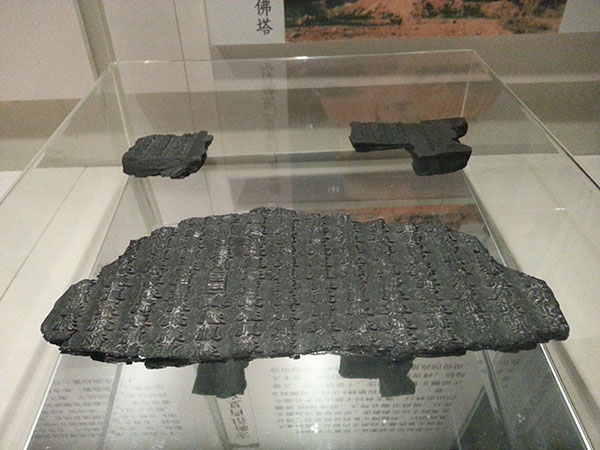
The printing blocks show includes relics of wood blocks for printing of sutras in the Western Xia (1038-1227) regime. [Photo by Deng Zhangyu / China Daily]
Ancient books are today rare, but even rarer are those wooden blocks used to print books hundreds of years ago. The show of precious printing blocks at the National Museum of Classic Books, which opened last week and runs through the end of July, features a large collection of the blocks known as woodcuts. It's the first and the most comprehensive exhibition of its kind in China.
On display are 147 blocks used for printing text, images and patterns collected by more than10 Chinese museums, libraries, institutions and private collectors. In addition, 60 ancient books published by woodblock printing are also on show.
Block printing originated from the Tang Dynasty (AD 618-907), when Buddhist sutras were widely printed. People had to engrave characters on a block, and a book required hundreds of woodcuts to print. The world's earliest book is the Chinese scroll known as the Diamond Sutra, printed in 868 and now in the collection of the British Museum.
The earliest woodcut in the show is from the Western Xia regime (1038-1227), unearthed in1990 in a pagoda in the Ningxia Hui autonomous region. It was used to print an interpretative book of sutras. Blocks from the Qing Dynasty (1644-1911) reveal important medical texts passed down from the Song Dynasty (960-1279), when the spread of block printing reached its peak.
Woodcut printing was used for more than books. The technique was widely applied in daily life. Blocks in the exhibition were used to print posters, contracts, pictures for Spring Festival, marriage certificates and patterns to ward off diseases and troubles. Most blocks of this kind were used only once; they are more difficult to find than books.
Woodcuts highlight ancient printing
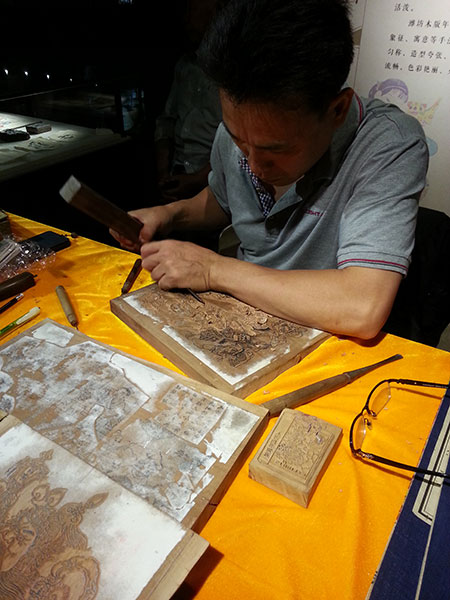
A craftsman demonstrates the methods to engrave patterns on a wood blockin the exhibition room of the National Museum of Classic Books. [Photo byDeng Zhangyu / China Daily]
"For quite a long time, we have ignored the importance of protecting printing blocks. But the show sends a message that China is beginning to rank the protection of blocks with that of ancient books," says An Pingqiu, an expert on ancient books.
An says that printing blocks need a large place to be stored and are hard to transport. Compared with ancient books, they're more difficult to protect and pass down.
Shi Jinbo, director of the research center of the culture of the Western Xia regime at the Chinese Academy of Social Sciences, says that there are many ancient books from the Song Dynasty, but the blocks are rare. The only existing block for the printing of ancient books in the Song Dynasty is in the United States. Germany, meanwhile, has the most blocks from the Western Xia regime.
"I suggest that China's block protection should start from private collectors. Shows of this kind are a good way to increase public awareness," says Shi.
The show also invites experienced craftsmen from ancient-book printing houses to demonstrate how to make woodcuts and demonstrate the process of printing.
This year, blocks for ancient book printing are on the protection list of China's rare ancient books, so institutions that collect these relics will receive government support and funding.