Monday, 24 September 2012

Ancient site needs saving not destroying


By Brent Huffman, Special for CNN
September 24, 2012 -- Updated 0900 GMT (1700 HKT)
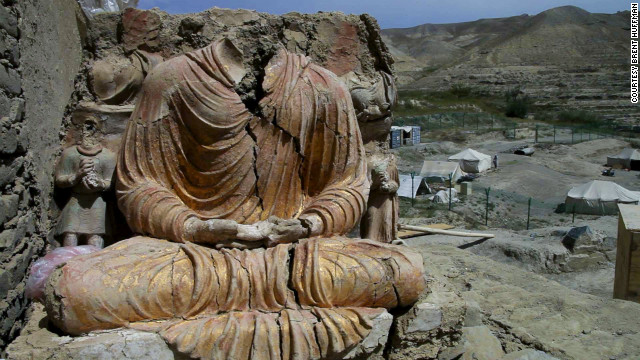
A Buddhist statue overlooks a Chinese government-owned mining compound in Logar province, Afghanistan. Mes Aynak, a 2,600-year-old Buddhist site, could be destroyed in December to create a massive copper mine.A Buddhist statue overlooks a Chinese government-owned mining compound in Logar province, Afghanistan. Mes Aynak, a 2,600-year-old Buddhist site, could be destroyed in December to create a massive copper mine.
HIDE CAPTION
Mining operation threatens Buddhist icons
<<
<
1
2
3
4
5
6
7
>
>>

STORY HIGHLIGHTS
  • Huffman says the ancient site will be destroyed by plans to mine the area
  • A Chinese company has permission to create a massive open-pit style copper mine
  • Huffman: Mes Aynak is missing link showing Afghanistan's historic role in Asia
  • He says destroying Mes Aynak is equivalent to wiping Machu Picchu off the map
Editor's note: Brent Huffman is a documentary filmmaker and assistant professor at the Medill School of Journalism at Northwestern University. He started making a film about the Mes Aynak site in the summer of 2011 thinking he would be documenting the site before it was demolished and recording the process of rescue archeology. Now he hopes he can use his film to raise awareness to actually save Mes Aynak.
(CNN) -- Please bear with me as I ask you to briefly use your imagination. Close your eyes. Imagine Machu Picchu at dawn cloaked in fog. Now imagine the fog slowly lifting to reveal an enormous ancient city perched on the edge of a mountain.
Picture a sense of mystery being immersed in thousands of years of history as you walk between antiquated hewn stone structures. There is tranquility in the wind-blown stillness of the primeval site. You feel a renewed sense of kinship with the past and with your ancestors and feel a deep reverence for their lives and accomplishments.
Now imagine the menacing sound of bulldozers closing in and men at work. Their heavy machinery rattles the ground. You hear workers rigging dynamite to these massive stone structures. There is a brief lull and then the deafening blow of multiple explosions as Machu Picchu is razed to the ground.
Be at ease, Machu Piccu is a UNESCO protected site. But a very similar 2,600-year-old Buddhist site in Logar province, Afghanistan isn't so lucky.
Documentary-maker Brent Huffman
This site is called Mes Aynak and is nothing short of awe-inspiring: a massive walled-in Buddhist city featuring massive temples, monasteries, and thousands of Buddhist statues that managed to survive looters and the Taliban. Holding a key position on the Silk Road, Mes Aynak was also an international hub for traders and pilgrims from all over Asia.
Hundreds of fragile manuscripts detailing daily life at the site are still yet to be excavated. Beneath the Buddhist dwellings is an even older yet-unearthed Bronze age site indicated by several recent archaeological findings.
Mes Aynak is set for destruction at the end of December 2012. All of the temples, monasteries, statues as well as the Bronze age material will all be destroyed by a Chinese government-owned company called China Metallurgical Group Corporation (MCC). Six villages and the mountain range will also be destroyed to create a massive open-pit style copper mine.
In 2007, MCC outbid competitors with a $3 billion bid to lease the area for 30 years. MCC plans to extract over $100 billion worth of copper located directly beneath the Buddhist site. Ironically, the Buddhists were also mining for copper albeit in a more primitive fashion.
MCC says they weren't told about the archaeology site's existence until after the contract was signed. Following significant international pressure and perhaps sensing an impending PR nightmare, MCC in 2009 gave archaeologists three years to attempt to excavate the site.
Archaeologists say they need at least 30 years to do the job but had no choice but to accept MCCs brief timetable. Specialists on site are working with extremely limited funding and the crudest of tools.
There is a magic to Mes Aynak -- an ability to draw in people from around the world who will risk their lives to save it.
Brent Huffman
Afghan archaeologists, who do the majority of the excavation, don't have access to computers or digital cameras and have been sleeping on the floor in a wooden shack when staying on the site overnight.
Today, three teams of international archaeologists led by DAFA, a French archaeological delegation, scramble to save as many relics as they can. These experts are performing rushed rescue archeology, which focuses on removing movable objects and not on preserving structures.
Archaeologists now have less than four months to do three decades worth of excavation. They are also risking their lives daily as locals of Logar Province, angry at the loss of their villages partner with the Taliban to regularly attack both the MCC site and the archaeology location with rockets and land mines.
In July, a Logar worker unearthed a landmine that exploded in his face. Later that month, four Afghan policemen were killed by a landmine on the road leading to the archaeology site.
I am often asked, "Why save it? It is, after all, just another remnant of the past, right?" Wrong.
Mes Aynak is the missing link that shows Afghanistan's interconnectivity throughout Asia on the Silk Road. Afghanistan needs to see the value of learning its own cultural history as too often the country's story is co-opted by the lens of another.
Afghans need to claim their cultural significance in the world for current and new generations. And the findings at Mes Aynak will be the key to doing that.
In addition to Mes Aynak's historical significance, the site is breathtaking to behold in person. I can't help but feel privileged and honored to have been able to set foot inside its ancient walls, to have been able to bare witness to massive Buddhas, many of which are still coated in gold paint overlooking their ancient city.
These statues have miraculously survived looting, survived the intense heat and cold, and survived over three decades of continuous war.
There is a magic to Mes Aynak -- an ability to draw in people from around the world who will risk their lives to save it. I fell in love with this ancient site and will do everything in my power to try to help save it.
It sickens me to know that in a short time this site will be destroyed in the same violent and disrespectful way the Buddha of Bamyan was destroyed. This desecration shows no reverence to culture or religion.
Imagine someone bulldozing your grandparents' graves and blowing up their cemetery. How could the world look away letting such crime happen in the name of capitalism?
Unfortunately, Mes Aynak has gained some powerful enemies. MCC, The World Bank and Afghan ministries all want mining to start ASAP.
In my opinion, they want Mes Aynak to set a precedent -- to be a model for resource extraction of the one trillion dollars plus of valuable minerals like oil, copper, lithium and iron buried underneath Afghanistan.
According to archaeologists that I spoke with, every mining location holds cultural heritage. On every potential mine lies an ancient site like Mes Aynak. So, even worse than the senseless destruction of Mes Aynak, is the thought that this kind of cheap destructive process will be replicated all across Afghanistan.
I often hear talk about mineral extraction being somehow good for Afghanistan, but I promise you this is not the case.
Given the country's out of control corruption there are a privileged few who will see any payout from such endeavors. Afghan citizens have absolutely nothing to gain from this copper mine or any other international extractive industry.
I believe Chinese will bring in their own laborers to manage the mine and Afghans will be given only low level and terribly paid positions working in slave-like conditions.
And I have said nothing about the environmental devastation. Many mining experts have told me the toxic pollution from the mine will likely turn Mes Aynak into a site so toxic that in the future people will be advised against even setting foot on the ground. They tell me this pollution will be permanent, rivers will be polluted and the toxins will travel to other areas -- and the locals have never been educated about these risks to the area.
So not only will Afghanistan lose an ancient site, a key to unlocking its important history, but the country will lose the land and everything living on it. And what happens when Afghanistan needs copper or oil or iron for its own development? Will they have to buy it back from China at inflated rates?
My fear is that in the future Afghanistan will consist of hundreds of these gaping toxic craters and the resources the country needs for its own development will be lost. Afghans will see no benefit. They will suffer from irreversible environmental devastation and the permanent loss of invaluable cultural heritage.
So as a final request I want you to close your eyes once again. Imagine a city-sized toxic crater in the ground where the majestic Machu Picchu once stood. That sight, unfortunately, is the future of Mes Aynak unless we do something to stop it.

Sunday, 23 September 2012

Exhibition Horse & Rider - From Homer to Genghis Khan extended till 4th of November 2012


I visited this saturday this exhibition in Amsterdam. 

For those unfamiliar with the Mongolian history, it's quite unusual to actually be able to view any remains from the Mongolian era as there are hardly any remains from this nomads apart from their spectacular stories and history,largely recorded by the people they conquered.

Recent finds in Mongolia show a small part of their actual daily belongings and are quite rare.

These new finds are on show at this exhibition in the Allard Pierson Museum in Amsterdam which exhibition has been extended till the 4th of November 2012.
!

For more details, go to:


Horse & Rider - From Homer to Genghis Khan

In the world of the Greeks (1300 - 300 BC) and on the Mongolian steppe (600 - 1400 AD) 

Allard Pierson Museum, Amsterdam  16 May to 16 September 2012


Poster exhibition 'Horse & Rider'.The combined exhibition Horse & Rider - From Homer to Genghis Khan is presented in the Allard Pierson Museum from 16 May to 16 September 2012. The impact of horse and rider on the world of the Greeks and on Central Asia lies at the focus, with two different cultures coming under the microscope: a nomadic and once feared nation from the Asian steppe and a city-based and influential society centred on the Mediterranean that we know as the cradle of our current Western civilisation. These are two highly evocative cultures, with Homer and the Mongol Empire of Genghis Khan as iconic opening and closing points. By means of this combined exhibition the Allard Pierson Museum for the first time confronts and combines its own classical collection with finds from a period and region that are not normally covered.
The Greek part of the exhibition shows the rise and use of the horse as mount and status symbol roughly from the Troy described by Homer right up to Alexander the Great, between 1300 and 300 BC. The Mongolian part shows archaeological finds recently excavated from rock graves in Mongolia. These finds from the 7th to 14th centuries AD have been exceptionally well preserved. They include musical instruments, items of clothing, weapons and of course saddles and harnesses. During this period, owing to the introduction of the stirrup, the rise of the steppe peoples reached its apogee in 1206 with the founding of the Mongol Empire by Genghis Khan - one of the largest empires in world history. The exhibition depicts a society in which man and horse work together as a single unit. The exhibition Horse & Rider transports the viewer to two different worlds in which man and horse are inextricably bound up with each other.
To mark the exhibition, a catalogue of the Mongolian part is being published (17.95 euros) along with a special from AP Notifications by the Association of the Friends of the Allard Pierson Museum (6.50 euros). In addition, there is a wide range of associated events, including lectures, guided tours, study days and workshops. Visitors - young and old - will be able to imagine themselves as true inhabitants of the Mongolian steppe in a fully equipped yurt, or traditional nomad tent, complete with appropriate clothing. The Mongolia of today as source of inspiration can be seen in Blue Sky, a selection of photographs and artwork by Matthea van Staden and Jeroen Toirkens.
More than 200 museum artefacts will be presented against a backdrop of life-size antique mosaics and Mongolian steppe landscapes, with 100 of them on loan from the Academy of Sciences of Mongolia. The arresting exhibition design , rich in texture and tangibility , is by Theo Braams. The exhibition has been made possible with the assistance of the LVR LandesMuseum in Bonn, the Bundesministerium für Bildung und Forschung (German Ministry for Education and Research) and the Gerda Henkel Foundation.
There is an additional charge of € 3 throughout the Horse & Rider exhibition, period (16 May to 16 September 2012).

For further information/images contact Katja Vermeulen, Communications & PR Allard Pierson Museum, 020-5252555/56,c.m.a.vermeulen@uva.nl
A review copy of the 96-page, richly illustrated publication (ISBN 9789040007439) is available from WBOOKS, 038 4673400,sales@wbooks.com
Horse & Rider - From Homer to Genghis Khan (16 May to 16 September 2012)
Allard Pierson Museum, Oude Turfmarkt 127, Amsterdam, www.allardpiersonmuseum.nl

Steppenkrieger: Reiternomaden des 7.-14. Jahrhunderts aus der Mongolei (3)

Um einen Bogen im Ritt zu spannen, braucht man enorm viel Kraft und Körperbeherrschung - die Steppenreiter hatten beides. Schon bevor Dschingis Khan Anfang des 13. Jahrhunderts die Mongolei formierte, lebten in Zentralasien Reitervölker: etwa die Alttürken, die Uiguren und die Kitanen. Das LVR-Landesmuseum Bonn widmet ihnen die Ausstellung "Steppenkrieger. Reiternomaden des 7. bis 14. Jahrhunderts aus der Mongolei".
Die mehr als 100 Objekte wurden in der West-Mongolei entdeckt, in Bonn restauriert und werden nun erstmals der Öffentlichkeit präsentiert. Wie dieser Sattel, in dem ein Steppenbewohner den Großteil des Tages verbrachte. "Die Sättel waren zwar aus Holz, aber ergonomisch angefertigt. Damit man die Zeit auf dem Pferd auch ohne Blessuren übersteht", sagt Micheael Schmauder, einer der Kuratoren vom LVR. Meistens hatten die Sättel noch einen Lederbezug.
Ein echtes Schmuckstück, das über 1.000 Jahre alt ist. Einen solchen Seiden-Kaftan konnten sich nur sehr Reiche leisten. Dieses Unikat wurde in einer Felshöhle in den Bergen gefunden, die als heilige Orte der Götter galten. Ein zirka 15 Jahre alter Junge wurde mit diesem Mantel beerdigt. Innen war das Stück früher purpurrot.
Die Struktur dieser Tasche erinnert an die Haut einer Schlange. "Wahrscheinlich handelt es sich aber um Fischhaut", sagt Michael Schmauder. Obwohl es in der Mongolei viele Seen und Flüsse gebe, sei bisher nicht bekannt gewesen, dass Fische in Mittelasien als Werkstoff verwendet wurden. Die Restauratoren mussten die Tasche über Monate mit Wassernebel bedampfen, um den Inhalt herausholen zu können. Sie fanden Feuerstahl und –stein. "Das gehörte damals zur Standardausrüstung."
Michael Schmauder (rechts) betrachtet gemeinsam mit einer Restauratorin und dem Bonner Archäologie-Professor Jan Bemmann einen Reflexbogen, der die Durchschlagskraft eines heutigen Sportbogens hat. Bemmann und sein Team kooperieren seit zwölf Jahren mit ihren Kollegen in der Mongolei.
Tasse, Teller und der Behälter für die Pfeile – alles aus Holz. Nicht etwa, weil die Reitervölker keine Keramik kannten: Die wäre auf dem Pferd einfach zu schwer und zu zerbrechlich gewesen. Der Köcher mit den Pfeilen wurde – immer griffbereit – seitlich am Gürtel getragen.
Eigentlich gilt die Pferdekopfgeige als das mongolische Nationalinstrument. Deshalb waren die Wissenschaftler überrascht, als sie nicht etwa eine solche Geige, sondern diese Harfe in den Felshöhlen fanden. Auf der Unterseite sind Verzierungen angebracht, die Jagdszenen darstellen.

Steppenkrieger - Reiternomaden des 7. - 14. Jahrhunderts aus der Mongolei (2)

Die Konservierung und Dokumentation der Grabbeigaben des Felsgrabs im mongolischen Altai, mit der Studenten der FH Köln betraut waren, ist nun vollendet.
Die Ergebnisse des Gemeinschaftsprojekts der Fachhochschule Köln, der Universität Bonn, des LVR-LandesMuseums Bonn und des Instituts für Archäologie der Mongolischen Akademie der Wissenschaft können ab dem 26. Januar 2012 in der Sonderausstellung »Steppenkrieger. Reiternomaden des 7.- 14. Jahrhunderts aus der Mongolei« im LVR-Landesmuseum Bonn besichtigt werden.
Herzstück dieser Ausstellung bilden die restaurierten und dokumentierten Funde der 2008 entdeckten mongolischen Felsgräbern des 7.-11. Jahrhunderts, in denen sich aufgrund des trockenen Klimas zahlreiche Textilreste erhalten haben.
Aufsehen erregend sind vor allem die Funde aus Dugui Cahir (11. Jahrhundert), zwei unterschiedliche Gewändern aus der reiternomadischen Kultur.
Damit liegen zum ersten Mal originale Beispiele von Bekleidung aus dem 11. Jh. vor, die bis heute nur aus Abbildungen bekannt sind.

Die Nahaufnahme zeigt einen kleinen Ausschnitt vom Seidenkaftan (Foto: FH Köln/Thilo Schmülgen) 

Maike Piecuch und Laura Peters, beide Masterstudentinnen an der FH Köln, gelang es unter der Leitung von Prof. Dr. Annemarie Stauffer, aus den vielen Einzelteilen einen einzigartigen Seidenkaftan aus chinesischem Damastgewebe und den ältesten bis heute bekannten Wolldeel (einen Mantel aus Wollfilz) zu rekonstruieren.
»Die Seide wurde in üppigster Weise verarbeitet – der Kaftan besteht vollständig aus Seide«, schwärmt Professorin Annemarie Stauffer. »Das lässt Rückschlüsse auf die hohe Position und den Reichtum seines Besitzers zu und zeigt, dass man einen Zugang zu Handelsgütern und Zugang zu China hatte. Allerdings wissen wir noch nicht auf welchen Wegen der Seidendamast in die Nordmongolei kam.« Nur Chinesen konnten damals Damastseide weben. Möglicherweise war der Seidendamast ein wertvolles Geschenk. Der Träger muss ein sehr hoch gestellter Reiterfürst gewesen sein, selbst das Innenfutter ist aus Seide. Der raffinierte Schnitt wirft ein neues Licht auf die herausragenden Leistungen der reiternomadischen Kultur: »Wir wussten«, so Prof. Dr. Annemarie Stauffer, »dass die Ärmel der Reitergewänder in unterschiedlicher Weise getragen werden konnten. Erst jetzt wissen wir, wie das Gewand konkret geschneidert war und getragen wurde. Es hat sehr lange Ärmel, durch Schlitze unter den Armen konnten die Arme zum Reiten aus den Ärmeln gezogen und diese mit einem Knopf am Rücken befestigt werden.«

Auch der 1000 Jahre alte Wollmantel belegt höchste Schneiderkunst der ebenso gefürchteten wie bewunderten Reiternomaden (Foto: J. Vogel/LVR-LandesMuseum Bonn) 


 Höchste Schneiderkunst belegt auch der zweite Textilfund, der Wollmantel. Er besteht aus einzelnen zusammen genähten Bahnen. Das Besondere sind die Feinheit und die Verarbeitung des Tuchs. Der Mantel ist hochfunktionell geschneidert: Oben eng anliegend, unten weit geschnitten (damit man aufs Pferd steigen konnte), und so genäht, dass der Reiter nicht auf den Nähten sitzen musste und seine Beine geschützt waren. Zudem hatte er eine Kapuze zum Schutz gegen die Witterung. Auch zeigt er die Besonderheiten der reiternomadischen Tracht: einen besonderen Dekor aus farblich abgesetztem Filz und kunstvolle Verschlüsse. Bis heute stellt er das älteste derartige Gewand dar.Und das alles in einer sehr feinen Faser, schön und gleichmäßig verarbeitet.

Maike Piecuch (Masterstudentin), Laura Peters (Masterstudentin), Prof. Dr. Annemaire Stauffer, Leiterin der Studienrichtung Restaurierung und Konservierung von Textilien und Archäologischen Fasern der Fachhochschule Köln (Foto: FH Köln/Thilo Schmülgen) 

Die Erforschung, Rekonstruktion und anschließende Konservierung der Gewänder wurde von der Gerda Henkel Stiftung und dem Bundesministerium für Bildung und Forschung gefördert. Bis zum 29. April 2012 präsentiert die Sonderausstellung nun erstmals anhand einzigartiger Objekte Bewaffnung, Ausrüstung und Kleidung der Nomaden. Anhand der Objekte gelingt ein tiefer Einblick in das Leben der Steppennomaden und damit in eine kulturelle Welt, die immer wieder die mitteleuropäische Geschichte maßgeblich beeinflusst hat. Die neuen Erkenntnisse sind Meilensteine der Kulturgeschichte und in der Erforschung der mongolischen Kultur.
Presseinfo FH Köln

Steppenkrieger: Reiternomaden des 7.-14. Jahrhunderts aus der Mongolei (1)

Steppenkrieger: Reiternomaden des 7.-14. Jahrhunderts aus der Mongolei [German] [Hardcover]

Das Begleitbuch zur Ausstellung im LVR-LandesMuseum Bonn vermittelt anhand beeindruckender und einzigartiger Funde Einblicke in die Lebenswelt der Reiternomaden. Von den Alttürken bis zu den Mongolen wird vor allem die überlegene Bewaffnung der Reiterkrieger vorgestellt.Über Jahrtausende stießen Reiternomaden aus den fernen Steppen Asiens bis nach Europa vor. Aus Sicht der westlichen Welt war es eine bedrohliche Masse, die unter vielen Namen bekannt war. Attilas Hunnen und die Mongolen Dschingis Khans prägten sich tief in das europäische Bewusstsein ein. Aber wer genau waren diese Menschen, die unter dem Begriff Reiternomaden zusammengefasst werden? Bisher standen nur wenige archäologische Zeugnisse aus der Lebenswelt der Steppenbewohner des 7. bis 14. Jahrhunderts zur Verfügung. Neue Antworten und Erkenntnisse bieten nun die dank des trockenen Klimas sensationell gut erhaltenen Grabausstattungen ranghoher Verstorbener aus der Mongolei. Die Ausstellung Steppenkrieger präsentiert zum ersten Mal in Europa die gefürchteten Reflexbögen sowie Köcher mit Pfeilen und Reitzeug. Kleidungsstücke, u. a. der älteste erhaltene Filzkaftan, und das einzige bisher bekannte frühmittelalterliche Saiteninstrument beleuchten in Kombination mit detaillierten naturwissenschaftlichen und technologischen Analysen der Artefakte bisher kaum bekannte Aspekte der Kultur der eurasischen Steppenvölker.

Saturday, 22 September 2012

Free admittance Lecture Series "The transformation of Buddhism across Central Asia from India to China "

Starting the 2nd of October Prof. Meiji Yamada will teach two courses about Buddhism at the University of Leiden.

The transformation of Buddhism across Central Asia from India to China (Start the 2nd of October)
Time: Every Tuesday evening from 19.00-21.00
Venue: LIPSIUS Building Room 228, Leiden University


and

The Way of Tea, the Way of the Buddha( Start the 10th of October)


The courses are free accessible for anyone interested in this/these subject(s) 

Start first lecture Tuesday 2nd of October 2012 
Lipsius Building, Room 228, 
Cleveringaplaats 1,
Leiden University


The course " The transformation of Buddhism across Central Asia from India to China" will trace the spread of Buddhism from the Indian heartland toward the Northwest, into regions now in Pakistan and Afghanistan, and then further over the mountain passes into Central Asia, whence eastward toward western China. It will focus on the importance of the Indian emperor Asoka, on the cult of relics of the Buddha and the stupas or memorial mounds within which they were entombed, on the relation between Buddhism and trade, and the ways in which Buddhism spread along the so-called ‘Silk Routes,’ namely the great trade routes which ultimately linked Rome and China.
Attention will also be given to the status of treatment of the dead in Buddhism, the role of divine figures, and their visual depiction especially in Central Asian cave temples. Texts excavated from diverse sites along the trade routes will be examined in light of what they can tell us about indiginous Buddhisms.
The Pure Land traditions, which later take on so much importance in East Asia, are then treated, and finally consideration will be given to an almost universally ignored region of Buddhist expansion, that into what is now Iran and Persian regions far to the west of what is usually considered the borders of Buddhist geography.

Contents:

1. The Legends of King Asoka and his Missionizing: The encounter of Buddhism and other religions.

2. The Relic Cult 1: Its origins and development. Relic stupas in the region of Sanchi

3. The Relic Cult 2: From Gandhara and Taxila Eastwards

4. Trade, Business and the Spread of Buddhism: The Buddhist faith of the Sakas

5. The East Asian Development of Lay Buddhism 1: Funerals and Buddhism

6. The East Asian Development of Lay Buddhism 2: Apsaras and Vajrapa

7. Central Asian Ruins and Excavated Documents: Donation and Supplication

8. The Development of the Bodhisattva Idea 1: Avalokitesvara / Guanyin

9. The Development of the Bodhisattva Idea 2: Maitreya and the Ideal Future

10. The Crossroads of Asia: The importance of Bamiyan

11. The Spread of Pure Land Buddhism: From mindfulness of the Buddha to Buddha-name recitation

12. The Spread of Buddhism West to Iran

Friday, 21 September 2012

The Khitans and Liao Dynasty

Again an excellent series of seven episodes in "Journeys in Time" from CNTV, called "The Khitans and Liao Dynasty"


Wednesday, 19 September 2012

Tattoos as a means of communication


Nineteen years ago, the well-preserved body of a young woman who died at the age of 25 around 2,500 years ago was recovered from the permafrost of a kurgan (burial mound) of the Pazyryk Culture high on the Ukok Plateau of the Altai Republic, a part of the Russian Federation.  Nearby were the bodies of two warriors who guarded her in death.
Earlier archeological excavations in the same area had recovered the frozen remains or other individuals belonging to the Pazyryk Culture, including one who is referred to as a chief.  All of these ice mummies bore elaborate tattoos on their bodies, and these were the subject of a recent, spectacularly illustrated article in the Daily Mail (August 14, 2012) that was occasioned by the transfer of the remains of the "princess" to a permanent glass sarcophagus in the National Museum in Gorno-Altaisk, capital of the Altai Republic.

The culture of the Pazyryk people in the Altai Mountains was similar to that of the nomadic Scythians of the Ukraine and elsewhere who roamed across the Eurasian steppe.  The Scythians, too, sported tattoos on their bodies, and Herodotus tells us that they were a sign of nobility.  A Scythian without tattoos was of low social status.
In light of this renewed interest in the tattoos of the Pazyryk princess and her compatriots, I am prompted to consider this type of body art as a form of inscribed communication.  Lars Krutak has several excellent articles on tattoo among the Iroquois and in Siberia and Arctic regions that provide insight for the functions of tattoos in other parts of the world.  One observation that may be made about some of the tattoos Krutak has documented is that they serve as a sort of signature, albeit a highly complex and artistic one.
Now I come to the nub of this post.  Note that the earliest (around 1200 BC) Chinese character for writing, wén 文, originally depicted and referred to tattoo (concerning this website, see my post on "Chinese 'Etymology'").
A few centuries later, when wén 文 acquired the meanings of "culture, civilization, writing", a new character based upon it (by adding the silk radical to the left) was created to stand for the original meaning, wén 纹 ("lines, design").  It is remarkable that this character is still used in the Mandarin word for "tattoo", viz., wénshēn 纹身 (lit., "lines / design-body").  Thus, there is a direct and unmistakable connection between tattoo and the development of writing in China.  This is not surprising in light of the fact that the burial practices of the elite in the East Asian Heartland (EAH, subsequently to become the core of a sequence of dynasties now retrospectively referred to as "Chinese") during the second half of the second millennium and the first half of the first millennium BC displayed clear affinities with steppe cultures.  See my "Religious Formations and Intercultural Contacts in Early China," in Volkhard Krech and Marion Steinicke, ed., Dynamics in the History of Religions between Asia and Europe (Dynamics in the History of Religion, 1 [Ruhr-Universität Bochum]) (Leiden:  Brill, 2011), pp. 85-110.
It is ironic that, toward the latter part of the first millennium BC, tattoos had become a form of punishment in China and were used to stigmatize criminals.
Incidentally, I wonder whether body tattoos might have influenced the designs on early bronzes in China.  Many of them have a very tattoo-like look.  We now know that the deer stones (concentrated mainly in Mongolia and Siberia, but also in Eastern Central Asia and elsewhere) are vaguely anthropomorphic and depict the same sorts of designs as appear on the tattooed bodies of steppe warriors.  Hence it would not be unusual to see body tattoo being transferred to cultural artifacts.
As Mark Bender said to me in a personal communication:
=====
It is really amazing that the ephemeral human body is the vehicle for inscription in these cultures in so many places…, but it makes sense.  Tattoo is portable in the most practical way.  Genealogy was also a major feature in many cultures, and lineages are reflected in traditional tattoo designs belonging to particular clans.  Thus tattoo is not just a matter of self identity.  I suspect that tattoo also has links to cave paintings, rock inscriptions, weaving, etc.   Furthermore, I’m fascinated by possible connections with the steppe bronzes of deer, tigers, and so forth.
=====
We have now come full circle, with Chinese characters being inscribed on the bodies of our coevals, though the results have in many cases been badly skewed.  The misuse of characters in contemporary tattoo has been extensively documented on Hanzi Smatter.  See also "Queen of the World" for one particularly intriguing case.
Imre Galambos has written several perceptive essays on tattoos and Chinese characters:
For those who would like to pursue this subject in greater depth, here are some works and sites that I've found useful (the books were purchased at a wonderful exhibition held at the American Museum of Natural History in 2000):
=====
Caplan, Jane, ed., Written on the Body:  The Tattoo in European and American History (Princeton:  Princeton University Press, 2000).  My emphasis added to the first word of the title.
Gilbert, Steve, ed. and intro.  Tattoo history:  a source book (New York:  Juno Books, 2000.  An anthology of historical records of tattooing throughout the world.
Hesselt van Dinter, Maarten, Tribal Tattoo Designs (Amsterdam:  The Pepin Press, 2000).  This is a beautiful little book of drawings and paintings (many of historical vintage).  See also the author's The World of Tattoo (hesseltvandinter.com).
Mayor, Adrienne, "People Illustrated: Tattooing in Antiquity," Archaeology (March-April 1999), 54-57.
Phoenix & Arabeth http://www.tattooheaven.com/
Reed, Carrie E., "Early Chinese Tattoo," Sino-Platonic Papers, 103 (June, 2000), 52 pages.
=====
I'm sure that readers would welcome other suggestions of resources for the study of the history and significance of tattoo.
Finally, I would like to point out that tattooing has been going on for a long time, since we find it already on the body of Ötzi the Iceman (ca. 5300 BP) who had many tattoos on his body.  I suspect that Ötzi's tattoos had something to do with the development of acupuncture, inasmuch as they were concentrated on the surface of parts of his body beneath which there was bone deformation or deterioration, particularly at joints (ankles and knees) and in the lumbar area of the spine.  The Tarim mummies (2nd and 1st millennia BC) also sported tattoos, some of which may have been therapeutic (around the wrist and other joints), but others appear to have been primarily decorative and symbolic.  The Thracians (as well as the Illyrians and Dacians) of antiquity (i.e., Paleo-Balkan peoples) were especially known for their tattoos, a feature which was remarked upon by Greek and Roman historians.
[A tip of the hat to all those who called the Daily Mail article to my attention, which stimulated me to write this post]

Tongwancheng ruins in NW China


nglish.news.cn | 2012-09-14 13:55:05 | Editor: An

CHINA-SHAANXI-JINGBIAN-TONGWANCHENG (CN)
Photo taken on Aug. 23, 2012 shows the Tongwancheng ruins in Jingbian County, northwest China's Shaanxi Province. Tongwancheng was the capital city of the Xiongnu (Hun) 1,600 years ago. The Xiongnu was a northern nomadic ethnic group that was influential in northern China for 10 centuries in ancient times. The Tongwancheng walls are made with sand and white-powdered earth mixed with glutinous rice water. This mixture makes the earthen walls as hard as the stone walls. In 1996, the State Council designated Tongwancheng as the national key cultural relics protection unit. Now the local government is preparing to apply for world cultural heritage. (Xinhua/Tao Ming)

   1 2 3 4 5 6   

Monday, 10 September 2012

The Story of Kucha

In July 2012 on CCTV ran the documentary "The story of Kucha"
Click HERE to view the first part "The Lost Kingdom"


If you want to know the story of Kucha, click HERE to read about it (Wikipedia).
To watch the whole documentary series (7 Parts), look at the right side of my blog under the Heading "The Story of Kucha".

Saturday, 8 September 2012

Afghan National Museum finds its footing

September 7, 2012

Watch Video

Play Video
The National Museum of Afghanistan was looted and plundered through years of civil war. But now it’s on its way back to its former glory after international donors returned stolen treasures. What’s more, the museum is now looking forward to a brighter future. Let’s take a look.
This Buddha from the 4th-5th century graces the hallway of the newly restored National Museum of Afghanistan. The freshly-painted walls, and glass cabinets are far removed from the museum’s more violent past. The building was shelled, looted and caught fire during the 90s civil war. Many centuries-old statues were destroyed.
Afghan National Museum director, Omara Khan Massoudi, says the staff hard worked to restore the artifacts.
Omara Khan Massoudi, director of Afghan National Museum, said,"After the collapse of the Taliban, together with the ministry of Information and Culture, we all tried our best to rebuild all our departments up from nothing. Now all our department is very active, I am very happy we were able to restore and also clean, treat the artifacts which needed urgent treatment."
Now, the museum is slowly being restored thanks to international efforts to return thousands of looted treasures - and to heroic Afghan staff members who hid its most priceless works during the war years and kept the secret for more than a decade.
Recently, the museum welcomed home nearly 850 Afghan artifacts - including a 3,000-year-old Bronze Age axe, a first century ivory elephant carving and a life-sized Buddha statue.
The British Museum catalogued and helped return the pieces. This was the second huge handover of Afghan historical pieces by the British Museum. In 2009, around 1,500 historical pieces were returned.
The aim is to restore the facility to its pre-war reputation as one of the finest in the region - with displays ranging from the Bronze Age to more contemporary Islamic art.
Ghulam Nabi, visitor, said,"In other countries there are very nice museums, I want change for the better here as well. Though it is good now, there are still some shortages here in Afghanistan and these shortages have to be met, so that it can be a better place to visit - and a good source of education for the people."
The museum building still lacks such modern museum basics as humidity control, high-tech security, and a reliable supply of electricity. It is seeking funds to build a new, modern home near the current building. Many hope this will help usher in new era for Afghan history.


Editor:Qin Xue |Source: CCTV.com

Burial Mounds Preserve Culture of Ancient Nomads in Kazakhstan


August 23, 2012

From: Around the Mall-  Scenes and sightings from the Smithsonian Museums and beyond.

Kurgan
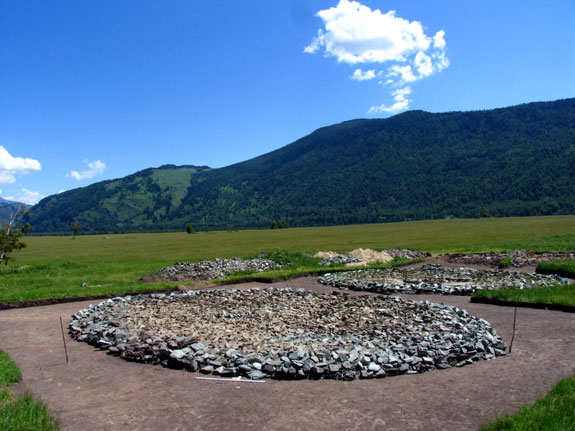
View of the “kurgan” burial mounds at Berel in East Kazakhstan. Photo courtesy of the Embassy of Kazakhstan.
Although little is known of the lives of the nomadic tribes, who 2,500 years ago roamed the Asian steppe land in today’s Kazakhstan, the region’s semi-arid climate has provided the perfect temperature and humidity in the ground’s permafrost for the preservation of rare organic artifacts. Richly woven textiles, gorgeous gold-leaf covered wooden horse tack ornaments and other rare organic artifacts, normally not preserved in other areas of the Ancient Near East and Central Asia, have been excavated in burial mounds, or “kurgans”—some more than 100 feet in diameter—that uniformly dot the Kazakhstan landscape, a vast landlocked country, larger than all of western Europe and sharing borders with  Russia, China, Kyrgyzstan, Uzbekistan and Turkmenistan.
More than 150 artifacts and works of art excavated from these sites are on display in a new exhibition “Nomads and Networks: The Ancient Art and Culture of Kazakhstan,” which opened at the Smithsonian’s Arthur M. Sackler Gallery on Saturday, August 11. The works represent some of the most significant archaeological discoveries made in Kazakhstan over the past few decades, and the show marks the first time that the ancient visual arts of Kazakh culture have been showcased in a Washington, D.C.-based museum.
Since the tribes moved about the countryside with each change of the season, few physical evidences or traces remain of the culture. No centralized city centers or trade routes could be found or documented. Instead to understand how the nomads lived and died, archeologists mainly rely on the kurgans, where elite members of the society were interred with their goods and even with their horses.
What is beginning to emerge from the excavations is the evidence of a highly sophisticated culture, one that maintained communication networks and strategic migratory routes. But also evidenced is the fact that the Saka people, as the nomadic tribes were called in ancient Persian sources, had a close, almost sacred bond, with their horses. Not an entirely surprising fact, since nomadic cultures throughout the millennia have depended on domesticated animals for both transportation and food. But archeological evidence uncovered from Saka burial mounds indicates that horses were treated as divine beings.
Since the ground’s pervasive layer of permafrost keeps the organic contents of a kurgan at a constant temperature, preventing decay, archaeologist Alexander Nagel, the show’s curator, says that researchers must take extreme measures to protect artifacts during excavation. Oftentimes, entire sections of the excavated site are packaged and removed from the ground intact. The tomb is then transported to a climate-controlled laboratory where researchers carefully examine the kurgan’s contents.
Horse Ornamentation
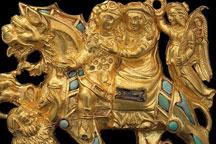
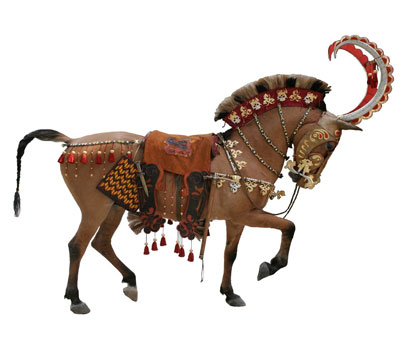
The Saka often portrayed their horses as divine, supernatural creatures, outfitting them with wooden horns and gold-leaf gilded ornamentation. This horse tack reconstruction is by Krym Altynbekov. Photo courtesy of the Sackler gallery.
In one unearthed kurgan, a man was interred with a woman—who was presumed to be his mother—in a large sarcophagus, surrounded by 13 horses that were sacrificed for the burial. Three of the horses were decorated to resembled supernatural creatures, and wearing leather masks with wooden horns painstakingly decorated with gold leaf
In life, horses were outfitted with saddles and bridles as extravagantly decorated with ornate gold-laden garb similar to the rich costumes of their riders, often Saka nobility. As for the nobles, gold ornaments were sewn into intricately woven textiles and diadems, golden headbands signifying royal descent, graced the heads of the richest tribe members. Metal shaping tools were used to form incredibly minute and precise details on the golden ornaments, and semi-precious stones such as carnelian and turquoise were carefully applied as accents.
The craftsmanship was appreciated far beyond the borders of today’s Kazakhstan. Carvings sculpted into the palace walls of ancient Persia depict the arrival of foreign Saka delegations to present Persian kings with trade items. On the façade of the Apadana, a fifth century building at Persepolis in southwestern Iran, a carving depicts a procession of Saka people bringing jewelry and other ornaments as tributary to the Persian King.
Horse tack ornaments and jewelry carved from Kazakh trees has surfaced in many archeological finds spanning many territories in Eurasia, suggesting that the Saka people were heavily integrated in the ancient trade network.
Yet as much as researchers can glean from the physical remnants of the ancient nomads, much about their way of life is still shrouded in mystery. Local Kazakh animals, such as red deer, snow leopards, wolves, ravens, ibexes and Bactrian camels are frequently seen in jewelry and small altars made of stone or bronze. In some depictions, snow leopards were given wings, suggesting they might have been deified just as the horned horses were. The ibex appears again and again in ancient artifacts and still today remains a symbol of supernatural power in Kazakhstan.
Diadem
A golden diadem decorated with turquoise, carnelian and coral. Depicted are horned animals, winged animals and a human rider on a creature. Photo courtesy of the Central State Museum of the Republic of Kazakhstan in Almaty.
“Scholars are just beginning to learn more about the rituals practiced by the Nomadic tribes,” Nagel says. “We do know that later on, shamanism was practiced and that it continued into the modern 19th century.”
“Central to the Sackler exhibit is the depiction of how the nomadic tribes interacted with their landscape,” says Nagel. The show reveals physical evidence of how the nomadic tribes traversed large expanses to participate in regional trade networks and to herd domesticated sheep and goats through seasonal changes.
The exhibition was organized by New York University’s Institute for the Study of the Ancient World.  The Sackler’s show includes new landscape photographs by Wayne Eastep, as well as reconstruction drawings. As part of the exhibit, the Sackler has partnered with archeologist Claudia Chang. Chang will be blogging about her experience digging in Tuzusai, Kazakhstan. Nomads and Networks: The Ancient Art and Culture of Kazakhstan is on view through November 12, 2012.

Saturday, 1 September 2012

Gandhara relics: Seized artefacts fake, but ‘pieces of art’ to still get museum display


A policeman inspects seized antique artifacts, displayed for media at a police station in Karachi July 7, 2012. PHOTO: REUTERS

RELATED STORIES


KARACHI: The saga surrounding the seized artefacts supposedly dating to the Gandhara civilisation is about to end. The experts have found the majority of the “relics” confiscated in a July raid are replicas, according to a report yet to be released by the National Museum in Karachi.

While the museum director, Mohammad Shah Bokhari, refused to share the information before it is made public, culture department’s archaeology director Qasim Ali Qasim told The Express Tribune that a good number of the figures were fake. “From what I have come to know, only a handful of them are originals from the Gandhara civilisation,” he said.
Talking about the authenticity process, Qasim said that only the original statues had holes in their base. The sand on the statues was also checked, whether they were buried recently or had been underground for ages. “Mud on the genuine statues cannot be removed easily.”
The committee of archaeologists from Khyber-Pakhtunkhwa, headed by Dr Farid Khan, who also examined the artefacts in Karachi, concluded that 90 percent of them were replicas.
The report has been prepared by the curator and director of the museum and is expected to be released on Monday.
Around 395 sculptures were seized by the police from a container truck. About 298 of them were said to be related to the Gandhara art, while two depicted Lord Shiva. For several days, the figures were kept at a police station, but were later moved to the National Museum.
Among the statues were large Buddha sculptures with the biggest one – 94 inches tall and 70 inches wide – showing Buddha in meditation with his devotees. According to Qasim, this figure along with all the big ones is fake.
The sculptures would still be displayed at the museum, as they are “pieces of art”, the archaeology director said. Around 95 bronze items, including flasks, horse shoes and vases, from the Mughal era were found to be genuine.
Published in The Express Tribune, September 1st, 2012.
judge noted, however, that they had failed to produce any evidence from any authority or court to corroborate their claims. “The accused have forcibly occupied the place. Their possession over Daro Joonach/Devri Jo Daro is illegal,” the judgment read.

In the hearings preceding the conviction, Judge Soomro ordered two separate inquiries which were conducted by Mukhtiarkar Muhammad Ali Khwaja and Tando Ghulam Ali SHO Salahuddin Rustamani. Both reports implicated the Nizamanis. They mentioned that the site was vacant before the monsoon rains of 2011.
According to Qasim, there are 130 heritage sites in Sindh where exploration and excavation work has to be begin. Devri jo Daro is one of them.
Published in The Express Tribune, September 1st, 2012.