Monday, 8 December 2014

Bringing a Ming painting back to life

The British Museum    8 December 2014
Jin Xian Qiu, Senior Conservator of Chinese Paintings and Carol Weiss, Conservator of Chinese Paintings, British Museum
On entering the BP exhibition Ming: 50 years that changed China, one of the first objects visitors see is a large silk painting depicting an official in front of Beijing’s Forbidden City. This Ming dynasty painting by artist Zhu Bang was conserved especially for the exhibition, using traditional Chinese scroll mounting techniques that have been passed down from master to student since before this 500-year-old painting was even painted.
The British Museum is extraordinarily fortunate to have as its Senior Conservator of Chinese Paintings Mrs Jin Xian Qiu, who originally trained and worked in Shanghai Museum before coming to the British Museum 27 years ago. It is thanks to her expertise that many of the Museum’s Chinese paintings can be displayed today. For this particular project, along with the help of her assistants and colleagues in the Hirayama Studio (part of the British Museum’s Department of Conservation and Scientific Research, working on East Asian paintings) Mrs Qiu was joined by Mr Chu Hao, a Senior Paintings Conservator from Shanghai Museum, who assisted with some of the processes that make up this painstaking treatment.
Anonymous, Portrait of an offical in front of the Beijing imperial palace, hanging scroll, ink and colours on silk, c. 1480-1580 (British Museum 1881,1210,0.87.CH). Before conservation.
Anonymous, Portrait of an offical in front of the Beijing imperial palace, hanging scroll, ink and colours on silk, c. 1480-1580 (British Museum 1881,1210,0.87.CH). Before treatment.
Traditionally, East Asian scroll paintings are habitually conserved and cared for over the course of their lifetimes by a process of remounting. The paintings themselves are cleaned and repaired, whilst the surrounding silk borders and accompanying lining papers are replaced with new materials. It is because of this remounting that many silk paintings survive today as hanging scrolls. Because our painting was in poor condition, it was decided to completely remount it.
Before any work could start on the painting, its condition was documented using detailed photography and microscopy. At the same time, appropriate materials had to be prepared and sourced; from dyeing the new first lining paper to exactly the right shade and tone, to finding matching old silks to repair all the missing areas. Mrs Qiu donated a Ming dynasty silk, which matched very closely the colour and weave of the painting, from her own collection (which was passed down to her by her scroll mounting teacher in Shanghai). 
Strengthening pigments with nikawa (a traditional East Asian consolidant)
Strengthening pigments with nikawa (a traditional East Asian consolidant)
After consolidating any vulnerable pigments, the treatment could begin. The old unsuitable mount was removed from the painting, and in the process of doing so, wider hidden painted edges and more of a seal were revealed. The painting was then ‘washed’ four times in a wet treatment that removes acidity and discolouration from the silk. This process involves carefully sprinkling water onto the surface of the painting before gently removing the excess.
After cleaning, in order to stabilise the silk weave during the upcoming treatments, a temporary facing was applied to the painting’s surface, now nicely flattened by the wet treatment. This facing is made of tong oil paper (a specially treated water-resistant paper) with further layers of xuan paper (a short-fibred paper used in all Chinese scroll mounting and much East Asian calligraphy and painting) applied on top for extra stability.
Mrs Qiu with her two assistants, Valentina Marabini and Carol Weiss, removing the painting’s old backing papers
With the surface protected, the painting could be turned over and stuck to the table face-down to reveal many layers of backing papers. These were removed with tweezers, sometimes in long strips, sometimes fibre by fibre, along with old unsuitable silk repairs. Only now was the real extent of damage to the painting revealed, and while still damp, misaligned silk pieces were carefully realigned to their correct positions. 
Mrs Qiu repairing the missing silk areas
Once dry, the process of silk repair could begin, being careful not to waste any of the precious ancient silk resources. Shaped patches of repair silk were adhered to the back of the missing areas and once dry any overlapping edges were carefully pared away. Because the painting was in such bad condition, this process alone took three conservators working for around six weeks. 
Mrs Qiu with her assistants and Mr Chu Hao from Shanghai Museum, after the painting has been lined and its facings removed.
It was at this stage that Mr Chu Hao from Shanghai Museum joined the team to help apply the new lining papers. The first lining was dyed Chinese xuan paper, and the second, long-fibred Japanese usumino paper. Mrs Qiu developed this technique, which she thinks provides extra strength, after coming to the British Museum’s Hirayama Studio, where our Chinese and Japanese expert scroll mounters work together – a wonderfully unique situation, and one of its kind here in Europe. After this double-layer of lining was applied to the painting using wheat starch paste, it could be turned over and the temporary facings removed. Then it was applied to a drying board to allow the process of toning the repairs to begin. 
Mrs Qiu and Mr Chu Hao retouching the painting on the drying board.
With the conservation aspect of the treatment finished, the mounting work could begin. Mount silks were lined and dyed to best enhance the painting, before being cut into carefully proportioned rectangles that were adhered to the painting’s edges to make an aesthetic border. Slender paper reinforcement strips were applied to the back of the lined painting wherever there was previously a crack or crease, and then the whole mounted painting was given a final backing of two layers of xuan paper with cover silk at the top (to protect the scroll once rolled). This was attached to the drying board for many months, before it was removed and the back burnished, producing a smooth finish ideal for a scroll that will be rolled up. Finally, wooden fittings including the top stave, bottom roller and roller knobs were attached, and the hanging braid and tying ribbon tied on to produce a finished hanging scroll.
Anonymous, Portrait of an offical in front of the Beijing imperial palace, hanging scroll, ink and colours on silk, c. 1480-1580 (British Museum 1881,1210,0.87.CH). After conservation.
Anonymous, Portrait of an offical in front of the Beijing imperial palace, hanging scroll, ink and colours on silk, c. 1480-1580 (British Museum 1881,1210,0.87.CH). After conservation.
From undertaking the first analysis to tying the final ribbon, the entire process took over a year, with other paintings worked on during the long periods of drying. The painting is now stable and can be rolled and unrolled for display without risk of damage; the silk has been cleaned and strengthened by the washing and repair processes and the entire painting has been flattened by its new lining. Details in the painting, previously hidden by stains or creases, are visible once more. A hundred or more years should pass before this painting will need to be remounted again, its journey of conservation and potential to be preserved never-ending while there are still expert scroll mounters to care for these works in the traditional Chinese style.
The BP exhibition Ming: 50 years that changed China is at the British Museum until 5 January 2015.
Supported by BP

The exhibition catalogue, The BP exhibition: Ming: 50 years that changed China, edited by Craig Clunas and Jessica Harrison-Hall, is available in paperback and hardback from the British Museum shop online

Sunday, 7 December 2014

The newsletter from the International Dunhuang Project is out (No 44)

THURSDAY, DECEMBER 4, 2014

IDP News No. 44, Autumn 2014

The digital dome projection in the Visitors’ Centre. Courtesy of the Dunhuang Academy. Photographer: Sun Zhijun.
IDP News No. 44, Autumn 2014 is now available to view online or download as a PDF (798KB). The current issue includes the articles:
  • The Visitors’ Centre at Dunhuang
  • Conservation and Research on Excavated Textiles from Mogao
  • Desmond Parsons in Chinese Archives
  • Prospects for the Study of Dunhuang Manuscripts: The Next 20 Years
  • Our Favourite Things: Excerpts from the IDP20 Blog
  • Obituary: Serguei Grigoryevich Klyashtornyj

Saturday, 6 December 2014

Mongolian National Central Archives

 Dissertation Reviews .org     December 2, 2014 - 

Mongolia_FFTA_Wei-chiehTsai
A review of the National Central Archives (Үндэсний Төв Архив), Ulaanbaatar, Mongolia
Strolling around downtown Ulaanbaatar, you may come across the statute of Khorloogiin Choibalsan, the leader of Mongolia from the late 1930s until his death in 1952, in front of Building #1 of the National University of Mongolia (NUM). Walking east for about one minute, you will find a gray-white concrete building, not very magnificent looking compared to the precious collections it houses. This is the National Central Archives of Mongolia (Үндэсний Төв Архив, hereafter NCAM).
Background
The NCAM, also known as the Historical Archives (Түүхийн Архив), was established in 1927 and preserves archival materials dating back to 1674. In 1957, the archives were moved to the current building. Since the building has been in use for more than 50 years, the authority decided to build a new complex of buildings to improve the preservation conditions of the archives. The original plan was to move all archives to a new site by June 2014, close to the Chinggis Khaan Airport, located about a 30-minute drive from Ulaanbaatar with no traffic. However, due to lack of funds the new complex as of this writing remains unfinished. The plan is suspended and the time of resumption is still unknown.
In the mid-1920s, the Mongolian authority ordered that local governments move their archives to Ulaanbaatar under central control. So if you want to find any kind of pre-1920s archives, do not bother to visit the countryside and instead visit the NCAM. According to the LALORC project survey, the NCAM contains more than 1,260,000 items of paper-based documents, plus audio recordings, videos, and newspapers in six languages: Mongolian, Russian, Tibetan, Chinese, English, and French. The condition of those archives varies. Some of the documents are good, but some of them have become fragmented into pieces.
I was honored to be invited by Professor Delgerjargal Purevsuren as a visiting scholar in the history department at NUM and spent five months at the NCAM from August 2013 to January 2014 for my PhD dissertation. My research is on the historical process of the integration of Han Chinese and Manchu immigrants into Qing Mongolian society. Since the materials are supposed to belong to local archives during the Qing era, I came to Ulaanbaatar and looked for Qing archival documents in Mongolian, Manchu, and sometimes Chinese. My goal was the archives under the fond M-85, the Office of Erdene Shanjodba, which was responsible for the administration of the Great Disciples (их шавь) under Jibzundamba Khutugtu, the highest living Buddha in Qing Outer Mongolia.
Access
If you are not a Mongolian citizen, in order to access the archives you will need to obtain a permit, which requires several steps. First, you will need a local collaborator who works at a public or academic institution to write a recommendation letter. On arrival at the archive, you must first visit the Director of the General Archival Authority (Aрхивын Ерөнхий Газар) with your recommendation letter in order to obtain their permission. After obtaining this permission, you can then go to the NCAM with your letter, where you meet the Head of the Central Archives, and then wait.
How long will it take? During normal working days, it should not take more than several days, but this depends on the timing of your submission. For example, when I arrived in Mongolia last summer, it was the day before Naadam, Mongolia’s largest summer festival. Everyone is on vacation at that time and usually goes back to the countryside, so it took me around two weeks to reach my sponsor and another two weeks to obtain permission from the Head of the NCAM. My suggestion is if you are planning to visit the NCAM, please take such timing issues into account and, if possible, see if your sponsor could accompany you through this stage.
After completing the entire process, you are allowed to enter the reading room to obtain your permit to conduct research. For your first visit before obtaining this permit, bring your passport and register at the information desk. The librarian will ask you to complete an application form on which you provide your basic information and research topic. Remember also to bring a one-inch square photo and money for the permit. The fees for non-Mongolian citizens are as follows: for a 14-day visit, the permit costs US$10; for a one-month visit, US$15; and for a two-month visit, US$20. These fees are payable in either U.S. dollars or the equivalent amount in Mongolian Tögrög (₮, MNT). Bring the permit with you every time you visit the NCAM; you will need to show it to the guard and sign in and out.
Laptops and other electronic devices are allowed to be brought into the reading room. You can transcribe the content of documents either on paper or on your laptop, but photography is strictly forbidden. There are cameras on the walls to watch the readers. When you leave the NCAM, the guard will check your bags and belongings to ensure you did not take any archival documents.
Searching the Catalog 
Since the NCAM has not built online or digital catalogs, you have to check the catalogs in binders. There is only one copy of each catalog, so you will have to wait if the binder you need has been borrowed. I was able to check out three or four at one time. When you check the catalog, the content of each document will be given in brief plus its date.
The structure of the Manchu/Qing-era (1636-1911) archives in the NCAM corresponds to the Qing administration of Outer Mongolia. The two western aimags (аймаг, province), Zasagtu Khan and Sayin Noyan, are under the left lieutenant-general in Uliastai, the two eastern aimags, Tüsiyetü Khan and Setsen Khan, are under the amban (imperial resident) in Khüriye (today’s Ulaanbaatar). The Oirats in the west Mongolian frontier are under two ambans in Khowd. Four aimags and the Khowd frontier are constituted into banners (хошуу) and Jibzundamba Khutugtu’s territory. This lays the foundation for the categorization of Manchu/Qing-era archives in the NCAM.
I would like to use a document from the Manchu/Qing-era archives as an example to show the categorization system of the NCAM. Here is an example reference number: M-85 D-1 KhN-39 (М-85 Д-1 ХН-39). This document is about the registration of Han Chinese men who married Mongolian women from the Great Disciples.
The reference for each record is composed of three parts. In this example, the first part corresponds to the Manchu/Qing-era archives, which are divided into 224 holdings (фонд, borrowed from Russian). You will find numbers from M-1 to M-224. ‘M’ stands for the Manchu era (Манжийн үе). Different eras have their own label, such as ‘A’ for the era of autonomy under Bogd Khan (1911-1924). The fond M-1 is the archives of the Office of Imperial Resident in Khüriye; M-2 to M-7, the Office of the Left Lieutenant-General in Uliastai; M-8 the Office of the Imperial Resident in Khowd; M-9 to M-30, Tüsiyetü Khan aimag; M-31 to M-57, Setsen Khan aimag; M-58 to M-77, Sain Noyan aimag; M-78 to M-84, Zasagtu Khan aimag; M-85 to M-142, Jibzundamba Khutugtu’s territories; M-143 to M-150, the post-road services; M-151 to M-157, the patrol duties; M-159 to M-164, the territories under Imperial Resident in Khowd; M-167, maps; M-168, genealogy; M-169, stamps and seals; M-170, the communication of the nobilities, officials and lamas. The rest of these archives are comprised of miscellaneous documents. The second part, ‘D,’ stands for file (данс). The third part, ‘KhN,’ stands for storage unit (хадгаламжийн нэгж).
Photocopying
If you want to obtain photocopies of documents, the NCAM can do that for you, but the fees are not cheap. In general, the earlier the archives, the higher the cost, so the Qing documents are the most expensive. The following fees are in Tögrög. For documents dated between 1674-1910, one A4-sized page costs ₮3,000; for documents from 1911-1920, ₮2,500; for documents from 1921-1960, ₮2,000; and for documents from 1960 to the present, ₮1,500. Based on the rules of the NCAM, the fee for Mongolian citizens is ₮500 less for each category. The exchange rate as of September 2014 was US$1 = ₮1,800. Usually you will get your documents on paper, however, if your documents are oversized, you might get digital photos.
Hours
The NCAM is open from Monday to Friday, 8:00 a.m. to 5:00 p.m. Lunch break is supposed to last one hour, from 12:00 p.m. to 1:00 p.m. The librarian often comes back early and will usually allow you to enter the reading room and resume your work 10 to 15 minutes early. However, since there is only one librarian working at the reading room, sometimes it will be closed because the librarian leaves to run some errands. Moreover, the reading room will also be closed when the archive is hosting a meeting. It is best to ask the librarian for the next day’s schedule before you leave the archive every time to make sure it will be open.
In short, despite the bureaucracy and red-tape, I recommend the NCAM to all colleagues who work on early modern Mongolian, Russian, and Chinese history.
Address
National Central Archives
Zaluuchuud Avenue 9
Sukhbaatar District
Ulaanbaatar, Mongolia
Location
Just in front of Building #2, National University of Mongolia
Hours: Monday-Friday: 8:00 a.m. to 5:00 p.m.
Tel: (976-11) 264361/51
Email: central_archiver@archives.gov.mn
Website: http://www.archives.gov.mn
For Further Information
I wish to thank Professor Jonathan Schlesinger for suggesting these two important articles:
Hiroshi Futaki 二木博史’s article in Japanese includes a full list of the Manchu/Qing-era archives preserved in the NCAM. (http://jairo.nii.ac.jp/0041/00001460/en)
Junko Miyawaki 宮脇淳子’s article in Japanese on the Manchu and Mongolian archives of the office of the Manchu amban stationed in Khüriye also provides an overview on the archives of the NCAM. (http://jairo.nii.ac.jp/0041/00001468/en)
Wei-chieh Tsai
Department of Central Eurasian Studies
Indiana University Bloomington

Image: Manchu document from the National Central Archives of Mongolia. Photograph by Author.

Xinjiang Khotanese Buddhist wall paintings displayed in Shanghai


China Culture.org   4 December 2014

An exhibition of Xinjiang Buddhist frescos, Buddhist Vestiges Along the Silk Road: Mural Art from the Damago Site, Hotan, Xinjiang, opened at the Shanghai Museum in East China's Shanghai municipality on Nov 28. 
The 51 items of culture relics on display marked the first time they were shown outside of Xinjiang, and they reflect rich connotations and artistic characteristics of paintings of Hotan Buddhism.
Hotan Prefecture is situated in the southern part of Southwest China's Xinjiang Uygur autonomous region. In the past it was known as Khotan, an ancient Buddhist civilization believed to date back to the third century BC.
From 2002 to 2010, precious cultural relics from Buddhist ruins were unearthed at three historical sites in Damago of the ancient kingdom of Khotan.
Judging from the layout of the ruins, the archaeologists believed the three sites were components of a single temple complex dating to the seventh and ninth centuries.
Among them, Topulukdong Buddhist temple ruins left a large number of murals, but unfortunately remained as fragments. Archaeologists were still able to identify them as the Khotanese Buddhist paintings of the eighth century.
The exhibition, Buddhist Vestiges Along the Silk Road, particularly focuses on the murals from Topulukdong and its nearby Buddhist sites, and it will be open through March 8.


Friday, 5 December 2014

Archeologists explore ancient ship of Song Dynasty

ChinaCulture.org  5 December 2014

Archeologists have started exploring the interiors of the ancient wrecked ship of Song Dynasty "Nanhai Number One".
The vessel, 30.4-meter-long and 9.8-meter-wide, was constructed during the Song Dynasty and sunk more than 800 years ago.
It is the oldest and the largest wrecked merchant vessel yet discovered, and also the best preserved.
The ship was found accidentally by the British Maritime Exploitation and Recover Company and Guangzhou Salvage Bureau in 1987. They were searching for another wrecked ship of East India Company, called "Rijnsburg", but they stumbled upon more than 200 cultural relics that were identified to be from Song Dynasty.
The salvage of "Nanhai Number One" did not begin until 2007 due to many technical difficulties, and then it was moved to Maritime SilkRoad Museum of Guangdong, which was especially constructed for its perseveration.
At the end of 2013, the full-scale excavation of "Nanhai Number One" started, and so far 623 porcelain samples, 107 gold wares, 5,000 bronze coins, and many other cultural relics have been extracted from the wreck.


A gold ware was unearthed from the wrecked ship belonging to the Song Dynasty "Nanhai Number One". [Photo/Xinhua]

Wednesday, 3 December 2014

The Lady with the Phoenix Crown: Tang-Period Grave Goods of the Noblewoman Li Chui (711-736)

The Lady with the Phoenix Crown: Tang-Period Grave Goods of the Noblewoman Li Chui (711-736) Hardcover – 29 Sep 2014

What did people eat in ancient China?


Speaking of archaeological discoveries, people usually associate them with historical sites, ancient tombs and unearthed cultural relics. Seldom do people link them with food.
"Some food remains have also been found in the archaeological digs. Such discoveries turnout to be very important, because they can rewrite the history of food that we knew," WanRenxiang, an expert with Institute of Archeology at the Chinese Academy of SocialSciences told Shenyang Evening News.
Chinese food culture has a very long history. When a documentary on Chinese food, Tasting China, was first shown on TV in 2012, it was a hit in the country. The followingdiscoveries show that the pursuit of good taste began early, since ancient times, and alsoproves that the foodies, or "chihuo", in Chinese, are not unique to our time.
Culture Insider: What did people eat in ancient China?
These noodles were discovered by archeologists at Lajia historical site in Minhe county ofNorthwest China's Qinghai province in 2002. Through research, archeologists concludedthat the ingredients in the noodles were a mixture of millets ("shu" in Chinese) and theycan be traced back 4,000 years, making them the earliest known noodles. 
Culture Insider: What did people eat in ancient China?


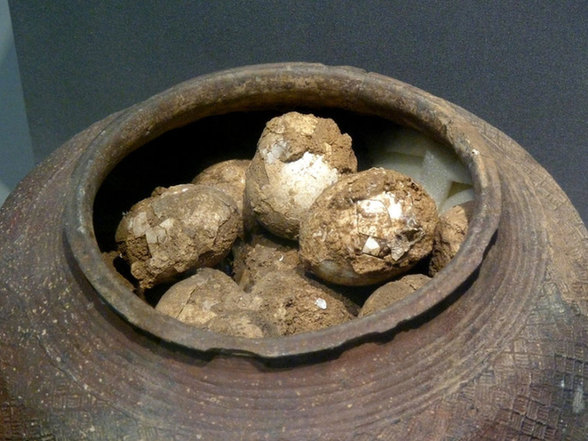
This terrine with eggs inside was unearthed in an ancient tomb from the Western ZhouDynasty (1046-771BC), with a history of more than 2,800 years. The eggs are the earliestever discovered in China and are petrified. 
What did people eat in ancient China?


The earliest Chinese dumplings were unearthed at Astana Cemetery in Turpan prefecturein Northwest China's Xinjiang Uygur autonomous region. They have a history of morethan 1,700 years. 
Culture Insider: What did people eat in ancient China?
Kabobs discovered at Han tombs in Northwest China's Ningxia Hui autonomous region. 
Culture Insider: What did people eat in ancient China?
A piece of a wall painting from the Frescoes of Liao tomb shows a kitchen in ancient times

Monday, 1 December 2014

Dunhuang culture on display in Hong Kong


A donated portrait of Lady Wang, who was from Taiyuan, at worship.[Photo/lcsd.gov.hk]
The exhibition Dunhuang - Untold Tales, Untold Riches was unveiled at the Hong Kong Heritage Museum on November 27.
The largest of its kind ever held in Hong Kong, the exhibition showcases nearly 120 artifacts, and unfolds chronologically to reveal numerous aspects of Dunhuang culture including religion, art, folklore, social life, East-West cultural exchange and cultural relics preservation.
The exhibits cover all of the core aspects of Dunhuang grotto art, such as replica caves, replica painted stucco statues, Buddhist script items, relics of Dunhuang, and copies of the cave murals.
Jointly presented by the Leisure and Cultural Services Department and the Dunhuang Academy, and co-organized by the Hong Kong Heritage Museum and the Dunhuang Academy, the show will run until March 16 next year.

Dunhuang, an ancient city in Gansu Province, western China, was the gateway to the Silk Road leading to central Asia and Europe. Dunhuang is world famous for its artistic sculpture statues and frescopaintings from the 4th-14th centuries in China, which reflect Silk Road civilization and important aspects of the Chinese people's religious life,arts, and customs, including the introduction of Buddhism to China during this period. In 1987, the Mogao Caves were among the first batch of Chinese sites to be listed as UNESCOWorld HeritageSites, reflecting their cultural value.
Mural depicting a butcher's shop in ancient times. [Photo/lcsd.gov.hk]

A visitor takes in an item on display at the exhibitionDunhuang - Untold Tales, Untold Riches,at the Hong Kong Heritage Museum, Nov 27.[Photo/Xinhua]

Visitors take in items on display at the exhibitionDunhuang - Untold Tales, Untold Riches, at the Hong Kong Heritage Museum, Nov 27.[Photo/Xinhua]