Saturday, 7 July 2012

Ancient Tibetan Seals


Recently I spent some time at the British Museum looking at objects from the Tibetan forts of Miran and Mazar Tagh, where many of the Tibetan manuscripts that I work with at the British Library come from. The reason for the somewhat arbitrary division of textual and non-textual material from the same site across two different institutions goes back to the British Library Act of 1972. While the decision to separate the texts from the things made sense in that the British Museum simply didn’t have the space to house an ever-increasing collection of books, it also resulted – in the case of the finds from Miran and Mazar Tagh – in letters being separated from the pens that were used to write them, and the seals that were used to stamp them.
As for those seals (and if you are wondering, that’s what is pictured above), I saw these for the first time recently when Catrin Kost, who has been cataloguing the British Museum’s artifacts from Central Asia, asked me to have a look at them. When the seals (three in total) were first brought to the Museum by Aurel Stein, he had impressions taken of them, and these were read by L.D Barnett. The latter’s readings were not bad, but he let his imagination run away with him in the case of this seal, which he read as a Tibetan version of the Western name Anthony (‘Ang to ne)! In fact, these Tibetan syllables seem to be a Chinese name (Wang to ne). As you can see from the image, the name ends with a swastika, and sits on a lotus blossom. The three seals are all made from animal horns, with a hole bored through the midpoint, probably so that they could be carried on a string or leather thong. I’m not sure what animal such horns might belong to – though this might not be clear from the photo, they are very small, only about 3 inches long.
We find stamps made with this kind of round seal in lots of documents from Miran, Mazar Tagh and Dunhuang. The round seals are always used by private individuals, in contrast to the larger, more impressive square seals used by officials (see this post for some examples of those). These personal seals would function like a signature on legal documents, like contracts and receipts. Pictured below is a receipt for the repayment on a loan of wheat (IOL Tib J 844), with the seals of three people involved in the transaction.
Since they were found in a Tibetan imperial fort, these seals should date to the first half of the ninth century — so they are by far the earliest examples of Tibetan seals. As far as I know, later examples are all made from metal, as in this picture from a Chinese exhibition (but note also the presence of holes in the middle of many of the seals, and the leather thong tied through one of them):
So, let me finish with an attempt to read the names on the three seals.
1. MAS.606 (pictured at top): this seems to be Wang To ne, certainly a Chinese surname, and probably a Chinese personal name as well.
2. MAS.607 (pictured above): Written in the four spaces marked out by a swastika, we have the Tibetan clan name Gnyos followed by Lha la brtsan. I’m quote sure about thebrtsan but not so much about the lha lha, if anybody else wants to try their hand, or eye. Barnett read it as khal.
3. MAS.608 (pictured above): This seal is now quite damaged, but if you click on the link to the IDP site, you can see a the imprint taken by Stein. The name I see is ‘O nam Gnyan lha, a clan name (‘O nal) that we also see in the Miran documents, and a common imperial period personal name (Gnyan lha). Similarly to the first seal, the name is flanked by swastikas and sits above a lotus.
*  *  *
Further Reading
British Museum: Search the Collection – if you type in the seals’ numbers here (e.g. MAS.606) you can see the full description by Catrin Kost, which includes my own readings.
Aurel Stein’s description of the Miran site, and all his finds, are in: Stein, Mark Aurel, Serindia, Oxford: Clarendon, 1921 (vol.1, p.480).

Sunday, 1 July 2012

Xanadu added to UNESCO's World Heritage List


The Site of Xanadu (China), the Bassari Country: Bassari and Bedik Cultural Landscapes (Senegal) and the Historic Town Grand Bassam, the first capital of Côte d’Ivoire have been added to UNESCO’s World Heritage List.
North of the Great Wall, the  Site of Xanadu  encompasses the remains of Kublai Khan’s legendary capital city, designed by the Mongol ruler’s Chinese advisor Liu Bingzhdong in 1256. Over a surface area of 25,000 hectares, the site exhibits a unique attempt to assimilate the nomadic Mongolian and Han Chinese cultures. This was the base from where Kublai Khan established the Yuan Dynasty that ruled over China over a century, extending its boundaries across Asia. The religious debate that took place here resulted in the dissemination of Tibetan Buddhism over northeast Asia, a cultural and religious tradition still practiced in many areas today. The site was planned according to the traditional Chinese feng shui  in relation to the nearby mountains and river. It features the remains of the city, including temples, palaces, tombs, nomadic encampments and the Tiefan’gang Canal along with other water works.

Brief Description

North of the Great Wall, the Site of Xanadu encompasses the remains of Kublai Khan’s legendary capital city, designed by the Mongol ruler’s Chinese advisor Liu Bingzhdong in 1256. Over a surface area of 25,000 hectares, the site exhibits a unique attempt to assimilate the nomadic Mongolian and Han Chinese cultures. This was the base from where Kublai Khan established the Yuan Dynasty that ruled over China over a century, extending its boundaries across Asia. The religious debate that took place here resulted in the dissemination of Tibetan Buddhism over northeast Asia, a cultural and religious tradition still practiced in many areas today. The site was planned according to the traditional Chinese feng shui in relation to the nearby mountains and river. It features the remains of the city, including temples, palaces, tombs, nomadic encampments and the Tiefan’gang Canal along with other water works.
Other Languages:
English French Arabic Chinese Russian Spanish
The western part of the city wall of the Palace City © Zhenglan Qi Administration of Cultural Heritage of the site of Xanadu City, Xilingol Meng, Inner Mongolia Autonomous Region

Saturday, 30 June 2012

New finds on the Nan Ao No. 1


Watch Video

Play Video
Xiaobai Jiao-1, an ancient merchant vessel which sank nearly 200 years ago during the Qing Dynasty. Recently archaeologists have found relic stones and porcelain pieces on-board the sunken ship.
The ship sank in waters near Ningbo city, which was a major hub for sea trade in ancient China.
Archaeologists are working 24 meters below sea level. It was there they found the Mei Yuan stones piled on the boat’s bottom. These precious stones were used as gifts for communication in ancient times.
An archaeologist says, "We have seen three bowls with green and white patterns. Two of them are broken and the rest is complete with the cover."
Archaeologists have also found porcelain pieces, pottery, seals, Spanish coins, stone and wooden pieces.
In addition, experts have found a rich variety of relics that will provide valuable information to historians about trade during those times.

Discovery magnificent Western Zhou Dynasty Tomb


● The unearthed objects include more than 20 bronze lacquer wares and weapons
● Archaeologists predict the tombs may belong to nobles

Watch Video

Play Video
Archaeologists have found a tomb complex dating back to the Western Zhou Dynasty, some three thousand years ago. The tombs are located in Baoji City in Northwest China’s Shaanxi Province.
The unearthed objects include more than 20 bronze lacquer wares and weapons. Most of them are well preserved and quite delicate, which could be used as precious materials for research.
Archaeologists predicted that the tombs may belong to nobles. It is one of the most important discoveries in China in the latest 30 years.
The unearthed objects include more than 20 bronze lacquer wares and weapons. Most of them
are well preserved and quite delicate, which could be used as precious materials for
research. 
The unearthed objects include more than 20 bronze lacquer wares and weapons. Most of them
are well preserved and quite delicate, which could be used as precious materials for
research.

Friday, 29 June 2012

The Image of the Winged Celestial and Its Travels along the Silk Road


SINO-PLATONIC PAPERS 
Number 225 June, 2012 


The Image of the Winged Celestial and Its Travels along the Silk Road 


by Patricia Eichenbaum Karetzky 

Winged celestials are a consistent feature in Buddhist art. Like so much of Buddhist imagery, they derive from the West and appear in the earliest extant Buddhist art. Associated with flight and the ascent into the ethereal zone, they convey spirituality. For centuries flying divinities were a regular feature, and during the Kushan era (first to third century) monks, merchants and missionaries brought them with Buddhist texts and icons east along the Silk Road. Thus representations of winged celestials can be found in early Buddhist art in Central Asia and medieval China. This paper will trace the evolution of the image of the Buddhist anthropomorphic flying heavenly spirit beginning with its earliest appearance in India, through its development in the area of Gandhāra (parts of Northern India, Afghanistan and modern Pakistan) during the Kushan era, and its transmission to Chinese Central Asia, before analyzing the appearance and role of these celestials in medieval Chinese art. Among the foci of analysis are a consideration of the topology of angels and a brief etymological and visual survey, for there are a variety of heavenly creatures.
Buddhist art developed late in India, for reasons that are surmised but not known. For the first three hundred years there appears to be no evidence of “Buddhist art” in permanent materials. Things changed under the leadership of the famous Buddhist king Aśoka (300–232 BCE) of the Mauryan dynasty (321–185 BCE), whose mid-life conversion to Buddhism resulted in a proliferation of activities celebrating his belief, among which the building of stone monuments with decorative programs stands out. Many of the images employed in this earliest stage of art were borrowed from foreign artistic traditions. One obvious source was the neighboring empire of Persia, where in addition to the use of stone, certain decorative motifs such as the lotus, lion, animal capitals, and winged anthropomorphic creatures appear over the centuries. For example, engraved on a tall stele at the Palace built by Ashurnasirpal II in the Assyrian city of Nimrud in the ninth century BCE, and now preserved in the British Museum, are a pair of tall winged figures shown in profile with long beards, dressed hair, tall caps, skirts, a scarf, and large wings; they flank the sacred tree.

Water Management in Jingjue 精絕 Kingdom

SINO-PLATONIC PAPERS 
Number 223 April, 2012 


Water Management in Jingjue 精絕 Kingdom: The Transfer of a Water Tank System from Gandhara to Southern Xinjiang in the Third and Fourth Centuries C.E. 


by Arnaud Bertrand

The present scholarly consensus is that the Chinese Han dynasty military force (second century B.C.E.–second century C.E.), when it reached the city-oases of the southern and northern Taklamakan Desert (in the modern Xinjiang region of Western China), introduced new agricultural and water techniques to the region. If this theory stands confirmed for some oases, such as Miran, Dunhuang and Turfan, via the famous tuntian 屯田 technique, the influence nevertheless is not only from one side. In fact, a great majority of the water systems still existing today among the oases of the region are either a product of local invention or of Western influence. Among these, water tanks excavated on the site of old Niya 尼雅 (Uighur Nïya نىيە; Southern Taklamakan), known since the Han dynasty as Jingjue 精絕, strike one with their distinctive shape. They were discovered in the early twentieth century, but few scholars have taken the time to analyze in depth their historical and technical relationship with the site and with the cultural panorama of Southern Xinjiang. In this article, by examining a combination of archaeological, geological, and textual records, I intend to show that migrants from the Gandhara region (Pakistan) either introduced or developed a tank-based water technique within the agricultural, economic and perhaps religious systems of the Jingjue oasis during the Kroraina kingdom’s rule over the Southern Taklamakan territories (third to late fourth century).

Wednesday, 27 June 2012

Valley of the Khans Experts meet in D.C.


Washington, June 4, 2012.
Two of the world’s greatest scholars of Mongol history joined their collaborators NG Emerging Explorer Albert Lin and NG Archaeology Fellow Fred Hiebert in Washington, D.C. last week to discuss their findings on the Valley of the Khans project, to meet with the Mongolian Ambassador to the U.S. Khasbazaryn Bekhbat, and to engage in other conversations around their exciting work.
For the past few years, Albert has been using cutting-edge technology and innovative crowd-sourcing methods to survey the vast openness of Mongolia in search of the area where Genghis Khan was buried. His collaborators have been uncovering the history of the Mongol leader quite a bit longer.
Professors Shagdaryn Bira and Tsogt-Ichiryn Ishdorj are internationally recognized as leaders in Mongol historical research, based on the decades of intense research they have done on the subject, helping to flesh out the story of the famous conqueror, and restoring a knowledge of the rich cultural impacts of his surprisingly modern empire–one that included free trade of goods and ideas, and freedom of religion for all.
Over the years, Bira and Ishdorj’s research has been difficult at times because of the scant clues in the written record and sensitive politics surrounding the legacy of Genghis Khan.
Professor Bira is now Secretary General of the International Association for Mongol Studies, and laureate of the state prize of Mongolia for his scholarly work on the history of the country. In particular, he has won international acclaim for his multifaceted research, including papers comparing modern and Mongol-era versions of globalization and warfare in the Middle East.
Professor Ishdorj is Deputy Director of the International Association for Mongol Studies, as well as Co-Principal Investigator and Mongolian Expedition Leader on the Valley of the Khans project. Together these scholars bring an incredible amount of historic information, cultural perspective, experience, and personal passion to the project.
2012 marks 850 years since the birth of Temujin, the Mongolian man who would unite his neighbors and conquer the known world under the title of Genghis Khan. After decades of research, years of hi-tech data gathering, and months of archaeological analysis, one more chapter in the long history of this man and his legacy is nearing completion. Stay tuned to discover what secret whispers may yet rise from the silent steppes.

Tuesday, 26 June 2012

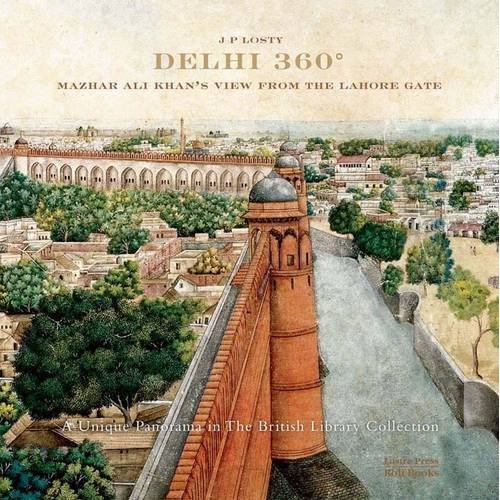
Delhi 360°: Mazhar Ali Khan's View from Lahore Gate


Delhi 360°: Mazhar Ali Khan's View from Lahore Gate [Hardcover] 
By: J.P. Losty

Hardcover: 92 pages
Publisher: Roli Books (October 16, 2012)
Language: English
ISBN-10: 8174368604

About the Book: 
Made in 1846, the painting commonly known as 'The Delhi Panorama' by the famous topographical artist Mazhar Ali Khan is the finest artistic rendering of Shahjahanabad ever made. It also affords a unique glimpse into the heart of the imperial palace in the Red Fort before much of it was destroyed after the 1857 Uprising. The 360 (Degree) view of Delhi along with its extraordinary detailing of the cityscape makes the panorama not just an important historical document but also the masterpiece of its artist. The 5-metre long panorama, which is in the collection of the British Library since 1981, along with all the Persian and Urdu inscriptions has never before been published complete. Its publication here is accompanied by essays that put the panorama in its historical and artistic context with a commentary on the inscriptions that brings it to life. 

About the Author: 
J.P. Losty was formerly curator-in-charge of the extensive Indian visual collections in the British Library in London. He has published many books and papers on many aspects of the painting of India from the twelfth to the nineteenth centuries. His major books include 'The Art of the Book in India' (1982), 'Calcutta City of Palaces' (1990), and 'The Ramayana' (2008). The paintings of late Mughal Delhi are central to his interests, and he has also edited a book titled 'Delhi from Red Fort to Raisina', which is on Delhi's journey from Shahajahanabad to New Delhi, and is contributing to the catalogue of the forthcoming exhibition on Delhi at the Asia Society, New York. His other forthcoming book (2012) is on the collection of Mughal paintings in the British Library.