Wednesday, 7 January 2015

News about the tomb of Genghis Khan

Has Genghis Khan's tomb beeen spotted from SPACE? Online 'explorers' narrow down the location of the grave using satellite images 

  • Final resting place of Mongol leader has remained a secret for 800 years
  • His tomb is said to be near Burkhan Khaldun mountain in north Mongolia
  • Scientists used crowdsourcing to scour 84,000 satellite images of the area
  • More than 10,000 volunteers surveyed more than 2,300 square miles
  • They identified 55 archaeological sites that could be Genghis Khan's tomb
  • Archaeologists believe they are closer than ever to finding his burial site


He may have been the ruler of an empire that covered most of Asia, but the final resting place of Genghis Khan remains a mystery.
After dying of a sudden illness in 1227 at the age of 72, the Mongol leader was buried at a secret location that has yet to be uncovered.
Legend says that as his body was carried to its final resting place, anyone encountered along the route was put to the sword before those escorting the body also killed themselves
More than 10,000 volunteers tagged stuctures, roads and rivers on satellite images as part of the project

More than 10,000 volunteers tagged stuctures, roads and rivers on satellite images as part of the project
But now scientists, aided by a team of amateur archaeologists, believe they are close to finding the final resting place of the first Mongolian emperor.
By scouring more than 84,000 satellite images of the area where he suspected of being buried, more than 10,000 volunteers identified sites that looked like they might be of archaeological signficance.

A FATHER TO 16 MILLION MEN 

Genghis Khan has 16 million male descendants living today, according to DNA research.
Scientists have traced a cluster of extremely similar Y-chromosomes back to a single ancestor living in Mongolia around 800 years ago.
They believe the only man with the opportunity to father enough children would have been the Mongolian warlord.
Within 80 years he built an empire that covered much of China, Iran, Pakistan, Korea and South Russia.
The findings confirmed earlier studies that Khan's DNA fingerprint was widespread over the Asican subcontinent.
The highest concentration of 'Khan chromosome' carriers was in a group of ethnic Kazakhs.
Tom Robinson, an accountancy professor whose ancestors came from the Lake District, was the first man outside Asia to be identified as carrying the Khan chromosome.
It was found that Professor Robinson's paternal forebears came from the Caucasus near the Black Sea. 
The crowdsourcing project allowed the researchers to survey an area of 6,000 sq km (2,316 square miles), an area twice the size of Yosemite National Park.
In a paper published in the journal Public Library of Science One, they claim to have identified 55 potential archaeological sites that could be home to the remains of Genghis Khan.
The team were then able to visit some of the sites in Northern Mongolia to carry out ground surveys and use drone aircraft to take pictures from above.
Dr Albert Yu-Min Lin, the researcher who led the project at the Calfiornia Institute for Telecommunications and Information Technology at the University of California, in San Diego, and a self-confessed Genghis Khan obsessive, said the work has brought them closer to finally answering the question of where Genghis Khan is buried.
Dr Yu-Min Lin said that using the help of the public through crowdsourcing helped his team plough through enormous quanities of information that would would have taken years for a single archaeologist to survey all the satellite photos.
He added: 'Looking at the data size challenge, we have surveyed a historically significant area of roughly 6,000km2.
'A ground survey of this detail for the entire range would have been prohibitive.
'A single archaeologist would have had to scroll through nearly 20,000 screens before covering the whole area.'

Legendary: The Mongol leader built one of the largest empires ever seen in just 80 years but the location of his final resting place after he died  remains a mystery (actor playing Ghengis Khan pictured)
Legendary: The Mongol leader built one of the largest empires ever seen in just 80 years but the location of his final resting place after he died remains a mystery (actor playing Ghengis Khan pictured)

While the tomb has still to be found, monuments and statues like the one above exist all over  Mongolia
While the tomb has still to be found, monuments and statues like the one above exist all over Mongolia

The satellite images helped the archaeologists find 55 sites that were archaeologically interesting like a circular khirigsuur burial mound (labelled A and B), and stone megaliths known as 'deer stones' (labelled C)

Most experts believe Khan was buried somewhere in a valley near the sacred Mongolian mountain of Burkhan Khaldun, near his birthplace in Khentii Aimag, northeastern Mongolia.
Despite building up an empire that stretched from the Kaspian Sea to the Yellow Sea, little more is known about where his remains were buried.
Recent research has shown that one in every 200 men on the planet is genetically related to Genghis Khan, yet his tomb remains a secret.
His direct descendants who followed him as Khan are also thought to have been buried alongside him.
Accounts by traders such as Marco Polo who served with the Khublia Khaan in the 13 Century describe how the great Mongol Lords were buried.
He described how they were taken to a great mountain called Altai and anyone encountered on the route was killed.
It is said that when Kublai Khan, the grandson of Genghis Khan, died more than 20,000 men were put to the death after encountering his body.
Popular legend also says that the area around the tomb where Genghis Khan was buried was also trampled by horses for month to obliterate signs of the grave.

Genghis Khan was initially called Temüjin when he was born in 1155 or 1162 near Burkhan Khaldun mountain

The Mausoleum of Genghis Khan (above), built in Xinjie Town in Inner Mongolia in 1954, attracts hundreds of thousands of visitors every year, but the location of the actual tomb that contains his remains has been lost

In an attempt to find this legendary Valley of the Khans, and the tomb of their first great leader, volunteers were asked to tag modern and historic features and structures on satellite images.
Within six months 10,000 people had spent a total of 30,000 hours, or 3.4 years, tagging more than 2.3 million sites as part of the project, that was conducted with National Geographic.
From these the research team were able to narrow down the list to 100 accessible locations, of which 55 appeared to have archaeological significance.
These included circular 'khirigsuur' burial mounds and rectangular burial mounds ranging from the Bronze Age to the Mongol period.
The search also found stone megaliths and ancient city fortifications.

Genghis Khan is thought to be buried in the legendary Valley of the Khans near to Burkhan Khaldun mountain

The researchers visited some of the 55 sites and surveyed them from the air using drone aircraft

Although the researchers visited the sites identified, digging at these locations is highly controversial and previous attempts to excavate potential tombs in Mongolia have been deeply unpopular with the public.
Instead the researchers may have to use ground penetrating radar and other equipment in an attempt to narrow down their search further.
Dr Yu-Min Lin said: 'In total, a wide variety of archaeological material was identified from the crowd based analytics, ranging from 10 meter diameter rock piles to 200 meter wall structures.'
He added that their project had also shown the power of using crowdsourcing to help scientific and archaeological studies.
He said the recent attempt to locate the missing Malaysian Airlines flight MH370, where 8 million participants surveyed satellite images for signs of the plane showed the power of such techniques.
He said: 'The shear mass of participation in this example provides a glimpse of the potential of our networked society.
'These crowdsourcing activities help us dive into the unknown and extract the unexpected.' 


What did Empress Wu Zetian look like?

The TV drama The Empress of China is hot among audiences recently. Actress Fan Bingbing, who plays the role of Empress Wu Zetian, is a fabulous beauty. What did Wu Zetian, China's only female monarch, look like in real life? Let's explore the possibilities.
A painting by Zhang Xuan is said to have portrayed Wu Zetian. [Photo/Artron.net]
The famous Chinese scholar Guo Moruo researched this, and he thinks that a plump empress portrayed in a painting by Tang Dynasty painter Zhang Xuan is Wu Zetian. Zhang left many famous paintings, such as Paintings of Lady of Guoguo on a Spring Outing of the Tang DynastyCourt Ladies Preparing Newly-Woven Silk and Lady of Wei.
It is guessed that Zhang Xuan was a court painter and had met Wu Zetian before, so the portrait by him is quite reliable.
An image of Wu Zetian from the Images of Ancient People in History. [Photo/Artron.net]
Another frequently seen image of Wu Zetian is the block-painted edition of Images of Ancient People in History, created in 1498, during the reign of Emperor Hongzhi in the Ming Dynasty. However, as the painting was recreated by Ming people, it is not very reliable and possibly a portrait born out of imagination.
The original stone statue of Wu Zetian in Sichuan province. [Photo/Artron.net]
There are also many stone statues of Empress Wu Zetian, and the most ancient one is now at her birthplace, Guangyuan in Sichuan province. The statue is said to be very close to the real appearance of Wu Zetian.
The statue after restoration. [Photo/Artron.net]
The Vairocana Buddha in Fengxian Temple. [Photo/Artron.net]
When Empress Wu Zetian ascended the throne, she built many temples and Buddha statues. Many Buddha statues in the Longmen Grottoes in today's Luoyang in Henan province were constructed during her reign. Among them, a large Vairocana Buddha in Fengxian Temple is considered to be a "portrait" of Wu Zetian at 44 years old.
The Buddha has characteristics of an oriental beauty's face and is honored as the most beautiful Buddha in the world. At 17.14 meters high, the face of the Buddha looks elegant, pretty and plump, and has a mysterious smile.
Wu Zetian funded the statue's construction and took part in the consecration ceremony when it was completed. Ancient people assumed that the statue was an embodiment of Empress Wu Zetian.
Chinese actress Fan Bingbing in the TV drama The Empress of China. [File photo]

According to ancient records, Wu Zetian had big eyes, a long neck, a big face and a square forehead. Anyway, Wu Zetian would not look like Fan Bingbing, who has the little face of a modern beauty. Moreover, maybe Wu Zetian was a woman who had a face similar to a man's, as the Tang Dynasty regarded chubbiness as a standard of beauty and feminine temperament was not popular then.

Sunday, 4 January 2015

The Silk Road: Border Crossing (4/4) - duolecture in English


The Hellenistic East

&
Sculpture and the question of contacts between China and the Hellenistic East
 

This duo-lecture is English spoken.
This session brings together the worlds of Alexander the Great and
more specifically his Hellenistic legacy with that of the First Emperor of China
and his terracotta army. In this controversial but fascinating encounter, the
audience will be able to look at Qin Shihuangdi’s terracotta army from an
entire new and fresh perspective. The speakers of this session include an
expert on ancient Greek art and a specialist in the art history and archaeology
of China and the Silk Road.
Lecturers
Prof. Judith Barringer (University of Edingburgh) & dr. Lukas Nickel (School of Oriental and African Studies, University of London)
Date and hour
zo 25.01.14   I   10:30 - ca. 13:00 (2 x lecture of 1 hour)
Where
Auditorium, KMKG Jubelparkmuseum, Brussels
Price
€ 8 / € 6 / free for members BIHCS/IBHEC, VED, DC en Per Musea

The Silk Road: Border Crossing
SESSIE IV - SESSION IV (EN)
Hellenistic Sculpture East and West: Homogeneity and Diversity
Dr. Judy BARRINGER (The University of Edinburgh)
At the time of Alexander the Great’s death in 323 B.C., vir- tually the entire known world from Greece eastward was under his command, a patchwork of disparate cultures, languages, religions, terrains, and climates. When the Greek world finally fell under Roman control in 31 B.C., this Hellenistic period (c. 323-31 B.C.) had produced some of the most extraordinary works of sculpture from the ancient Greek world, when variety itself was a field of artistic exploration.
One can trace the stamp of Hellenism - its manifesta- tions, uses, and adaptations to local cultures–but as one moves further east, Greek flavor and style exert a less assertive influence: Hellenism is present but muted in deference to local needs, tastes, and traditions.
Judy Barringer received her Ph.D. in Classical Archae- ology from Yale University in 1990. She holds the position of Professor of Greek Art and Archaeology at the Univer- sity of Edinburgh, where she has been teaching since 2005.
Her scholarly work centers on the archaeology, art, and culture of Greece, particularly the intersection between art, myth, and religion, from the Archaic through Hel- lenistic periods. More specifically, she is interested in why images, particularly sculpture and vase painting, appear as they do and how they acquire meaning for ancient pa- trons and viewers from their physical and social contexts.
Her publications concentrate on vase painting iconol- ogy, myth and religion, social history, and contextual readings of sculpture in both public sanctuaries and pri- vate contexts. She has just finished a textbook, The Art and Archaeology of Ancient Greece, with Cambridge Uni- versity Press and is currently completing a monograph, A Cultural History of Olympia and its Monuments, c. 600 B.C.-400 A.D.
Sculpture and the question of contacts between China and the Hellenistic East
Dr. Lukas NICKEL (SOAS, University of London)
In 221 BC the western Chinese state of Qin succeeded in conquering the last of several competing polities in East Asia. Its ruler declared himself First Emperor of Qin, Qin Shi Huangdi. The event that was a turning point in his- tory and laid the foundations of China as we know it today.
To mark his achievements the First Emperor designed a new iconography of power. He melted down the weapons of the defeated armies and cast twelve giant bronze sculptures which he placed in front of his palace. Thou- sands more terracotta sculptures of soldiers, acrobats, and officials as well as bronze animals were made to equip the chambers of his gigantic tomb. This paper will examine the extraordinary role sculpture played in the self-presentation of the empire. As it was a new form of art in East Asia, there were no local artistic traditions to draw upon. However, at the time, public and monumental sculpture was widely employed in Central Asia, by the Greek colonies in Bactria and the other successor states to Alexander the Great’s empire. The question arises as to whether the Emperor did find inspiration and skills beyond China’s western borders? The lecture investigates to what extent the emperor’s unprecedented interest in sculpture may be explained by interactions with the con- temporary Hellenistic world.
Lukas Nickel researches the Art History and Archaeo- logy of China and the Silk Road. He has published on Qin and Han funerary art, Bronze Age archaeology, and early Buddhist material culture. Recently he began to concentrate his research on the early interaction between China and wider Asia. Lukas Nickel has taught at Zurich University, University College London, Heidelberg Univer- sity and the Central Academy of Fine Arts in Beijing. He is now reader at the School of Oriental and African Studies, University of London. 

Saturday, 3 January 2015

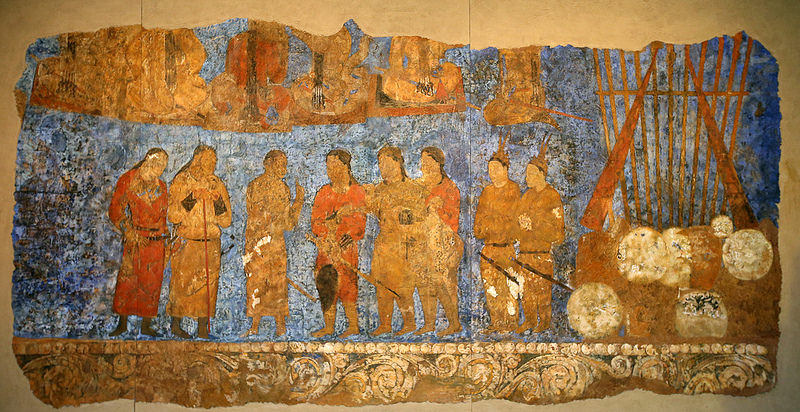
More about the restored Sogdian wall painting that seems to show a group of foreign ambassadors

Quite recently I published an article from the Korean Government about a Sogdian wall painting from the 7th century.

In 1965, a new mural was discovered in the Afrasiab Hills where an old palace was located. This wall painting was presumed by historians to have been produced during the reign of King Barhuman in the year 655 during the Sogdian Kingdom. It has attracted global and academic attention as the painting shows a group of people that seem to be foreign ambassadors. Historians suggested that two of them on the right of the west wall seemed to be from the Goguryeo Kingdom (37 B.C.-A.D. 668), sparking heated debate on the history of international relationships across Asia in ancient times. 

Marita Rohde visited the Afrasiab Museum in Samarkand in 2012 and sent me this picture below of how the wall painting  looked like at that moment.
If you compare this picture with the following picture which resulted from the examination with some cutting-edge devices, the differences are quite stunning.
To say it more simple, without modern techniques one would never be able to discover the identity of the two persons on the right and how they looked like!
Thanks very much Marita for your reaction.


Diana Driscoll's lectures on the Silk road and India


DIANA driscoll'S LECTURES on the Silk Road and India


Diana gives lectures on her tours with Cox and Kings and also gives gallery talks at the British Museum. The objective of her lectures and gallery talks is to convey the history, ideas, culture and personalities, which shaped societies over the centuries. 

UPCOMING LECTURES AND TALKS 


THE SILK ROAD: GIFTS, TRADE & DIPLOMACY
British Museum
Room 52
January 24, 2015
1:15pm
Cost: Free 


MUGHAL INDIA: SILVER AND JEWELLED HOOKAHS
British Museum
Gallery 34
March 14, 2015
1:15pm
Cost: Free 

RECENT LECTURES AND TALKS 


THE SILK ROAD: MERCHANTS AND MONKS
British Museum
Room 52
November 22, 2014
1:15pm
Cost: Free 

CENTRAL ASIA: CARAVANS ON THE SILK ROAD 
British Museum
Gallery 52 – Ancient Persia
January 30, 2014
1:15pm
Cost: Free 


MUGHAL INDIA TREASURES: JADE & JEWELS 
British Museum
Room 34
February 28, 2014
1:15pm
Cost: Free 


MUGHAL INDIA TREASURES: JADE & JEWELS 
British Museum
Room 34
May 17, 2014
1:15pm
Cost: Free 


NOMADS OF THE SILK ROAD 
British Museum
Gallery 52 – Ancient Persia
June 21, 2014
1:15pm
Cost: Free 

Ancient Chu tomb unearthed in Hubei


Chinaculture.org  30 December 2104

A Chu tomb belonging to the Chinese Warring States Period (475-221 BC) has been unearthed at Xiajiatai cemetery in Jingzhou city of Central China's Hubei province on Dec 25, 2014. 
The well-preserved coffin chamber is rectangle shaped and black in color.
More than 30 burial objects have been retrieved from the tomb, including a pair of wooden figurines, a leathered amour, and some dried fish.
These items turned out to be of great research value for Chinese archeology and the whole coffin will be transported to Jingzhou Museum for research and preservation, according to the archeologists.
So far, 385 tombs have been discovered at Xiajiatai cemetery, and more than 80 percent of them belong to the Warring States Period.


Tea in China: A Religious and Cultural History


Tea in China: A Religious and Cultural History

ABOUT THIS BOOK | AUTHOR BIOGRAPHY
ABOUT THIS BOOK
Tea in China explores the contours of religious and cultural transformation in traditional China from the point of view of an everyday commodity and popular beverage. The work traces the development of tea drinking from its mythical origins to the nineteenth century and examines the changes in aesthetics, ritual, science, health, and knowledge that tea brought with it. The shift in drinking habits that occurred in late medieval China cannot be understood without an appreciation of the fact that Buddhist monks were responsible for not only changing people’s attitudes toward the intoxicating substance, but also the proliferation of tea drinking. Monks had enjoyed a long association with tea in South China, but it was not until Lu Yu’s compilation of the Chajing (The Classic of Tea) and the spread of tea drinking by itinerant Chan monastics that tea culture became popular throughout the empire and beyond.
Tea was important for maintaining long periods of meditation; it also provided inspiration for poets and profoundly affected the ways in which ideas were exchanged. Prior to the eighth century, the aristocratic drinking party had excluded monks from participating in elite culture. Over cups of tea, however, monks and literati could meet on equal footing and share in the same aesthetic values. Monks and scholars thus found common ground in the popular stimulant—one with few side effects that was easily obtainable and provided inspiration and energy for composing poetry and meditating. In addition, rituals associated with tea drinking were developed in Chan monasteries, aiding in the transformation of China’s sacred landscape at the popular and elite level. Pilgrimages to monasteries that grew their own tea were essential in the spread of tea culture, and some monasteries owned vast tea plantations. By the end of the ninth century, tea was a vital component in the Chinese economy and in everyday life.
Tea in China transcends the boundaries of religious studies and cultural history as it draws on a broad range of materials—poetry, histories, liturgical texts, monastic regulations—many translated or analyzed for the first time. The book will be of interest to scholars of East Asia and all those concerned with the religious dimensions of commodity culture in the premodern world.

Friday, 2 January 2015

This Sunday last day of the Ming exhibition in the British Museum


The unregarded woman: another look at a Ming painting

Craig Clunas, Professor of the History of Art, University of Oxford and co-curator of the BP Exhibition Ming: 50 years that changed China
Of the many paintings included in the BP exhibition Ming: 50 years that changed China, one of the most famous is the ‘Elegant gathering in the Apricot Garden’, showing a swanky party held in 1437 in the garden of Yang Rong (1371–1440), Grand Secretary and all-round important person of early fifteenth-century China. It’s in all the books on Ming painting, appears on loads of websites, and is generally one of the most reproduced images dating from the period covered by the exhibition. This is partly because of where the painted silk handscroll now is, in the collection of the Metropolitan Museum of Art, New York, and so it has been relatively easy to view and study, as well as to publish in books about Chinese art. I’ve used it myself in the classroom and lectures in all sorts of ways, as it’s a very rich image for talking about patronage of the arts, the relationship between politics and art in the Ming, the role of the artist and lots of other topics. I find it is one of those images that you can always learn more about, and indeed there remain a number of mysteries. 
Who is it by? It bears the signature of an artist called Xie Huan; his dates used to be a bit vague, but recent research by Yin Ji’nan, Professor of Art History at the Central Academy of Fine Arts, Beijing, has established definitively that he was born in 1377 and died in 1452. He was an important person in the early Ming art world, apparently working as an advisor and painter to the Yongle and Xuande emperors, as well as maintaining a presumably lucrative private practice, producing images like this for important people like Yang Rong and his friends. 
Anonymous, after Zie Huan (1377-1452), 'Elegant gathering in the Apricot Garden' (detail); handscroll, ink and colours on silk, 1437. © Metropolitan Museum of Art, New York, Purchase, The Dillon Fund Gift 1989.
Anonymous, after Zie Huan (1377–1452), ‘Elegant gathering in the Apricot Garden’ (detail); handscroll, ink and colours on silk, 1437. © Metropolitan Museum of Art, New York, Purchase, The Dillon Fund Gift 1989.
The nature of the event – senior officials of the empire demonstrating the calm and peaceful state of affairs by gathering for a day of relaxed gentlemanly pastimes – means that more than one person present might have wanted to have an image of the party. Indeed another version of the same subject exists, in the Zhenjiang Museum in China. Are both paintings by Xie Huan? Did he, like Italian artists at the time, run a workshop where multiple versions of the same subject were turned out with the help of assistants? Is one painting the original, and the other just a copy? 
Anonymous, after Zie Huan (1377-1452), 'Elegant gathering in the Apricot Garden' (detail); handscroll, ink and colours on silk, 1437. © Metropolitan Museum of Art, New York, Purchase, The Dillon Fund Gift 1989.
Anonymous, after Zie Huan (1377–1452), ‘Elegant gathering in the Apricot Garden’ (detail); handscroll, ink and colours on silk, 1437. © Metropolitan Museum of Art, New York, Purchase, The Dillon Fund Gift 1989.
All of these views have been put forward by art historians at some point, and indeed I’ve contributed in my time to the scholarship on this painting; I’m particularly intrigued by the painting within the painting (of which we can only see a tiny corner). So it’s a bit humbling to confess that there is a detail of this painting that I’ve never really noticed before, though I’ve looked at it many times, both in reproductions and at the Met in New York. The figures depicted as attending the party are all men, since mixed-sex gatherings would have been vaguely indecent affairs in the Ming, where men and women were strictly segregated in most aspects of elite life. The servants who attend them are all male too, young boys who hold up the painting for viewing, or roll up scrolls no longer wanted, or attend to incense or bringing in the drinks.
Anonymous, after Zie Huan (1377-1452), 'Elegant gathering in the Apricot Garden' (detail); handscroll, ink and colours on silk, 1437. © Metropolitan Museum of Art, New York, Purchase, The Dillon Fund Gift 1989.
Anonymous, after Zie Huan (1377–1452), ‘Elegant gathering in the Apricot Garden’ (detail); handscroll, ink and colours on silk, 1437. © Metropolitan Museum of Art, New York, Purchase, The Dillon Fund Gift 1989.
Except (and this is what never registered properly with me until I had the chance for extended viewing of the picture in the exhibition), that there is one woman visible. She is right at the very left edge of the scroll, the last section to be unrolled when the painting was viewed in sections. She is peeping out from behind a tree, coming out from (presumably) the kitchens carrying a large handled basin. We can’t see the contents, perhaps it is hot water to warm the wine, or maybe it is meant to represent a serving of snacks to go with the drinks. She is doing something important, but unregarded. As it happens, historical Ming gossip tells us that Yang Rong had a famously dowdy wife, a woman from his home province of Jiangxi in the south; she was once given a makeover by the empress, to the extent that she was unrecognisable beneath the added palace glamour. I don’t think the woman in the painting is meant to be her. Yang Rong’s wife was after all a lady, she did not serve the drinks at parties. But I’ve become aware that my own failure to notice her until recently has compounded the invisibility of women, which skews our understanding of Ming art and Ming culture more generally.
In 1437 the emperor was a young boy, and the gentlemen we see here were in fact governing the empire in coalition with the powerful women of the imperial family, the child ruler’s mother and grandmother. I like to think – in fact it’s entirely reasonable to think – that in the depths of the palace they and their ladies-in-waiting were partying in their own way. But they’re not in the picture.
The BP exhibition Ming: 50 years that changed China is at the British Museum from 18 September 2014 to 5 January 2015.

Thursday, 1 January 2015

Digital show of Qianlong Emperor's tour opens at National Museum

Digital show of Qianlong Emperor's tour opens at National Museum


A part of the Qianlong Emperor's Southern Inspection Tour. [Photo/chnmuseum.cn]

China Daily  29 December 2014

The digitization display of The Qianlong Emperor's Southern Inspection Tour opened at the National Museum of China on Dec 28, which marked the official opening of the stationary digital gallery in the national museum.

                                            The route of the tour. [Photo/chnmuseum.cn]

The Qianlong Emperor's Southern Inspection Tour is one of the national treasure collections at the National Museum. The court painter Xu Yang was commissioned by the Qianlong Emperor to record on 12 scrolls (154.17m in length) the emperor's historic 112-day, 2,900 km tour of southern China in 1751.
The display consists of two parts. The first introduces the painter Xu Yang, the background,the origin and the route of the tour and features a high definition copy of the first and the sixth scrolls. The second part, a 3D animated, four-mimute movie about the Qianlong Emperor's Southern Inspection Tour, includes an advertising video. The first scroll also is displayed on an Imax screen measuring four meters high by 30m long.
"The other 11 scrolls of the Qianlong Emperor's Southern Inspection Tour will continue to be displayed by 3D movies in the future while more modern technical skills will be used in the scroll's display to help audiences have a better understanding of this encyclopedic masterpiece," said Lv Zhangshen, the director of the National Museum.
Hours: Four times each day, 9:30 am, 10:30 am, 2 pm, 3 pm
Venue: Gallery S6


Restored mural suggests 1,300 years of ties between Goguryeo (Korea) and Samarkand (Sogdian Kingdom)

15897791580_f50358b9ef_c.jpg

Korea News  December 26, 2014
Samarkand is a city in Uzbekistan, in Central Asia. Geographically located at the midpoint along the Silk Road, between Asia and Europe, the city enjoyed many years of prosperity during ancient times. The city was the then capital of the Sogdian Kingdom where people from the East and the West met for trade and to exchange philosophies, business and the arts. 

In 1965, a new mural was discovered in the Afrasiab Hills where an old palace was located. This wall painting was presumed by historians to have been produced during the reign of King Barhuman in the year 655 during the Sogdian Kingdom. It has attracted global and academic attention as the painting shows a group of people that seem to be foreign ambassadors. Historians suggested that two of them on the right of the west wall seemed to be from the Goguryeo Kingdom (37 B.C.-A.D. 668), sparking heated debate on the history of international relationships across Asia in ancient times. 

It has commonly been believed that Goguryeo's ancient international relations were limited to East Asia, that is, to mostly Japan and China. It has also commonly been thought impossible for Goguryeo to establish diplomatic relations with a nation in Central Asia that is as far as 5,000 kilometers away. Discovery of this wall mural, however, offers researchers the chance to re-evaluate the global ties that connected ancient Goguryeo to the world. 

The two figures, thought to be from Goguryeo, share two things in common concerning their garments that were typically worn by ancient Koreans: a hat with a feather and a sword with a round pommel at the tip. President Kim Hak-jun of the Northeast Asian History Foundation said, “Most historians believe that Yeon Gaesomun (603-666), a powerful diplomat and generalissimo from Goguryeo, might have sent envoys to the Sogdian Kingdom in order to keep Tang Dynasty (618-907), a rival country, in check." 

Recently, this wall painting was brought back to life in cooperation with the Northeast Asian History Foundation and the Afrasiab Museum in Samarkand. The historic artwork is now on display, starting December 23, in the Central Asian Room on the third floor of the National Museum of Korea in Yongsan-gu District, Seoul. 


Historians suggest that the two people on the right, wearing hats with feathers and carrying swords with round pommels, are presumed to be from Goguryeo. A copy of the restored wall painting is on display at the National Museum of Korea.

Since discovery of the mural in 1965, the painting has been poorly cared for over many years. Hearing the news, the Northeast Asian History foundation decided to do something to save it. They signed an agreement with the Afrasiab Museum in 2013 and started the joint restoration and preservation project. 

Director Samaridin Mustafakulov says that the Afrasiab mural gives us a chance to get a glimpse into the relationship between ancient Korea and ancient Uzbekistan, such as how the relationship started and how it continues through to this today.

Director Samaridin Mustafakulov of the Afrasiab Museum said, "This mural is a historic record that shows the political, economic and social atmosphere of ancient times. It proves that merchants from Asia, including Japan and Tang Dynasty China, brought their products along the Silk Road and through to Rome.” He expressed his gratitude to Korea’s support that, "enabled the ancient heritage item to be copied and digitally restored." 

The mural was restored with the use of a couple of cutting-edge devices, such as a digital stereoscopic microscope, an infra-red analyzer and by using near-infrared spectroscopy. The original wall painting was first photographed at life size to create high-resolution images. The microscope and spectroscopy were used to check some parts that couldn't be seen with the bare eyes. A total of two replicas were produced, and the two organizations decided to store one each. 

15897791740_5a92179feb_c.jpg

President Kim Hak-jun (left) of the Northeast Asian History Foundation attends a press conference on December 22 to explain how the mural painting was revived.

President Kim said, “Visitors to the exhibition will be touched by the feeling that they are part of ancient history. This will lay the foundation to have a comprehensive look at the nation’s origins, roots and our ancient systems of trade.” 

An informational video about the restoration has been translated into five languages, including Korean, Uzbek, Russia, English and French. It will be played at the museum starting in February. 

By Wi Tack-whan, Lee Seung-ah 
Korea.net Staff Writers 
whan23@korea.kr

Nanhai One: Removal of silt reveals shipwreck artefacts

Nanhai One: Removal of silt reveals shipwreck artifacts


An important step has been made in the recovery of thousands of relics from a famous Song Dynasty ship which sunk in the South China Sea about 800 years ago.
After one year of hard work, silt covering thousands of artefacts loaded within the ship has been largely cleaned up. The mystery shrouding the ancient merchant ship and its treasures could soon be lifted.
It's estimated that there are 60,000 to 80,000 relics inside the ship, including gold artefacts, brass and iron wares, and a large amount of porcelain. Now that the mud and silt has been mostly cleaned up, one can see densely arranged relics exposed.
The discovery of the sunken ship in 1987 was said to shed new light to the marine silk road, through which China's silk, porcelain and other artefacts were transported to Southwest Asia, the Middle East all the way to Africa and Europe. But the wreckage was not lifted from the ocean floor until December 2007.
It was then placed in a pool-type container called the "Crystal Palace", which became part of a Marine Silk Road Museum built on the site, in the city of Yangjiang, Guangdong province.
At the museum, visitors can witness the salvage process, and marvel at the thousand artefacts already extracted from the ship. Made of gold and porcelain by Song artisans, they were meant to be sold overseas. Some of the more recently restored relics bear strong influences from mid-western Asia.
Nanhai One is the oldest and largest sunken ship ever found in China. The remaining ship body is 21.8 meters long, with 13 large cabins to contain goods. It's expected to take another two to three years to take out all the relics from the wreckage.