Buried for Almost a Millennium, Archaeologists Recover Over 1,500 Religious Artifacts at Lost Chinese Temple
A team of archaeologists has uncovered more than 1000 tablets inscribed with Buddhist scriptures and over 500 pieces of stone sculpture, as well as glazed tiles with inscriptions, at the site of a temple that had disappeared almost a millennium ago in China.
The “Divine” Role of Fugan Temple
A team of archaeologists has spent several months excavating a temple that was lost for almost a millennium in southwest China's Sichuan Province, as China.org.cn reports.
The Fugan Temple, located in downtown Chengdu, was a famous temple that lasted from the Eastern Jin Dynasty (317- 420 AD) to the Southern Song Dynasty (1127-1279 AD). The temple is mentioned by Daoxuan, a famous Tang Dynasty (618-907 AD) monk, who recorded that an official religious ceremony was once held in front of the temple for the civilians to pray for rain to end a persistent drought. Interestingly, after the rite was over it rained heavily, a fact that elevated the temple’s prestige in the eyes of thousands of believers.
Because of this miraculous incident, the temple got its name “Fugan”, which means "perceive the blessing." Furthermore, a popular Tang Dynasty poet named Liu Yuxi left a poem to honor and celebrate the temple's renovation, describing its divine character and its important role during that period.
Workers inside an unearthed ditch at the excavation site of the Fugan Temple, Chengdu, China. (XINHUA)
The Temple is Rediscovered
Despite its undeniable glory and significance for the local population, the temple suffered a lot of damage during the later period of the Tang and Song dynasties, especially after the Song emperors began to experience fiscal difficulties. For example, the population’s growth in China had outdistanced economic growth, while military expenses associated with northern border wars had drained China economically, as did the cost of an ever-increasing governmental bureaucracy.
The bureaucracy, moreover, was torn by factions proposing different measures regarding tax reform and land distribution. These reforms failed, as they had during the Han dynasty, and for the same reason: opposition from the largely Confucianist gentry, who put their individual economic interests ahead of the common good. Eventually, the temple became the ultimate victim of that situation and disappeared during the many wars that took place.
Almost a millennium later though, a team of archaeologists excavating the area where the legendary temple was “hiding” all these centuries, uncovered more than 1000 tablets inscribed with Buddhist scriptures and over 500 pieces of stone sculpture as well as glazed tiles with inscriptions. "We have only excavated a part of the temple's area, but already have a glimpse of its past glory," Yi Li, lead director of the excavation project, told the media; while adding that his team has also discovered the temple's foundation, ruins of surrounding buildings, wells, roads, and ditches.
A stone Bodhisattva head unearthed at the excavation site of the Fugan Temple in Chengdu, China. (news.cn)
More than 80 Ancient Tombs Found Near the Temple
Interestingly, during the excavation archaeologists found around 80 ancient tombs dispersed near the temple, dating back to the Shang and Zhou dynasties (1600-256 BC). Additionally, they also unearthed large amounts of household tools, utensils, and building materials dating back to different periods from the Song to Ming dynasties.
Experts and archaeologists are optimistic and suggest that the temple's discovery could significantly contribute to the examination of the spread of Buddhism in China during that time, as Wang Yi, director of the Chengdu Cultural Relic Research Institute told China.org.cn
More than 1,000 tablets inscribed with Buddhist scriptures were found at the site of the famous Fugan temple in Chengdu, China. (Western China Metropolis Daily)
Top Image: Remains of the famous Fugan Temple that was recently discovered in Chengdu, China. (XINHUA) Insert: A stone Bodhisattva head unearthed at the excavation site. (news.cn)
In the year 721, a young Buddhist monk named Hyecho set out from the kingdom of Silla, on the Korean peninsula, on what would become one of the most extraordinary journeys in history. Sailing first to China, Hyecho continued to what is today Vietnam, Indonesia, Myanmar, India, Pakistan, Afghanistan, and Iran, before taking the Silk Road and heading back east, where he ended his days on the sacred mountain of Wutaishan in China.
With Hyecho’s Journey, eminent scholar of Buddhism Donald S. Lopez Jr. re-creates Hyecho’s trek. Using the surviving fragments of Hyecho’s travel memoir, along with numerous other textual and visual sources, Lopez imagines the thriving Buddhist world the monk explored. Along the way, Lopez introduces key elements of Buddhism, including its basic doctrines, monastic institutions, works of art, and the many stories that have inspired Buddhist pilgrimage. Through the eyes of one remarkable Korean monk, we discover a vibrant tradition flourishing across a vast stretch of Asia. Hyecho’s Journey is simultaneously a rediscovery of a forgotten pilgrim, an accessible primer on Buddhist history and doctrine, and a gripping, beautifully illustrated account of travel in a world long lost.
List of Illustrations
About This Book
About the Maps
Introduction: Tracing Hyecho’s Route
1. Dunhuang: The Discovery of the Pilgrim’s Account
2. Silla: The Birthplace of the Pilgrim
3. At Sea: The Pilgrim Sails for the Holy Land
4. Kuśinagara: The Buddha Enters Nirvana
5. Vulture Peak: Two Buddhas Seated Side by Side
6. Bodh Gayā: The Buddha Attains Enlightenment
7. Lumbinī: The Buddha Is Born
8. Śrāvastī: City of the Buddha’s Miracles
9. Sāṃkāśya: The Buddha Descends from Heaven
10. Gandhāra: Past Lives of the Buddha
11. Arabia: Buddhism Encounters Islam
12. Wutaishan: The Pilgrim Passes Away
Coda
The essays in this volume dispel some of the myths concerning the Mongolians and other Inner Asian peoples.
This remarkable volume edited by and dedicated to Morris Rossabi challenges the depictions of these mostly nomadic pastoral groups as barbaric plunderers and killers while not denying the destruction and loss of life they engendered.
Several essays pioneer in consulting Mongolian and other Inner Asian rather than exclusively Chinese and Persian sources, offering new and different perspectives.
Such research reveals the divisions among the Mongolians, which weakened them and led to the collapse of their Empire. Two essays dispel myths about modern Mongolia and reveal the country’s significance, even in an era of superpowers, two of which surround it.
Contributors are: Christopher Atwood, Bettine Birge, Michael Brose, Pamela Crossley, Johan Elverskog, Jargalsaikhan Enkhsaikhan, Yuki Konagaya, James Millward, David Morgan, and David Robinson.
Contents:
Introduction: Myths about Mongols and Inner Asians - Morris Rossabi 1 Sagang Sechen on the Tumu Incident - Johan Elverskog 2 What did the Qianlong Court Mean by huairou yuanren 怀柔远人? An Examination of Manchu, Mongol and Tibetan Translations of the Term as it Appears in Chengde Steles, as a Defense of “New Qing History” - James Millward 3 Jochi and the Early Western Campaigns - Christopher Atwood 4 Iran’s Mongol Experience - David Morgan 5 Qipchak Networks of Power in Mongol China - Michael Brose 6 “How the Mongols Mattered: A Perspective from Law” - Bettine Birge 7 Celebrating War with the Mongols - David M. Robinson 8 Flank Contact, Social Contexts, and Riding Patterns in Eurasia, 500–1500 - Pamela Kyle Crossley 9 Modern Origins of Chinggis Khan Worship: The Mongolian Response to Japanese Influences - Yuki Konagaya 10 Mongolia: Addressing the Risks and Promises of the Nuclear Age - Enkhsaikhan Jargalsaikhan
Genghis’s heirs continued to expand the Mongol empire. Over the next century they would double its size, adding southern China, all of Iran, most of Turkey, Georgia, Armenia, Azerbaijan, most of habitable Russia, Ukraine, and half of Poland – in all, roughly 20 percent of the world’s land area.
Genghis had established not only an empire but a governing foundation that his heirs would build into the Pax Mongolica, the period of relative peace and stability that extended over much of Eurasia from 1206 to the mid-fourteenth century. This empire underpinned an era of globalisation that was unprecedented. The Mongols revolutionised warfare, which made their conquests possible, but the empire lasted so long because of the expansion of trade, transportation, and communication; the intermixing of people, ideas, and culture; and the unification of administrative procedures.
The big advantage that the Mongols had over previous empire builders is that they themselves had nothing in the way of deeply ingrained ideas of politics, economics, or culture to spread abroad. They were not driven by ideology or any messianic impulse – only by the hunger to amass wealth. As a result, they did not impose political ideology or cultural or religious ideas on others but, rather, created an environment of extreme tolerance, so long as the basic governing regime wasn’t fundamentally challenged and so long as the booty owed smoothly from the far-flung territories to the Mongolian centre.
Tolerance for religious freedom was particularly notable and reflected the way Genghis thought.
He understood that he had much to gain by showing respect for proud local cultures and influential religious leaders, and he sought out strong relations with them.
Indifferent to controlling matters of religion or culture, the Mongols focused on building commerce and the physical, administrative, and legal infrastructure to help it flow freely. Before the Mongol Empire, for example, few traders were able to travel the entire Silk Road in large part because Arab middlemen in places such as what are today Syria, Iraq, and Lebanon insisted on standing between the buyer and the seller, imposing high taxes on all sides.
At the height of Pax Mongolica, however, there were no significant trade barriers on the road from the Mediterranean to China, where the big cities became cosmopolitan metropolises. In what today is Beijing, Genghis’s grandson Kublai Khan (1260-1294) established special sections for merchants of multiple nationalities from all over the empire, some who came from as far away as Italy, India, and North Africa. The Mongols also encouraged their subjects, particularly the Chinese, to emigrate to foreign trading posts in order to facilitate more commerce.
Genghis’s offspring became great transmitters of art and culture through the trading channels they established.
Their tastes for colorful clothing, silver jewellery, and images of animals provoked a desire throughout the empire to create items that pleased them, leading to a convergence of styles. Moreover, the interconnection among societies resulted in Chinese textiles and painting becoming even more popular in Persia, where Iranian tile work began to re ect the images of the dragon and phoenix that were popular in the Middle Kingdom.
As the number of travelers on the empire’s roads rose, some became notable figures. Marco Polo is the most widely known of these travellers today, but there were many others, including the Muslim jurist Ibn Battuta, the Nestorian Christian Rabban Sauma, the Franciscans John Plano Carpini and William of Rubruck, and the Chinese Confucian Zhou Daguan. Their writings described places from Angkor Wat to Hangzhou to Tabriz to Paris, making these special sites cultural touchstones for elites across the empire.
Under Mongol rule, China’s lustre as an empire was restored. Starting with Genghis Khan, the Mongol leadership transformed the Middle Kingdom from a civilisation torn asunder by civil war and hostile dynasties into a unified nation, capable of outlasting revolts, invasions, and other attempts at foreign domination for six centuries.
In western Asia, the Mongols were able to forge unity among competing Islamic chieftains, giving birth to the modern Persian Empire. Although the Mongols never occupied eastern Europe and the Mediterranean countries, they stimulated a revolution in productivity in these regions by exposing the West to specialised tools, new blast furnace technology, new crops that required less work to plant, and to new concepts such as paper money, primacy of state over church, and freedom of religion.
In 1620, the English scientist Francis Bacon named three innovations that changed the world, citing the printing press, gunpowder, and the compass. All three came to the West during the heyday of the Mongol Empire.
Historian and journalist Nayan Chanda put it well. “Empires played a key role in the rise of governance as they extended rules and regulations over an expanding territory,” he wrote. After pointing to the advances made in the Roman Empire, the Mauryan Empire in India, and the Han Empire in China, he continued:
“The scope of governance grew to a new height under the Mongol Empire...Deep Mongol interest in trading meant that the Silk Road across Central Asia emerged as a well-guarded conveyer belt of goods, people, and ideas. The road, with its Mongol sentry points and inns, its postal system, and its rudimentary passport and credit card (paiza) system, provided unprecedented governance for land-based trade and transportation.”
The empire’s impact on governance in China, in particular, was notable. The administration begun under Genghis would reach its peak under heirs like Kublai Khan, who guaranteed landowners property rights and reduced taxes. Kublai also built an extensive network of schools, professionalised the civil service, and introduced paper money and bankruptcy laws. He established an office for the stimulation of agriculture to improve farmers’ lives and crop yields, and a Cotton Promotion Bureau to improve planting, weaving, and textile manufacturing techniques.
He promoted the arts and literature, translating Persian and other classics into Chinese. He instituted universal education five hundred years before any ruler in Europe did, and he refused to allow public execution of criminals at a time when they were a popular spectacle in Europe. These achievements occurred well after Genghis Khan, but they evolved from his early attempts at establishing a multicultural society spanning vast territory.
Globalisation, Mongol style
It is often said that the first golden age of globalisation began near the start of the industrial revolution in Europe around 1870 and ended in 1914, when the outbreak of World War I shattered the idea that growing political and economic bonds between nations would guarantee peace. This period had indeed experienced a great boom in global trade, investment, migration, and innovations in communications such as the telegraph. But that period is the wrong starting point.
The first golden age was the thirteenth and fourteenth centuries. It was in the era of Genghis and his sons and grandsons when the routes they built and secured opened a new world of possibilities. Europeans were able to buy silk and other rare textiles, exotic spices, even paper-making technology from China. Chinese iron-smelting technology was mixed with Persian engineering skills to build advanced weapons. Medicines from India, China, and Persia were combined to create great advances in pharmacology.
Indeed, the story of Genghis Khan is in microcosm a story about globalisation itself. It illustrates the force that military conquest has played in furthering the connections among disparate societies. It shows how commerce follows conquest, how commerce and culture intersect, and how transport and communications networks become so important. Together with his sons and grandsons, Genghis also faced the enduring challenge of balancing central administrative control with tolerance for local institutions and culture.
In world history no group has contributed more to the expansion and deepening of globalisation than those who built empires encompassing many millions of people and large swaths of geography. After all, globalisation is about connecting on multiple levels and breaking down many of the walls that separate populations of various origins, customs, and beliefs.
Globalisation also entails developing systems of government that centralise administration and enforce common standards of behaviour. The empire that Genghis Khan established in the thirteenth century did both with unprecedented scale and scope. It thus provided one of the most powerful boosts to globalisation ever seen.
Excerpted with permission from From Silk to Silicon: The Story of Globalization Through Ten Extraordinary Lives, Jeffrey E Garten, Tranquebar.
When a man named Temüjin was given the title of Genghis Khan in 1206, the Mongols were a recently united people, tucked away in the northeast corner of Asia. By the time Genghis Khan died in 1227, they were sunning themselves on the shores of both the Pacific Ocean and the Caspian Sea. By 1241 they were knocking at Vienna's door, and they remained the terror of eastern Europe for the rest of the century. The Mongols claimed the largest consolidated land empire in history. Seemingly the only way to keep them out was to put the Himalayas between you and them. And many historians believe their power stemmed from an incredibly simple technological innovation: the stirrup.
No one knows when the stirrup was first invented, but it was a boon to any military that used it. Even the simplest of stirrups, a leather loop, let mounted soldiers ride longer distances and stay mounted on their horses during battle. The military success of the forebears of the Cossacks is often attributed to two loops of leather. Same with the Goths and the Huns. Some believe the stirrup even shifted the balance of power in Europe from foot soldiers to mounted knights, dubbed the "armored tanks" of the medieval world by historian Roman Johann Jarymowycz.
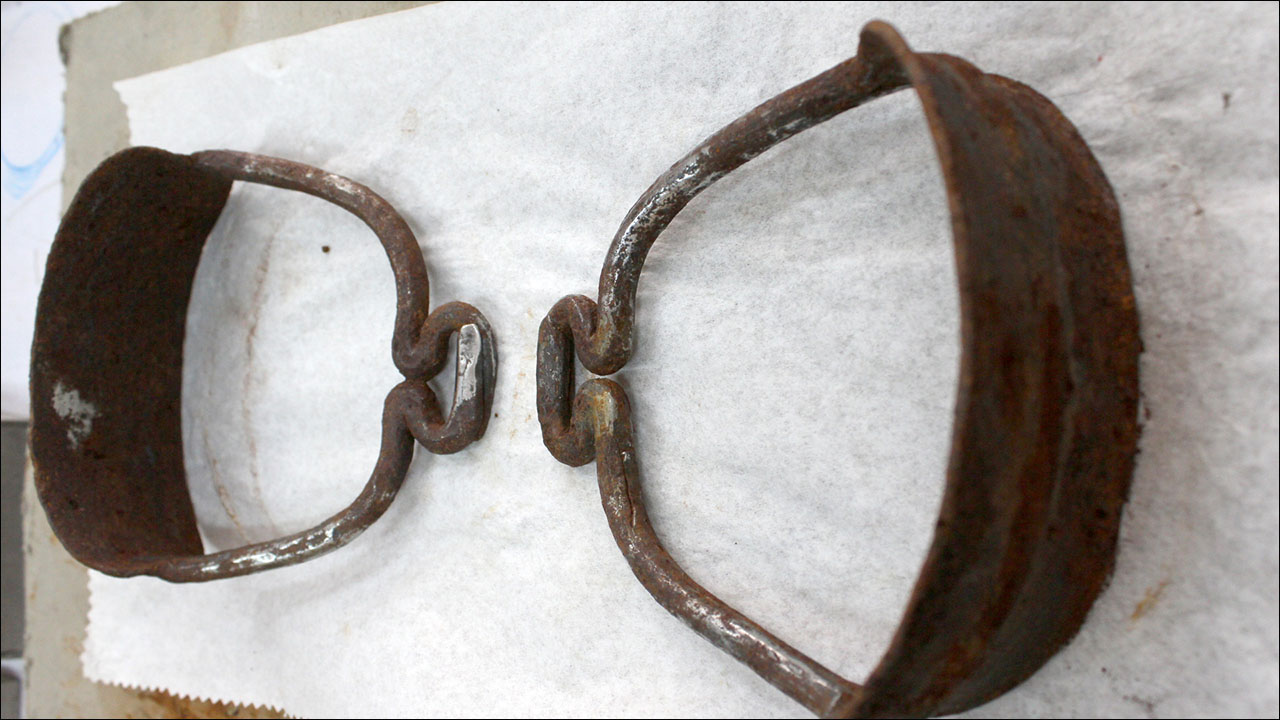
The Mongols took things further. Historians think they not only had leather stirrups, but metal ones as well. In 2016, archaeologists at the Center of Cultural Heritage of Mongolia unearthed the remains of a Mongolian woman dating back to the 10th century AD. Along with sturdy leather boots and some changes of clothes, she was buried with a saddle and metal stirrups described as in such good condition that they could still be used today. The stirrups are one continuous thick piece of metal with an open loop for a saddle strap on the top and a wide, flattened, and slightly rounded foot rest. The stirrups had to be comfortable and tough, because Mongols used them to ride in a way no one else rode.
Enlarge/ This pair of 1,100-year-old metal stirrups was unearthed from a Mongolian woman's grave in 2016. They were part of a well-preserved saddle with reinforcements that would have allowed the rider unprecedented mobility.
The Center of Cultural Heritage of Mongolia.
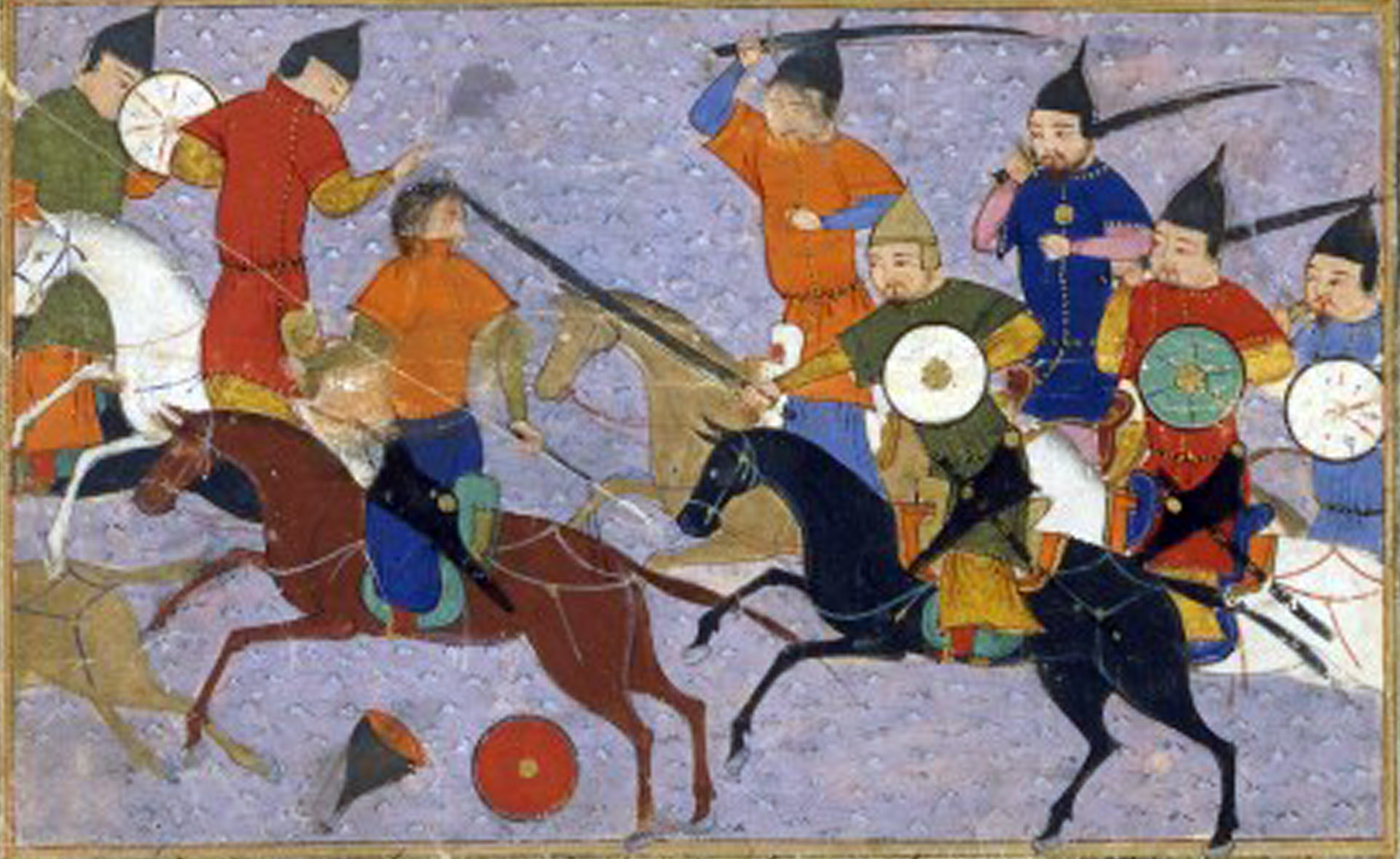
A general of the Song Dynasty (960-1279) described the Mongols riding long distances standing up in the saddle, with "the main weight of the body upon the calves or lower part of the leg with some weight upon the feet and ankles." The stirrups were meant to keep the rider centered and upright in even the most tumultuous situation. They hung from a saddle that was made of wood and had a high back and front. These, supplemented with endless hours of practice, gave a Mongol rider unprecedented stability. The rider could maintain hands-free balance on the horse while the horse twisted and turned and while the rider himself turned in the saddle. A fluidly mobile rider could then use his hands to fire arrows in any direction as he rode.
At a time when most armies won by driving ineluctably forward, the Mongols advanced and retreated while never letting up on their assault. When they met their opposition, their cavalry galloped forward with wild agility, shooting arrows continuously, presenting a terrifying united front. As they got within a few yards of the other army, the charging horsemen's unity broke. They turned and galloped away as quickly as they'd come.
The power of retreat
Historian Thomas Craughwell explains that an ability to twist in their saddles meant that, even as the Mongols rode away, they could shoot arrows back toward the enemy army. As the army continued to charge and retreat, their patterns became ever more chaotic. Marco Polo, who saw the Mongols in action, described their technique: "They never let themselves get into a regular melee, but keep perpetually riding around and shooting into the enemy."
If traditional mounted troops were like tanks, Mongol-mounted warriors were fighter pilots. Their mastery of movement made them unbeatable. The other army would advance on a shifting, uniting, scattering, and reuniting foe.
Enlarge/ This is a representation of a battle between Mongols and the Chinese, recorded in 1211 in the Jami' al-tawarikh, by Rashid al-Din. Note the Mongols standing in their saddles.
When all else failed, the Mongols used psychology. At a signal, the cavalry could wheel around and make a convincingly jumbled false retreat. Unwary opposition forces would often then charge after them, believing that the battle had, unexpectedly, gone their way. The Mongol cavalry would then turn right back around, having lured a few overconfident souls too close. More often, though, they would continue their retreat and then maneuver out of the way. Then, unmounted archers would shower the pursuing army with arrows, and more heavily armored cavalry could charge in with lances. At that point, the battle was as good as over.
The Mongolian Empire's stunning rise to power reveals how one technological development provided a literal stepping point for a new style of warfare—one that could not be resisted by any existing army. The largest land empire the world has ever known did not exist because of any one factor. A thousand different circumstances helped Genghis Khan and his immediate descendants conquer most of a continent. But the stirrup played an indispensable role. Engineering the perfect stirrup gave an army, and a people, an ineradicable place in history.
Palace Museum celebrates Maritime Silk Road and Buddhist art
CGTN.com News
By Ji Xin
11-5 2017
The Palace Museum in Beijing is hosting two major exhibitions. The first is titled “The Forbidden City and the Maritime Silk Road,” the second, “Painting and Calligraphic Works by Four Monk Artists.” The latter is in the Hall of Martial Valor, and features the largest ever collected display of 17th-century artworks by four master monk artists.
The first one displays 140 exhibits featuring cultural treasures of the ancient sea trading route. Staged at the West Wing of the Tower Gallery in the Meridian Gate, items on display include ceramics, paintings, calligraphy, books, gold and silverware, timepieces, scientific instruments, and weapons. The show was designed to reflect China’s historic interactions with the outside world.
The second one showcases the works of Hongren, Kuncan, Bada Shanren and Shitao from the early Qing Dynasty (1644-1911). They are considered some of the best painters among Buddhist monks in ancient China. The 163 pieces displayed, make it the largest "Four Monks" themed art exhibition ever in history.
In 1965, archaeologists in China discovered an ancient sword unlike any other. This ancient weapon unique because it is presumed to be around 2,500 years old and, what is more fascinating, it was still shiny and sharp when it was discovered.
This truly unique archaeological artifact, known as the Sword of Goujian, was unearthed in one of more than 50 tombs which were found in Hubei, China. The researchers discovered over 2,000 artifacts from the sites, including this perfectly preserved bronze sword.
Sword of Goujian, Hubei Provincial Museum Photo Credit
Sword of Goujian, Hubei Provincial Museum Photo Credit
According to Ancient Origins, the sword “was discovered in a tomb, in a near air-tight wooden box next to a skeleton. When it was unsheathed, the blade was revealed to be untarnished despite being buried in damp conditions for two millennia. A test conducted by the archaeologists showed that the blade could easily cut a stack of twenty pieces of paper.”
Archaeologists believe that this stunning sword made of copper, tin, and small amounts of iron, is now considered to be a state treasure of China from the Spring and Autumn period (770 to 403 BCE).
People photographing the famous sword Photo CreditSword of Goujian, Hubei Provincial Museum Photo Credit
Named after a book, Spring and Autumn Annals attributed to Confucius, the Spring and Autumn period is one of the most turbulent periods in the history of Ancient China. A high number of conflicts between powerful nobles, who fought for supremacy during this period, led to the production of some of the finest bronze high-quality weapons and the Sword of Goujian appears to be among the most outstanding examples.
Measuring 22 inches in length, with a 1.8 inches wide blade and 3.3 inches long handle, the sword is beautifully decorated with turquoise crystals. Eight characters in ancient Chinese script are engraved on the blade near the hilt and translate to: “The Sword belongs to the Goujian, the King of Yue State.”
Deciphering the scripts on the Sword of Goujian Photo Credit
Sword of Goujian, Hubei Provincial Museum Photo Credit
Goujian, the son of King Yunchang of Yue, who reigned over the Yue State (south of today’s Zhejiang Province) in the late Spring and Autumn Period, is considered by many as one of the most famous emperors in the history of China.
As above-mentioned, during the Spring and Autumn period, there was a great number of conflicts. The one between the states of Yue and Wu is said to have left permanent marks on history. King Goujian defeated the Wu army in the first battle, back in 496 BC, but one year later, Yue was defeated, and Goujian and his wife were captured. They were finally released in 490BC, and upon his arrival home, King Goujian started making plans for revenge. It took him ten years to prepare himself and his army to attack the Wu capital. It is said that Goujian used the famous sword to defeat the Wu State in the last major conflict during the Spring and Autumn period and eventually annexed the rival.
There is no doubt that this high-quality bronze sword is of great historic significance not just for China, but also for the rest of the world. Moreover, historians and researchers are also fascinated by the fact that the Sword of Goujian is completely untarnished and it still cuts like new.
Sir Aurel Stein and the ‘lords of marches’: new archival materials by Luca Maria Olivieri is a new addition to the historiography of Indo-Pakistani archaeology
Investigations in the history of archaeology have been gaining more and more attention, across the world, due to multiple reasons. Two principal scholarly approaches — internalism and externalism — have influenced these historiographical considerations. The former posits in the validity of the ‘cumulative knowledge’ and tries to explore ‘objective truth’ about socio-cultural and natural phenomena. Contrarily, the latter situates ‘knowledge production activity’ in a wider socio-political context which results in subjective understanding.
The colonial archaeology of British India has also recently been approached from various theoretical standpoints. And Sir Aurel Stein and the ‘lords of marches’: new archival materials by Luca Maria Olivieri is a new addition to the historiography of Indo-Pakistani archaeology.
As is obvious from the title, the book presents archival research and sheds great light on some rather obscure issues of colonial archaeology of Gandhara. It comprises four main parts. The first part includes, as is common to all research works, ‘list of illustrations’, ‘foreword’, ‘list of abbreviations’ and ‘editorial notes’. The following part, in addition to a comprehensive ‘introduction’, presents a ‘catalogue’ in summarised form of all the archival documents in sequence and chronological order. It is followed by a detailed commentary of the author giving nuanced explanations and analysis from a historical and contextual point of view about the documents.
The third part of the book deals with seven appendices while the last one is all about different types of indexes (such as of names, places and typology of documents), references and sample photographic documentation of the documents.
Sir Aurel Stein and the ‘lords of marches’ emerged from cataloguing the pre-1947 documents at the Malakand Fort, Khyber-Pakhtunkhwa. Among the material, three folders containing 348 documents and spanning the period between 1895 and 1937 concerning archaeological matters and themes were isolated for further detailed analysis.
The book is not only itself an original research based on primary sources but at the same time provides new grounds and insights for further investigations.
All the documents have been categorised by the author as ‘Endorsement Letters, Circulars, Notifications . . . demi-official Letters . . . notes, generally handwritten. . . ’. All this material tells the story of the beginning and development of archaeological activity in the ex-state of Swat (1917-69) and Malakand Agency. A number of famous scholars such as A. Caddy, A. Foucher, L. A. Waddell and A. Stein make, all through the book, their pioneering debut in the archaeology of the area. Similarly, the role of many important British political officers at Malakand has also been brought to the fore. Not less prominent than the colonial scholars and administrators are the rulers of the ex-Swat State, Miangul Abdul Wadud and Miangul Abdul Haq Jahanzeb. The enlightenment they have exhibited in the whole story clearly reflects in the book.
One of the issues the book is dealing with is the institutional and legal dimension of archaeological work in Malakand and Swat. Did the area, not making part of the settled provinces of British India, come under the jurisdiction of the Ancient Monuments Preservation Act 1904 and for that matter the Archaeological Survey of India? Diverse opinions and responses are found throughout the book based on personal interest or indifference of political officers stationed at Malakand.
Likewise, the issue of illegal digging and trafficking in antiquities as well as concerns for protection make another fascinating feature of the book. Such things have been rather related by the author to the overall archaeological context of the time in his commentaries.
Another important matter from a historical point of view is surfacing of the long forgotten story of Caddy’s archaeological expedition to Swat-Malakand. Caddy was a painter, photographer and antiquarian. Initially, he remained associated in different capacities with the Government of Bengal. Later on, Caddy busied himself in different projects as a painter and antiquarian. And it was in this context that Secretary to the Bengal Government commissioned him to Swat and Gandhara to make a collection of Gandhara art for the Calcutta Museum. He reached Swat in 1896 and, among other activities such as photography and landscape survey, excavated the world-wide famous Buddhist site of Loriyan. The collection is lying in the Calcutta Museum and is widely known for its artistic sophistication.
The original report which Caddy had submitted to the government was unavailable to scholars till its recent discovery in the Malakand Fort material. It is carefully studied by Kurt Behrendt and makes part — as appendix 4 — of Sir Aurel Stein and the ‘lords of marches’. Furthermore, a catalogue of the Gandhara collection at Malakand Fort has been prepared by P. Brancaccio as appendix 5.
Another valuable addition the book makes to our scholarship is with regard to Aurel Stein’s archaeological explorations into Swat. His very first visit took place in 1926 in which he documented great many sites in Swat, Shangla and Buner. But more importantly, Olivieri’s study for the first time makes it known that Stein also made attempts in 1928, 1931 and 1933 to get into Swat for seeking solutions to some crucial historical problems. However, he could not achieve that success which fortune had reserved for him in 1926.
The book is not only itself an original research based on primary sources but at the same time provides new grounds and insights for further investigations. Archaeological activities during the last years of nineteenth century in Swat require further interpretations and analysis especially in the framework of post-coloniality. Caddy’s photographic documentation of the Swati landscape of the period, his collection for the Calcutta Museum and his expedition’s legality in the wider framework of archaeological trends of the time present fascinating themes for further research.
Similarly, with the help of this new archival material a more defined socio-political context can be added to Stein’s work in Swat. Inspiration is also provided for future research with respect to illegal digging in Swat valley, its business context and concerns in relation to heritage preservation of the area.
Sir Aurel Stein and the ‘lords of marches’: new archival materials Author: Luca Maria Olivieri Publisher: Sang-e-Meel Publications, 2015 Pages: 401 Price: Rs3000