MORE ON
THIS STORY
THIS STORY


Abigail Reynolds’ ‘Ruins of Time’ exhibition is the result of a five-month journey through 2,000 years and half the globe

Abigail Reynolds and I peer at each other through a two-way mirror – the kind police use to observe suspects in interrogation rooms. We’re in the BMW Lounge at Art Basel Hong Kong, at the Hong Kong Convention and Exhibition Centre, in Wan Chai. The space is brightly lit, so the glass works as a mirror and a window at the same time. Both of our faces are looking directly at me. I know, however, that we are standing opposite each other. As my brain scrambles to solve the visual puzzle, my face, reflected in the mirror, registers confusion. Reynolds is pleased.
“I like to create distortion and play with perspective. I’m really aware of that in my work with sculpture, and I make things that you perceive differently, as you change position.”
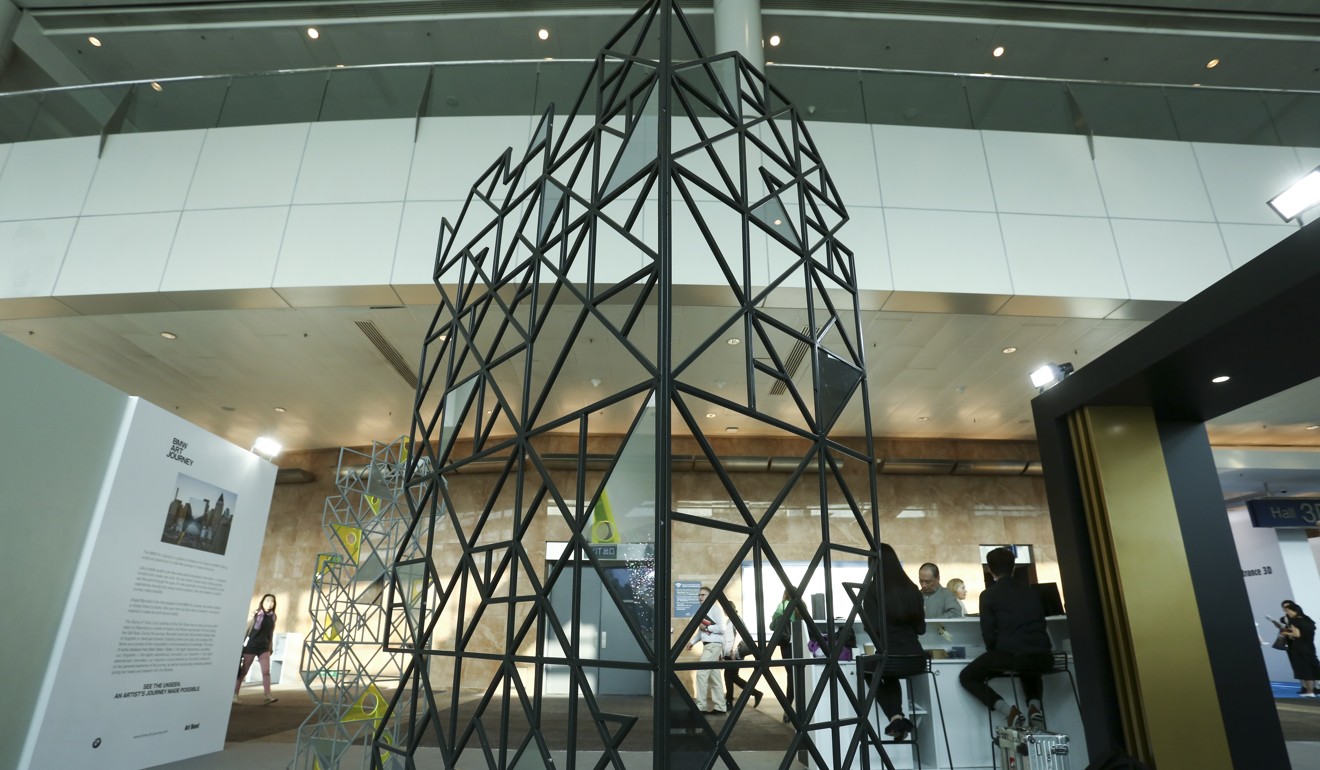 “Stelae I, 2016”, by Reynolds, in the BMW Lounge, at the Hong Kong Convention and Exhibition Centre, Wan Chai, in March. Picture: Jonathan Wong
The British artist is in Hong Kong to showcase her latest exhibition, “The Ruins of Time: Lost Libraries of the Silk Road”. The mirrors are set into Stelae, a sculptural form made of square grids broken down into geometric shapes, like latticework. This, and the other works on show, are the outcome of an epic set of journeys Reynolds made over five months to the sites of 16 lost libraries along the Silk Road. Shattered by natural disasters, destroyed by war or dismantled by competing rulers, the libraries span half the globe, and over 2,000 years of history.
The Silk Roads by Peter Frankopan is a dazzling piece of historical writing
The two arms of Stelae stand at 90 degree angles, like an open book. “Lattice structures are a common feature,” says Reynolds. She explains that some ancient libraries contained papyrus scrolls, rather than books. “The papyri would have rolled off traditional shelves, so instead they were slotted into lattices, like bottles in a wine rack.” I ask where her fascination with libraries stems from.
“I have always loved them,” says Reynolds. “I was born in the UK in the 1970s, when the welfare state was alive and kicking and libraries were well supported. As a child, I was allowed to go to the library, on my own, every day after school. It was a freedom for me. The way I perceive libraries is that they’re a place that’s free to enter, where people’s voices travel through time.”
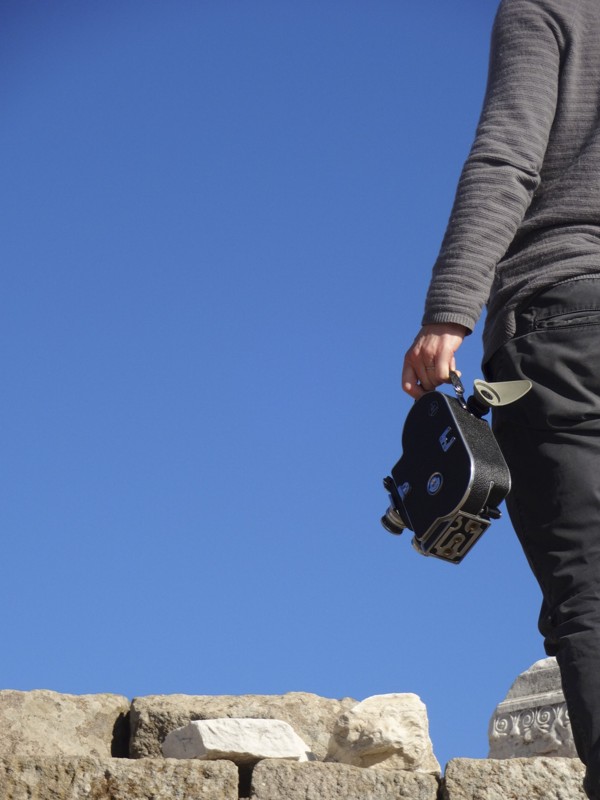 Reynolds with her Bolex camera at Pergamum, Turkey.
Reynolds is a member of a group fighting to save the library (one of many falling victim to austerity measures) near her home in the most westerly town in England – St Just, on the north coast of Cornwall.
“I’m a big fan of proper, democratic, non-commercial structures like libraries; I’m incensed by the lack of funding for them and I don’t understand why they aren’t more valued,” she says. “Can we really not stump up the relatively tiny amount of money that’s required to keep them running?”
Does her work have a political element?
Tourism and development threaten ancient painted caves in western China
“I planned the journey before Brexit,” says Reynolds. “Those developments really depressed me because it feels as if we are turning our backs on the march of progress. Since then, the work has taken on a political resonance. It felt important to be travelling, to visit Islamic countries, to meet people and think about the Silk Road and its story of connectivity and migration, and how people, books and knowledge travelled up and down it.”
The BMW Art Journey prize – of which Reynolds is the third recipient – was created to support emerging artists. A panel of judges selected three artists who were invited to submit proposals for their journeys.
“I hadn’t heard of the prize so the call came completely out of the blue,” says Reynolds. “I realised it was a chance to do something on a grand scale. With the support that was being offered, I could take more risks and be more adventurous than I would ever dare to be on my own.”
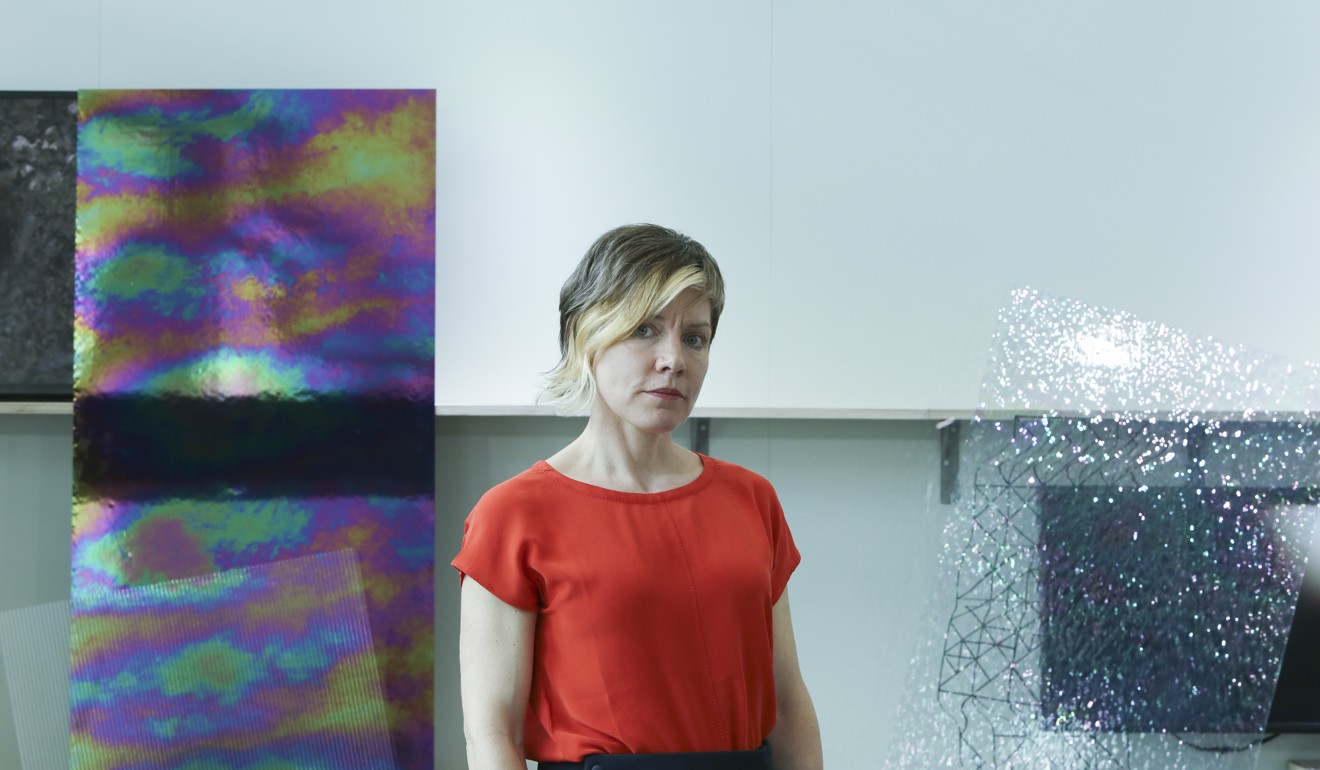 Abigail Reynolds, in the BMW Lounge, at the Hong Kong Convention and Exhibition Centre, in Wan Chai. Picture: Jonathan Wong
Reynolds’ bid won by a unanimous vote. Two pieces of machinery were central to her plan.
“I wanted to travel by motorbike as much as possible,” she says. Reynolds commutes daily from her home to her studio, located in the seaside town and artistic hub of St Ives. “There’s very little car parking and I can’t bear crawling around looking for an available space.” So at the age of 40 she bought a motorbike and learned to ride it. “Initially it was just a solution to a transportation problem, but it quickly became this fantastic thing in my life. I absolutely love it. The journey to the studio has become as important as arriving there. I’ve got the high moor on one side, and the cliffs and sea on the other. It’s totally beautiful. And it’s very freeing – on the bike, I don’t have any encumbrances, and I can move through space fast, and I’m not dependent on other people. The motorbike has become closely attached to my sense of identity.”
The other piece of kit was a 1960s, 16mm, wind-up Bolex camera.
“I filmed at each library site, and I found that the camera helped me to simplify complex experiences,” she says. “The mechanical process of using it was very stabilising and gave structure to my work. I believe that creativity sometimes benefits from constraint. If you have all the possibilities in the world, it can be hard to know how to start. So I limited my options to this one piece of equipment.”
 Reynolds filming at Pergamum, Turkey.
The camera, though, wasn’t an easy travelling companion. “It added an extra layer of physical arduousness to the trip,” she says. “I had to carry it everywhere, and it’s unbelievably heavy and lumpy. And it’s difficult to use. You have to load it in the dark and each spool gives only three minutes of footage.”
Would a digital camera have been more convenient? “Digital imagery is a whole load of babble and chatter; it’s too fast. I chose film because it’s slow, and it records glimmers and glimpses and captures the feeling of a place. When you watch the footage, you have to project yourself imaginatively.”
Film is sensitive to X-rays, which gave rise to another set of challenges.
Samarkand: the cultural crossroads of Central Asia that few people have heard of, and you’ll never forget
“I spent a lot of time weepily trying to hang onto it in airports,” says Reynolds. In Uzbekistan, gun-toting soldiers wrenched film from her hands and threw it under a scanner. On another occasion, she was stranded for six hours in the Kamchik Pass when the car she was travelling in broke down. The film, which must be kept cold, cooked in the scorching sun. “When I made my plans, I didn’t realise what I was setting myself up for,” she says. “It was more stressful than I can tell you.”
When she returned home, Reynolds developed and surveyed the film. The X-ray damage appears as a blue pulse, running through it. She realised it wasn’t a problem – in fact, it helped express what she wanted to communicate.
I was often bewildered and it frequently felt like I was moving through a cultural fog. There was a lack of clarity. You know that feeling when you’re a bit too drunk to get your key in the door? It was like that.
“The material registers where I went and what I experienced, and it mirrors the disintegration of many of the library sites,” she says.
Selected clips are playing on monitors at the Convention Centre exhibition. We watch one together. A large black circle wheels through the centre of the moving footage.
“When 16mm film is developed, the end of each roll is hole punched with a ‘sync mark’,” explains Reynolds. “I didn’t know about this until I had the film developed.” For her, the unexpected holes – dramatic negative spaces in the middle of the landscape – echoed the libraries that had been lost. So she took sections of the footage and punched a hole in every frame. “I wanted to convey an experience of blindness, because that was at the heart of my journey. I was travelling to arrive at places that aren’t there anymore.”
It makes for strangely compelling viewing. “The holes make the viewer focus on the film more intently,” she says. “It heightens our sense of what is left and what has been lost forever. What remains becomes very precious.”
 Reynolds filming at the entrance to Cave 17 at the Mogao Caves complex, Dunhuang, China.
To me, the hole recalls a total eclipse of the sun – perhaps the most fundamental of absences.
As well as filming, Reynolds wrote extensively, in diary form, to help capture and make sense of her experiences. She writes beautifully, describing landscapes and structures with an artist’s eye for texture and detail. She conveys feelings of disorientation and recounts relationships – sometimes harmonious, sometimes fraught – with the English-speaking locals employed to act as her guides in various countries, exploring how those interactions strengthen or soothe the emotional intensity of the journey.
Travelling solo, as a woman, and encountering unfamiliar places and cultures, was gruelling at times.
“I was often bewildered and it frequently felt like I was moving through a cultural fog. There was a lack of clarity. You know that feeling when you’re a bit too drunk to get your key in the door? It was like that. I couldn’t read the road signs, I couldn’t speak the language, I couldn’t interpret peoples’ body language. It was very isolating and created a sense of disembodiment – like I was floating.”
In some places, her presence attracted more attention than she was comfortable with.
Hong Kong adventurer takes on China’s ‘desert of death’
“I have such a European face that even in a hijab, I stand out like a sore thumb. Usually I like to go under the radar. I dress unobtrusively because I prefer being able to do my own thing and make my observations unobserved.”
But the clear definition of the project helped her to stay focused.
“At each destination my mission was simply to find the site where the library used to stand. Nothing else. Often I couldn’t locate it precisely, or couldn’t access the actual site. But I tried to get as close as possible, and to stay for as long as I could, to experience it fully.”
The motorbike also helped to combat the feeling of being lost in space.
“I’m a very physical, practical person, and on a motorbike, I know who I am and I feel like myself,” says Reynolds. “It kept me grounded in a very literal way."
Click on the map to see the 16 sites in 14 locations Abigail Reynolds visited
 Map based on one in Peter Frankopan’s The Silk Roads: A New History of the World
XIANYANG PALACE LIBRARY, XIAN, CHINA
The oldest lost library on the Silk Road, Xianyang Palace Library was founded in 350BC by Qin Shi Huang – the first emperor to rule a unified China, and head of the Qin dynasty, from which China derives its name. When his empire toppled, the library and its holdings were burned. The scholars and readers who used the library were buried alive. All that remains today is a barren plot of wasteland.
“It was incredibly difficult to locate the library. The tourist bureau claimed the site didn’t exist and my guide tried to persuade me to visit the terracotta army instead. I did eventually find a small museum on the site of the palace, which is close to the airport. It was miserable and totally neglected. There was a dusty, crumbling model of the palace, some faded photographs and a pot that had been scrawled with indelible marker pen. The site outside has fallen apart, and the old brick pathways are broken up with tree roots. But I found a plaque with the palace’s name on it, and some earthworks that looked as if they had supported the palace walls.”
FOREST OF STONE STELAE, XIAN, CHINA
During the Tang dynasty, around AD837, the Analects of Confucius were carved on large, upright stones and mounted at the roadside, so the public could read them. Around AD900 the city shrank in size and the stone books were abandoned in the wilderness outside the city wall. On being rediscovered, in the 10th century, they were removed to a Confucian temple within the new city wall, where they remain.
 Abigail Reynolds filming at the Forest of Stone Stelae, Xian, China.
“The Confucian temple feels much more like a library than a religious building. It’s a very tranquil space. The first room contains a stone library of the ancient Confucian texts. These stelae create a wall, which is dark and vast and forbidding. In other rooms, the stelae date much later and are very ornate. They are prized for the quality of the calligraphy, rather than the text itself. Many of them stand on the backs of ornately carved stone turtles, which have shiny heads because people have been petting them for hundreds of years. The writing is an old form of Chinese. I spent a long time trying to capture the characters on film.”
MOGAO CAVES, GANSU PROVINCE, CHINA
 Reynolds filming in the desert surrounding Dunhuang.
In 1900, a smoker in the Mogao caves, near the oasis town of Dunhuang, observed his cigarette’s fumes disappearing through a crack in the wall. The wall was removed to reveal a cave that contained an extraordinary library. It housed 50,000 documents, dating from the 5th to the 11th centuries. Among them was the Diamond Sutra – the world’s earliest dated book printed on paper. The texts, which encompass religion, history, literature, astronomy and astrology, are written in Chinese, Tibetan, Uygur, Mongolian and Hebrew, and a number of extinct languages, including Sanskrit, Khotanese, Tangut and Kuchean.
“This is the single most celebrated lost library in the world. Long corridors, decorated with beautifully painted murals, open into huge Buddhist cave temples. The library was hidden in the entrance to Cave 16 and is out of bounds to visitors. I stood outside it for three days and, eventually, the director arranged for it to be unlocked, out of hours. To enter, I had to crawl through a doorway at waist height. All that remains inside are some modest wall paintings and one white statue of Buddha, but breaching that barrier was an Alice in Wonderland moment for me.”
HAST IMAM LIBRARY, TASHKENT, UZBEKISTAN
The Hast Imam Library contains just one book – the Uthman Koran, the oldest Koran in the world. It was written shortly after the death of the Prophet Mohammed in Kufic, the oldest Arabic script. Around 500 years later, the Central Asian Emperor Timur (also known as Tamerlaine) defeated the Ottomans in present-day Iraq and took the Uthman Koran, as a trophy, back to his splendid capital in Samarkand. There it stayed until the 19th century, when the occupying Russians transferred it to the Imperial Library in St Petersburg. In 1924, Lenin returned it to Uzbekistan, where it has remained ever since.
 Hast Imam Library, Tashkent, Uzbekistan.
“The Uthman Koran isn’t a lost library and is not the reason I went to Uzbekistan. The book’s story isn’t clear – when history goes back this far, the narrative threads get twisted. But what’s known is that it was used as a political pawn. Throughout history, books have been seized and added to different libraries because of their immense cultural significance and financial value. The Koran is huge. You’d need two people to carry it. Each page is larger than A1. Each letter is 10cm long. The parchment, made of calfskin, is so old and brittle and yellow, the pages look like a pile of poppadoms. The giant letters, traced with a split bamboo using ink made from charcoal, are beautiful.”
PALACE OF HAPPINESS LIBRARY, NISHAPUR, IRAN
Nishapur was a key city on the Silk Road, and wealthy until it was sacked by Oghuz Turks in the 12th century, in revenge for the killing of Genghis Khan’s son-in-law. The entire population was slaughtered.
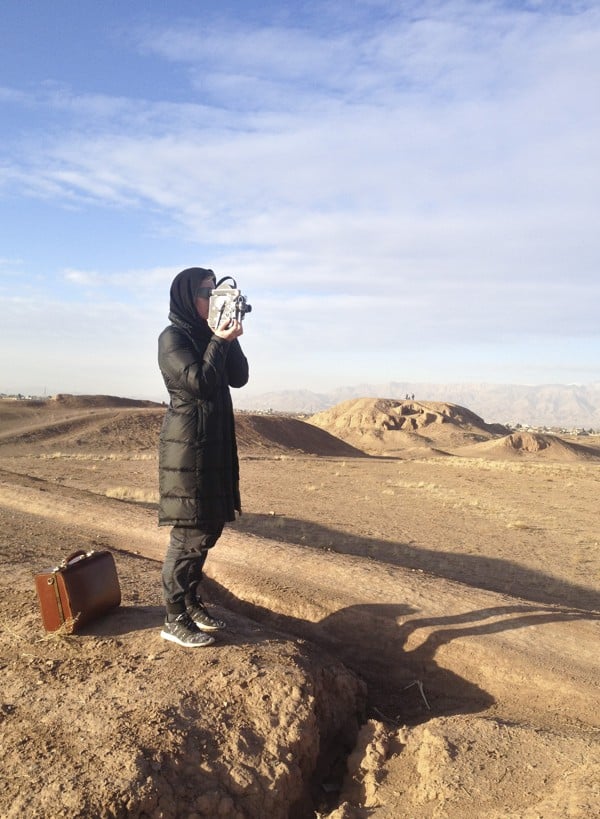 Reynolds in Iran.
“Very little archaeological excavation has been done here, and the exposed walls of the Palace of Happiness are mere stumps of muddy brick. Local children enjoy riding their trail bikes up and down them.
“I found Iran confusing and challenging. As a woman, I had to have my head covered at all times in public, and wear a long coat that reached half way to my knees. My phone didn’t pick up a signal other than Wi-fi. I couldn’t ride a motorbike but I could drive a car.The year starts mid-March, not January. The weekends are on Thursday and Friday. And they start their common era when the Prophet Mohammed was 40, about 600 years after our year zero. More than any other nation I have visited, the Iranians want you to love their country. They are exceptionally proud of it, and they desire to share its magnificence with you. Women and girls of all ages wanted to talk to me, and a photograph with me was often requested.”
EPHESUS, PERGAMUM AND NYSA LIBRARIES, TURKEY
 Reynolds filming at Ephesus library in Turkey.
Western Turkey is home to three historically important lost libraries, Ephesus, Nysa and Pergamum – from which we get the word “parchment”. Built by wealthy patrons during the second century AD, at the height of the Roman Empire, they served the community.
“I was very excited to go to the Roman libraries. Until that point on the trip, I’d been looking at cultures I didn’t understand. But in Turkey, I was re-engaging with my own cultural history. I love Roman and Greek mythology. Of the three, Nysa is the least well-known, but was the most magical. It’s the only library I went to that has an intact reading room. It’s located in an olive grove in a silent, remote valley of the River Maeander, whose winding course gives us the word ‘meander’. The building is a ruin, but the niches that the papyri scrolls once occupied are still there in the walls. The library, in common with all Roman libraries, had a Latin section and a Greek section.”
 Reynolds standing in a niche at Nysa library.
VILLA DEI PAPIRI, HERCULANEUM, ITALY
Founded in 58BC, the library was destroyed by the eruption of Mount Vesuvius in AD79. Its collection of scrolls was carbonised by the intense heat and buried under 30 metres of ash. The villa was not discovered until 1752. Since then, more than 1,800 papyri – crushed into stubs and fused around their umbilical sticks – have been retrieved. They would disintegrate if unrolled but new X-ray technology may allow researchers to see inside the scrolls without damaging them.
 Replica skeletons in the position that the bodies were found after the volcanic flow in AD79, in Herculaneum, Italy.
“The story of Herculaneum was the main catalyst for my journey. I heard a radio report about a group of academics who had petitioned the Italian government to fund continued excavation at the villa. At least one library room has not been unearthed and is thought to contain the lost Greek tragedies. I assumed that arranging a visit would be relatively easy, because the site’s in Europe. But it turned out to be the hardest and most frustrating experience of all. After six months, I finally received a reply, and the answer was no. My final attempt was to simply walk there, but the area is walled off, and I couldn’t get near. Nothing is happening at the villa because no one is funding the research. The papyri are not valued as they should be.”
INSTITUTE OF EGYPT, CAIRO, EGYPT
Established by Napoleon Bonaparte, the Institute of Egypt sits at the edge of Cairo’s Tahrir Square, the heart of civil unrest during the Arab spring. It was destroyed on December 17, 2011, during clashes between the military and protestors. Volunteers and staff salvaged what they could. Of a total of 200,000 volumes, 30,000 were saved.
 Institute Of Egypt, Cairo.
“Egypt is not strictly on the Silk Road but I went there because it was too dangerous to visit the libraries in Syria and Iraq that are currently being lost. Cairo was the closest I could get to experiencing the modern-day destruction of a library. I was told that under no circumstances was I to get my camera out. But I’d come all that way, and I couldn’t contemplate not attempting to film. Almost as soon as I started, there was shouting and a man snatched the camera out of my hands and took off down the road with it. I followed him through a series of courtyards. There were men with guns and dogs on leashes. We arrived at a government military building and I waited on a chair for two hours. There was lots of gesticulating and shouting. I was frightened because I couldn’t read the situation. I didn’t know if I would be detained; I didn’t know how badly they perceived my ‘crime’. Sometimes the guards stood right next to me, which felt threatening. And then, without explanation, they just gave me the camera and let me go.”
Also visited by Reynolds
● Baisikou Pagoda, Yinchuan (lost 1970)
● Hidden Libraries of Tehran (libraries hidden during the revolution in Iran, 1979)
● Khanate of Kokand (Qu’qon) Palace Library (Lost 1876)
● Ulpian Library, Rome (lost around AD600)
● The Cairo Genizeh (dispersed 1900)
● The Ancient Library of Alexandria (lost 393BC)
● Hidden Libraries of Tehran (libraries hidden during the revolution in Iran, 1979)
● Khanate of Kokand (Qu’qon) Palace Library (Lost 1876)
● Ulpian Library, Rome (lost around AD600)
● The Cairo Genizeh (dispersed 1900)
● The Ancient Library of Alexandria (lost 393BC)


