Tuesday, 6 June 2017

The Mongols built an empire with one technological breakthrough, the stirrup


The humble stirrup was a game-changing invention that altered history.


When a man named Temüjin was given the title of Genghis Khan in 1206, the Mongols were a recently united people, tucked away in the northeast corner of Asia. By the time Genghis Khan died in 1227, they were sunning themselves on the shores of both the Pacific Ocean and the Caspian Sea. By 1241 they were knocking at Vienna's door, and they remained the terror of eastern Europe for the rest of the century. The Mongols claimed the largest consolidated land empire in history. Seemingly the only way to keep them out was to put the Himalayas between you and them. And many historians believe their power stemmed from an incredibly simple technological innovation: the stirrup.
No one knows when the stirrup was first invented, but it was a boon to any military that used it. Even the simplest of stirrups, a leather loop, let mounted soldiers ride longer distances and stay mounted on their horses during battle. The military success of the forebears of the Cossacks is often attributed to two loops of leather. Same with the Goths and the Huns. Some believe the stirrup even shifted the balance of power in Europe from foot soldiers to mounted knights, dubbed the "armored tanks" of the medieval world by historian Roman Johann Jarymowycz.
The Mongols took things further. Historians think they not only had leather stirrups, but metal ones as well. In 2016, archaeologists at the Center of Cultural Heritage of Mongolia unearthed the remains of a Mongolian woman dating back to the 10th century AD. Along with sturdy leather boots and some changes of clothes, she was buried with a saddle and metal stirrups described as in such good condition that they could still be used today. The stirrups are one continuous thick piece of metal with an open loop for a saddle strap on the top and a wide, flattened, and slightly rounded foot rest. The stirrups had to be comfortable and tough, because Mongols used them to ride in a way no one else rode.
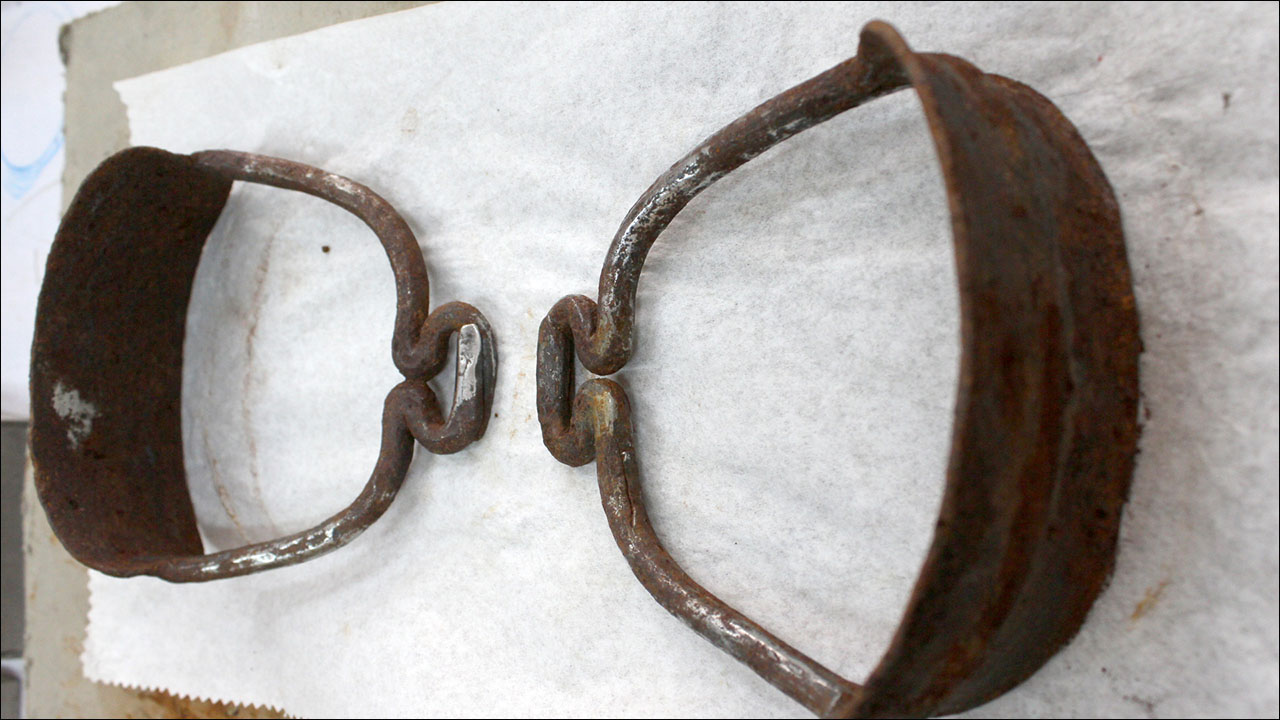
This pair of 1,100-year-old metal stirrups was unearthed from a Mongolian woman's grave in 2016. They were part of a well-preserved saddle with reinforcements that would have allowed the rider unprecedented mobility.
Enlarge / This pair of 1,100-year-old metal stirrups was unearthed from a Mongolian woman's grave in 2016. They were part of a well-preserved saddle with reinforcements that would have allowed the rider unprecedented mobility.
The Center of Cultural Heritage of Mongolia.

A general of the Song Dynasty (960-1279) described the Mongols riding long distances standing up in the saddle, with "the main weight of the body upon the calves or lower part of the leg with some weight upon the feet and ankles." The stirrups were meant to keep the rider centered and upright in even the most tumultuous situation. They hung from a saddle that was made of wood and had a high back and front. These, supplemented with endless hours of practice, gave a Mongol rider unprecedented stability. The rider could maintain hands-free balance on the horse while the horse twisted and turned and while the rider himself turned in the saddle. A fluidly mobile rider could then use his hands to fire arrows in any direction as he rode.
At a time when most armies won by driving ineluctably forward, the Mongols advanced and retreated while never letting up on their assault. When they met their opposition, their cavalry galloped forward with wild agility, shooting arrows continuously, presenting a terrifying united front. As they got within a few yards of the other army, the charging horsemen's unity broke. They turned and galloped away as quickly as they'd come.

The power of retreat

Historian Thomas Craughwell explains that an ability to twist in their saddles meant that, even as the Mongols rode away, they could shoot arrows back toward the enemy army. As the army continued to charge and retreat, their patterns became ever more chaotic. Marco Polo, who saw the Mongols in action, described their technique: "They never let themselves get into a regular melee, but keep perpetually riding around and shooting into the enemy."
If traditional mounted troops were like tanks, Mongol-mounted warriors were fighter pilots. Their mastery of movement made them unbeatable. The other army would advance on a shifting, uniting, scattering, and reuniting foe.
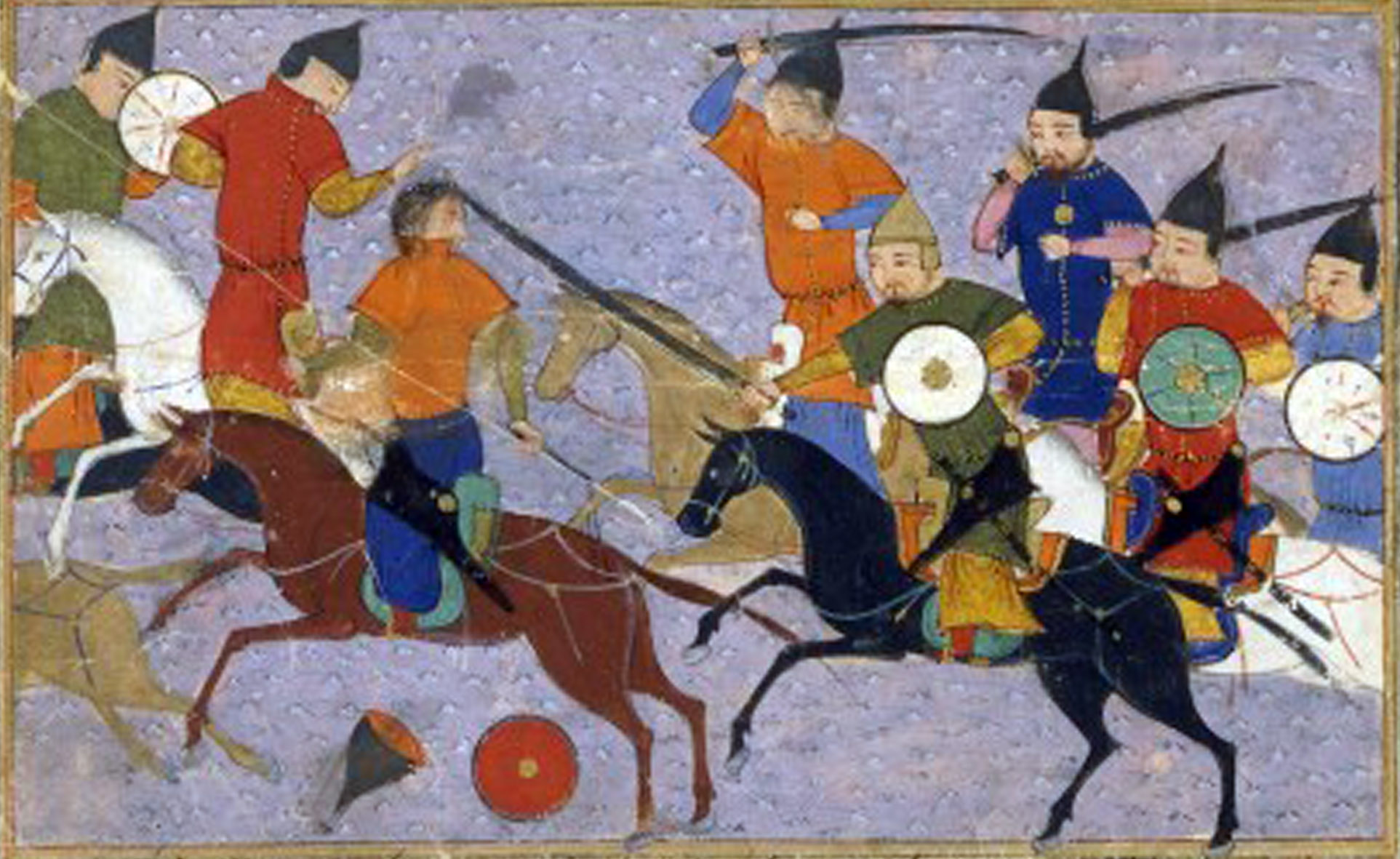
This is a representation of a battle between Mongols and the Chinese, recorded in 1211 in the <em>Jami' al-tawarikh</em>, by Rashid al-Din. Note the Mongols standing in their saddles.
Enlarge / This is a representation of a battle between Mongols and the Chinese, recorded in 1211 in the Jami' al-tawarikh, by Rashid al-Din. Note the Mongols standing in their saddles. 

When all else failed, the Mongols used psychology. At a signal, the cavalry could wheel around and make a convincingly jumbled false retreat. Unwary opposition forces would often then charge after them, believing that the battle had, unexpectedly, gone their way. The Mongol cavalry would then turn right back around, having lured a few overconfident souls too close. More often, though, they would continue their retreat and then maneuver out of the way. Then, unmounted archers would shower the pursuing army with arrows, and more heavily armored cavalry could charge in with lances. At that point, the battle was as good as over.
The Mongolian Empire's stunning rise to power reveals how one technological development provided a literal stepping point for a new style of warfare—one that could not be resisted by any existing army. The largest land empire the world has ever known did not exist because of any one factor. A thousand different circumstances helped Genghis Khan and his immediate descendants conquer most of a continent. But the stirrup played an indispensable role. Engineering the perfect stirrup gave an army, and a people, an ineradicable place in history.

Palace Museum Being hosting new exhibition "The Forbidden City and the Maritime Silk Road"

Palace Museum celebrates Maritime Silk Road and Buddhist art
CGTN.com News
By Ji Xin
11-5 2017
The Palace Museum in Beijing is hosting two major exhibitions. The first is titled “The Forbidden City and the Maritime Silk Road,” the second, “Painting and Calligraphic Works by Four Monk Artists.” The latter is in the Hall of Martial Valor, and features the largest ever collected display of 17th-century artworks by four master monk artists.
The first one displays 140 exhibits featuring cultural treasures of the ancient sea trading route. Staged at the West Wing of the Tower Gallery in the Meridian Gate, items on display include ceramics, paintings, calligraphy, books, gold and silverware, timepieces, scientific instruments, and weapons. The show was designed to reflect China’s historic interactions with the outside world. 
The second one showcases the works of Hongren, Kuncan, Bada Shanren and Shitao from the early Qing Dynasty (1644-1911). They are considered some of the best painters among Buddhist monks in ancient China. The 163 pieces displayed, make it the largest "Four Monks" themed art exhibition ever in history.

Monday, 5 June 2017

A 2500-year-old untarnished sword discovered in China


In 1965, archaeologists in China discovered an ancient sword unlike any other. This ancient weapon unique because it is presumed to be around 2,500 years old and, what is more fascinating, it was still shiny and sharp when it was discovered.
This truly unique archaeological artifact, known as the Sword of Goujian, was unearthed in one of more than 50 tombs which were found in Hubei, China. The researchers discovered over 2,000 artifacts from the sites, including this perfectly preserved bronze sword.

Sword of Goujian, Hubei Provincial Museum  Photo Credit


Sword of Goujian, Hubei Provincial Museum   Photo Credit

According to Ancient Origins, the sword “was discovered in a tomb, in a near air-tight wooden box next to a skeleton. When it was unsheathed, the blade was revealed to be untarnished despite being buried in damp conditions for two millennia.  A test conducted by the archaeologists showed that the blade could easily cut a stack of twenty pieces of paper.” 
Archaeologists believe that this stunning sword made of copper, tin, and small amounts of iron, is now considered to be a state treasure of China from the Spring and Autumn period (770 to 403 BCE).

People photographing the famous sword Photo Credit
Sword of Goujian, Hubei Provincial Museum  Photo Credit

Named after a book, Spring and Autumn Annals attributed to Confucius, the Spring and Autumn period is one of the most turbulent periods in the history of Ancient China. A high number of conflicts between powerful nobles, who fought for supremacy during this period, led to the production of some of the finest bronze high-quality weapons and the Sword of Goujian appears to be among the most outstanding examples.
Measuring 22 inches in length, with a 1.8 inches wide blade and 3.3 inches long handle, the sword is beautifully decorated with turquoise crystals. Eight characters in ancient Chinese script are engraved on the blade near the hilt and translate to: “The Sword belongs to the Goujian, the King of Yue State.”

Deciphering the scripts on the Sword of Goujian  Photo Credit


Sword of Goujian, Hubei Provincial Museum  Photo Credit

Goujian, the son of King Yunchang of Yue, who reigned over the Yue State (south of today’s Zhejiang Province) in the late Spring and Autumn Period, is considered by many as one of the most famous emperors in the history of China.
As above-mentioned, during the Spring and Autumn period, there was a great number of conflicts. The one between the states of Yue and Wu is said to have left permanent marks on history. King Goujian defeated the Wu army in the first battle, back in 496 BC, but one year later, Yue was defeated, and Goujian and his wife were captured. They were finally released in 490BC, and upon his arrival home, King Goujian started making plans for revenge. It took him ten years to prepare himself and his army to attack the Wu capital. It is said that Goujian used the famous sword to defeat the Wu State in the last major conflict during the Spring and Autumn period and eventually annexed the rival.

Close up of the sword  Photo Credit


Sword of Goujian, Hubei Provincial Museum  Photo Credit

The sword is on display at the Hubei Provincial Museum along with many other impressive artifacts.
There is no doubt that this high-quality bronze sword is of great historic significance not just for China, but also for the rest of the world. Moreover, historians and researchers are also fascinated by the fact that the Sword of Goujian is completely untarnished and it still cuts like new.

Sir Aurel Stein and the 'Lords of the Marches

Sir Aurel Stein and the 'Lords of the Marches

Tuesday, 30 May 2017

The Scythians are coming to the British Museum

Scythians 

Warriors of ancient Siberia 14 September 2017- 

14 January 2018 

British Museum London 

organised with the State Hermitage St Petersburg Russia 


2,500 years ago groups of formidable warriors roamed the vast open plains of Siberia. Feared, loathed, admired – but over time forgotten… Until now.

This major exhibition explores the story of the Scythians – nomadic tribes and masters of mounted warfare, who flourished between 900 and 200 BC. Their encounters with the Greeks, Assyrians and Persians were written into history but for centuries all trace of their culture was lost – buried beneath the ice.
Discoveries of ancient tombs have unearthed a wealth of Scythian treasures. Amazingly preserved in the permafrost, clothes and fabrics, food and weapons, spectacular gold jewellery – even mummified warriors and horses – are revealing the truth about these people’s lives. These incredible finds tell the story of a rich civilisation, which eventually stretched from its homeland in Siberia as far as the Black Sea and even the edge of China.
Many of the objects in this stunning exhibition are on loan from the State Hermitage Museum in St Petersburg. Scientists and archaeologists are continuing to discover more about these warriors and bring their stories back to life.
Explore their lost world and discover the splendour, the sophistication and the sheer power of the mysterious Scythians.
e 2017 – 14 January 2018

Introducing the Scythians


The Scythians (pronounced ‘SIH-thee-uns’) were a group of ancient tribes of nomadic warriors who originally lived in what is now southern Siberia. Their culture flourished from around 900 BC to around 200 BC, by which time they had extended their influence all over Central Asia – from China to the northern Black Sea.
From September 2017 you can discover these fearsome warriors and their culture in a special exhibition at the British Museum. But before that, swot up on some key facts and impress your friends down the pub with your new-found Scythian knowledge.
1. They were formidable warriors
Gold plaque of a mounted Scythian. Black Sea region, c. 400–350 BC. © The State Hermitage Museum, St Petersburg, 2017. Photo: V Terebenin.
Until the 1700s, a lot of what we knew about the Scythians was cobbled together from a range of ancient sources – none of them written by the Scythians themselves as they didn’t ‘do’ writing. So what we had was a collection of accounts written by Greeks, Assyrians and Persians – and they were usually terrified (although often also impressed).
The Greek historian Herodotus, in his Histories (Book 4, 5th century BC), wrote: ‘None who attacks them can escape, and none can catch them if they desire not to be found.’ Assyrian inscriptions from the 7th century BC also refer to fighting Scythians, with one mentioning a peace treaty secured by marrying off an Assyrian princess to a Scythian king.
When the Scythians weren’t being hide and seek champions, or being fobbed off with foreign princesses, they even developed a powerful new type of bow which was made from different layers of wood and sinew. It was much more powerful than a regular wooden bow, as the different layers increased the forces and energy when the string was released.
Gold sew-on clothing appliqué in the form of two Scythian archers.
In battles, the Scythians would use large numbers of highly mobile archers who could shower hundreds of deadly arrows within a few minutes. As late as the 6th century AD a Byzantine writer described the deadly effect of mounted archers like these: ‘they do not let up at all until they have achieved the complete destruction of their enemies.’ If this were not terrifying enough, several classical writers state that the Scythians dipped their arrows in poison!
Arrow heads
Scythian arrow heads. © The State Hermitage Museum, St Petersburg, 2017. Photo: V Terebenin.
When the Scythians fought on foot, their weapon of choice was a battle-axe with a long narrow pointed blade (like a narrow pick-axe). This type of fighting was personal and face to face – the weapons’ tell-tale puncture marks have been found on the heads of excavated human remains.
So all in all, pretty fearsome.
2. They were nomads
Scythians with horses under a tree. Gold belt plaque. Siberia, 4th–3rd century BC. © The State Hermitage Museum, St Petersburg, 2017. Photo: V Terebenin.
The brilliantly named ‘pseudo-Hippocrates’ wrote that: ‘The Scyths… have no houses but live in wagons. These are very small with four wheels. Others with six wheels are covered with felt; such wagons are employed like houses, in twos or threes and provide shelter from rain and wind … The women and children live in these wagons, but the men always remain on horseback.’
Nomadic peoples tended not to leave a lot behind in terms of cities or literature – what used to be called ‘civilisation’. What we know of the Scythians is largely through excavations of burial mounds (kurgans), and examples of rock art. It is from these remains that we have the archaeological evidence to see if the ancient writers like Herodotus were right – or if they were making it up as they went along.
In fact, our old friend Herodotus thought that the fact they were nomads meant they were extra scary:
‘For when men have no stablished cities or fortresses, but all are house-bearers and mounted archers, living not by tilling the soil but by cattle-rearing and carrying their dwellings on wagons, how should these not be invincible and unapproachable?’ (Histories, Book 4)
Being nomadic, of course, meant having portable possessions that were robust. The objects the Scythians buried with their dead are generally small or lightweight – such as small drinking flasks and wooden bowls. There is no furniture to speak of – the few surviving tables are low and come apart. Thick floor coverings were essential though – sheepskins, felt rugs and even an imported pile carpet have all been found in tombs.
3. They loved their horses
Artist’s impression of a Scythian on a horse. Reconstruction by D V Pozdnjakov.
Siberia is vast. It stretches over eight time zones and borders Europe, China, the Pacific Ocean and Arctic Circle. It is made up of three major ecological zones – icy tundra at the north, dense forest in the central part, and mixed woodland and grassy steppe in the south. This last section forms a wide grassy corridor of rich grazing from Mongolia and China to the Black Sea. It is here that the Scythians began to develop more efficient ways of riding horses which meant they could move bigger herds to new grazing grounds over larger distances.
The Scythians developed horse breeding and riding to a new level. They were accomplished riders and did not use spiked bits or muzzles. Scythian horse gear (saddles, bridles, bits etc) was also highly developed and functional, durable and light. We know this because the large burial mounds contain large numbers of sacrificed horses. These were accompanied by halters, bridles and saddles, and occasionally whips, pouches and shields.
The saddle horses were buried with very elaborate costumes including headgear with griffins or antlers, saddle covers decorated with combat scenes, and long dangling pendants.
Horse headgear. © The State Hermitage Museum, St Petersburg, 2017. Photo: V Terebenin.
Scythian horses were well looked after – many were aged between 15 and 20 years when they were put to the grave. Almost all the buried horses were killed in the same manner – a hard blow of a pointed battle-axe to the mid-forehead. Although this is regarded today as a ‘humane’ method, within a society which prized horses, the killing of horses must have made a deep impression.
4. They liked getting drunk and high!
Gold plaques showing Scythians drinking. © The State Hermitage Museum, St Petersburg, 2017. Photo: V Terebenin.
Like many cultures, the Scythians drank to excess and got high. Feasting was an important part of Scythian funeral ceremonies – it was also important for social bonding between individuals and tribes. Originally known as ‘milk drinkers’, the Scythians adopted wine consumption from Greeks and Persians. They soon acquired a reputation for excessive drinking of undiluted wine (the Greeks used to mix their wine with water). Greek authors then commented on how the Scythians, like the Persians, liked to drink to excess. You can lead a horse(man) to water (but he’d prefer wine, apparently).
Herodotus also describes how the Scythians had a ritual which involved getting high on hemp in a kind of mobile ‘weed sauna’:
‘They anoint and wash their heads; as for their bodies, they set up three poles leaning together to a point and cover these over with woollen mats; then, in the place so enclosed to the best of their power, they make a pit in the centre beneath the poles and the mats and throw red-hot stones into it… The Scythians then take the seed of this hemp and, creeping under the mats, they throw it on the red-hot stones; and, being so thrown, it smoulders and sends forth so much steam that no Greek vapour-bath could surpass it. The Scythians howl in their joy at the vapour-bath. This serves them instead of bathing, for they never wash their bodies with water.’ (Histories, Book 4)
The Scythians realised the pain relieving effects of marijuana, which no doubt came in useful if they had been in a riding accident or a fierce battle.
5. They were tattooed
Fragment of mummified skin showing a Scythian tattoo. © The State Hermitage Museum, St Petersburg, 2017. Photo: V Terebenin.
All the frozen Scythian bodies examined so far from different sites are heavily tattooed. The designs covered the arms, legs and upper torsos. They include fantastic animals locked in combat, rows of birds and simple dots resembling modern acupuncture.
Line drawings of tattoos on a Scythian man.
Other than tattoos, what did the Scythians look like? Some of the women have fair hair and blue eyes but the men are strongly built and have red or dark hair.
6. They liked a bit of bling
Gold torc with turquoise inlays. © The State Hermitage Museum, St Petersburg, 2017. Photo: V Terebenin.
Scythian craftsmen were good at casting metal. They worked gold, bronze and iron, using a combination of techniques like casting, forging and inlaying with other materials. None of these required large amounts of equipment and Siberia is rich in metal ores, but it did require skill. There will be many exquisite examples of Scythian metalwork in the exhibition.
7. They mummified their dead
Artist’s impression of a burial mound. Watercolour illustration, 18th century. Archive of the Institute of Archaeology of the Russian Academy of Sciences, St Petersburg.
In the high Altai mountain region near the borders of Russia, Kazakhstan, China and Mongolia, the frozen subsoil has meant that the organic remains of Scythians buried in tombs have been exceptionally well preserved in permafrost.
The Scythians took great effort to preserve the appearance of the dead using a form of mummification. They removed the brain matter through holes cut in the head, sliced the bodies and removed as much soft tissue as possible before replacing both with dry grass and sewing up the skin.
Wooden coffin. Late 4th–early 3rd century BC. © The State Hermitage Museum, St Petersburg, 2017. Photo: V Terebenin.
As already noted, nomads do not leave many traces, but when the Scythians buried their dead they took care to equip the corpse with the essentials they thought they needed for the perpetual rides of the afterlife. They usually dug a deep hole and built a wooden structure at the bottom. For important people these resembled log cabins that were lined and floored with dark felt – the roofs were covered with layers of larch, birch bark and moss. Within the tomb chamber, the body was placed in a log trunk coffin, accompanied by some of their prized possessions and other objects. Outside the tomb chamber but still inside the grave shaft, they placed slaughtered horses, facing east.
WOAH! That’s enough for now…
Although Scythian culture remains relatively unknown, new discoveries are happening all the time. Stay tuned to the blog and our other social media channels to find out more about these fascinating nomadic warriors, and book your tickets now to see their culture on display in our special exhibition.

The BP exhibition Scythians: warriors of ancient Siberia is on at the British Museum from 14 September 2017 to 14 January 2018. Supported by BP.
Find out more about some of the key objects on display in this blog post.