Tuesday, 21 April 2020

The Last Journey of the San Bao Eunuch, Admiral Zheng He

By Sheng-Wei Wang

Paperback: 400 pages
Publisher: Proverse Hong Kong (17 Nov. 2019)
Language: English

ISBN-10: 9888491814

From 1405, in order to maintain and expand the Ming Dynasty’s tributary system, Yongle Emperor Zhu Di (reigning 1402-1424) and Xuande Emperor Zhu Zhanji (reigning 1425-1435) ordered eunuch Zheng He to lead giant fleets across the seas. But soon after Zheng He’s seventh and last voyage in the 1430s, the Ming emperors put an end to this activity and ordered all records of previous voyages to be destroyed. Chinese writer Luo Maodeng (罗懋登), knowing the history of some of these voyages, wished to preserve a record of them, but, conscious of the possible penalty, decided to record the facts “under a veil”, in his 1597 novel, An Account of the Western World Voyage of the San Bao Eunuch (《三宝太监西洋记》). This is what Dr. Sheng-Wei Wang has concluded after reading and analysing Luo’s novel. Her book, The last journey of the San Bao Eunuch, Admiral Zheng He, shows the methodology and evidential arguments by which she has sought to lift the veil and the conclusions she suggests, including the derivation of the complete trans-Atlantic navigational routes and timelines of that last journey and the idea that Zheng He’s last expedition plausibly reached the ancient American Indian city, Cahokia, in the U.S. central Mississippi Valley in late autumn, 1433, long before Christopher Columbus set foot for the first time in the Americas. She supports the hotly debated view that Ming Chinese sailors and ships reached farther than previously accepted in modern times and calls for further research. She hopes this book will become an important step in bridging the gap in our understanding of ancient China-America history in the era before the Age of Discovery. An interesting contribution to an ongoing debate. This edition has 48 scattered b/w illustrations and 8 b/w plates.

Thursday, 16 April 2020

Empire of Horses by John Man

The First Nomadic Civilization and the Making of China 

by John Man 


  • Hardcover: 336 pages
  • Publisher: Pegasus (3 Mar. 2020)
  • Language: English
  • ISBN-10: 1643133276

The author of landmark histories such as Genghis Khan, Attila, and Xanaduinvites us to discover a fertile period in Asian history that prefigured so much of the world that followed.
The people of the first nomadic empire left no written records, but from 200 bc they dominated the heart of Asia for four centuries, and changed the world in the process. The Mongols, today's descendants of Genghis Khan, see these people as ancestors. Their rise cemented Chinese identity and inspired the first Great Wall. Their descendants helped destroy the Roman Empire under the leadership of Attila the Hun.
We don't know what language they spoke, but they became known as Xiongnu, or Hunnu, a term passed down the centuries and surviving today as "Hun," and Man uncovers new evidence that will transform our understanding of the profound mark they left on half the globe, from Europe to Central Asia and deep into China.
Based on meticulous research and new archaeological evidence, Empire of Horses traces this civilization's epic story and shows how this nomadic cultures of the steppes gave birth to an empire with the wealth and power to threaten the order of the ancient world.

Tuesday, 14 April 2020

Walking to Samarkand

The Great Silk Road from Persia to Central Asia

Monday, 13 April 2020

Lecture of an hour on Buddhist Art by Mimi Gardner Gates (April 2019)


THE PAULINE AND JOSEPH DEGENFELDER FAMILY DISTINGUISHED LECTURE IN CHINESE ART

Caves of Dunhuang: Buddhist Art on China’s Silk Road 

Speaker: 
Mimi Gardner Gates, Director Emerita, Seattle Art Museum
Sunday, April 14, 2019, 2:00 p.m.
Gartner Auditorium
The spectacular Buddhist caves of Dunhuang, on the Silk Road in the Gobi Desert in northwest China, are a UNESCO World Heritage site. This lecture presents the sites’ sculptures and wall paintings, among the finest and earliest examples of Buddhist art in China. 
Used by Buddhist monks since the AD 300s, the caves were the focus of worship and cultural interaction for thousands of years; they also served as a rich repository for precious art treasures and manuscripts that were rediscovered in the early 1900s. 
Dr. Mimi Gardner Gates, president of the American Friends of the Dunhuang Foundation, addresses the challenges of preserving the site today, as undertaken by the Dunhuang Academy in collaboration with the Getty Conservation Institute in Los Angeles.

Mimi Gardner Gates: A Chinese art history scholar, Mimi Gardner Gates earned a BA from Stanford University and a PhD from Yale University. Now director emerita, she was director of the Seattle Art Museum for 15 years (1994–2009). Under her leadership, the Olympic Sculpture Park was created, the downtown museum was expanded, and the artistic program achieved a high level of excellence. Prior to moving to Seattle, she was curator of Asian art (1975–1986) and director (1987–1994) of the Yale University Art Gallery. Among the numerous exhibitions she has organized, Cave Temples of Dunhuang: Buddhist Art on China’s Silk Roadwas held in 2016 at the Getty Center, Los Angeles. 
She currently chairs the Dunhuang Foundation and the board of managers of the Blakemore Foundation. She is a member of the board of the Terra Foundation for American Art, Asian Art Museum of San Francisco, Northwest African American Museum, and Copper Canyon Press. Gates is a former fellow of the Yale Corporation and the founder of the Gardner Center for Asian Art and Ideas at the Seattle Art Museum. 

The Metal Road of the Eastern Eurasian Steppe

The Formation of the Xiongnu Confederation and the Silk Road 

Sunday, 12 April 2020

Lives of Sogdians in Medieval China

  • By Moritz Huber

  • Hardcover: 350 pages
  • Publisher: Harrassowitz (31 Mar. 2020)
  • Language: English
  • ISBN-10: 3447113804

Sogdians, a group of Central Asians based between the Amu Darya and the Syr Darya, played a significant historical role at the crossroads of the Silk Roads. Travelling the world as caravan leaders, organised in trading networks, they were found from Byzantium to the Chinese heartland. The Sogdian language was a candidate for the lingua franca of the Silk Roads for some hundred years and Sogdians acted as polyglot mediators at courts and prominent translators of Buddhist texts. In the Chinese capitals, fire temples were erected for their use and the exotic products they imported were cherished by the people and the court.
This socio-historical study by Moritz Huber provides a translation of the transmitted Chinese records on Sogdians in Sogdiana and China and combines them with archaeological evidence to present a differentiated picture of their presence in China from the 3rd to 10th century CE. Besides the transcription and translation of all epitaphs of Sogdians from an archaeological context, used to tell their interconnected biographies, as well as a detailed discussion of their political organisation in China under the sabao 薩保/薩寶, this publication further includes a case-study of the Shi 史 families in Guyuan 固原, Ningxia 寧夏 Province.

Along the Silk Roads in Mongol Eurasia

Generals, Merchants, and Intellectuals

Monday, 30 December 2019

Non-Han Literature Along the Silk Road

by Xiao Li (Editor)


  • Hardcover: 151 pages
  • Publisher: Springer; 1st ed. 2020 edition (2 April 2020)
  • Language: English
  • ISBN-10: 9811396434

This volume includes outstanding scientific articles on documents written in ancient languages such as Tocharian, Sogdian, Khotanese, and Old Uyghur. Its chief aims are to contribute to the present state of research by adding essential findings on newly discovered historical documents; to present a multi-dimensional investigation of diverse aspects including the history, religion, art, literature, and social life along the Silk Road; and to outline potential future research directions for non-Han literature studies and inspire research into other aspects, such as economics and comparative studies.

    About the Author

Dr. Xiao Li, a professor at the School of Chinese Classics, Renmin University of China, has participated in archaeological fieldwork and pursued extensive research on the prehistoric and historical periods in northwestern China and Central Asia. With his outstanding experience, both in fieldwork and theoretical research, he has considerable expertise in the archaeology and history of Xinjiang, the origin and development of the central Asian civilizations, and the modes of interactions between Xinjiang and Central Asia.

Friday, 27 December 2019

Caravanserai: Traces, Places, Dialogue in the Middle East

By Tom Schutyser

  • Hardcover: 180 pages
  • Publisher: 5 Continents Editions; Bilingual Edition: English & French ed. edition (30 Jan. 2019)
  • Language: English, French
  • ISBN-10: 887439604X

A 'caravanserai' is a roadside inn found along ancient caravan routes in the Muslim world. For centuries the caravanserais served as staging posts in the Middle East and Central Asia, providing accommodation to traders, pilgrims, and other travellers along the Silk Road that connected China, India, and Europe. The caravanserais were vital nodes in what was in effect the first globalised overland network and trading system. Thousands of these caravanserais were built and successfully operated. They survived empires, caliphates and wars until the demise of the caravan trade. Those that have not vanished, have become crumbling ruins, or survive as hotels, museums, shops, storage space, living quarters, or military outposts. In the tumultuous state of relations between the Western and Muslim worlds today, the caravanserais stand as evidence of ancient multi-cultural exchange and trade. They inspire the quest to find such new platforms of multi-cultural dialogue for the future.

Belgian photographer Tom Schutyser has travelled the Silk Road numerous times in fifteen years, first photographing caravanserais in northeast Iran. For this project, Schutyser chose the levant region of Lebanon, Syria, and Jordan, photographing both ruined and restored caravanserais as well as the landscape and surroundings of these buildings, seeking to capture the sense of history still present in these places. His stunning, powerful photographs, illuminated by contributions from some of the most eminent writers, thinkers, and journalists specialising in the Middle East and foreign relations, combine to present a new dimension on the debate about the region as it is today.

Text in English and French.

      About the Author

Tom Schutyser is a Belgian documentary photographer and researcher who specialises in architecture and history. His coverage of caravanserais has been shown in galleries in Paris, Beirut, and Portland, Oregon. Andrew Lawler, a contributing editor to science and archaeology magazines, also writes for Smithsonian, Discover, National Geographic and other publications. Reza Aslan, a scholar of religions and Professor of Creative Writing at University of California at Riverside, a member of the Council on Foreign relations and a bestselling author. Rachid al-Daif is a writer whose novels have been translated from Arabic into eleven languages. Robert Fisk is a multiple award-winning journalist on the Middle East, based in Beirut. He writes for The Independent and other publications. Dominique Moïsi is a senior adviser at the French Institute for International relations (IFrI), and the author of several books on international affairs. Paul Salem is director of the Carnegie Endowment for International Peace Middle East Center.

Thursday, 26 December 2019

The Mongols in Iran: Qutb Al-Din Shirazi's Akhbar-i Moghulan

  • By George Lane

  • Hardcover: 136 pages
  • Publisher: Routledge; 1 edition (7 May 2018)
  • Language: English
  • ISBN-10: 1138500526

The polymath, Qutb al-Dīn Shīrāzī, operated at the heart of the Ilkhanate state (1258–1335) from its inception under Hulegu. He worked alongside the scientist and political adviser, Nasir al-Dīn Ṭūsī, who had the ear of the Ilkhans and all their chief ministers. 

The Mongols in Iran provides an annotated, paraphrased translation of a thirteenth-century historical chronicle penned, though not necessarily authored, by Quṭb al-Dīn Shīrāzī. This chronicle, a patchwork of anecdotes, detailed accounts, diary entries and observations, comprises the notes and drafts of a larger, unknown, and probably lost historical work. It is specific, factual, and devoid of the rhetorical hyperbole and verbal arabesques so beloved of other writers of the period. It outlines the early years of the Chinggisid empire, recounts the rule of Hulegu Khan and his son Abaqa, and finally, details the travails and ultimate demise and death of Abaqa’s brother and would be successor, Ahmad Tegudar. Shirazi paints the Mongol khans in a positive light and opens his chronicle with a portrait of Chinggis Khan in almost hallowed terms. 
Throwing new light on well-known personalities and events from the early Ilkhanate, this book will appeal to anyone studying the Mongol Empire, Medieaval History, and Persian Literature.


Wednesday, 25 December 2019

Making Mongol History: Rashid Al-Din and the Jami' Al-Tawarikh

by Stefan Kamola

  • Hardcover: 320 pages
  • Publisher: Edinburgh University Press (31 Aug. 2019)
  • Language: English
  • ISBN-10: 1474421423

This book examines the life and work of Rashid al-Din Tabib (d. 1318), the most powerful statesman working for the Mongol Ilkhans in the Middle East. It begins with an overview of administrative history and historiography in the early Ilkhanate, culminating with Rashid al-Din's Blessed History of Ghazan, the indispensable source for Mongol and Ilkhanid history. Later chapters lay out the results of the most comprehensive study to date of the manuscripts of Rashid al-Din's historical writing. The complicated relationship between Rashid al-Din's historical and theological writings is also explored, as well as his appropriation of the work of his contemporary historian, `Abd Allah Qashani

The Muslim Merchants of Premodern China: The History of a Maritime Asian Trade Diaspora, 750-1400

by John W. Chaffee


  • Paperback: 212 pages
  • Publisher: Cambridge University Press (23 Aug. 2018)
  • Language: English
  • ISBN-10: 1107684048

In this major new history of Muslim merchants and their trade links with China, John W. Chaffee uncovers 700 years of history, from the eighth century, when Muslim communities first established themselves in southeastern China, through the fourteenth century, when trade all but ceased. These were extraordinary and tumultuous times. Under the Song and the Mongols, the Muslim diaspora in China flourished as legal and economic ties were formalized. At other times the Muslim community suffered hostility and persecution. Chaffee shows how the policies of successive dynastic regimes in China combined with geopolitical developments across maritime Asia to affect the fortunes of Muslim communities. He explores social and cultural exchanges, and how connections were maintained through faith and a common acceptance of Muslim law. This ground breaking contribution to the history of Asia, the early Islamic world, and to maritime history explores the networks that helped to shape the pre-modern world.


Tuesday, 14 May 2019

Iran After the Mongols

Iran After the Mongols

Hardcover – 16 May 2019

Digital exhibition "The Sogdians: Influencers on the Silk Roads" available


The Sogdians: Influencers on the Silk Roads


Who were the Sogdians? While mostly lost to history, these ancient people of the Silk Roads shaped the world around them—not with an empire or an army but through trade.

Sogdian Trade Route Map
Land and sea trade routes in the first millennium CE. Bukhara and Samarkand were major cities in Sogdiana.

One of the first references to the Sogdians dates to the fifth century BCE. They were known for their importance on the trade routes that crisscrossed Asia, from the Mediterranean to the Sea of Japan. The Sogdian homeland, in present-day Uzbekistan and Tajikistan, was famous for its bountiful oases that served as crucial stopovers between expansive deserts and rugged mountains.
The Sogdians traded silk from China, horses from Uzbekistan, gemstones from India, musk from Tibet, and furs from the northern steppes. Skilled artisans, they made and sold luxurious objects, particularly metalwork and textiles, across the Asian steppe and into China. They also exported fashions, dances, and music traditions. In addition to serving as diplomats and translators, the Sogdians were instrumental in spreading Buddhism, Christianity, and Manichaeism, a dualistic Iranian religion founded in the third century CE. The Sogdians largely disappeared by the eighth century, and their language, architecture, and history were lost to time.
Archaeological discoveries—from ancient letters to monumental wall paintings—have allowed scholars to reconstruct some of the extraordinary contributions Sogdians made to Late Antiquity. To learn more about these dynamic people who crossed geographic, political, and cultural boundaries, the Freer|Sackler assembled an international team of scholars, convened workshops across the world, and worked with graduate students for almost a decade.

carved brown stone showing figures and divinities
Frontal from the base of a funerary couch with Sogdian musicians and dancers and Buddhist divinities. China, purportedly Anyang, Northern Qi dynasty (550–577 CE). Marble with traces of pigment. Freer Gallery of Art, Gift of Charles Lang Freer, F1915.110.

The Sogdians: Influencers on the Silk Roads is a new digital exhibition that explores Sogdian art through existing material culture. It focuses on the golden age of the Sogdians, from the fourth to the eighth centuries CE, when Sogdiana flourished through trade and agriculture. Sogdian emigrant communities spread across China, South and Southeast Asia, and into the Central Asian steppe and Mongolia. During these centuries, a highly sophisticated and distinct Sogdian urban culture developed, epitomized by richly colored wall paintings and exceptional textiles, metalwork, and sculptures.
Various dimensions of Sogdian culture, from art, music, and feasting to religious and funerary practices, are presented in this digital exhibition. New 3-D models of metalwork objects, photographs of archaeological sites, and international scholarship reveal new details about these forgotten people. Investigate Sogdian objects, travel the Silk Roads on an interactive map, and watch leading scholars discuss their latest research as you discover the most important people you’ve (maybe) never heard of.
Explore the digital exhibit: www.freersackler.si.edu/sogdians
Explore this 3-D interactive model of a winged camel ewer, late 7th or early 8th century, now in the State Hermitage Museum, St. Petersburg. Model © The State Hermitage Museum, S-11.
This online exhibition is made possible through the generosity of the Leon Levy Foundation, with additional support from the Thaw Charitable Trust and the Smithsonian Provost Scholarly Studies Award program.
We warmly recognize the collaboration of the State Hermitage Museum, the Institute for the Study of the Ancient World (NYU), XE: Experimental Humanities and Social Engagement (NYU), the Bard Graduate Center, and the Association Sauvegarde Peinture Afrasiab.
This piece is part of a series on The Sogdians: Influencers on the Silk Roads. Check back for additional posts from our collaborators.

Sunday, 12 May 2019

Buried Treasures of the Silk Road


Buried Treasures of the Silk Road from Bruce Museum on Vimeo.

Exhibition "Buried treasures of the Silk Road" in the Bruce Museum, Greenwich

February 9, 2019 - June 2, 2019

Buried Treasures of the Silk Road showcases the extraordinary collection of Chinese tomb sculpture in the Fred and Jane Brooks Collection of the Bruce Museum. Featuring dozens of rare and delicate terra cotta figurines, painted and glazed ceramics, and other antiquities, Buried Treasures of the Silk Road will be on view in the Museum’s Arcade Gallery through June 2, 2019.
During the period of peace and prosperity of the Han Dynasty (206BCE – 220CE), considered the Golden Age of China, emissaries ventured from China into Eurasia. Merchants soon followed, laden with polychrome, patterned silk – a luxury never seen outside of China. In time, these merchants transported other exotic goods, including lapis lazuli and other precious metals, furs, and ivory on the backs of camels, donkeys, and horses to ever more distant markets, extending the range of trading partners along the way.
Evolving into a network of overland and water routes that stretched thousands of miles across China and Central Asia to Eastern Europe, the Silk Road introduced and formalized the practice of international trade.
Han administrators established military garrisons housed in watch towers along the land route, imposed strict travel and trade regulations, and collected taxes. The invention of paper provided portable, reliable maps and indelible ink trade contracts. Trade centers grew to become bustling, cosmopolitan cities where markets supported a multicultural exchange of ideas, inventions, and commodities. The Han Dynasty maintained control of trade over the Silk Road for four hundred years.

Lokapala, Tang Dynasty,618-906.
Sancai glazed pottery, 35 ½ x 15 x 7 in,
Gift of Fred and Jane Brooks, 
Bruce Museum Collection, 2013.15.01. 
Photo by Paul Mutino
China's second great empire, the Tang Dynasty (618 CE-906 CE) is considered the Golden Age of Chinese Cosmopolitanism, an era when foreign ideas, products, and religions were welcomed. Tang Emperors reestablished the Han model of control over taxes and tolls along the network of Silk Road markets. Prosperity supported the arts, and multicultural influences created interest in new forms of music, dance, fashion, and artistic expression. Traditional Chinese rites and customs evolved.
During both the Han and Tang dynasties, mortuary rites and customs were important elements of Chinese culture. Wealthy citizens expanded on the tradition of furnishing their massive burial chambers with numerous and elaborate art objects. Grave goods, called mingqi or “spirit goods,” indicated the status of the person on earth and were interred for use in the afterlife. The materials and stylistic elements of grave goods reflect the way artists and craftsmen embraced the multicultural influences that entered China via the Silk Road.

Camel, Tang Dynasty, 618-906. 
Sancai with blue glaze pottery, 
15 x 12 ½ x 6 in.,
Gift of Fred and Jane Brooks,
Bruce Museum Collection, 2013.15.04.
Photo by Paul Mutino.
Buried Treasures celebrates the artistic achievements of anonymous Chinese artists supported by the riches earned on the Silk Road.  The exhibition will also feature art objects from the Museum’s permanent collection exchanged on the Silk Road.
“When we in the Western world think of ancient art, we tend to focus on Greek and Roman culture,” says Fred Brooks, a longtime Greenwich resident who, with his wife Jane, has spent decades collecting Chinese ceramics, notably ancient tomb art. “But all through that period of time, the Han Dynasty also had a great empire, and art was central to their lives – and more important to the leaders, their afterlife.”
In light of the current Chinese government’s efforts to restore and revive this ancient trade route, this exhibition has a special topicality, says Kirsten Reinhardt, Museum Registrar and the organizer of Buried Treasures.
“For more than one thousand years, from 206 BCE until 907 CE, Chinese Emperors dealt with the same issues that are in the news today: international trade treaties, tariffs, border walls, nationalism, and immigration,” says Reinhardt. “Through military strength, diplomacy, and technological advancements China developed, controlled, and prospered from commerce on the Silk Road. Everything old is new again.”
To complement this exhibition, the Bruce will present a series of docent tours and related programs. On Wednesday, February 27, 1:00 – 2:00 pm, Kirsten Reinhardt will give a Curator’s Talk on the Fred and Jane Brooks Collection of Chinese tomb art, as well as objects and antiquities from the permanent collection featured in the exhibition. The talk is free to Museum members and visitors with paid admission.
On Monday, March 18, 10:00 – 11:00 am, Virginia Bower, Adjunct Professor at the University of the Arts in Philadelphia, will discuss “Of Camels and Kings: The Silk Road and Tang Dynasty Tomb Sculpture.” This talk is free to Museum members; $10 for non-members.
On Thursday, April 18, 6:00 – 8:00 pm, David Ake Sensabaugh, former Ruth and Bruce Dayton Curator of Asian Art at the Yale University Art Gallery, will present “Providing for the Afterlife in Han Dynasty China,” speaking to the ways in which Han Dynasty tomb furnishings reveal beliefs in the afterlife as well as illuminate aspects of daily life. The evening lecture is free for Museum members and students with ID; $15 for nonmembers. Reservations are required for all programs and may be made online at brucemuseum.org.
Docent-led exhibition tours take place on Tuesdays, 1:30 – 2:30 pm and Fridays, 12:30 – 1:30 pm. Family Gallery Tours, designed for children ages 6-10 and their families, are on Sundays, 11:30 am – 12:15 pm. 
The Bruce Museum is grateful for support of this exhibition from The Charles M. and Deborah G. Royce Exhibition Fund and the Connecticut Office of the Arts, as well as for the ongoing generosity of Fred and Jane Brooks in sharing these Buried Treasures with the public.


Saturday, 11 May 2019

Origins of the Silk Road


Lecture by Rowan Flad, John E. Hudson Professor of Archaeology, Department of Anthropology, Harvard University on October 24, 2018 at the Peabody Museum
Approximately 4,000 years ago, the peoples of China and Eurasia gradually began to develop networks of interaction and exchange that radically transformed the cultures of both regions. These networks eventually gave rise to the Silk Road trade routes connecting the East and West. 
Rowan Flad will examine the archaeological evidence—from the Qijia Culture of Northwest China—that documents the agricultural, metallurgical, and technological innovations that resulted from the earliest trans-Eurasian exchanges, and how studies of the Silk Road origins are being reinvigorated by China’s One Belt, One Road initiative.

Friday, 10 May 2019

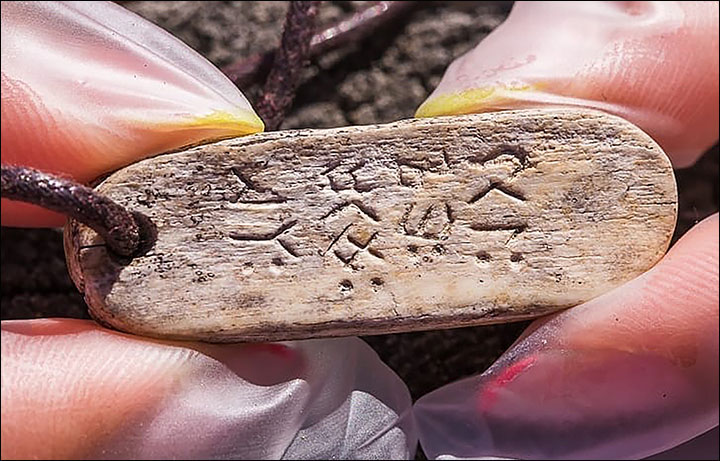
‘1,000 year old message’ written in runes on pendant made of mammoth bone

By The Siberian Times reporter

‘If it is confirmed that this bone found in Namsky district is genuine, it will be a great scientific discovery for the republic.' Picture: Michil Yakovlev
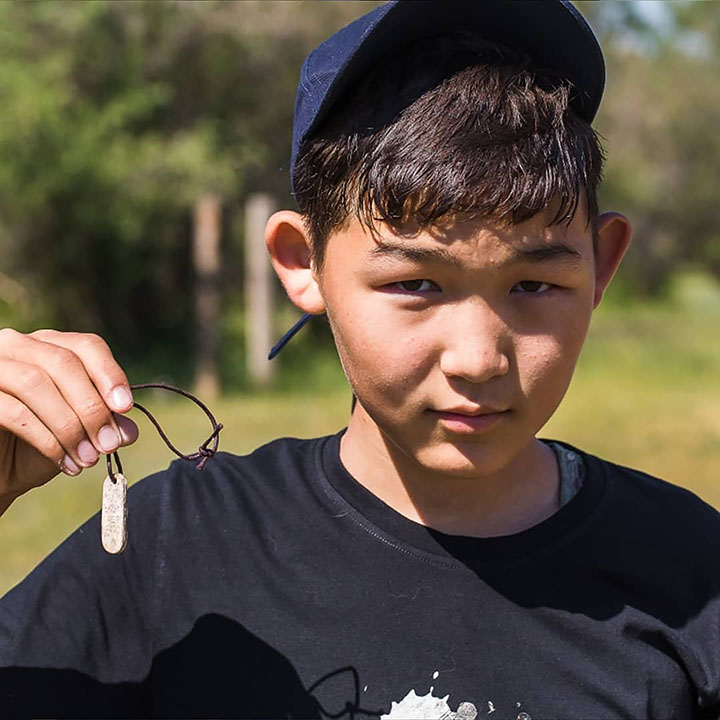
The fifth grade student discovered the ‘jewellery’ decorated with ancient Turkic runic inscriptions.
The four words are believed to be in the Orkhon-Yenisei type script.
Such writings are normally found in rock art in Yakutia, also known as Sakha Republic, the world’s coldest region and the largest within the Russian Federation. 
Academic Ninel Malysheva said: 'Runes rarely occur on such things as talismans and amulets. 
‘If it is confirmed that this bone found in Namsky district is genuine, it will be a great scientific discovery for the republic. 
‘A comprehensive study is now required involving paleontologists, archaeologists and Turkologists.’
Pavel with the find

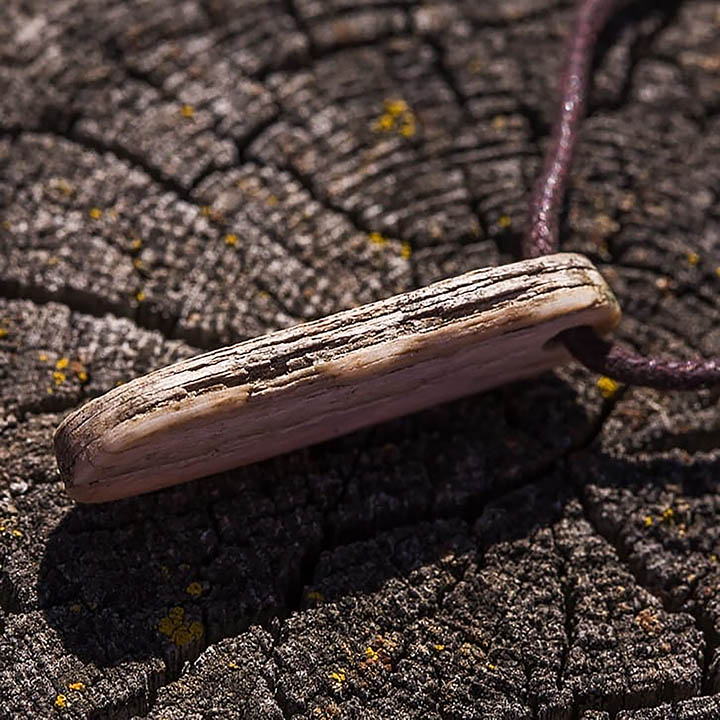
Pendant

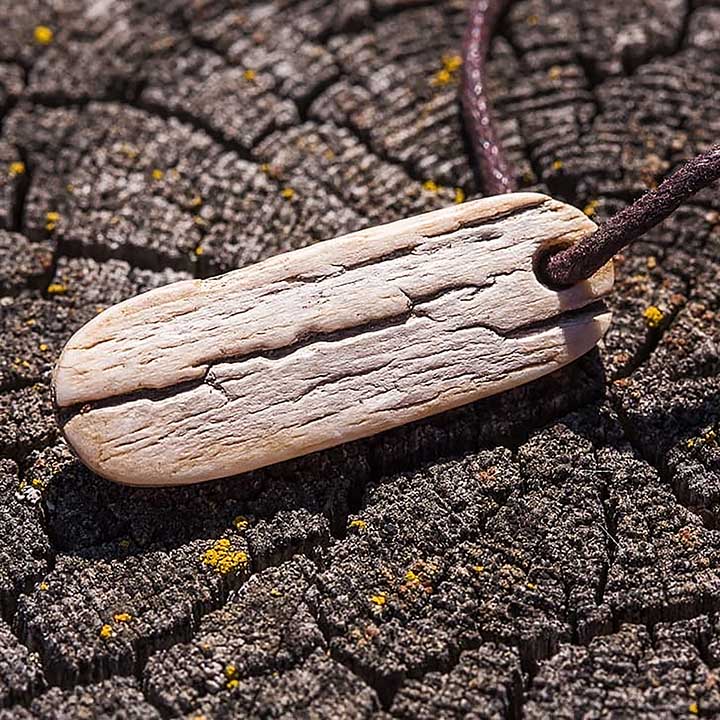
Pendant
The fifth grade student Pavel discovered the ‘jewellery’ decorated with ancient Turkic runic inscriptions. Pictures: Michil Yakovlev
Studies on exact dating and decoding the inscription are underway at the Museum of Writing, part of the North-Eastern Federal University (NEFU).
One theory is that the words express ‘good wishes’, but scientists hope to find the exact meaning. 
Pavel’s village is some 100 kilometres north of Yakutsk, the regional capital, and the world’s coldest city.
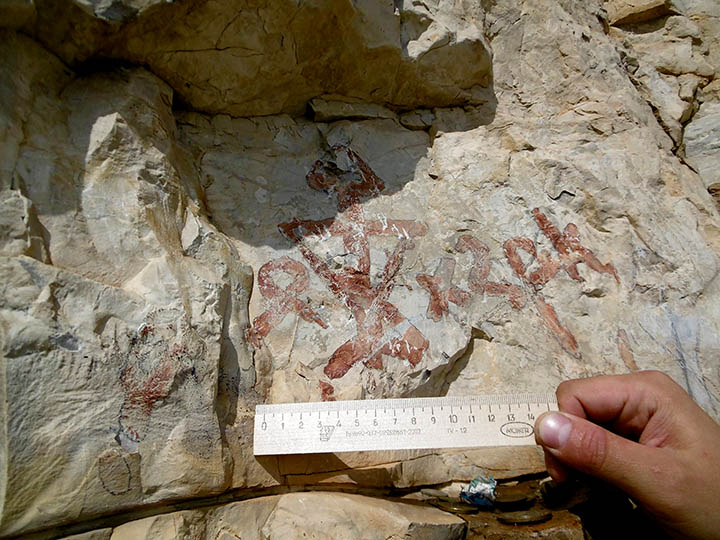
Another example of Turkic runes in Yaktutia is the so-called Petrov inscription.
It is a writing made using ocher some 200 km from Yakutsk. 
It is known as the most northerly rune inscription in the world.
Studying the pendant
Studies on exact dating and decoding the inscription are underway at the Museum of Writing, part of the North-Eastern Federal University (NEFU). Picture: Michil Yakovlev
Researchers in the middle of the last century believed that the inscription indicated the location of medieval treasure.
A literal translation is said to read: 'Pearls of the tribe Az.’
Such Turkic scripts date back 1,000 years or more. |
The Old Turkic script - also known as variously Göktürk script, Orkhon script, Orkhon-Yenisei script -  is the alphabet used by the Göktürks and other early Turkic khanates during the 8th to 10th centuries.
The script is named after the Orkhon Valley in Mongolia where early 8th century inscriptions were discovered in an 1889 expedition by Nikolai Yadrintsev. 
These Orkhon inscriptions were published by Vasily Radlov and deciphered by the Danish philologist Vilhelm Thomsen in 1893.
Petrov inscription
Another example of Turkic runes in Yaktutia is the so-called Petrov inscription. Picture: NEFU
This writing system was later used within the Uyghur Khaganate. 
Additionally, a Siberian variant is known from 9th century Yenisei Kirghiz inscriptions, and it has likely cousins in the Talas Valley of Turkestan and the Old Hungarian alphabet of the 10th century. Words were usually written from right to left.
Yakut runic letters are the least studied in Siberia.
They provoke heated discussions among the linguists and Turkologists. 
But most new finds of inscriptions are made in Yakutia. 
Now the total number all Yakutian finds is close to 90.
Most runic inscriptions of Yakutia have not yet been deciphered.