Tuesday, 7 May 2013

The Making of an Imaginary Archaeological Culture


Sino Platonic Papers No. 237, April 2013

Kungang (昆岗): The Making of an Imaginary Archaeological Culture
Victor H. Mair, University of Pennsylvania, and
Cheng Fangyi, Tsinghua University 


This article analyzes the cultural imaging and fictitious construction employed in designating and describing the “Kungang Ancient Tombs,” including their naming to echo an ancient historical site, the collecting and relocation of cultural relics, and the fabricated explanations for these relics. As we explore further, we find that local interests, motivated by the expectation of benefitting materially from attention and tourism, were responsible for instigating the exploration and exploitation of a desert archaeological site. Besides the Kungang Ancient Tombs, we also discuss the Northern Cemetery, which proves to be of the same cultural type as Xiaohe (小河) Cemetery, far to the east.

Friday, 3 May 2013

Exhibition on Cultural Exchange and Cooperation between China and Central & Eastern Europe

National Museum of China, Beijing
Date: May14 - May 20, 2013
Venue: Gallery S8

Central and Eastern European countries are among the first to have established diplomatic relationships with the People’s Republic of China and have a long history of cultural exchanges with China. The Chinese Government has always attached great importance for the cultural exchanges and cooperation with these countries and enjoyed ever-growing fruitful cultural exchanges with them on the basis of mutual respect, equality, sincere and win-win cooperation. The physical and image materials displayed in this exhibition epitomize the highlights in the cultural exchanges between China and Central & Eastern Europe countries over the past six decades, witness the growing exchanges and painstaking efforts of generations of culturati, and arouse “golden memory” in this regard. Approaching to the future with memory of the history is a shared aspiration of all of us.

Thursday, 2 May 2013

Huns and the Central Plains

Watch Video
The Beijing World Art Museum is using ancient cultural relics to tell a story of conflict and hard-won unity. The show takes us through the turbulent relations between the nomadic Huns and the Central Plains dynasties, many centuries ago.
Centuries-old bronzeware, pottery, jade pieces, gold and silver, and even ancient weapons.
More than 130 artifacts reveal the long road to integration between the Huns and the Central Plains dynasties. This story spans a great swath of history, from the late Warring states period to the Han Dynasty.
The Beijing World Art Museum is using ancient cultural relics to tell a story
of conflict and hard-won unity.
The Huns were an ancient nomadic people in north China. Due to their different beliefs and lifestyles, the Huns and the Han people experienced many conflicts throughout history. But there was also extensive trade, alliances were struck, resulting in the eventual blending of the cultures.
Feng Guangsheng, deputy curator of Beijing World Art Museum, said, "I think this exhibition is meaningful in many aspects. First, it gives us a clear impression of the history, the clashes and convergence of the Huns and the Central plains dynasties. Second, it makes us think about our world, because there are still conflicts and wars. I think looking at how ancient people treated each other will surely benefit us."
The exhibition is not only about cultural relics.
It also features 28 modern creations by contemporary oil painters. Some of the paintings depict well-known historical events. And some reproduce the daily lives of people living in ancient times.
The Beijing World Art Museum is using ancient cultural relics to tell a story of conflict
and hard-won unity.
Feng Guangsheng said, "The exhibition is a combination of cultural relics and modern oil paintings. These modern creations will help visitors get a deeper understanding of the history, and make it more interesting at the same time. Take this painting for example. It depicts a very famous historical event called "Zhaojun departing for the frontier". Zhaojun was a very beautiful lady. She was sent by Emperor Yuan to marry the Xiongnu Chanyu in order to establish friendly relations."
All the artifacts on display come from five museums located in Henan, Inner Mongolia, Gansu and Ningxia. The exhibition has already been held in Zhengzhou and other cities.
The Beijing World Art Museum will also invite experts to give lectures on the history of the period described in the exhibit.
Source: CCTV.com
For more information (in Chinese): Beijng world Art Museum

Ancient Asian artefacts under the hammer in UK


Watch Video

Play Video
From a rare Buddhist temple step to ancient Indian and Islamic artefacts, one auction house in London is causing quite a stir with their new lots.
This is the first time a 1000-year-old pre-Hindhu stone step has appeared at an auction. The only other such examples of this kind remain in situ in Sri Lanka.
Weighing at three quarters of a ton, the carved stone features a curved procession of animals, including lions, horses, elephants, birds and cows. Despite being moved around and used in English country gardens for decades, it’s surprisingly still in one piece and in excellent condition.
The lot has attracted interest from around the world with private collectors and museums keen to purchase the historic pieces. Works by three of India's greatest painters are also among the highlights at the Bonhams Indian and Islamic sale. They are predicted to fetch record prices.
"The Tyeb Mehta that we have at 400,000 to 600,000 has never been shown on the market before," said Nour Aslam, Bonhams' specialist of modern and contemporary art from South Asia. "It is very rare of this calibre of the artist. He did very few canvases, and he has always had a great record history with everyone. With Bonhams, this is the first time around that we've had such a spectacular piece of his."
Bonhams says all the estimates are set low in order to attract bidders, but they expect the works to eventually sell for much higher prices.
Source: CCTV.com


10 Jan 2013

Rare Buddhist Anuradhapura period (377 BC - 1017 AD) Indian carved stone temple step discovered by Bonhams in a Devon garden will be sold in London

A Sri Lanka Temple moonstone- This item is very heavy please handle with care
A carved granite temple step (Sandakada pahana) similar to those found in the ancient city of Anuradhapura in Sri Lanka will be sold in Bonhams Indian and Islamic sale in London on April 23rd.
This magnificent work of art featuring a cow and other animals has come to light in the garden of a Devon bungalow. It is estimated to attract bids in excess of £30,000.
The beautiful 1,000 year old pre-Hindu stone step is one of only six examples known to date from this period, making this discovery the seventh. The temple step is a feature unique to Sinhalese architecture in Sri Lanka.
The massively heavy – three-quarters of a ton stone measure eight ft by four foot and is six inches thick.
Sam Tuke of Bonhams in Exeter says of the discovery: "I met the client when she was collecting an item from our office. She mentioned in passing that she had a large slab of carved granite that had come from her mothers house in Sussex and that she had known and loved it since she was four years old. She loved running her fingers around the animals carved into the stone."
"I said that it sounded an interesting object and she arranged to drop a photograph into me the next day. When I saw the photographs and she explained the full story, I knew that it could be of great historical interest and importance. The house in Sussex had been bought from a tea planter in the 1950's and the stone had been moved six times. Her brother had seen similar stones in Sri Lanka whilst on holiday. She explained that she could not bear to leave the stone behind after her father died and the house was sold. It has been known affectionately in the family as 'The Pebble' and is currently lying outside the front of their bungalow at the end of a concrete path."
The beautifully carved stone features a curved procession of animals including lions, horses, elephants, birds and Brahim cows. Alice Bailey, Head of Department for the Islamic and Indian Art Department, states "It's a truly wonderful find and one of great importance. Identical temple steps can be seen in situ in early 19th century photographs of the monuments of Sri Lanka and the condition and quality of the carving are superb. It is a museum piece."
Anuradhapura and the city of Polonnaruwa are the vitally important attractions in the Sri Lankan cultural triangle. Anuradhapura, the greatest monastic city of the ancient world dates from the middle of the 5th century B.C. and remained the proud seat of kingdom of Sri Lanka until the 11th century A.D. Today Anuradhapura, a UNESCO World Heritage Site, is replete with renovated monuments, restored edifices, preserved ruins and historical sites where the archeological excavations are still being continued.
Anuradhapura was the cradle of the glorious Sinhalese Buddhist civilization. The pride of place in Anuradhapura was taken by the ancient stupas and ancient reservoirs. Towering stupas (dagobas) of stupendous domes, the marvels of ancient civil engineering.
Among the other attractions at Anuradhapura are magnificent rock carvings of richness and grace, colossal stone pillars, Buddhist monasteries and temples and magnificent stone cut swimming pools of sophisticated hydrology.

Source: Bonhams.com

Wednesday, 1 May 2013

Surprising Discoveries From the Indus Civilization

Archaeologists say the Indus civilization wasn’t nearly as peaceful as popularly thought.


The ancient city of Harappa.
The Indus civilization was first identified at Harappa, once a city of 80,000 people.
Photograph by James P. Blair, National Geographic
Traci Watson
Published April 29, 2013
They lived in well-planned cities, made exquisite jewelry, and enjoyed the ancient world's best plumbing. But the people of the sophisticated Indus civilization—which flourished four millennia ago in what is now Pakistan and western India—remain tantalizingly mysterious.
Unable to decipher the Indus script, archaeologists have pored over beads, slivers of pottery, and other artifacts for insights into one of the world's first city-building cultures.
Now scientists are turning to long-silent witnesses: human bones. In two new studies of skeletons from Indus cemeteries, researchers have found intriguing clues to the makeup of one city's population—and hints that the society there was not as peaceful as it has been portrayed.
Peaceful or not, the Indus civilization accomplished great things. At its peak, its settlements spanned an area greater than that of ancient Egypt, a contemporary culture. Indus jewelry was so coveted that examples have been found as far as Mesopotamia, some 1,500 miles (2,500 kilometers) away. Indus cities boasted blocks of houses built on a grid pattern and drains that funneled sewage from homes to dumping grounds outside the city walls.
But who was living in those cities? A new study to be published in the May issue of the Journal of Archaeological Science focuses on Harappa, one of the largest and most powerful Indus centers, with a population of up to 80,000. Researchers examined the chemical composition of teeth from a Harappan cemetery used from roughly 2550 to 2030 B.C. The analysis showed that the city was a cosmopolitan melting pot. Many of the deceased had grown up outside Harappa—the first direct evidence that "individuals were indeed migrating to the city," says University of South Alabama bioarchaeologist Lesley Gregoricka, who was not involved in the study.

A skill of an adult male.
This skull of an adult male shows traces of a broken nose and a blunt-force injury.
Photograph courtesy Gwen Robbins Schug


Most likely the newcomers came to Harappa from elsewhere in the far-flung Indus area, perhaps for trade. But they may also have come to cut another kind of deal—marriage. Many of the outsiders, surprisingly, are men buried near women native to Harappa. The findings are preliminary, but they suggest men moved in with their brides, even though in South Asia women traditionally move to their husband's homes. Confirmation of these early results, says lead authorMark Kenoyer of the University of Wisconsin–Madison, would point to a "system where women were powerful."
The new study is pioneering, says Indus expert James Shaffer of Case Western Reserve University, and offers "one of the few real insights we have" into the structure of Harappan society. If the study is correct, Harappa's unusual gender roles could mean that social structure in the Indus region was radically different from that of other ancient cultures, Shaffer says. In Mesopotamia, for instance, ancient texts show that women were usually subordinate to men.
Experts have long thought that the Indus region was indeed vastly different from ancient Egypt and Mesopotamia in one respect: the level of violence. Based on the lack of evidence for mass destruction of any Indus cities, and the lack of depictions of soldiers or killing, the Indus is often described as a "peaceful realm." But recent scrutiny of another group of Harappan skeletons tells a darker story.
Bones from about 1900 to 1700 B.C.—more than a millennium later than those examined by Kenoyer—make it clear that at least some Harappan residents were subjected to savage violence. The skull of a child between four and six years old was cracked and crushed by blows from a club-like weapon. An adult woman was beaten so badly—with extreme force, according to researchers—that her skull caved in. A middle-aged man had a broken nose as well as damage to his forehead inflicted by a sharp-edged, heavy implement.
Of the 18 skulls examined from this time period, nearly half showed serious injuries from violence, researchers reported in a recent paper in the International Journal of Paleopathology. The rate of skull injuries tied to violence is the highest recorded in the prehistory of South Asia, the researchers say. It may be no coincidence that at the time of these burials the Indus civilization was beginning to disintegrate and parts of Harappa were being abandoned, for reasons that scholars are still debating.
The results run contrary to "the myth of the peaceful Indus civilization," says Appalachian State University's Gwen Robbins Schug. "Violence … [was] part of life at Harappa." Schug carried out this study with help from Kelsey Gray, a graduate student, and Veena Mushrif-Tripathy, from Deccan College in Pune, India.
Schug's conclusions divide outside experts. Nancy Lovell, a professor emeritus at the University of Alberta who has also studied Harappan skeletons, says the study's findings are "a really important contribution, because the tendency has been to think of Harappa as being fairly … peaceful." Shaffer argues, however, that the violence reported in the new paper is not unexpected in a crowded city. Schug agrees but says her findings contradict previous opinions that Harappa was an oasis of serenity.
The analysis of more skeletons in the future may settle the matter, but for now, the Indus people are keeping their long-held secrets.

Source: National Geographic Daily News

Monday, 29 April 2013

Animal sculptures to be returned to China

From: CCTV.com

Watch Video

Play Video
After over 100 years, two lost Chinese national treasures are finally coming home. After holding talks with Chinese officials in Beijing, Francois-Henri Pinault, a French luxury brand tycoon, has announced that he will return the famous bronze rat and rabbit heads to China.
The sculptures are two of 12 zodiac animal heads originally found in Beijing’s Yuan Mingyuan, also known as the old Summer Palace. The palace was looted and destroyed by French and British forces during the second opium war. The animal heads were scattered around the globe after the war.
In 2009, the rat and rabbit heads were put up for auction in France, drawing sharp criticism from China. The Pinault Family bought the artifacts and now plan to send them back to China later this year.
After over 100 years, two lost Chinese national treasures are finally
coming home.
After over 100 years, two lost Chinese national treasures are finally coming home.
After over 100 years, two lost Chinese national
treasures are finally coming home.
After over 100 years, two lost Chinese national
treasures are finally coming home.

Manuscripts under the microscope

From earlyTibet.com by Sam van Schaik
papermulberry
What I like about working with manuscripts is that there are so many different ways to approach them. You can read the texts written on them (and sometimes that’s as far as you get) but you can also look at their shape and size, how they were put together, how the writing is laid out on the page (codicology) and the style of the writing itself (palaeography). You can get into their materiality, feel the rough and smooth sides of a page, their coarse and fine fibres, the subtle patterns of laid and chain lines. If you’re lucky, you can find out who wrote them, who owned them and how they were used, who repaired and re-used them, and so on.
I like to think this isn’t just the idle curiosity of somebody who’s spent too much time around books. While most studies of the early Tibetan manuscripts from Dunhuang and other Central Asian sites are focussed on the texts, there’s a lot more we can find out from the physicality of the thing itself. Sure, we can discover what a text is about by reading it and comparing it with other texts. But there are a lot of things we won’t know, like who made the manuscript, who used it, and what it was used for. If we can get some kind of answers to those questions about the manuscript, our understanding of the text will be enriched. Or to put it another way, if we want to know the meaning of a text, we should look at how it was used.
* * *
A few years ago I started working with Agnieszka Helman-Wazny, a scientist specializing in the study of Tibetan and Central Asian paper. Agnieszka’s speciality is the microscopic analysis of paper fibres. She also looks at the patterns left on the paper by the process of making paper (such as the fine pattern of ‘laid lines’) and other aspects of the technology of papermaking. Gradually we developed a plan to bring the results of her analysis of the paper in the Tibetan manuscripts from Central Asia with the work I had done in the palaeography of the manuscripts, and of course the contents of the texts as well. We selected a group of fifty manuscripts, put everything we could find out about them into a table, and looked at the patterns that emerged.
One of the most interesting results was this: those manuscripts that had been brought to Dunhuang from Tibet itself, were made in quite different ways from those that were made locally at Dunhuang. Though our sample was limited, this opens up the possibility of ‘fingerprinting’ a manuscript to find out where it was made.
It looks like the manuscripts made in Dunhuang and other Central Asian areas inhabited by the Tibetans during the 8th and 9th centuries were made with rag paper, which is probably mainly recycled textiles. The technical apparatus of papermaking was a mould made from a sieve made from bamboo or reeds arranged on a wooden frame, which leaves the tell-tale pattern of laid lines on the finished paper. The advantage of this kind of mould is that you can lift out the piece of paper and leave it to dry while you begin to make another one. On the other hand, in places like Tibet, Bhutan and Nepal, the method to this day is to use a wooden frame with a cloth backing stretched across it. With this kind of mould the paper cannot be removed until dry, so the paper dries on the frame. This is obviously a slower method, and the paper produced this way does not have the laid lines characteristic of the sieve method.
DaphneTwo manuscripts, letters that we already thought may have been originated from Tibet, did turn out to have been made on a woven mould. Also, they were not made of rag paper, like the locally produced Central Asian manuscripts, but paper made from the Daphne orEdgeworthia plants, which grow along the Himalayas. As well as these letters, a sutra manuscript written in the archaic ‘square style’ also turned out to be composed of Daphne fibres.
Then there are the big Perfection of Wisdom manuscripts that were brought to Dunhuang to be used as models by the local scribes who had been ordered by the Tibetan emperor to produce copies. The Perfection of Wisdom manuscripts made in Dunhuang are composed of rag paper made on a sieve mould, like other locally made manuscripts. But those that were brought in are composed of Paper Mulberry (Broussonetia) fibres and were made on a woven mould. Paper Mulberry is not native to Central Tibet, but it is found in Eastern Tibet, so perhaps these Perfection of Wisdom manuscripts were produced in the Eastern regions of the Tibetan Empire, before being brought to Dunhuang. This would give us a triangle of geographic locations to which we can assign the manuscripts: Central Asia, Central Tibet and Eastern Tibet.
*  *  *
Though I can’t put the article in which we published our results on this site, I am going to make it briefly available for download here. Of course, the 50 manuscripts that we studied are a tiny proportion of the Central Asian manuscripts in Tibetan, so more work needs to be done to confirm what we have suggested. As well as using these results to pin down the geographical origin of early Tibetan manuscripts we can also say a bit more about what ‘Tibetan paper’ means in this early period. If we can begin to speak of a type of paper with specifically Tibetan characteristics, it is a paper composed of Daphne or Edgeworthia (from Central Tibet) or Paper Mulberry (from Eastern Tibet), made on a woven mould — a technology that continues to the present day.
*  *  *
References
Helman-Wazny, Agnieszka and Sam van Schaik. 2012. “Witnesses for Tibetan Craftsmanship: Bringing Together Paper Analysis, Palaeography and Codicology in the Examination of the Earliest Tibetan Manuscripts.” DOI: 10.1111/j.1475-4754.2012.00687.x
Iwao, Kazushi (forthcoming). “On the Tibetan Śatasāhasrikā-prajñāpāramitā sūtra from Dunhuang.” In Scribes, texts, and rituals in early Tibet and Dunhuang (eds. B. Dotson, K. Iwao and T. Takeuchi). Wiesbaden: Reichert Verlag.
Photographs
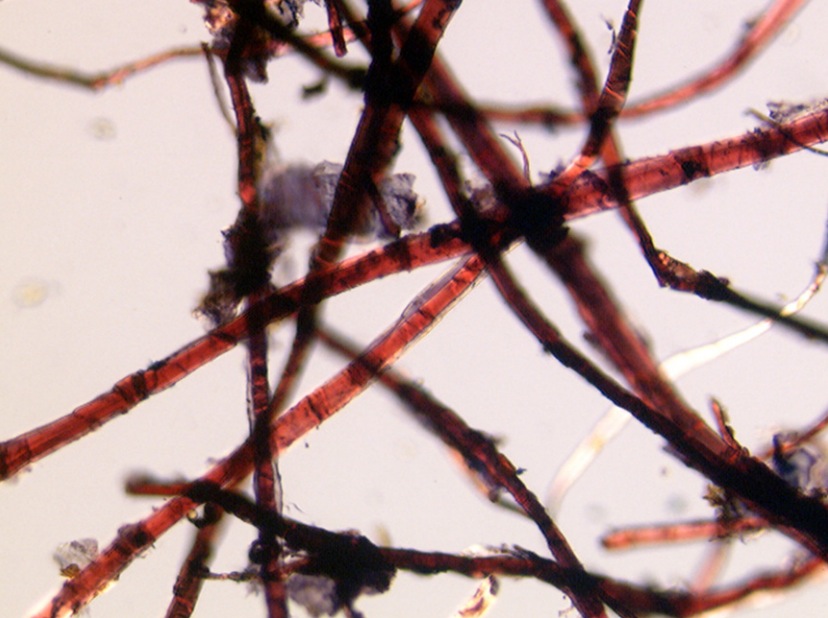
1. Paper mulberry (Broussonetia sp.) fibres stained with Herzberg stain, found in IOL Tib J 1560.
2. A large-size ‘floating’ mould, constructed with a wooden frame and attached woven textile, placed in water (a stream) in Gyantse, c. 1910–1920. Photo 1112/2 (139), © The British Library
3. The flower of the Daphne plant.
4. Sheets of paper left to dry on individual moulds on the mountain slope near Tawang, Arunchal Pradesh, 1914. MSS Eur/F157 (324), © The British Library.
*  *  *
Final Notes
Paper made from the Daphne and Edgeworthia species  is shog shing or dung lo main Tibetan. There is also a Tibetan paper made from the roots of both the Stellera chamaejasme species (re lcag pa in Tibetan) and, more seldom, Euphorbia fisheriana (re lcag gi rtsa ba in Tibetan). It has been suggested that re lcag pa is the “original” Tibetan paper. Though we did not find any of this paper in our study, finds from Tibet itself may help to confirm whether it was produced during the Tibetan imperial period or later. Also, it is hard not to oversimplify this complex research, and I had better clarify here (as we did in the article) that the rag paper in the Dunhuang manuscripts was also often made with the addition of Paper Mulberry and/or Hemp. Agnieszka Helman-Wazny’s continuing work on the Chinese manuscripts from Central Asia will no doubt add much more to our knowledge of Central Asian papermaking.
*  *  *
papermaking_tawang

Wednesday, 17 April 2013

53 New Books in the Digital Archive of Toyo Bunko Rare Books


The Toyo Bunko (Oriental Library) is a leading library in the field of Asian studies. Its collection amounts to 880,000 books of historical importance, and an especially interesting collection in the Toyo Bunko is "Morrison Library," which consists of 24,000 books about China and Asia written in several European languages. Regarding its relevance, scale and coverage, we decided to start our digital archive project from the Morrison Library, and initiated the digitization of precious books in 2002.
We are in the pursuit of two research directions. The first direction concerns the application of optical character recognition (OCR), machine translation and image processing for the automatic analysis of digitized documents. Our motivation behind this direction is the need for the management of large number of books; that is, we put more emphasis on speed in the speed and precision tradeoff in order to increase the number of books in the digital archive. Although the current OCR technology is imperfect, even imperfect results can support useful search. The second direction is the collaborative annotation environment for digital cultural resources. We begin with closed annotation by domain experts, but in the future we aim at establishing a mechanism for soliciting collective annotation in a collaborative environment.
User interface on the Toyo Bunko Portal is designed so that it suggests as many navigational links as possible to increase for a user the opportunity of browsing deep into the archive. We provide other mechanisms for defining various contexts in which digital archives are to be viewed using our proposed database engine. Finally, this project is within a framework of Digital Silk Road Project.


We added 53 new books to become the collection of 203 books, 59,358 pages.
  1. Im fernen Osten : vol.1
  2. Atlas zur Reiseroute in Ost-Asien : vol.1
  3. Mission archéologique dans la Chine septentrionale : vol.1
  4. Mission archéologique dans la Chine septentrionale : vol.2
  5. Mission archéologique dans la Chine septentrionale : vol.3
  6. Mission archéologique dans la Chine septentrionale : vol.4
  7. Mission archéologique dans la Chine septentrionale : vol.5
  8. Les documents chinois découverts par Aurel Stein dans les sables du Turkestan Oriental : vol.1
  9. Documents sur les Tou-kiue (Turcs) occidentaux : vol.1
  10. Un traité manichéen retrouvé en Chine : vol.1
  11. Les documents chinois de la troisième expédition de Sir Aurel Stein en Asie Centrale : vol.1
  12. Wall Paintings from Ancient Shrines in Central Asia : vol.1
  13. Wall Paintings from Ancient Shrines in Central Asia : vol.2
  14. China : vol.1
  15. China : vol.2
  16. China : vol.3
  17. China : vol.4
  18. China : vol.5
  19. Atlas von China : vol.1
  20. Atlas von China : vol.2
  21. Die Geographische-Wissenschaftlichen Ergebnisse meiner Reisen in Zentralasien, 1894-1897 : vol.1
  22. Scientific Results of a Journey in Central Asia, 1899-1902 : vol.3
  23. Scientific Results of a Journey in Central Asia, 1899-1902 : vol.4
  24. Southern Tibet : vol.1
  25. Southern Tibet : vol.2
  26. Southern Tibet : vol.3
  27. Southern Tibet : vol.4
  28. Southern Tibet : vol.5
  29. Southern Tibet : vol.6
  30. Southern Tibet : vol.7
  31. Southern Tibet : vol.8
  32. Southern Tibet : vol.9
  33. Southern Tibet : vol.10
  34. Southern Tibet : vol.11
  35. Southern Tibet : vol.12
  36. Meine Tibetreise : vol.1
  37. Meine Tibetreise : vol.2
  38. Reise in China und Tibet, 1905-1908 : vol.1
  39. Antiquities of Indian Tibet : vol.1
  40. Antiquities of Indian Tibet : vol.2
  41. 羽田博士史学論文集 : vol.1
  42. 羽田博士史学論文集 : vol.2
  43. Documente de l'Époque Mongole des XIIIe et XIVe Siècle : vol.1
  44. The Book of Ser Marco Polo : vol.1
  45. The Book of Ser Marco Polo : vol.2
  46. Ser Marco Polo : vol.1
  47. Marco Polo : vol.1
  48. Marco Polo : vol.2
  49. 圓明園東長春宮西洋樓圖 : vol.1
  50. India : vol.1
  51. Indische Palaste und Wohnhauser : vol.1
  52. Nouvelles recherches archéologiques à Bāmiyān : vol.1
  53. Shotorak : vol.1

Examining the Connection Between Ancient China and Borneo


Examining the Connection Between Ancient China and Borneo Through Santubong Archaeological Sites


by Wan Kong Ann,  Tsinghua University

Abstract
Historical relations between China and Borneo can be traced back two thousand years or more. This is explained by the fact that, although Borneo was not a destination of the highest importance for China, it was, nevertheless, the largest island in the Malay archipelago, and one whose strategic geographic position ensured that it had an economic role to play in regional trade. Borneo has in fact been a significant part of China’s orbit ever since the Chinese conquered the South China Sea.
Though there are few specific records, we can trace a little of what transpired in that history by looking at Maritime Silk Road records and reading about the travels of Admiral Zheng He. We can also gather historical information from the ancient Chinese history books to augment our understanding of the reasons that Borneo was never really a backwater region. And now, through archaeological studies carried out in the Niah Caves and at Santubong, Sarawak, we are slowly getting a clearer picture.

Introduction
Borneo is the third largest island in the world and the largest in the Malay Archipelago. On its western flank is the South China Sea, and far in the distance is the Middle Kingdom, China. Today Borneo consists of three different political entities, East Malaysia, which is made up of Sabah and Sarawak, Brunei Darussalam, and Kalimantan, Indonesia. 


In ancient times, it was referred to as “Poli” (婆利) in the history annals of China. It is difficult to trace records of Borneo in China, but not impossible if one digs deep enough. There are a number of small footnotes in China’s recorded history that, if collectively considered, suggest a picture of Borneo as it was in the past.
In the ancient records of China, Borneo crops up under various guises because it was at various times named “Poli (婆利),” “Boni (渤尼/渤泥/浡泥)” or “Polo (婆罗).” China and Borneo both possess a long history of recorded interactions. Thus if one were to travel through Borneo, one would still be able to see the Chinese influence clearly. For example, the Dayaks in Kalimantan and Sarawak treasure their family heirlooms: big gongs (tawak-tawak) and earthenware jars (tajau lama). On these can be found images of the dragon (“loong” totem 龙图 腾) that originates in China. Much like copper artillery and ancient chinaware, these big gongs, used mainly for dancing and ceremonial occasions, are a status symbol for the Dayak community.

Borneo in the annals of China
In the Song Shu (宋书 Liu Song History Annals), which was edited by Shen Yue (沈约, 441–513) during the Nan/Southern dynasty, are records concerning the Poli nation (婆利国). Liang Shu (梁 书 Liang Dynasty History Annals), Nan Shi (南史 History Annals of the Nan/Southern Dynasty), Bei Shi (北史 Bei/Northern Dynasty History Annals), Sui Shu (隋书 History Annals of the Sui Dynasty), Jiu Tang Shu (History Annals of the Old Tang Dynasty) and Xin Tang Shu (新唐书 History Annals of the New Tang Dynasty) all show records of the arrival of an emissary from the Poli nation to pay tribute to China (进贡). In the Song Shi (宋史 Song Dynasty History Annals), Borneo was called “Boni” (渤尼/渤泥), and in the Ming Shi (明史 History Annals of the Ming Dynasty), Borneo was also most often known as “Boni (浡泥).”

Most records authenticate the tale of the arrival of the emissary of the Poli nation with the object of paying tribute to the emperor of China...................

Source: Sino-Platonic.org 

Xingjiao temple seeks to preserve buildings


Watch Video

Play Video
The Xingjiao temple is one of the city’s best known sites. Recently the temple was advised to remove some of its surrounding buildings in order to stand a better chance of receiving UNESCO World Heritage site status.
With a history stretching back over 1300 years, Xingjiao temple is the burial place of many eminent individuals, including Xuanzang, a buddhist monk and Chinese pilgrim to India during the Tang dynasty.
Now, in its quest to become protected as a UNESCO World Heritage site, local authorities are planning to preserve the Xuanzang Stupa hall, but demolish most of its surrounding buildings, including the temple’s abstinence hall and the monk’s living quarters.
The Xingjiao temple is one of the city’s best known sites. Recently the temple was advised to
remove some of its surrounding buildings in order to stand a better chance of receiving UNESCO
World Heritage site status.
Master Kuanshu, Xingjiao Temple, said, "If these buildings in the temple are removed, the monks will have nowhere to live, eat or read Buddhist scriptures. Their daily rituals will be damaged. This is one of our top concerns."
Local authorities emphasize the demolished buildings will be replaced, in accordance with the law, with new structures, resembling the originals.
Zhang Ning, Director of Changan District Religions Dept. Xi’an, said, "According to relic protection law, no buildings are permitted within 30 meters of the protected relics. For example, this Sanzang house is very near to these pagodas, so it violates relic protection law."
The Xingjiao temple is one of the city’s best known sites. Recently the temple was advised to
remove some of its surrounding buildings in order to stand a better chance of receiving UNESCO
World Heritage site status.
Many monks in the temple believe it is good to apply for World Heritage status, but that their daily religious lives are also an important aspect of these relics.
As a result, on Thursday the temple proposed withdrawing itself from the application in protest against the planned demolition. Many experts have called for more discussion and consultation on protecting this famous Buddhist temple.
Having world heritage status can bring better conditions to preserve these pagodas in the long run. But during the application process and after, local authorities must find a balance between protecting relics and religious activities. The monks’ Buddhist way of life should be guaranteed, after all it is those who have been looking after these relics all these years.
The Xingjiao temple is one of the city’s best known sites. Recently the temple was advised to
remove some of its surrounding buildings in order to stand a better chance of receiving UNESCO
World Heritage site status.

The Xingjiao temple is one of the city’s best known
sites. Recently the temple was advised to remove some
of its surrounding buildings in order to stand a better
chance of receiving UNESCO World Heritage site status.


Editor:Zhang Pengfei |Source: CCTV.com

Famous emperor's tomb found in E. China

The tomb of one of the most famous emperors in Chinese history was discovered on Sunday at a construction site in Yangzhou, Jiangsu province, while a fake burial site has been a tourist attraction for many years.

Famous emperor's tomb found in E. China
The tomb of Yang Guang, an emperor of the Sui Dynasty (AD 581-618) [Credit: China Daily]
Archaeologists from all over the country rushed to Yangzhou and confirmed that the tomb found in Xihu township of Hanjiang district belonged to Yang Guang, who is considered to be one of the worst tyrants in Chinese history.

Generally, Chinese historians say Yang's tyranny brought the Sui Dynasty (AD 581-618) to an end. But he also completed several great construction projects during his reign, including the Grand Canal and the reconstruction of the Great Wall.

According to Shu Jiaping, director of Yangzhou's archaeological bureau, the inscription on a tablet found in the tomb proves that its owner was Yang.

"Yang's tomb wasn't even as luxurious as normal rich people's tombs in the Sui Dynasty, due to his sudden death when he fled revolts to Jiangdu, which is Yangzhou today," Shu said.

The tomb is only 4.98 meters long from north to south, and 5.88 meters long from east to west.

"Grave robbers had visited the tomb," Shu said. "Also, the roof of the tomb is not in good condition because some residential buildings were built above it."

Although the tomb had been robbed, four valuable articles that could be used only by ancient royal family members were found, including lion-shaped door knockers made of gold and iron, and a jade belt decorated with gold.

However, according to the local archaeological bureau, no remains or coffin parts have been found yet.

The discovery of the tomb turned out to be a happy surprise for people living nearby.

"We heard that construction workers continuously found bricks in the site, which they thought were from normal ancient tombs," said Zhou Jian, a resident. "It never occurred to me that I'm the neighbor of an ancient emperor, even if he was a notorious one."

Archaeologists also discovered another tomb nearby, which they say might belong to Yang's queen.

The discovery proves that another mausoleum, which is about 6 kilometers from the construction site and has been thought to be Yang's burial site since the Qing Dynasty (1644-1911), is a fake, Shu said.

Compared with the tomb discovered, the "fake mausoleum" occupies an area of 30,000 sq m and has magnificent memorial arches, tomb doors and walls.

Author: Cang Wei and Song Wenwei | Source: China Daily [April 16, 2013]