Showing posts with label Aurel Stein. Show all posts

Thursday, 29 March 2012

Sir Aurel Stein "Collegues and Collections"


Edited by Helen Wang
British Museum Research Publication 184
ISBN 978-086159-1848
© The Trustees of the British Museum 2012


Line drawing of a seal of Pallas Athene
This volume, published to mark the 150th anniversary of the birth of Sir Aurel Stein, presents papers about him, his colleagues and his collections.


Read the introduction (pdf) 
Helen Wang, curator, East Asian Money,
British Museum
Follow the links below to download and read
the full publication.


On Stein, his work and colleagues


Aurel Stein’s Calcutta Connection (pdf)  
Susmita Basu Majumdar, Suchandra Ghosh, Anusua Das

Rai Bahadur Lal Singh: Sir Aurel Stein’s Surveying Companion (pdf) 
Daniel Lal Sander and Stephen Sander (Sukwant Singh)

Recent work on the Stein Collections

Dunhuang Textiles in London: A History of the Collection (pdf) 
Helen Wang, Helen Persson and Frances Wood


Saturday, 24 March 2012

Photo's from Old China


Greatwall China [1907] Herbert G. Ponting [RESTORED]
Group Of Chinese Women With Fans, Canton, China [c1880] Afong Lai [RESTORED]
Yen's Soldiers, Militarism In China, Here Are Specimens Of The Soldiery Who Protect The People By Dominating Them, Who Protect Property By Looting It, Liao Chow, Shansi, China [c1925] IE Oberholtzer (probable) [RESTORED]
Chinese Family [c1875] Attribution Unk [RESTORED]
Boxer Prisoners Captured By 6th US Cavalry, Tientsin, China [1901] Underwood & Co [RESTORED]
Beggars, Beihai Park [c1917-1919] Sydney D. Gamble [RESTORED]


From: Ralphrepo in Random Pics from Old China


"Pics in this set are those that were taken from the Pre Deng XiaoPing period (that is, any pic taken in China or of the Chinese diaspora, before the death of Mao). All pictures are restored, meaning that they were digitally corrected to either enhance viewing ability, or to correct defects from historic damage. In no instance were any alterations performed to change the perception of political or social history that the image would otherwise convey. These photographs are posted purely to stimulate and educate the public, and to further knowledge, interest and discussion of Chinese history. All images in this collection were found on the internet; either in public, private or commercial web pages or galleries. I have also tried, to the best of my ability, to provide working links to the original non restored image sources so that viewers have a point of comparison should they so desire. To the best of my knowledge and research, the images themselves are either out of copyright (in the United States) or collected and posted under fair use rules for strictly non commercial purposes".  Ralphrepo

Tuesday, 17 January 2012

An unrecognized photo of Aurel Stein

From: Chinese Manuscripts, a blog by Imre Galambos

Last week we went down for a few days to the south of Hungary and while there I wanted to see at a village called Gádoros, near Orosháza, the “museum” of Zsigmond Justh (1863-1894), a talented Hungarian writer who died too young to fulfill his early promise. He was a close friend of Lionel Dunsterforce (1865-1946), the later major-general, after whom R. Kipling modelled the character Stalky in his book Stalky and Co. (Dunsterville later used this name in the title of his own memoirs: Stalky’s Reminiscences, London: 1928.) Justh visited Dunsterville in 1892 in Mian Mir where the Englishman was stationed at the time. It is here that he met the young Aurel Stein who was working at the Oriental College in Lahore. Following their acquaintance, Stein wrote a number of very warm letters to Justh and in the following summer even visited him at his estate in Szenttornya, not far from Gádoros where his museum is today. Although Justh died the following year (1894), Stein and Dunsterville corresponded for decades (at the Hungarian National Library there are letters from Dunsterville to Stein from 1941). In the two small rooms of the museum (or rather, exhibition) there are lots of photographs and letters. Among the material related to his trip to India, there is a group photo where the bearded Justh sits on a chair, holding a tea cup on his knee. The caption reads, “With his friends in India — next to him is Lionel Dunsterville.” But on the left side, we can see the standing figure of the young Aurel Stein. This is a rare photo from this early period of Stein’s life, long before he became a celebrated explorer. The photo must date to December 1892, when Justh was visiting.

Friday, 2 December 2011

Dissolving

From Poemas del Rio Wang

Roman bridge above the Wadi al-Murr near Mosul, Iraq. Photo by the German archaeologist Max von Oppenheim researching the ancient city of Tell Halaf, 1920s.First publication: National Geographic, November 2009

Roman bridge, Eski Mosul, with policeman on the right. Cat. Stein LHAS Photo 23/1 (38) Photo by the Hungarian-British archaeologist Aurel Stein reconstructing the route of Alexander the Great in Persia, 1930s. First publication: the Aurel Stein site of the Library of the Hungarian Academy of Sciences prepared by us, April 2008.

Digging through the Directors' Correspondence: Letters from Aurel Stein

Digging through the Directors' Correspondence: Letters from the Archaeologist M. Aurel Stein
By: Virginia Mills - 02/11/2011

From the website of Kew Royal Botanical Gardens

Read about our trip to the British Library's International Dunhuang Project, the amazing scrolls discovered by archaeologist M. Aurel Stein, and some of Stein's letters that we recently unearthed from the Kew's Directors' Correspondence archive collection.


Recently, the Directors' Correspondence team decamped to the British Library to see some of the material they hold on the Danish botanist Nathaniel Wallich, which has been digitised as part of a collaborative project with RBG Kew and other institutions. Watch out for more news and blogs on the Wallich and Indian Natural History project coming soon.

We were also lucky enough to visit the International Dunhuang Project: a collaborative project digitising manuscripts and artefacts from Dunhuang and other sites on the Silk Road. This well established project has partners in China, Japan, Germany, Korea, Russia, France, USA, Sweden, India, Ireland and the UK allowing related but widely dispersed historical documents, photographs and relics, and treasures of all kinds to be brought together into a single digital collection of over 322,000 images and still growing!

Bundles of manuscript rolls from the walled-up temple library, Dunhuang. Digitised by the International Dunhuang Project. © The British Library.

Sir Marc Aurel Stein

At the beginning of the 20th century archaeologists began to excavate numerous sites along the Silk Road that had long been buried under the desert sands. One such archaeologist was Aurel Stein (1862 to 1943). His most famous acquisitions came from the 'Library Cave' at Dunhuang, and include the Diamond Sutra, the world's oldest dated printed book (A.D. 868). The British Library's Stein collection contains over 45,000 manuscripts as well as paintings and photographs taken by Stein on his travels all over central Asia.

Photograph taken by Stein in March 1908 of him and his researchers (and his dog Dash II) at Ulugh-mazar, China. Digitised by the International Dunhuang Project. © The British Library.

Letters from Stein in the Directors' Correspondence

Inspired by our trip to the British Library we looked up Stein within our very own DC collection and found a rather more modest two documents, which we thought were interesting none the less.
The letters from Stein in the DC collection date from October 1903 and concern ancient cereals which Stein found preserved within the ruins of ancient dwellings at Khotan, buried under drift sand in the Taklamakan desert. He explains that documents from the same site have allowed him to determine that the ancient city was ruined at about A.D. 269. Stein is interested to know whether the historic cereals are materially different from those grown in the area in the 20th century. Stein's labourers, from the nearest Oasis towns, had no difficulty in recognizing all but one of the cereals. This one was however familiar to one of Stein's party from the Kangra district in India, who identified it as a root used as a condiment. The fact that there was an Indian man within Stein's own party who recognised this condiment, apparently from an Indian plant, which Stein was digging up in China over 1500 years later, is just one small but striking illustration of how far reaching was the trade that once brought exotic commodities along the Silk Road.

Extract taken from a descriptive list enumerating the ancient cereal grains found by Stein and sent to Kew for identification. Annotations on the right hand side show that the experts at Kew identified one of the cereals as Panicum miliaceum, a form of millet still grown for livestock feed today. © RBG, Kew

Stein also enquired of Kew whether there was any truth to the stories that wheat had been grown from ancient seeds found in Egyptian tombs. If you are interested in finding out whether these enduring stories are fact or legend you can read the answer given by Kew's experts at the Millennium Seed Bank: how long can seeds live?

- Virginia -

Thursday, 1 December 2011

Niya: "The Pompeii of the East"

When Aurel Stein first uncovered the vestiges of a once thriving kingdom along the Niya River deep in the Taklamakan, he described it as 'The Pompeii of the East.' But although the ancient Romans and the people of Cadota - the name of the Niya kingdom - shared a love of the grape, the sites are very different. Life in Pompeii was arrested by the lava. The sands of the Taklamakan, while no less invidious, invaded over time. There are cemeteries at Niya but the living community had already left before the sands seeped in.

Working in collaboration with the Xinjiang Institute of Archaeology, the IDP team has just returned from Niya and the documentary photographs and videos showing many of the sites of Niya - and the caravanserai of Karadong - will be soon start becoming available online on IDP and HERE.

Saturday, 5 November 2011

Fragments from a Dead City

Again from one of my favorite blogs "Babelstone"

The remains of the Tangut fortress city known in Mongolian as Kharakhoto "Black City" and in Chinese as Heishuicheng 黑水城 "Black Water City" are located on the edge of the Gobi desert in the far west of Inner Mongolia (41° 45′ 51.50″N, 101° 08′ 38.00″E). It was a major military outpost of the Western Xia regime until it was captured by Genghis Khan in 1226. The city remained under Mongolian control until it was taken by the army of the newly established Ming dynasty in 1372, after which it was abandoned.

Photograph of the Ruins of the city of Kharakhoto by Aurel Stein

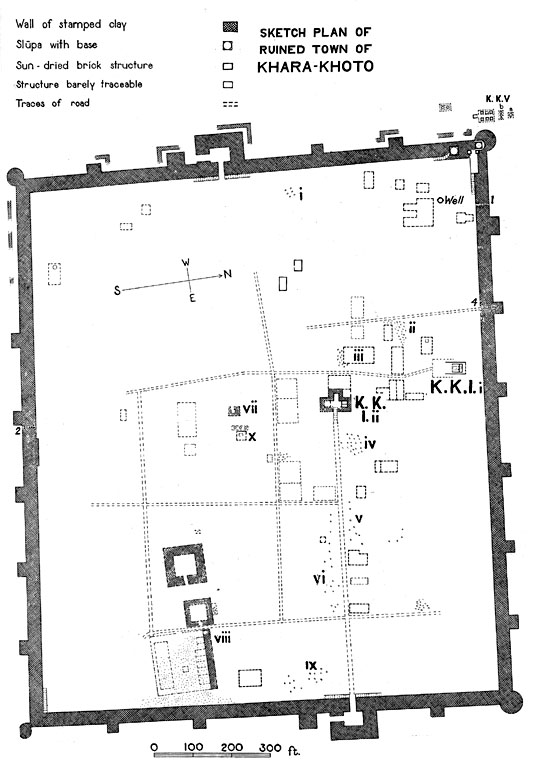
Kharakhoto from the sky (cf. Stein's plan of Kharakhoto)

When the Russian explorer Pyotr Kozlov stumbled upon the ruins of the city in 1907–1909 he found hundreds of books and documents written in the Tangut script, mostly hidden inside a stupa, including such important works as the Tangut dictionary, the Sea of Characters (文海).
But by the time that Aurel Stein came to visit Kharakhoto during his expedition of 1913-1916 there was not much left, and he was reduced to searching through rubbish tips and looking down wells. Although he didn't find any complete Tangut texts such as Kozlov had, he did manage to recover a great number of fragmentary scraps of paper with Tangut writing, some 4,000 of which are now held at the British Library (enter "Kharakhoto" in the search box to see some examples).
Among the scraps of paper that Aurel Stein recovered from a rubbish tip in the ruins of Kharakhoto are two insignificant and rather uninspiring strips of paper covered with irregular black marks which are now held at the British Library, catalogued as Or.8212/1142 and Or.8212/1144 :


By themselves they do not seem to have very much to offer, but when you join the two fragments together (Or.8212/1144 on the left, and Or.8212/1142 on the right) the black marks magically resolve into a relatively clear line of Phags-pa text :


It is not very much, but it is the only certain example of the Phags-pa script that I have been able to find in the entire online collection of the International Dunhuang Project (there are other more impressive examples of Phags-pa manuscripts, and even a fragment of a printed text, in the Berlin Turfan Collection, but these are not yet in the IDP database). Incidentally, although there is such a paucity of Phags-pa material in the British Library's Dunhuang collection, the library does hold the only known copy of what I would argue is the single most important Phags-pa text in existence, the Phags-pa Chinese rhyming dictionary Měnggǔ Zìyùn 蒙古字韻 (Or. 6972).

The top lefthand edge of the joined strips is still cut off, and I have been unable to locate a matching strip of paper in the British Library collection. However, even with this defect the text is still perfectly legible, comprising four Phags-pa syllables, reading ti khung ·an tu ꡈꡞ ꡁꡟꡃ ꡖꡋ ꡈꡟ :


According to Měnggǔ Zìyùn, there are 49 Chinese characters that are spelt ti, 12 characters that are spelt khung, 4 characters that are spelt ·an, and 38 characters that are spelt tu (the Phags-pa script does not distinguish tone, so Měnggǔ Zìyùn separates Chinese characters with the same Phags-pa spelling into groups based on their tone in Classical Chinese: level tone [平聲], rising tone [上聲], falling tone [去聲], and entering tone [入聲]) :


ꡈꡞ ti Level tone characters: 嗁啼遆蹄折提題媞綈稊醍禔鵜荑緹騠
Rising tone characters: 弟娣悌遞
Falling tone characters: 弟第遰提髢締{⿰目帝}(!)悌娣禘棣杕踶題遞逮地
Entering tone characters: 狄荻敵籊翟覿笛籴糴滌踧頔
ꡁꡟꡃ khung Level tone characters: 空箜崆悾倥(倥侗颛蒙)
Rising tone characters: 孔倥悾
Falling tone characters: 控倥空鞚
ꡖꡋ ·an Level tone characters: 安鞌
Falling tone characters: 按案
ꡈꡟ tu Level tone characters: 徒屠瘏塗途酴駼荼圖菟(?)
Rising tone characters: 杜肚土
Falling tone characters: 渡斁鍍度
Entering tone characters: 獨讀黷讟髑殰櫝牘韥瓄瀆犢匵毒蝳宊揬纛腯堗鈯

This would theoretically give 49 × 12 × 4 × 38 = 89,376 possibilties for the four-syllable phrase ti khung ·an tu, but actually there is only one permutation that makes any real sense in this context: tí kòng àn dú 提控案牘, which is the title of a minor official in charge of official documents at the local government office during the Yuan dynasty (see Charles O. Hucker, A Dictionary of Official Titles in Imperial China (Stanford University Press, 1985) #6453: "tʼí-kʼùng àn-tú 提控案牘 or tʼí-kʼùng YÜAN: lit., in charge of files: Record Keeper, a lowly or unranked clerical worker commonly found in both central government agencies and units of territorial administration"). The lettering appears to be printed on the paper rather than handwritten, so this was perhaps a stamp that was used by this official sometime during the Mongolian occupation of Kharakhoto between 1226 and 1372 (though of course it must post-date the invention of the Phags-pa script in 1269).