Thursday, 17 November 2011

Deciding Between Heritage and Hard Cash in Afghanistan

Many in Afghanistan hold that the country's future lies underground, in vast mineral deposits with the potential to boost the country's economy for decades. Nowhere is that more true than Mes Aynak. The ancient mine, 30 km south of Kabul in Logar province, is believed to be the world's second largest untapped copper source. According to Afghanistan's Mining Ministry, the site is worth tens of billions of dollars at today's prices. Extracting the metal could deliver thousands of jobs and $1.2 billion in revenue a year to a country in desperate need as international assistance dries up ahead of the planned U.S. and NATO withdrawal in 2014.
Copper, however, is not the only treasure at Mes Aynak. Archaeologists are also excavating an ancient Buddhist temple complex located on top of the deposits. It has so far yielded manuscripts, Buddha statues and stunning ancient architecture. The discovery rivals Machu Picchu in terms of historic import, says Philippe Marquis, a French archaeologist overseeing the project, and could also rewrite the history of Buddhism and the Silk Road.

In a reversal of the theory that religious centers grew up alongside but separate from commercial activity, Marquis and his team suspect that in Mes Aynak, religious leaders may have actually directed copper mining and refining and used the monastery network to trade the metal as far away as Japan and Korea. "People always talk about the Silk Road," says Marquis. "What if it was the Copper Road or the Buddhist Road that established trade across the region?"
The clock, however, is ticking. The Chinese-government-backed China Metallurgical Group Corp., which successfully bid on the mine in 2007, wanted to start mining in '09. The work will destroy the temple complex, so the group agreed to a three-year pause for a basic excavation. The short window is emblematic of the difficult compromises that must be made as Afghanistan struggles to balance financial and cultural concerns. "I don't think anyone can argue with the fact that the Buddha statues would last far longer than copper in terms of generational value," says Laura Tedesco, an archaeologist and manager of the U.S. embassy's cultural-heritage programs. "But the needs of the country right now are in the revenue from the mine."

Mes Aynak's more recent history is less glorious than its ancient past. The hidden valley, located at the end of a dusty road that zigzags past rocky hills streaked with chalky green stains of oxidizing copper, was once an al-Qaeda training ground. No one has found graffiti from Osama bin Laden yet, but most archaeologists familiar with the site agree that the terrorist group, among others, looted statues to sell on the international antiquities black market. According to a recent article in the Journal of Art Crime, Mohammad Atta, the lead hijacker in the 9/11 terrorist attacks, attempted to sell looted artifacts from Afghanistan to a German archaeologist in order to fund his Florida flight training.
The irony is that although the Chinese mine will eventually destroy the archaeological site, it has contributed to the protection of its artifacts. "We have enough examples of other Buddhist sites in Afghanistan destroyed because of looting, ignorance and lack of care," says Marquis. But because of the international attention brought to Mes Aynak in the wake of the Chinese bid, archaeologists now have some $50 million from the World Bank, USAID and other foreign donors to invest in excavation and the construction of a nearby interpretive museum. Security for the mine also helps protect the archaeologists, and the site, from nearby insurgents. Besides, Marquis adds, the ancient mud construction materials and unbaked-clay statues would not last long exposed to the Afghan elements. "The fact is that preservation in situ would be impossible."

If Marquis's theories are correct, copper once made Afghanistan the hub of central Asian trade. And if he and his team of archaeologists dig fast enough, Mes Aynak could yet restore some of Afghanistan's regional luster, not just in copper, but in culture as well.

Source: Time

Rome presents the treasures of Dvin, the medieval capital of Armenia


November 15, 2011. (Romereports.com)
Twenty years ago, Armenia gained independence from the Soviet Union. To remember this event, Rome has opened its doors to an elaborate exhibition on the city of Dvin, the capital of Armenia between the fifth and ninth centuries.

“It was we used to say the capital linking West and East, and it was the capital of the silk road. The Armenian historian Shirakavan, as I mentioned in my speech, there were six commercial roads going out from the city linking to the silk road and to different parts of the world.”

Dvin had 150,000 inhabitants and was an important trade center during medieval times. But in the year 893 an earthquake destroyed the city. The only thing to survive were different works of art and a memory of the city.

These works of art gives a sense of greatness the society held, displayed by these glass plates and ceramics, crucifixes and pots made of silver and bronze, as well as old coins from the time period and tapestries that tell the life of Christ.

One in particular shows two chapters of the crucifixion and a model of a church sculpted in stone. A bible from the fifth century is also presented, which was the first book written using the Armenian alphabet.

Rouben Karapetian
Ambassador of Armenia to Italy

“We wanted to present a small part of the heritage and the high level of the culture that existed. An art in ceremonies, in a manuscript, in the frescoes and in carpet as you have seen the one 'govelen' of the 8th century of the Armenian Apostolic Church. Armenia is the first Christian nation in the world, we adopted Christianity in 301. We are also proud to have our small part of some artifacts of the Armenian Church.”

During the inauguration, traditional music was played with an Armenian flute called a 'duduk'. The exhibition is open to the public until January 29, 2012 and is expected to host the President of Armenia in a few weeks.

Lights, camels, action as 'Traveling the Silk Road' exhibit rides into Taipei


A once-in-a-lifetime chance to visit the world-changing Silk Road has arrived in Taiwan, as a special exhibition teleports visitors on an adventure through the ancient pathway beginning in Taipei, today.

Originally exhibited in the New York City-based American Museum of Natural History in Summer 2010, the “Traveling the Silk Road” (穿越時空-絲路行特展) exhibition reached Taipei's National Taiwan Science Education Center (國立台灣科學教育館), and will be open to the public for three months, until Jan.29 2012.

Measured to 7,400 kilometers in length, the Silk Road was the most important ancient route for cultural, religious, commercial, scientific and artistic exchanges between the East and the West, beginning as early as 1,600 years ago.

“We are excited that the exhibition could take place in Asia,” Presston Brown, manager of the American Museum of Natural History's Global Business Development Department Traveling Exhibition Operations, said yesterday, surrounded by duplicates of ancient artifacts and life-sized stuffed camels.

Having taken two years to plan, the exhibition is inclusive, with knowledge on all 7,400 kilometers of the pathway provided, and major cities along the way getting specific focus.

Just as in real life, an epic journey along the Silk Road exhibition brings visitors from Xian, featuring silk products from the Tang Dynasty and music from ancient instruments, through Turfan, where treasures from night markets stoke imagination, on to Samarkand, where an interactive map table showcases the geographical, technological, and cultural specialties along the Silk Road. Visitors eventually arrive at Baghdad, where amateur astronomers may operate a replica of an ancient Islamic astrolabe model.

For its educative nature and interactive setup, the exhibition had been a great hit in NYC, Brown said, and the original exhibitors are eager to see what new knowledge of the Silk Road the exhibition could bring to those from the East and are descendents of those who had passed knowledge down, and vice versa.

Echoing Brown's comments, National Taiwan Science Education Center Director-General Chu Nan-shyan (朱楠賢) encouraged visitors from all age groups to experience the interdisciplinary wisdom from thousands of kilometers away and 16 centuries ago, from today through Jan. 29, 2012.

Source: Chinapost

Mongolian Studies Open Conference

Mongolian Studies Open Conference

25 November 2011, 9:00am - 5:15pm
Hedley Bull Centre (130), Garran Road,
Australian National University, Canberra

Sponsored by the Mongolian Studies Centre, Australian National University and generously supported by the Mongolian Embassy in Australia

» Program schedule & abstract
» MOSOC promotional flyer

The MOSOC is a multi-disciplinary conference which provides a forum for the presentation of new research on Mongolia and Mongols in Australia. The conference provides an opportunity for scholars with interests in Mongolia to meet, to hear each other's work and to exchange ideas and information. It emphasizes interaction between younger and established scholars and between Mongolists and those with a comparative interest in Mongolian Studies. The conference is open to all. There is no registration fee.

Tuesday, 15 November 2011

Monday, 14 November 2011

Ancient bronze artifact from East Asia unearthed at Alaska archaeology site

Artifact resembles small, broken buckle, could have been horse ornament

University of Colorado, November 14, 2011

A team of researchers led by the University of Colorado Boulder has discovered the first prehistoric bronze artifact made from a cast ever found in Alaska, a small, buckle-like object found in an ancient Eskimo dwelling and which likely originated in East Asia.

The artifact consists of two parts -- a rectangular bar, connected to an apparently broken circular ring, said CU-Boulder Research Associate John Hoffecker, who is leading the excavation project. The object, about 2 inches by 1 inch and less than 1 inch thick, was found in August by a team excavating a roughly 1,000-year-old house that had been dug into the side of a beach ridge by early Inupiat Eskimos at Cape Espenberg on the Seward Peninsula, which lies within the Bering Land Bridge National Preserve.

Both sections of the artifact are beveled on one side and concave on the other side, indicating it was manufactured in a mold, said Hoffecker, a fellow at CU-Boulder's Institute of Arctic and Alpine Research. A small piece of leather found wrapped around the rectangular bar by the research team yielded a radiocarbon date of roughly A.D. 600, which does not necessarily indicate the age of the object, he said.

"I was totally astonished," said Hoffecker. "The object appears to be older than the house we were excavating by at least a few hundred years."

Hoffecker and his CU-Boulder colleague Owen Mason said the bronze object resembles a belt buckle and may have been used as part of a harness or horse ornament prior to its arrival in Alaska. While they speculated the Inupiat Eskimos could have used the artifact as a clasp for human clothing or perhaps as part of a shaman's regalia, its function on both continents still remains a puzzle, they said.

Since bronze metallurgy from Alaska is unknown, the artifact likely was produced in East Asia and reflects long-distance trade from production centers in either Korea, China, Manchuria or southern Siberia, according to Mason. It conceivably could have been traded from the steppe region of southern Siberia, said Hoffecker, where people began casting bronze several thousand years ago.

Alternatively, some of the earliest Inupiat Eskimos in northwest Alaska -- the direct ancestors of modern Eskimos thought to have migrated into Alaska from adjacent Siberia some 1,500 years ago -- might have brought the object with them from the other side of the Bering Strait. "It was possibly valuable enough so that people hung onto it for generations, passing it down through families," said Mason, an INSTAAR affiliate and co-investigator on the Cape Espenberg excavations.

The Seward Peninsula is a prominent, arrowhead-shaped land mass that abuts the Bering Strait separating Alaska from Siberia. The peninsula was part of the Bering Land Bridge linking Asia and North America during the last ice age when sea level had dropped dramatically, and may have been used by early peoples as a corridor to migrate from Asia into the New World some 14,000 years ago.

The artifact was discovered in August by University of California, Davis, doctoral student Jeremy Foin under 3 feet of sediment near an entryway to a house at Cape Espenberg. Other project members included Chris Darwent of UC Davis, Claire Alix of the University of Paris, Nancy Bigelow of the University of Alaska Fairbanks, Max Friesen of the University of Toronto and Gina Hernandez of the National Park Service.

"The shape of the object immediately caught my eye," said Foin, who spotted the soil-covered artifact in an archaeological sifting screen. "After I saw that it clearly had been cast in a mold, my first thought was disbelief, quickly followed by the realization that I had found something of potentially great significance."

The CU-led excavations are part of a National Science Foundation-funded project designed to study human response to climate change at Cape Espenberg from A.D. 800 to A.D. 1400, a critical period of cultural change in the western Arctic, said Mason. Of particular interest are temperature and environmental changes that may be related to Earth's Medieval Warm Period that lasted from about A.D. 950 to 1250.

"That particular time period is thought by some to be an analog of what is happening to our environment now as Earth's temperatures are rising," said Mason. "One of our goals is to find out how these people adapted to a changing climate through their subsistence activities."

The Cape Espenberg beach ridges, wave-swept deposits made of sand and sediment running parallel to the shoreline that were deposited over centuries, often are capped by blowing sand to form high dunes. The Cape Espenberg dwellings were dug into the dunes and shored up with driftwood and occasional whale bones.

The team is examining the timing and formation of the beach ridges as well as the contents of peat and pond sediment cores to help them reconstruct the sea-level history and the changing environment faced by Cape Espenberg's settlers. Information on past climates also is contained in driftwood tree rings, and the team is working with INSTAAR affiliate Scott Elias, a University of London professor and expert on beetle fossils, who is helping the team reconstruct past temperatures at Cape Espenberg.

While the hunting of bowhead whales was a way of life for Inupiat Eskimos at Barrow and Point Hope in northwestern Alaska 1,000 years ago, it is still not clear if the Cape Espenberg people were whaling, said Mason. While whale baleen -- a strong, flexible material found in the mouths of whales that acts as a food filter -- and a variety of whale bones have been found during excavations there, the sea offshore is extremely shallow and some distance from modern whale migration routes. However, there is evidence of fishing and seal and caribou hunting by the group, he said.

The Inupiat Eskimos are believed to have occupied Cape Espenberg from about A.D. 1000 until the mid-1800s, said Hoffecker. They are part of the indigenous Eskimo culture that lives in Earth's circumpolar regions like Alaska, Siberia and Canada.

The Cape Espenberg site has yielded a treasure trove of several thousand artifacts, including sealing harpoons, fishing spears and lures, a copper needle, slate knives, antler arrow points, a shovel made from a walrus scapula, a beaver incisor pendant, ceramics, and even toy bows and toy harpoons. The bronze artifact unearthed in August is currently under study by prehistoric metallurgical expert and Purdue University Assistant Professor H. Kory Cooper.

Two New Shows of Asian Art Open at the Freer Gallery

A silver Chinese box in the shape of a flower, Tang Dynasty, late 7th to early 8th century. Photo courtesy Freer and Sackler Galleries.

A delicately painted Korean wine pitcher, from the late 12th century. A massive marble Chinese burial platform, originally carved around 550 AD. An ornately decorated clam-shaped silver box, which was an elite Chinese household’s treasure in the seventh century. Through these treasures and many others, two new exhibits at the Freer Gallery trace the evolution of artwork in Asia over the course of centuries.

“Cranes and Clouds: The Korean Art of Ceramic Inlay” features a range of stoneware vessels from the 11th through 16th centuries that exemplify one of the chief characteristics of Korean art from the era: the technique of inlay, known in Korean as sanggam. “Sanggam was one of Korea’s great contributions to worldwide ideas of ceramic decoration,” says Louise Allison Cort, who curated the exhibition.

The technique was an entirely novel way of embellishing ceramic art, typically used for tableware and ceremonial vessels. “Inlay involves carving design into the soft clay just after the vessel is formed, and then, with a small brush, using a liquid material to fill in the grooves,” says Cort. At the exhibition, the inlay decoraions seem to glow from deep within. Rather than appearing as surface decorations, the centuries-old intricate designs are crisp, as though created yesterday.

A kundika water bottle with inlay waterscape motifs, Goryeo perod, late 12th to early 13th century. Photo courtesy Freer and Sackler Galleries

The variety of jugs, bowls, plates and ornaments in the show demonstrate the many different decorative motifs. A featured item is an elegantly shaped water bottle known as a kundika. “It’s a perfect example of how glaze is combined with inlay color to create a landscape on the surface of the vessel,” says Cort. “You see a little world created there: water, ducks, plants, reeds and lotuses.”

In an adjacent gallery, the exhibition, “Silk Road Luxuries From China,” examines the exchange of luxury goods and artistic concepts that moved along the “Silk Road,” a trade route that linked China to Central Asia during the Tang dynasty (618-907 AD). During the era, stability and prosperity brought about an interest in outside cultures and tastes across Central Asia, resulting in the fusion of artistic styles.

A silver bowl, at the center of the show, was excavated in China, but its inscriptions lead scholars to believe it was originally made by the Sogdian people, who lived in what is now Uzbekistan or Kazakhstan. “The appearance of objects like this in China would have been earth-shattering, revolutionary,” says J. Keith Wilson, the curator of the show. “Because at the time, bronze was the medium of choice.”

Soon, though, the arrival of items like this triggered a change in Chinese tastes, as they adopted gold and silver. ”Rather than import everything, they learned the techniques and employed them in their own way,” Wilson says. An array of elaborately designed silver boxes and bowls show the combination of foreign techniques with traditional Chinese motifs.

The exhibition also features a remarkable object that exemplifies the reverse: adaptation of Chinese cultural practices by Sogdian peoples in China. A large marble slab, purchased by the museum’s founder Charles Lang Freer in New York City in 1915, had long been a mystery. “When he bought it, it was unclear exactly what it was,” says Wilson.

But when matching pieces surfaced in other museums, experts realized its function: despite the Sogdian designs, the elements actually fit together to form a large funerary couch, a platform used beneath the coffin in traditional Chinese burial. “It combines Buddhist elements on the bottom part with these non-Chinese musicians and dancers on the side,” Wilson says.

The priceless artifacts shed light on the cultural forces that helped shape trends in classical Asian art over time. “This is not simply a China story,” says Wilson. “It’s a bigger, international story.”

“Cranes and Clouds: The Korean Art of Ceramic Inlay” and “Silk Road Luxuries From China” are on display indefinitely at the Freer Gallery.

A Piece of Xiongnu History on Display


UB Post, November 15, 2011 by Tilovalo
Time changes everything. It’s known that time leaves its traces on all things, as they begin to fade or are broken.
However, if you go far enough back in time, there reaches a point when archeological findings tell us not only about history, but are also considered as art.
The Treasures of Xiongnu exhibition, which opens at the National Museum of Mongolia is one such example.
The exhibition runs from July 2011 to December 2011 and in it you can see more than 100 findings related to the Xiongnu, such as vases, horsewhips, cauldrons, and teapots.

Xiongnu is a multi-ethnic nomadic grouping from Central Asia, which existed between about 300 B.C. and 450 A.D. The Xiongnu were based in what is now Mongolia, and frequently raided south into China. They were such a threat that the first Qin Dynasty emperor, Qin Shi Huang, ordered the construction of huge fortifications along the northern border of China - fortifications that later were expanded into the Great Wall of China.
Scholars have long debated the ethnic identity of the Xiongnu: Were they a Turkic people? Mongolian? Persian? Or some mixture?
But more than 5000 archeological findings have been found in Mongolia, especially from Arkhangai, Khovd aimag. The name Xiongnu may be cognate to the name Huns(in Mongolian “People”), but the evidence for this is controversial.
The first modern excavations of Xiongnu sites were undertaken by Iu. D. Tal'ko-Gryntsevich between 1896 and 1902 in the south of Buryat, near the border with Mongolia.
He identified and drew at schematic maps of many of the important Xiongnu cemeteries, which have subsequently been the focus of work by Russian and Buryatian archaeologists.
His tomb excavations, while far from meeting any modern standards, uncovered numerous artifacts, and he provided the earliest drawing of the surface structure of a square ramped Xiongnu tomb.
Perhaps most famous Xiongnu tombs are those at Noyon uul (Noin Ula), the mountain in north central Mongolia, a site first identified in 1912 and then first excavated beginning in 1924 under the supervision of S. A. Kondrat'ev and S. A. Teploukhov, who were part of the Tibeto-Mongolian expedition led by the famous Russian explorer Pyotr Kuzmich Kozlov.
The remarkable achievement of the first excavations at Noyon uul was the retrieval of a wide range of organic materials, which had been preserved thanks to the tombs having been flooded.
The Noyon uul burials of Xiongnu elite were nested in wooden chambers, hung with textiles. Many items of clothing were preserved.
A Chinese lacquer ware cup with a date of 4 CE provided a terminus post quem for one of the graves.
Excavations at Noyon uul were resumed by Mongolian expeditions led by Kh. Perlee and Ts Dorjsuren in the mid-1950s.
A joint project involving the well-known Siberian archaeologist Natalya Polos'mak has continued work at Noyon uul in recent years.
A selection of the Noyon uul finds may be viewed today in the Hermitage Museum in St. Petersburg and in the National Museum of Mongolian History in Ulaanbaatar.
In 2007 and 2008, the Silkroad Foundation and National Museum of Mongolian History worked in the Khovd region of western Mongolia. The excavation in 2007 focused on one major elite grave in at Takhiltin-khotgor, a cemetery a flat area between two river valleys: the Khoit (North) Tsenkher River and the Dund (Middle) Tsenkher River in Manhan sum, the site had earlier been studied by Ts. Dorjsuren and D. Navaan, and a number of satellite burials and ritual features, which shed new light on the nature of tomb complexes.
National Museum of Mongolia, Juulchin Street -1, POB 332
Ulaanbaatar.

Fan Jinshi, Lady of the Grottoes

ShanghaiDaily.com, 11 november 2011
A young woman with short-cropped hair looks up at the sky and places her left fist over her heart. A travel bag on her shoulder and cap trailing in her hand, she's ready for whatever comes.
She is the statue titled "Youth" standing at the entrance to the Dunhuang Academy, the institution in charge of protecting and researching the famous Mogao grottoes in the deserts of Gansu Province in northwest China.
The model for the sculpture - in her younger days - is the academy's president, 73-year-old Fan Jinshi, who arrived at Dunhuang at the age of 25. That was in 1963. She was ready for the daunting task of protecting the ancient, fading, crumbling, even looted grottoes, and ready for the harsh living conditions in the desert.
But the young archeologist didn't expect to stay there for 48 years.
Fan grew up in Shanghai and had no idea she would one day wish to spend the rest of her life in Dunhuang, like many of the academy's archeologists and artists from an older generation.
Dunhuang was an important stop on the Silk Road that connected ancient China with Central Asia and Europe and it gradually became a political, economic and cultural center of the region in the ancient times.
According to records, a Buddhist monk built the first cave in the fourth century AD after receiving a vision of a thousand Buddhas bathed in golden light. At the time, people called them the Mogao caves in Chinese, meaning the high spot in the desert. Over the years hundreds of caves, many filled with frescoes and statuary, were carved by monks and artisans in the sandstone mountains, reflecting different cultures through the Yuan Dynasty (AD 1271-1368).
To date, 812 caves have been discovered; they contain more than 2,000 colored works of sculpture and 45,000 square meters of preserved frescoes on walls and ceilings. Some of the most famous are the spectacular apsaras and celestial spirits.
For Fan, it is more than just labor of love.
"She (the caves) is like an old person, who needs to be taken care of constantly. Protecting the caves is an endless project, since you can never say how healthy an old person is. She can get out of the hospital today and go right back in tomorrow," Fan told Shanghai Daily.
"But it's very much worth the expense and difficulty because it is such an amazing collection of arts, where diverse cultures have come together and merged. It is priceless both in terms of its archive and artistic value."
Fan visited Shanghai for the opening of "The Highlights from Mogao Grottoes" exhibition, which features exact replicas of caves, frescoes and statuary; visitors can enter the caves, study the art and feel the ambience.
She spoke with Shanghai Daily and a few reporters about the past, present and future of Dunhuang and herself.

Past - Passion and legends
Gray-haired, diminutive Fan was energized, expansive and eloquent when talking about protection, archeology, artistry, religion and culture.
At times she would abruptly stand up and gesture to illustrate the size of the caves, or pace off distances and explain certain perspectives.
But she ran short on words when describing her own remarkable life.
"Hangzhou native (her father's family), childhood in Shanghai, college years in Beijing, stayed in Dunhuang thereafter. That is it – simple," Fan summed it up.
The Dunhuang expert was born in Beijing and spent the first 18 years of her life in Shanghai. She studied archeology at Beijing University and after graduation was assigned to the academy.
Fan's parents strongly opposed the assignment in the remote, desolate area without running water or electricity. Newspapers were often 10 days late. Dunhuang was virtually cut off from the outside world.
Her parents wrote to the university, pleading for reconsideration, citing Fan's health, which they described as frail.
But young and idealistic Fan tore up the letter. "I would go where the nation called me," she recalled in the interview.
"Some people call me an idealist. When I arrived at the academy, I was a naive 25-year-old woman, and now I have become a naive old lady, which is not bad," she said.
Fan was straightforward in expressing her dissatisfaction with Shanghai before local journalists. "No offense. But I'm aware that Shanghai people usually prefer Western culture than our own ancient culture and arts," Fan told surprised reporters, some of whom considered her impolite.
"I probably have stayed in the desert so long that I have become accustomed to the remote location. I hope to stay near the caves as long as I'm healthy and spend the rest of my life there if possible."
When she arrived, she didn't expect to stay so long - the university had promised to send a replacement in three years. But by that time, Fan had became engrossed with her work and decided to stay on. She was fascinated by the caves and touched by the total devotion and persistence of scholars and artists of the older generation. Many were producing superb reproductions of frescoes and sculptures so that more people could appreciate the treasures and scholars could study them.
Many excellent artists and archeologists went to the desert when they were very young, determined to do their part in protecting heritage.
"These masters could make millions if they went somewhere else, but they chose to stay on in a remote place, working anonymously with the academy. Thanks to archeologists and artists, more caves were protected from natural erosion and more people were able to see great reproductions that are nearly identical to the originals," Fan said.
Many of these artists from all over China continue to work, even after official retirement, and still live near the caves until they can no longer work. The oldest is 89 years old.
"I was moved by their passion, which was passed on to my generation at the academy," she said.
Some people called Fan a cold-blooded woman for choosing to stay with the caves, even at the price of separation from her family.
When she was assigned to Dunhuang in 1963, she said good-bye to her lover. The couple married a few years later but lived in different provinces, only seeing each other occasionally. Fan later sent her two children to live with her parents and in-laws because she had no time to care for them. There was no child care at the academy.
The family of four was separated for 23 years.
"I don't like talking about sacrificing something for something. It is simply a matter of choice, and I made my choice. Many employees with the academy today still face similar difficult choices, and many choose to stay," Fan said.

Present - Problems and solutions
As president of the academy, Fan promotes the caves wherever she goes and never tires of describing the spectacular culture. She recognizes the paradox between the need to protect and the need to promote.
"The grottoes are the cultural heritage that belongs to all people and we would love to share it with all visitors. But in terms of the protection, the increasing number of visitors poses a huge challenge," explained Fan.
The sculptures in the caves are made of earth, clay, grass and wood, and the colors of the frescoes and sculptures come mainly from minerals. Colors fade over the years and works crumble. The dry desert climate has helped preserve the artwork, but bad weather, such as sandstorms, damages the art.
Some experts predict that without intervention all frescoes and sculptures would disappear within 1,000 years. The tourism boom has also accelerated the deterioration of the sculptures and frescoes because people increase the warmth and humidity in the caves, not to mention the tramping of feet and vibrations. Touching and flash photography are banned, but occasionally, some visitors still do.
Since the caves were opened to tourists in 1979, the number of visitors has steadily increased; in recent years more than half a million people visit annually.
Studies show that the temperature inside a cave increases by five degrees Celsius if 15 people remain for 10 minutes.
"We are using more advanced technologies to protect the caves and we have achieved a lot. But the natural process is irreversible and we continue to face new challenges from the environment and crowds," she said.
Fan said the erosion is very apparent when one compares a photo of a fresco taken in 1908 with a photo of the same painting today. She cited the example of the carved inscription in cave 156, which was clearly recognizable in the 1960s, but has disappeared today. A lion sculpture that was intact in cave 61 in the 1960s today is only a lion's tail.
Fan's "solution" - still a work in progress - was to create a digital database and a multimedia presentation center. She hopes to complete a three-dimensional database of all caves for future studies and archives - and to allow visitors to take a virtual trip, rather than walking into the caves. To date, 43 of more than 800 caves have been completely photographed and digitalized. They are the most spectacular.
The multimedia presentation center provides 3D tour of selected caves "so we can share the amazing arts with visitors while limiting the damage."
In the early 1990s Fan initiated research into digitalizing the caves and worked with both domestic and international experts on dealing with the special, dark cave environment. The cave interiors are very complicated in shape, many containing niches, and there is little or no light - originally there were candles or oil lamps. It's virtually impossible for standard still and video cameras to capture interiors.
Experts took thousands of photos of each cave and put them together to recreate the images, then pasted them onto walls and ceilings of recreated grottoes. For example, a cave as large as 300 square meters would require more than 45,000 photos.
Fan is a perfectionist, insisting that the images are precisely reproduced.

Future – Talent
Fan does not hesitate when asked what the academy needs most.
"Talent," she said. "We are in urgent demand of talented people from all fields."
When Fan arrived, she was one of 48 employees. Today, the academy has more than 500 employees. In the past, most staff members were graduates of the prestigious Beijing University or Qinghua University. Some came from overseas universities and are well-established artists.
Fan, the academy's third president, cited the example of the academy's founder and first president Chang Shuhong (1904-94), a well-established oil painter who studied in France. In 1942 he was invited by the Kuomintang to establish the academy. Traveling thousands of miles, he arrived at the caves in March 1943 but authorities stopped funding less than one year later. Many people, including his first wife, left, but he stayed on and managed basic operation of the academy by selling his paintings.
In 1948, the KMT ordered Chang to retreat with them to Taiwan and take a selection of art. He refused and stayed on.
"It was the rare talents like Mr Chang who established the base for the academy when I was a girl. But today, it's difficult to attract graduates from prestigious schools - their salary demands are too high and we are too remote," Fan said.
She was also disappointed that some young artists went to the caves and painted for a few months and then left, rushing to sell their work.
"How can you encapsulate the essence of Dunhuang art if you lack the patience to wait for more than a few months?" she asked.
"Excellent graduates don't come. It's okay. We will train our own talents."
Fan spends around one-fifth of the government's annual funding on training. Most tour guides have only high school diplomas but they have been trained by experts from many fields and are familiar with archeology, history, art and culture and stories of the caves.
They were sent overseas to study languages, including English, French, German, Japanese, Korean and many others. Their in-depth knowledge and language skills impress visitors.
"Talent is key to protecting Dunhuang, more than equipment, money or academic levels," Fan concluded.
"But first of all, they must love Dunhuang. One will only stay at such a remote place if he or she truly loves it.

Sunday, 13 November 2011

Behind the scenes in the Search for Noah's Flood

The Philadelphia Jewish Voice, November 11, 2011

Fans of educational television may be familiar with the documentary film, The Quest for Noah's Flood that first aired in 2001 and repeatedly several times a year since then (and even available on VHS). Plenty of fans, including teens, were in attendance on at the Penn Museum to hear Fredrik Hiebert of the National Geographic Society share behind-the-scenes details of the expedition that located the source of the Biblical Flood to the Black Sea.
Dr. Hiebert was an archeologist, fresh out of Harvard and studying the Silk Road trade routes when he got an "out of the blue" call from Bob Ballard, the discoverer of the Titanic, who said he was interested in the Black Sea, at one end of the Silk Road, for completely different reasons. "His reason was that it was the world's most special deep-water environment. In the Black Sea, there are no microbes, no oxygen, no wood bores. If there were a shipwreck in that area, in deep water, it would be perfectly preserved...This was a dream situation."

What they've found since then was not Noah's Ark, but evidence that about 7,000 years ago — in 5120 BCE — a lake flooded at the end of the Ice Age and became the Black Sea. This phenomenon was the largest infilling that surpassed all the floods mentioned in historical and cultural artifacts in Mesopotamia. This time period could be defined variously by geologists as "instantaneous" or by archeologists as several feet for every couple of months. One area near the Bosphorous Strait may have experienced the force equivalent to that of the Niagara Falls, with the resultant noise so great that it would have reverberated for several miles. The shortest estimate for the infilling was in one year, but it could have taken up to a hundred years.
The Black Sea became the breadbasket of the Greek world and a center of maritime civilization. When the Russians defeated the Ottoman Empire, they divided the Black Sea in two and the West was closed off from travel to that region. Today, the Black Sea has experienced renewed interest in the Silk Road, with oil from Central Asia coming through the Bosphorous.

The same 4,000-year-old Bronze Age culture we had found in the desert oasis, we also found in the Black Sea. But, surprisingly, we were also finding materials almost 6,000 years old. This was very interesting because it showed a strong interaction around the Black Sea. This was particularly interesting in light of what linguists have been proposing for some time about the origins of our language, Indo-European languages. Indo-European language may not be affiliated with one single culture, but it may well be an intercultural language, a trading language.
His work moved into the water with the use of technology developed by George Bass, the "father of underwater archeology," including remotely operated vehicles and sonar to "mow the lawn" as they systematically combed the seabed, just as archeologists have traditionally done on land. One of their first harvests was a Byzantine ship from 500 AD. One of the most unusual grant proposals he wrote was for no actual monetary funding, but for time spent on the U.S.S. Knorr, a research vessel suitable for going deep underwater.

Their project moved to the north to waters of the Black Sea near Bulgaria, and while interrupted in 2003 for Dr. Hiebert to lead an inventory project in Afghanistan (with support from the National Geographic Society and the U.S. National Endowment for the Humanities), has resumed with new technology to investigate the density of objects found at the seabed. No other group is doing similar robotic underwater research.

The audience was treated to a lively, upbeat lecture by a seasoned speaker, who interspersed his academic words with an account of behind-the-scenes anecdotes. His personal story? When he graduated high school in the 70's, he told his parents he didn't want to attend college. They consented to him going off to Paris, to serve as apprentice to an art studio. Alas, when he landed, he found out they had no position for apprentices. With no cell phone (as it was before our Always-Connected Generation) and no money, he was fortunate that they were willing to help him find another position, drawing for an archeological research team. When he returned home after a year abroad, he was fascinated by archeology and he went off to study, eventually earning a Ph.D. from Harvard in 1992.

Since then, Dr. Hiebert has traced ancient trade routes overland and across the seas for more than 20 years. He has led excavations at ancient Silk Road sites across Asia, from Egypt to Mongolia, including one at a 4,000-year-old city in Turkmenistan. He currently conducts underwater archaeology projects in the Black Sea and in South America's highest lake, Lake Titicaca, in search of submerged settlements.

To read more, click HERE

Ancient city of Palmyra, Bride of Desert

Xinhua/Yin Bogu, November 9, 2011
As a famous city in the ancient Silk Road, Palmyra used to be a trade center linking the East and the West. Palmyra's prosperity kept for more than 300 years, crowning itself as the Bride of the Desert. The Site of Palmyra, which covers an area of six square kilometers, was listed as a World Heritage Site by the UNESCO in 1980.

Visitors view the temple of Bel at the Site of Palmyra, 215 km northeast of Damascus, capital of Syria (Xinhua/Yin Bogu)


Wednesday, 9 November 2011

The original kamikaze: Kublai Khan’s invasion shipwreck found?

We are still learning about the Mongolian invasions, 750 years after they happened. Hanoi History Museum, James Delgado

We published earlier about these subjects but in this article in The Conversation by Mark Staniforth of 4 November 2011 everything is nicely put together.

Archaeologists from the University of the Ryukyus in Japan have discovered part of a 13th century ship that apparently belonged to Mongolian warlord Kublai Khan.
The ship is believed to be a remnant of a fleet that took part in one of Kublai Khan’s failed attempts to invade Japan, in 1274 or 1281.
The discovery could provide archaeologists and historians with new insights into medieval shipbuilding and about Kublai Khan’s multiple invasion attempts.
The wreck of the 20-metre-long vessel was discovered under 25 metres of water and one metre of sand, in waters off Takashima Island in Matsuura, Nagasaki prefecture.
The archaeologists uncovered a 12-metre-long section of keel and more than 4,000 artifacts, including ceramic shards, bricks used for ballast, cannonballs and stone anchors.
According to lead researcher, Yoshifumi Ikedia, there are no immediate plans to salvage the hull. The first step was to conserve the find by covering the site with nets.


On several occasions, from 1274 AD onwards, Kublai Khan dispatched armies aboard fleets of ships in an attempt to expand the Mongolian empire into East Asia (Japan) and Southeast Asia (Vietnam).
In 1281, he amassed an impressive armada of 4,400 ships carrying at least 140,000 Korean, Mongol and Chinese troops in a second attempt to invade Japan.
But Kublai Khan’s plans were thwarted when a two-day typhoon – known as a kamikaze (or “divine wind”) – hit the Tsushima Strait, apparently destroying approximately 80% of his fleet. Historians believe Kublai Khan’s troops either drowned at sea or were killed on the beaches by samurai.
The shipwreck discovered off Takashima Island is not the first archaeological evidence we have of Kublai Khan’s failed invasions.
Since 2008 an international research team, the Bach Dang Battlefield Research Group – comprised of archaeologists and scholars from around the world (myself included) – has conducted archaeological surveys and excavations at the Bach Dang River in north Vietnam.
We have been investigating the topography, archaeological evidence and later memorials, temples and shrines associated with another historically significant naval battle.

A 19th century copy of a 1293 painting of the Mongol invasions

The 1288 naval battle at Bach Dang occurred after the Mongol invaders captured the capital Thang Long (now Hanoi). They then found themselves trapped in an empty city without supplies.
The invaders decided to abandon the capital and retreat, but the Vietnamese decided to fight a decisive naval battle. The Vietnamese forces, under the command of Tran Hung Dao and his generals, lay in wait for the invasion fleet knowing they would have to return to China through an estuary at the mouth of the Bach Dang River.
Tran Hung Dao had his men plant wooden stakes in the bed of the Bach Dang River to create a line of defence so the Mongols could not retreat.
As the fleet entered the mouth of the river, a few small boats engaged the enemy. When the tide ebbed, the fleet was thrown on to the wooden stakes.
Tran Hung Dao was victorious and many of the Mongol ships (perhaps hundreds) were burned or lost during the battle.
In 2009, the Bach Dang Battlefield Research Group conducted an extensive survey in Quang Yen town – where the Bach Dang River used to meet the sea – and on nearby Ha Nam Island.

Trenches at Dong Ma Ngua from which 25 defensive stakes were extracted. Nguyen Mai Huong

Our research group mapped the defensive stakes at the riverside Dong Ma Ngua site and excavated a small area to examine the soil profile.
Fieldwork at the Dong Ma Ngua site has since yielded a large number of artefacts, including 55 stakes and other wooden fragments, pottery (ceramic and stoneware), bricks and tiles. A broken oar most probably associated with a small boat was also unearthed.
A remote sensing survey, core sampling and limited test excavations will hopefully uncover stake yards buried below several meters of silt. These stake yards are likely to still be in excellent condition – the silt preserving the original configuration of the stakes.
These ongoing investigations in Vietnam, and the new discovery off the coast of Japan, are providing valuable historical information about the Mongols' attempted invasions.
Our research group will present its findings (thus far) at the inaugural Asian Academy for Heritage Management Asia-Pacific Regional Conference on Underwater Cultural Heritage next week.

Beatrice hits the Silk Road


Oke, it's not about the history of the Silk Road but Beatrice is old enough to have met Aurel Stein in his days!

A 92-year-old Welsh lady realises a lifetime romantic dream, travelling throughout Uzbekistan to visit the fabled Silk Road trading centres of Tashkent, Samarkand, Bukhara and the remote walled desert city of Khiva. She visits the magnificent tomb of the emperor Timur the Lame, known to us as Tamberlane, and the Registan, described by Lord Curzon in 1899 as "still, even in its ruin, the noblest public square in the world", now gloriously restored. She tours Shakhrisabz, where Tamur was born and is still celebrated. She inspects the Ark Fortress where the Emir imprisoned the British agents Captain Conolly and Colonel Stoddart in the 'bug pit' for four years before having them beheaded, a grim contrast to the exquisite Ismail Samani Mausoleum, built of mud-bricks a thousand years ago, and preserved from the depredations of Ghengis Khan only because it had been buried under the desert sands. Her journey is an appreciative tour through the glories of Islamic architecture and artistic handcrafts.

Forbidden Tomb of Genghis Khan on Nat. Geographic Channel


Wednesday, November 9, 2011 at at 9.00P et/pt on National Geographic Channel

Watch the show that people like you helped make possible! Journey to Mongolia's "Forbidden Zone" with a team led by National Geographic Emerging Explorer Albert Lin. Witness them try—with the help of citizen scientists contributing their own ideas—to find the tomb of Genghis Khan using sophisticated ground-penetrating imagery. Can technology solve an 800-year-old mystery and locate the tomb of the legendary warrior?

See photo's from the show, click HERE

Watch the video clip, click HERE

Tuesday, 8 November 2011

Silk road luxuries glitter at the Smithsonian's Freer in newly renovated Gallery

Lobed bowl with lotus petals, birds, animals, and floral scrolls. Probably Xi’an, Shaanxi province, China, early or mid-Tang dynasty, late 7th – early 8th century. Hammered silver with repoussé, chased, and ring-punched decoration and mercury gilding.

WASHINGTON, D.C.- Highways and byways crossing the vast Central Asian desert did more than facilitate the spread of Buddhism in the early Common Era, they also paved the way for the exchange of luxury goods between China and the West. “Silk Road Luxuries from China,” opened Nov. 5 in newly renovated Gallery 16 at the Smithsonian’s Freer Gallery of Art, reveals the cross-cultural impact of Silk Road trade on Chinese luxury goods.

The small but exquisite array of 21 objects, including intricately decorated mirrors, cups and other forms of tableware, display the highest levels of craftsmanship practiced by Tang dynasty artisans working in precious materials.

“A revolutionary change began to happen in China’s decorative arts, fueled by an open and cosmopolitan, multicultural society centered in the vibrant Tang capital, Chang’an,” said J. Keith Wilson, curator of ancient Chinese art. “The intermingling of Chinese traditions and foreign influences led to a remarkable change in luxury goods produced for Chinese urban elites in the sixth through the eighth century.”

Sogdian traders—ethnic Iranians originally from Sogdiana, now Uzbekistan and Tajikistan in Central Asia—introduced the Chinese to new ideas in the decorative arts in the form of western and central Asian luxuries they offered in exchange for silk and other sought-after Chinese products. Objects such as tablewares made of precious metals and glass helped transform Chinese secular artistic traditions and promoted explorations of new materials, techniques, forms and decorative patterns.

Ideas and goods traveled both into and out of China along the Silk Road. Among the objects that are on view is a lobed Sogdian dish of hammered silver, decorated with the image of a lion, that may have influenced Chinese metal artisans. An eighth-century silk brocade with floral medallions that was once among the treasures held by the Shōsōin repository in Nara, Japan, reveals how Chinese exports inspired craftsmen further east.

Groupings of exquisite mirrors and silver vessels presented in the exhibition illustrate new fabrication methods and decorative motifs inspired by foreign models. Chinese smiths and founders set aside old practices and began creating objects from precious metals, adopting western hammering and gilding techniques to forge a new Chinese luxury aesthetic.

One of the highlights of the exhibition is a massive piece of burial furniture made in China for the repose of a Sogdian who died far from home. This and a small number of other Chinese burial couches feature layered decorative styles and Buddhist and non-Buddhist iconography, including depictions of foreign musicians and dancers. Although made for Sogdians, the objects belong to a Chinese tradition and reflect a multicultural vision.

“Silk Road Luxuries from China” in Gallery 16 and “Chinese Ceramics: 10th-13th Century” in Gallery 15 are the most recent installations in the Freer’s plan to reimagine the entire suite of six Chinese galleries, showcasing major collections in redesigned spaces that reflect the founder’s original focus on aesthetics and comparative study.

Source: ArtDaily.org

Sunday, 6 November 2011

The Silk Road journal Volume 9 2011

The Silk Road Journal
Volume 9 2011

For the full PDF text, click HERE
This volume of The Silk Road opens with a study of the Brunei shipwreck, placing it in the wider context of maritime trade in Southeast Asia around 1500 CE. There are two articles dealing with images of Sogdian funerary practices, one based on materials found in China, the other on a vase found in Central Asia. A first for the journal, we have a report on a recent archaeological excavation in Iran, at a Parthian site. There is a photo essay on the Liao period Chaoyang Northern Pagoda, followed by an overview of the interesting collections of the Azerbaijan Museum in Tabriz. As the next article suggests, progress has been made in Afghanistan to restore and create museums, in the face of the ongoing difficult situation there. The “Wall of Chingis Khan” in Eastern Transbaikalia has long been a subject of speculation; here we learn about its Liao Dynasty origins, as demonstrated by recent archaeological surveys. One of the largest Xiongnu cemetaries is mapped in the next article. A long section of reviews begins with a review essay on a study of textiles and costume among the Pazyryk nomads of the Altai.

Visitors enter Dunhuang grottoes

The replicated giant reclining Buddha in Cave 158 (four-fifths of the actual size) is the most valued treasure in the current exhibition of Dunhuang art in Shanghai.

Shanghai Daily, October 31, 2011
Replicas of famous Buddhist statues and frescoes from the Dunhuang grottoes in Gansu Province are on display in cave-like settings in Shanghai through November 18.

Visitors will step into exactly reproduced "caves" to get the feel and context of the grottoes of ancient art.

"Highlights from Mogao Grottoes" is part of Gansu Culture Week in the 13th China Shanghai International Arts Festival.

The exhibition includes three exact reproductions of large Dunhuang grottoes, 10 reproductions of statues, 30 duplicate frescoes and 10 authentic documents and texts unearthed from the caves.

The exhibition is underway at the Expo Foot Print Pavilion, also known as the Shanghai Expo Memorial Exhibition Pavilion.

Dunhuang was an important stop on the Silk Road that connected ancient China with Central Asia and Europe. It was a place where multiple cultures intersected on the trade route.

The caves, frescoes and sculptures are considered a World Cultural Heritage by UNESCO.

So far 812 caves have been discovered in the region, with artwork from the 4th century BC to the Yuan Dynasty (1271-1368). They contain more than 2,000 colored works of sculpture and 45,000 square meters of preserved frescoes.

Dunhuang's art from an early period is a precious cultural legacy, says Fan Jinshi, president of the Dunhuang Academy. Most treasures in museums were created relatively late in Chinese history, while Dunhuang represents art from the Sui (581-618) and Tang (618-907) dynasties, she notes.

Most of the early frescoes and sculptures represent Buddhist stories and early Chinese legends.

Art from the Sui and Tang dynasties depicts lives of ordinary people, while the later works include paintings and sculptures of ethnic group leaders and Buddhist donors.

The three duplicate Dunhuang grottoes were transported to Shanghai for the exhibition. They represent a complete work of art, containing painted ceilings and walls, granite floors and the frescoes and statuary.

The duplicated grottoes are Cave 45 from the Tang Dynasty, 705 to 780; Cave 29 from the Yulin Grottoes created in Western Xia Dynasty from 1036 to 1226, and Cave 158 (four-fifths of the actual size) created in the mid Tang Dynasty from 781 to 847.

Cave 45 is famous for the fresco of "Flying Apsaras" (celestial nymphs) and colored Buddha sculptures; Cave 29 is especially valued for the ethnic and regional elements depicted in the frescoes; the giant reclining Buddha in Cave 158 is the most valued treasure in the current exhibition, according to Luo Huaqing, vice president of the Dunhuang Academy.

The Buddha is based on the story of Sakyamuni passing away in his sleep after eight years of teaching ordinary people. He lies on his right side and his tranquil face wears a smile, as if he had a pleasant dream. In the frescoes nearby, his distraught followers weep in grief.

Though the Buddha is four-fifths of the actual size, it is still 12 meters long and was difficult to transport. It was separated into four parts for transport and reassembled in the exhibition hall.

Despite that the works are reproductions, they are of great value. Copying the frescoes and sculptures has made it possible to study Dunhuang art and spread appreciation of the art among people who cannot visit the original.

The artwork has been reproduced since the 1940s and some of the artists started copying frescoes and sculpture when they were in their teens. Today they are masters and the eldest is 89 years old and still working.

"Many anonymous artists have devoted their lives to preserving and transmitting Dunhuang artwork," says Fan, president of the Dunhuang Academy.

A number of authentic documents are on display, including a restaurant bill from the Song Dynasty (960-1279), which attracts many visitors. Study of the documents yields information about politics, economy, religion and culture.

Saturday, 5 November 2011

Fragments from a Dead City

Again from one of my favorite blogs "Babelstone"

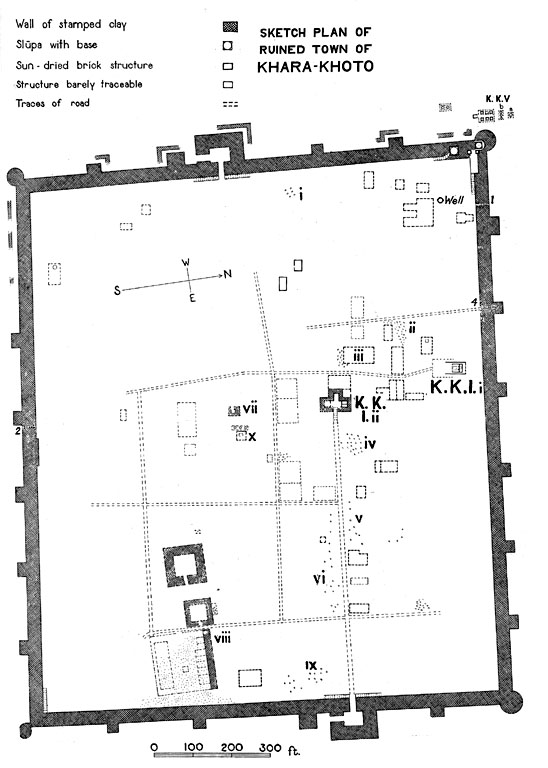
The remains of the Tangut fortress city known in Mongolian as Kharakhoto "Black City" and in Chinese as Heishuicheng 黑水城 "Black Water City" are located on the edge of the Gobi desert in the far west of Inner Mongolia (41° 45′ 51.50″N, 101° 08′ 38.00″E). It was a major military outpost of the Western Xia regime until it was captured by Genghis Khan in 1226. The city remained under Mongolian control until it was taken by the army of the newly established Ming dynasty in 1372, after which it was abandoned.

Photograph of the Ruins of the city of Kharakhoto by Aurel Stein

Kharakhoto from the sky (cf. Stein's plan of Kharakhoto)

When the Russian explorer Pyotr Kozlov stumbled upon the ruins of the city in 1907–1909 he found hundreds of books and documents written in the Tangut script, mostly hidden inside a stupa, including such important works as the Tangut dictionary, the Sea of Characters (文海).
But by the time that Aurel Stein came to visit Kharakhoto during his expedition of 1913-1916 there was not much left, and he was reduced to searching through rubbish tips and looking down wells. Although he didn't find any complete Tangut texts such as Kozlov had, he did manage to recover a great number of fragmentary scraps of paper with Tangut writing, some 4,000 of which are now held at the British Library (enter "Kharakhoto" in the search box to see some examples).
Among the scraps of paper that Aurel Stein recovered from a rubbish tip in the ruins of Kharakhoto are two insignificant and rather uninspiring strips of paper covered with irregular black marks which are now held at the British Library, catalogued as Or.8212/1142 and Or.8212/1144 :


By themselves they do not seem to have very much to offer, but when you join the two fragments together (Or.8212/1144 on the left, and Or.8212/1142 on the right) the black marks magically resolve into a relatively clear line of Phags-pa text :


It is not very much, but it is the only certain example of the Phags-pa script that I have been able to find in the entire online collection of the International Dunhuang Project (there are other more impressive examples of Phags-pa manuscripts, and even a fragment of a printed text, in the Berlin Turfan Collection, but these are not yet in the IDP database). Incidentally, although there is such a paucity of Phags-pa material in the British Library's Dunhuang collection, the library does hold the only known copy of what I would argue is the single most important Phags-pa text in existence, the Phags-pa Chinese rhyming dictionary Měnggǔ Zìyùn 蒙古字韻 (Or. 6972).

The top lefthand edge of the joined strips is still cut off, and I have been unable to locate a matching strip of paper in the British Library collection. However, even with this defect the text is still perfectly legible, comprising four Phags-pa syllables, reading ti khung ·an tu ꡈꡞ ꡁꡟꡃ ꡖꡋ ꡈꡟ :


According to Měnggǔ Zìyùn, there are 49 Chinese characters that are spelt ti, 12 characters that are spelt khung, 4 characters that are spelt ·an, and 38 characters that are spelt tu (the Phags-pa script does not distinguish tone, so Měnggǔ Zìyùn separates Chinese characters with the same Phags-pa spelling into groups based on their tone in Classical Chinese: level tone [平聲], rising tone [上聲], falling tone [去聲], and entering tone [入聲]) :


ꡈꡞ ti Level tone characters: 嗁啼遆蹄折提題媞綈稊醍禔鵜荑緹騠
Rising tone characters: 弟娣悌遞
Falling tone characters: 弟第遰提髢締{⿰目帝}(!)悌娣禘棣杕踶題遞逮地
Entering tone characters: 狄荻敵籊翟覿笛籴糴滌踧頔
ꡁꡟꡃ khung Level tone characters: 空箜崆悾倥(倥侗颛蒙)
Rising tone characters: 孔倥悾
Falling tone characters: 控倥空鞚
ꡖꡋ ·an Level tone characters: 安鞌
Falling tone characters: 按案
ꡈꡟ tu Level tone characters: 徒屠瘏塗途酴駼荼圖菟(?)
Rising tone characters: 杜肚土
Falling tone characters: 渡斁鍍度
Entering tone characters: 獨讀黷讟髑殰櫝牘韥瓄瀆犢匵毒蝳宊揬纛腯堗鈯

This would theoretically give 49 × 12 × 4 × 38 = 89,376 possibilties for the four-syllable phrase ti khung ·an tu, but actually there is only one permutation that makes any real sense in this context: tí kòng àn dú 提控案牘, which is the title of a minor official in charge of official documents at the local government office during the Yuan dynasty (see Charles O. Hucker, A Dictionary of Official Titles in Imperial China (Stanford University Press, 1985) #6453: "tʼí-kʼùng àn-tú 提控案牘 or tʼí-kʼùng YÜAN: lit., in charge of files: Record Keeper, a lowly or unranked clerical worker commonly found in both central government agencies and units of territorial administration"). The lettering appears to be printed on the paper rather than handwritten, so this was perhaps a stamp that was used by this official sometime during the Mongolian occupation of Kharakhoto between 1226 and 1372 (though of course it must post-date the invention of the Phags-pa script in 1269).

New Prehistoric Discoveries in Alxa League, Inner Mongolia

From: Chinese Archaeology Date:2011-11-1
In order to acquire a better understanding of the distribution, content and appearance of prehistoric cultures in Alxa League, Inner Mongolia, the Alxa League Museum has conducted a systematic field investigation across the whole league jointly with School of Archaeology and Museology of Beijing University in mid-July 2011. The result provides new materials for in-depth researches on local prehistoric cultures, and fulfills some gaps of the cultural sequences in western Inner Mongolia.

Prehistoric remains in Left Banner
Firstly previous found prehistoric sites within the Banner have been reviewed and positioned with GPS, and six sites including Lujuanshan, Toudaoshazi, Suhongtu I -VI have been confirmed. The Lujuanshan site, located 0.5 km southwest of the Banner, was found in 1950s and 1960s during capital construction. At that time a pit has been found containing a batch of ceramics from the Qijia cultural period, which are presently preserved in the Alxa League Museum. During this revisit only a broken stone knife with single perforation is collected.


The Toudaoshazi site is located at ca. 7.5 km northwest of Bayan Hot in Alxa League, a place on the east edge of the Tengger Desert, hence its name. It was found in 1999. During 2002-2003 Alxa League Museum has conducted three surveys and collected a great deal of stone tools and ceramics. This time the precise location of the site has been oriented and some artifacts are collected. According distributing of artifacts on the surface the sphere of the site is defined with a wide area measuring 2 km long from south to north and 0.5 km wide. The ceramics collected are mostly sandy wares, with the fine-sandy wares accounting for the largest number and coarse-sandy wares second. The ceramic colors are mainly reddish or reddish-brown, also include gray or gray brown and rare black. There are a large variety of complicated decorations such as basket pattern, cord pattern, attached design and incised pattern. Among them the rectangular pressed pattern and triangular incised pattern are characteristics of the locality. The collected stone tools are mainly chipped flakes and cores and the secondary processed tools are rare. Some stone querns and sticks are also collected.

The Suhongtu site is located at Wulijisumu, ca. 360 km north of Alxa League. It was discovered in 2004 and has been systematically investigated. This time the site is positioned precisely and the findings are re-numbered in accordance with the order they appear (Position I to Position IV). The position I and II are located at the hillside and the alluvial land 3-4 km east of Suhongtu, with 1 km apart. The artifacts are mainly chipped stone tools and no ceramic is seen. The position III and IV are located at a Gobi ca. 10 km northwest of Suhongtu and to its north about 500 m away is a sandy land. Besides stone cores, flakes and blades, the Position IV yields well-preserved ceramic Li cooker, jars with a round bottom and bowls.

Prehistoric remains in Right Banner
There are very few of prehistoric remains in right Banner. According to the previous findings, some sites are rich in contents, including both ceramics and microlithic objects. Stone tools include cores, flakes and oblong blades from indirect percussion. Ceramics are mostly sandy wares, either in red or reddish brown, decorated with cord pattern, basket pattern, attached design and comb pattern. There are few painted pottery, adorned with geometric designs composed of parallel stripes and trellis pattern, resembling painted potteries found in Machang Culture in Gansu Corridor. Eared jars, li cooker and spindles could be seen.

Prehistoric remains in Ejin Banner
Microlithic sites have been found before in the Banner, whereas those with ceramics are in small number. This time a large-sized prehistoric site, the Bayantaolai site, is discovered, which is located in the innermost desert ca. 25 km east of Dalaihubu Township, with an elevation of about 915 m. Surrounded with high huge sand dunes, the site measures 250 m long from south to north and 80 m wide from east to west, covering an area of ca. 20,000㎡. Artifacts are scattered on the surface of a long belt, indicative of its rich content. Stone tools collected are classified into chipped tool and polished tools. The chipped stone tools include cores, flakes and well-processed triangular arrow heads. The polished stone tools include querns, sticks, knives with perforations and axes. Among them most stone knives are broken, with one or two perforations at the middle part, which are drilled from both sides. Although only ceramic pieces could be found due to serious corrosion from sand, they have a large variety including double-eared jars, single-eared jars, jars with a flared mouth and jars with a tall neck. Most of them are fine-sandy red wares, and then coarse-sandy wares. Those with a flat bottom are very common. Most objects have a plain surface, and some are decorated with parallel geometric designs like cord pattern, attached design and incised design. Painted potteries could also be seen, mostly in black and some painted inside. In addition, there are a few animal bones scattered on the ground, belonging to sheep or pigs. The preliminary observation shows that the cultural features of the site bear strong resemblance with that of Siba Culture in western Gansu Corridor, while its specific nature is waiting for further study.

In general, these new archaeological finds will play a positive role for deepening the research on prehistoric cultures in western Inner Mongolia.

Ancient Tombs of Yanghai


This is Part 4 of a series of 10 by CCTV.

For the complete series, scroll down this blog and look at the left for"Ancient Tombs of Yanghai".

It is the best and most informative series of the last few years in the field of the archeology of Xinjiang

Tuesday, 1 November 2011

Babelstone- Diligently Carved in Tangut

I would like to draw your attention to the excellent blog "Babelstone" by Andrew West.
Here is his latest article "Diligently Carved in Tangut":

For the last of my impromptu trilogy of posts on manuscript fragments in extinct scripts that are freely available online thanks to the International Dunhuang Project I would like to take a look at an unprovenanced (but presumed to be from Dunhuang) manuscript of the Tangut translation of the Platform Sutra (六祖壇經) that is held at the Fu Ssu-nien Library at Academia Sinica in Taibei. This item comprises one large piece (13 lines of Tangut on one side and 11 lines of Tangut on the other) and four small fragments from a paper scroll, with the sutra text written in an untidy, semi-cursive hand. Actually, I have no particular interest in the Tangut text of the sutra, but I am puzzled by the writing on the back of two of the small fragments :

The same two Tangut characters, meaning "diligently carved" (Chinese qínkè 勤刻)Note 1, are written on both fragments :

(L1474/K2556) [·jɨr/·i̯ə̣] = "diligent" (Chinese 勤)
(L1630/K3219) [dzjɨj/ndzi̯e] = "to carve" (Chinese 雕刻)

(Note: the normal word for "carve" in the context of carving woodblock texts is [ku̱] (L5217), although the compound word [ku̱ dzjɨj] is given for "to carve" in the Homophones.)


The words "diligently carved" are the sort of thing that might be expected to be written at the end of a printed text indicating who was responsible for carving the woodblocks ("diligently carved by X"), but these are handwritten, appear to be written in isolation, and are not preceded by a personal name. But the big question is what are the two symbols underneath the words "diligently carved" on both fragments ? The two symbols, which are similar to each other but clearly distinct, are constructed with the same sort of brushstrokes that are used for writing Tangut or Chinese, but they do not seem to be Tangut, Chinese or Khitan characters, or indeed characters from any script that I am familiar with. The fact that the same two Tangut characters and following two symbols are written twice suggests that the author was practicing writing them; and given that he appears to be already able to write Tangut fluently, it is most probable that he was practicing writing the two symbols. But why would anyone need to diligently carve these two symbols ?

My only guess is that they are some sort of magical symbols intended to be used as a talisman, and that perhaps the word "carve" is here used in an extended sense of "inscribe", meaning that the writer has diligently inscribed these magical symbols on the paper. Maybe these two scraps of paper were deliberately torn off an old sutra, and the two symbols inscribed on them as a form of talisman. But that is just speculation — if anyone recognises these symbols or has any better suggestions as to what they mean, then please let me know.


Addendum A [2011-10-31]
After reading this post, Viacheslav Zaytsev very kindly supplied me with the following book written by Anatoliy Pavlovich Terentiev-Katansky (1934–1998) :

Терентьев-Катанский, А. П., Книжное дело в государстве тангутов (по материалам коллекции П. К. Козлова). Москва: Наука, 1981.
〔俄〕А.П.捷连提耶夫-卡坦斯基著,王克孝、景永时译,《西夏书籍业》。银川:宁夏人民出版社,2000年。
Viacheslav suggested to me that the two mystery symbols may be examples of tamgas — family or clan symbols used by Turkic and Mongolic peoples, used here to represent the name of the writer. This seems to me to be a very plausible theory, worth further investigation, but for now I will merely point out that Terentiev-Katansky's book gives a few examples of Tangut characters drawn stylistically as tamgas, including the character (L4743) [·iọ] meaning "round", which looks quite similar to the second mystery symbol (notice how the tamga form of L4743 has a little loop at the top, and the second mystery symbol has an oval blob at the top, which may be equivalent to the loop) :